Blog
Geography Optional Answer Writing: Master UPSC Mains 2026

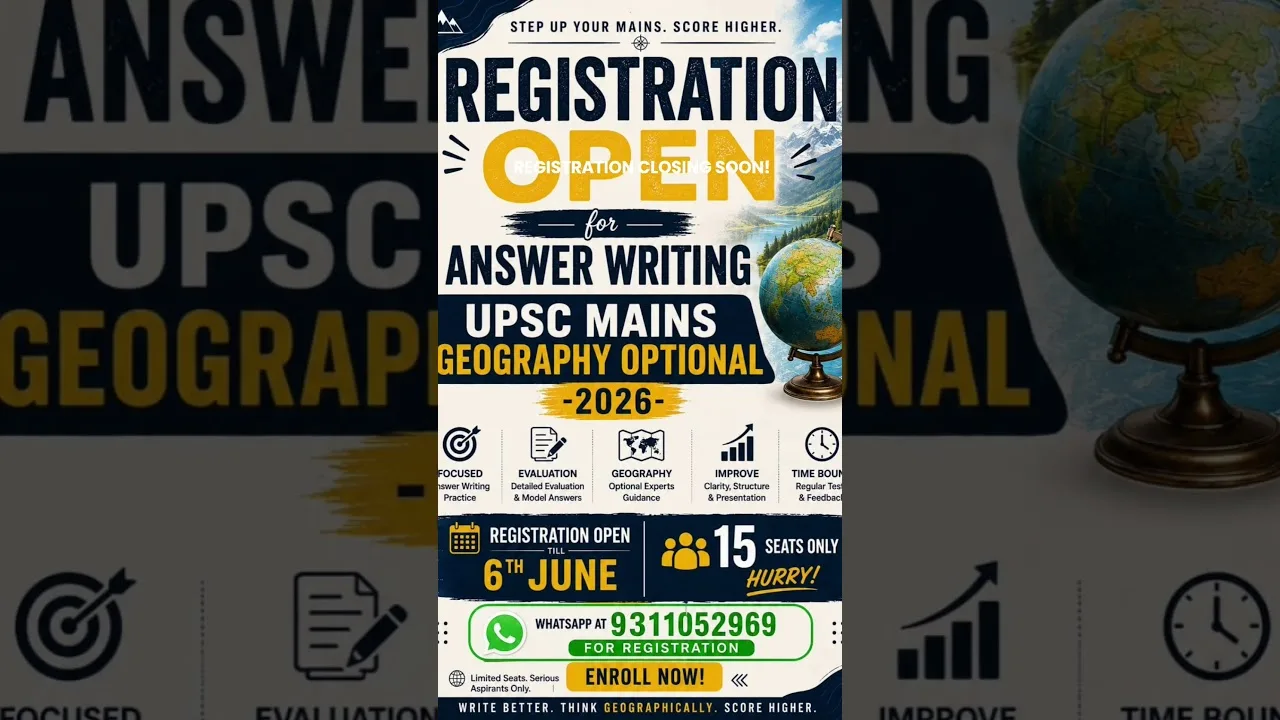
Table of Contents
- Mastering the Art of Geography Optional Answer Writing for UPSC 2026
- Why Geography Optional Answer Writing is the Game-Changer
- The Holistic Introduction
- The Power of Illustration
- Scholarly Substantiation
- Contemporary Relevance
- The Anatomy of a Top-Scoring Geography Answer
- 1. The Conceptual Core
- 2. Spatial Visualization (Maps & Diagrams)
- 3. The Interdisciplinary Bridge
- 4. The Policy-Oriented Conclusion
- How to Improve Your Geography Optional Answer Writing Skills
- Step-by-Step Implementation Strategy
- The Role of Peer Review and Mentorship
- TheGeoecologist’s Specialized Program for UPSC 2026
- Common Pitfalls in Geography Optional Answer Writing
- Conclusion: Transform Your Potential into a Rank
Mastering the Art of Geography Optional Answer Writing for UPSC 2026
Geography Optional Answer Writing is the most critical skill for any UPSC CSE aspirant aiming for a top rank in the Mains examination. While many candidates possess deep conceptual clarity, the ability to translate that knowledge into a high-scoring, structured response is what separates a rank holder from an average candidate. As the UPSC 2026 cycle approaches, candidates must shift their focus from mere rote learning to the strategic art of response construction, ensuring that every answer reflects both spatial intelligence and academic rigor.
- Visual Integration: Use maps and diagrams to substantiate every spatial argument.
- Interdisciplinary Approach: Connect physical geography with human and economic dimensions.
- Scholarly Depth: Integrate geographical thought and contemporary case studies.
- Strategic Structure: Move from descriptive paragraphs to analytical frameworks.
In the competitive landscape of the Civil Services Examination, Geography Optional Answer Writing requires a unique blend of scientific precision and humanities-based reasoning. Unlike purely theoretical subjects, geography is a spatial science. This means your answers must demonstrate an ability to visualize phenomena through maps, flowcharts, and diagrams. Whether you are discussing the tectonic movements of the Earth or the complexities of urban migration patterns, your presentation must be as dynamic as the subject itself.
Why Geography Optional Answer Writing is the Game-Changer
The UPSC Mains evaluation for Geography is not looking for a textbook reproduction. Instead, examiners seek a candidate’s ability to synthesize information. To excel in Geography Optional Answer Writing, you must master several key dimensions that elevate a standard answer to an exceptional one.
The Holistic Introduction
Avoid jumping straight into the facts. A great answer begins with a definition, a context-setting statement, or a relevant spatial framework that frames the question holistically. For instance, if a question pertains to geomorphology, starting with the fundamental principles of landform evolution provides the necessary academic grounding before diving into specific examples.
The Power of Illustration
In the context of Geography Optional Answer Writing, a map is not an option; it is a necessity. Whether it is a sketch map of India for regional geography or a cross-section diagram for geomorphology, visual evidence provides immediate credibility. A well-drawn map communicates spatial relationships more effectively than a thousand words, allowing the examiner to see your grasp of the geography at a glance.
Scholarly Substantiation
To add academic depth, you must cite prominent geographers. Mentioning the perspectives of Friedrich Ratzel for environmental determinism or Halford Mackinder for his Heartland Theory elevates your answer from a generalist response to a specialist one. This level of scholarly integration is what distinguishes high-scoring Geography Optional Answer Writing from basic descriptive attempts.
Contemporary Relevance
Geography is a living subject. Integrating current events—such as the impacts of the climate change crisis on coastal ecosystems or the geopolitical shifts in the Arctic—shows the examiner that you understand the real-world application of geographical theories. Linking theory to current affairs is a hallmark of sophisticated Geography Optional Answer Writing.
The Anatomy of a Top-Scoring Geography Answer

When practicing Geography Optional Answer Writing, you should follow a rigorous framework to ensure no component is missed. A perfect answer typically consists of four pillars that ensure comprehensive coverage of the prompt.
1. The Conceptual Core
Every answer must start with a clear understanding of the core geographical concept. If the question asks about ‘Plate Tectonics,’ your answer must demonstrate a fundamental grasp of subduction zones, convection currents, and transform boundaries before moving into specific examples. Without a strong conceptual core, the rest of the answer lacks direction.
2. Spatial Visualization (Maps & Diagrams)
In Geography Optional Answer Writing, the map is your strongest tool. For Indian geography, knowing the exact location of the Western Ghats or the major river basins is essential. For physical geography, being able to draw a quick, legible diagram of a volcanic landform or a hydrological cycle can save you hundreds of words and earn you extra marks. Precision in mapping reflects a candidate’s attention to detail.
3. The Interdisciplinary Bridge
UPSC loves questions that bridge the gap between Physical and Human Geography. For instance, if discussing ‘Desertification,’ don’t just explain the soil degradation (Physical); explain the socioeconomic impact on pastoral communities (Human). This interdisciplinary approach is the hallmark of advanced Geography Optional Answer Writing, as it demonstrates a holistic understanding of the Earth’s systems.
4. The Policy-Oriented Conclusion
Never end an answer abruptly. A high-scoring conclusion links the discussion to modern challenges or policy frameworks. Mentioning the Sustainable Development Goals (SDGs) or specific government initiatives like the PM Gati Shakti scheme provides a forward-looking perspective that examiners find highly impressive. This transforms your Geography Optional Answer Writing from an academic exercise into a policy-oriented solution.
How to Improve Your Geography Optional Answer Writing Skills
Improving your Geography Optional Answer Writing is a gradual process of iteration and feedback. Many students make the mistake of reading the entire syllabus before writing a single answer. However, the most successful candidates adopt a ‘write-as-you-learn’ approach.
Step-by-Step Implementation Strategy
First, begin with basic conceptual questions. Once you are comfortable with the theory, start integrating one diagram per answer. As you progress, introduce scholarly citations and current examples. Finally, time your answers to match the UPSC Mains constraints. This phased approach ensures that you don’t feel overwhelmed by the complexity of Geography Optional Answer Writing.
The Role of Peer Review and Mentorship
Self-assessment is rarely enough. To truly master Geography Optional Answer Writing, you need a mentor who can point out the ‘blind spots’ in your logic or the inaccuracies in your maps. Professional feedback helps you understand the difference between an answer that is ‘correct’ and an answer that is ‘high-scoring’.
TheGeoecologist’s Specialized Program for UPSC 2026
Recognizing the difficulty of mastering Geography Optional Answer Writing, TheGeoecologist has developed a comprehensive mentorship program specifically designed for the 2026 aspirants. We don’t just teach geography; we teach the art of presentation. Our program focuses on the practical application of knowledge, moving beyond the textbook to ensure you can handle any twist the UPSC might throw at you in the Mains exam.
Our curriculum is built around the pillars of Geography Optional Answer Writing: rigorous map practice, the integration of geographical thought, and the synthesis of physical and human geography. By joining this program, aspirants gain access to a structured feedback loop that transforms their writing style from descriptive to analytical.
Common Pitfalls in Geography Optional Answer Writing
Many candidates lose marks not because they lack knowledge, but because of poor execution. One common mistake is ‘over-describing’—writing long paragraphs of general information without addressing the specific demand of the question. Effective Geography Optional Answer Writing is about precision, not volume.
Another frequent error is the omission of maps. Some students believe that a detailed description can replace a diagram. In Geography, this is a fatal mistake. A lack of spatial representation indicates a lack of geographical thinking. To excel in Geography Optional Answer Writing, you must treat the map as an integral part of your argument, not an optional addition.
Conclusion: Transform Your Potential into a Rank
The journey to the UPSC Mains 2026 is a marathon, not a sprint. While conceptual clarity is the foundation, Geography Optional Answer Writing is the superstructure that makes your knowledge visible to the examiner. By focusing on structure, visualization, scholarly depth, and contemporary relevance, you can turn your optional subject into your highest-scoring asset.
Remember, the difference between a candidate who clears the cutoff and a candidate who makes the final list often boils down to a few marks per question. Those marks are won through the mastery of Geography Optional Answer Writing. Start practicing today, integrate the feedback, and build the spatial reasoning skills necessary to conquer the UPSC 2026 Mains.
Frequently Asked Questions
Maps are absolutely essential. In Geography, spatial visualization is a core requirement. A well-drawn map or diagram can convey complex information quickly and earn you significantly higher marks than a purely descriptive answer.
Yes. Citing scholars like Ratzel, Mackinder, or Hartshorne adds academic depth and demonstrates that you have a specialist's understanding of the subject, moving your answer beyond a generalist approach.
Always look for the 'cause and effect' relationship. For example, if discussing a physical phenomenon like volcanic activity, link it to the human impact, such as fertile soil for agriculture or the risks to urban settlements.