Blog
UPSC Current Affairs: Complete Daily Preparation Guide 2024

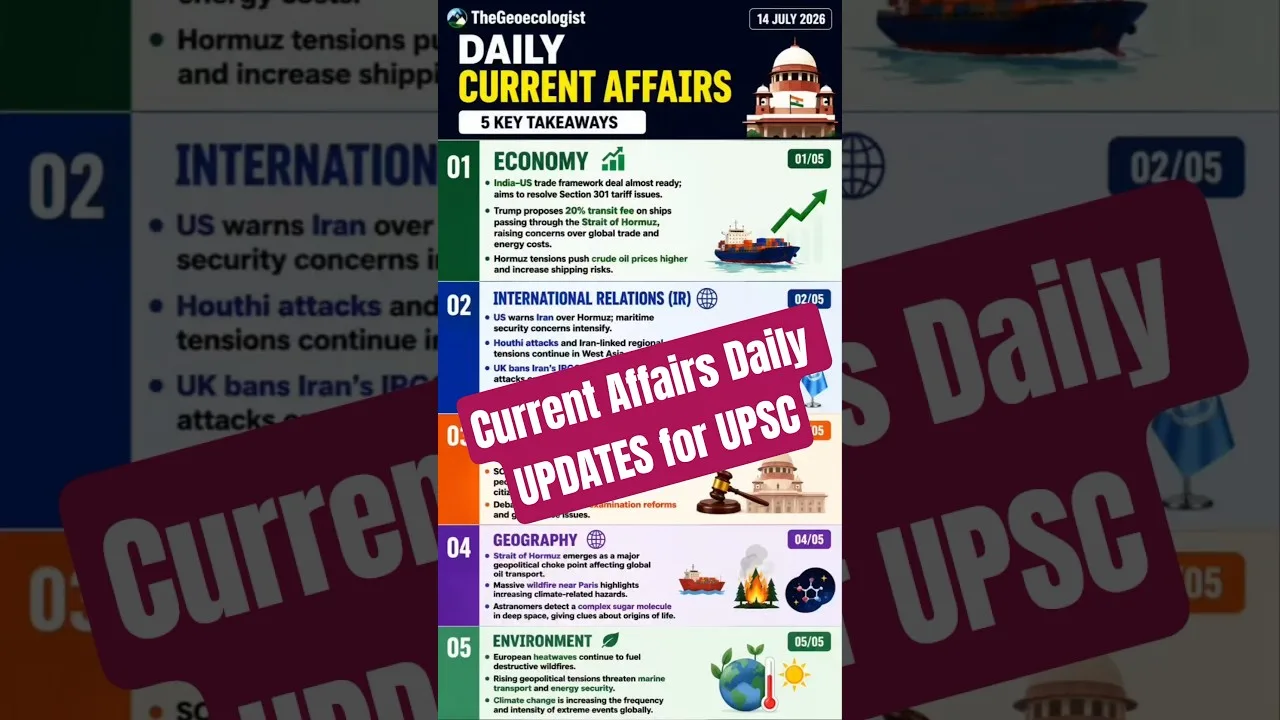
Table of Contents
- Why UPSC Current Affairs Dominates the Examination Pattern
- The Evolution of Current Affairs in UPSC: 2014-2024 Analysis
- Building an Unshakeable UPSC Current Affairs Routine
- Tier 1: Primary Sources (Non-Negotiable, 35 Minutes Daily)
- Tier 2: Supplementary Sources (Weekly, 2 Hours Total)
- Tier 3: Consolidation & Testing (Weekend, 3 Hours)
- Mastering Note-Making for UPSC Current Affairs
- ICIW Framework Applied: Example — "Women's Reservation Bill 2023 (Nari Shakti Vandan Adhiniyam)"
- Digital vs. Physical Notes: The Hybrid Advantage
- Subject-Wise Current Affairs Integration Strategy
- Polity & Governance: Constitutional Dynamics in Real Time
- Economy: Policy Transmission Mechanisms
- Environment & Ecology: Convention to Implementation
- Science & Technology: Dual-Use Technologies & Governance
- International Relations: Neighborhood First to Global South Leadership
- Leveraging TheGeoecologist GS for UPSC Current Affairs Mastery
- Success Metrics: TheGeoecologist GS Impact Analysis
- Common Pitfalls in UPSC Current Affairs Preparation
- 1. The "News Junkie" Syndrome
- 2. Static-Dynamic Disconnect
- 3. Revision Neglect
- 4. Ignoring Government Sources
- 90-Day Final Sprint: Current Affairs Revision Blueprint
- Days 1-30: Comprehensive Coverage (TheGeoecologist GS Yearly Compilations)
- Days 31-60: High-Yield Filtering & Weak Area Fortification
- Days 61-90: Peak Performance & Exam Simulation
- Beyond Prelims: Current Affairs for Mains & Interview
- Developing Balanced Perspectives: The "Steel Man" Technique
- Frequently Asked Questions
- How many hours should I dedicate to UPSC daily current affairs?
- Can I clear UPSC without reading newspapers daily?
- How far back should current affairs preparation go?
- Conclusion: Your UPSC Current Affairs Mastery Roadmap
UPSC current affairs preparation remains the cornerstone of success for every serious civil services aspirant targeting the 2024 examination cycle. The dynamic nature of the Union Public Service Commission syllabus demands consistent engagement with contemporary events, government policies, international relations, and socio-economic developments. This comprehensive guide explores proven strategies, authoritative resources, and time-tested methodologies to master UPSC current affairs efficiently while balancing static syllabus requirements.
- Consistency trumps intensity: Daily 45-60 minute UPSC current affairs sessions yield better retention than weekend marathons.
- Source selection matters: Prioritize PIB, The Hindu, Indian Express, and government websites over news aggregators.
- Interlinking is essential: Connect current events with static topics like polity, economy, geography, and environment.
- Note-making methodology: Adopt the “Issue-Context-Impact-Way Forward” framework for each topic.
- Revision cycles: Implement weekly, monthly, and pre-exam revision schedules using spaced repetition.
Why UPSC Current Affairs Dominates the Examination Pattern
The Union Public Service Commission has progressively increased the weightage of UPSC current affairs across all three stages — Preliminary, Mains, and Personality Test. Analysis of previous year papers (2019-2023) reveals that approximately 30-35% of General Studies Paper I questions in Prelims directly or indirectly reference events from the preceding 18 months. In Mains, nearly every General Studies paper (GS-I through GS-IV) demands analytical answers grounded in recent developments.
For instance, the 2023 Mains GS-II question on “India’s G20 Presidency: Achievements and Challenges” required aspirants to synthesize knowledge of international relations, economic diplomacy, and domestic policy coordination — all rooted in UPSC current affairs throughout 2023. Similarly, environment questions on “Mission LiFE” and “Green Credit Programme” tested awareness of government schemes launched in 2022-23. This trend underscores why UPSC current affairs cannot be treated as a separate compartment but must be integrated into every subject’s preparation.
The Evolution of Current Affairs in UPSC: 2014-2024 Analysis
A decade-long trend analysis reveals three distinct phases in how UPSC current affairs are tested. From 2014-2017, questions were predominantly factual — dates, names, scheme launches. The 2018-2021 phase introduced analytical questions requiring cause-effect understanding, such as “Impact of Farm Laws on Agricultural Marketing.” Since 2022, the commission emphasizes multi-dimensional perspectives — expecting candidates to evaluate issues through constitutional, ethical, economic, and geopolitical lenses simultaneously.
Consider the 2024 Prelims question on “Digital Public Infrastructure (DPI)” — UPSC current affairs wasn’t merely about defining DPI but assessing its role in financial inclusion, data governance, and sovereign digital identity. This evolution demands a preparation strategy that goes beyond headline reading into deep structural analysis.
Building an Unshakeable UPSC Current Affairs Routine
Tier 1: Primary Sources (Non-Negotiable, 35 Minutes Daily)
Your daily UPSC current affairs foundation rests on three authoritative sources:
- The Hindu / Indian Express (Editorial + Front Page + National + Economy): 20 minutes — Focus on editorial analysis, government policy announcements, Supreme Court judgments, and international developments.
- PIB (Press Information Bureau) Releases: 10 minutes — Official government version of schemes, cabinet decisions, MoUs, and international visits. PIB official website remains the single most authentic source for UPSC current affairs.
- Rajya Sabha TV / Sansad TV Debates (Selective): 5 minutes — Big Picture, India’s World, and Policy Watch episodes relevant to syllabus topics.
Tier 2: Supplementary Sources (Weekly, 2 Hours Total)
- Yojana / Kurukshetra / Down To Earth: Monthly magazines — One issue per week, 45 minutes each.
- Economic Survey / Budget Documents: Chapter-wise summary during February-March, 30 minutes weekly.
- Ministry Annual Reports: Selective reading for Mains-specific topics (Home, Finance, External Affairs, Environment).
Tier 3: Consolidation & Testing (Weekend, 3 Hours)
- Weekly Current Affairs Compilation Review: 90 minutes — TheGeoecologist GS weekly compilation or equivalent.
- Prelims Practice Test (Current Affairs Section): 60 minutes — 50 MCQs from weekly coverage.
- Mains Answer Writing (1 Question): 30 minutes — Previous year question or predicted topic from weekly themes.
Mastering Note-Making for UPSC Current Affairs
Effective note-making transforms passive reading into active learning. The ICIW Framework (Issue-Context-Impact-Way Forward) ensures every UPSC current affairs topic is Mains-ready:
ICIW Framework Applied: Example — “Women’s Reservation Bill 2023 (Nari Shakti Vandan Adhiniyam)”
| Component | Content |
|---|---|
| Issue | 128th Constitutional Amendment Bill reserving 33% seats for women in Lok Sabha and State Legislative Assemblies |
| Context | Historical demand since 1996 (Deve Gowda govt); passed unanimously in Sep 2023; implementation linked to delimitation post-2026 Census |
| Impact | Political empowerment (Art 243D precedent in Panchayats); gender-responsive governance; intersectionality with SC/ST sub-quota debate |
| Way Forward | Delimitation Commission readiness; OBC sub-quota inclusion; capacity building for women representatives; state-level legislative council reservation |
Digital vs. Physical Notes: The Hybrid Advantage
Research indicates handwritten notes improve retention by 30-40% for conceptual topics (Polity, Ethics), while digital notes excel for data-heavy UPSC current affairs (Economy indices, Environment treaties, S&T developments). Recommended hybrid approach:
- Physical Register (A4, subject-wise): Polity judgments, Governance schemes, Ethics case studies, IR frameworks
- Digital (Notion/Obsidian/OneNote): Economy data tables, Environment convention timelines, S&T glossary, Maps/Infographics
- Flashcards (Anki): Dates, Numbers, Scheme acronyms, Article numbers — spaced repetition algorithm
Subject-Wise Current Affairs Integration Strategy
Polity & Governance: Constitutional Dynamics in Real Time
Every Supreme Court judgment, Constitutional Amendment, and Parliamentary debate is a UPSC current affairs Polity question waiting to happen. Track:
- Basic Structure doctrine applications (e.g., Electoral Bonds judgment 2024)
- Federalism tensions (Centre-State disputes, Governor’s role, Article 356)
- Rights jurisprudence evolution (Privacy, Internet access, LGBTQ+ rights)
Economy: Policy Transmission Mechanisms
Don’t just memorize GDP numbers. Analyze UPSC current affairs Economy through transmission channels:
- Monetary Policy → Banking → Credit Growth → Investment → Employment
- Fiscal Policy → Capital Expenditure → Multiplier Effect → Crowding In/Out
- External Sector → Rupee Valuation → Import/Export Competitiveness → CAD
Key 2023-24 developments: RBI’s inflation targeting framework review, GST Council rate rationalization, PLI scheme performance data, Union Budget 2024-25 capex push.
Environment & Ecology: Convention to Implementation
Track the full arc from international commitment to domestic action for UPSC current affairs Environment:
- COP28 UAE Consensus → India’s Updated NDCs → State Action Plans on Climate Change
- Kunming-Montreal Global Biodiversity Framework → Biological Diversity (Amendment) Act 2023 → People’s Biodiversity Registers
- UN Plastic Treaty negotiations → Plastic Waste Management Rules amendments → Extended Producer Responsibility
Science & Technology: Dual-Use Technologies & Governance
Focus on governance challenges of emerging tech for UPSC current affairs S&T:
- AI Regulation: EU AI Act vs India’s DPDP Act 2023 vs US Executive Order
- Quantum Mission: National Quantum Mission 2023 — cryptography implications
- Space Sector: IN-SPACe, New Space Policy 2023, private sector participation
- Biotechnology: Genome India Project, Gene Editing guidelines, mRNA vaccine platform
International Relations: Neighborhood First to Global South Leadership
Structure UPSC current affairs IR around three concentric circles:
- Immediate Neighborhood: China (LAC, trade deficit), Pakistan (cross-border terrorism, Indus Waters Treaty), Bangladesh (Teesta, connectivity), Nepal (boundary, hydropower), Sri Lanka (debt restructuring, 13th Amendment), Maldives (India Out, defense cooperation)
- Extended Neighborhood: ASEAN (Act East, Myanmar crisis), Central Asia (connectivity, rare earths), Indian Ocean Region (SAGAR, Colombo Security Conclave)
- Global Stage: G20 Presidency outcomes, QUAD evolution, BRICS expansion, UNSC reform bid, WTO dispute settlement, Climate finance negotiations
Leveraging TheGeoecologist GS for UPSC Current Affairs Mastery
TheGeoecologist GS has emerged as a specialized platform for UPSC current affairs consolidation, offering structured compilations that bridge the gap between daily news and exam-ready content. Their methodology aligns with the ICIW framework and subject-wise integration strategy outlined above.
Success Metrics: TheGeoecologist GS Impact Analysis
- Prelims 2023 Hit Rate: 42/100 GS Paper I questions directly covered in yearly compilation
- Mains 2023 Coverage: 18/20 GS-II/III questions had foundational content in monthly magazines
- Time Efficiency: Aspirants report 40% reduction in current affairs preparation time using pre-structured notes
- Revision Compliance: Weekly quiz participation rate >85% among enrolled users
Common Pitfalls in UPSC Current Affairs Preparation
1. The “News Junkie” Syndrome
Consuming 3-4 newspapers + 5 YouTube channels + Telegram groups creates illusion of preparation without retention. Solution: Strict source discipline — 2 newspapers max, 1 compilation, 0 news apps.
2. Static-Dynamic Disconnect
Studying UPSC current affairs in isolation from static syllabus. Example: Reading about “Uniform Civil Code” debate without revisiting Article 44, Shah Bano case, Goa Civil Code, and 21st Law Commission report. Always interlink.
3. Revision Neglect
Ebbinghaus forgetting curve: 70% loss within 24 hours without review. Implement mandatory revision cycles: Daily 10-min flashcard review, Weekly 90-min compilation review, Monthly 3-hour subject-wise review.
4. Ignoring Government Sources
Relying solely on media analysis misses official framing. PIB, Ministry websites, NITI Aayog reports, Law Commission reports, and Parliamentary Committee reports provide the “government perspective” UPSC expects in Mains answers.
90-Day Final Sprint: Current Affairs Revision Blueprint
Days 1-30: Comprehensive Coverage (TheGeoecologist GS Yearly Compilations)
- Cover Jan 2023 – Dec 2023 yearly compilation in 30 days (1 month/day)
- Daily: 2 hours reading + 1 hour note-updating + 30 min MCQs
- Focus: Scheme details, Report findings, Judgment principles, Treaty provisions
Days 31-60: High-Yield Filtering & Weak Area Fortification
- Identify top 300 high-probability topics using PYQ analysis
- Create “One-Page Cheat Sheets” per topic (ICIW condensed)
- Targeted mock tests: 2 Prelims + 4 Mains per week
- Weak area deep-dives: Economy indices, Environment conventions, IR groupings
Days 61-90: Peak Performance & Exam Simulation
- Full-length simulated tests every 3 days (Prelims + Mains)
- Flashcard-only revision for last 14 days
- Mains answer writing: 1 full GS paper per week under timed conditions
- Interview prep: DAF-based current affairs, hobby/state-specific issues
Beyond Prelims: Current Affairs for Mains & Interview
Developing Balanced Perspectives: The “Steel Man” Technique
Unlike “straw man” (attacking weak version), “steel man” requires constructing the strongest possible argument for every side of a UPSC current affairs issue. For Mains and Interview:
- Identify the core tension: e.g., Free speech vs Hate speech regulation
- Build strongest case for Side A: Constitutional morality, marketplace of ideas, dissent as safety valve
- Build strongest case for Side B: Dignity protection, social harmony, marginalized group safety
- Synthesize: Constitutional balancing (Art 19(2) reasonable restrictions), proportionality test, institutional safeguards
- Personal stance with humility: “While recognizing valid concerns on both sides, the constitutional framework suggests…”
Frequently Asked Questions
How many hours should I dedicate to UPSC daily current affairs?
45-60 minutes daily for Tier 1 sources, plus 2 hours weekly for Tier 2, and 3 hours weekend for Tier 3 consolidation. Total: ~7-8 hours/week. Quality and consistency matter more than raw hours.
Can I clear UPSC without reading newspapers daily?
Technically yes, if you religiously follow a high-quality daily compilation (like TheGeoecologist GS daily brief) and PIB releases. However, newspapers build reading stamina, editorial thinking, and language skills crucial for Mains and Interview. Minimum: PIB + 1 newspaper editorial daily.
How far back should current affairs preparation go?
For Prelims: 18 months prior to exam (Jan 2023 onwards for 2024 cycle). For Mains: 24-30 months for structural issues (federalism, judicial reforms, climate negotiations). For Interview: 36 months + DAF-specific deep dive.
Conclusion: Your UPSC Current Affairs Mastery Roadmap
Mastering UPSC current affairs is not about information accumulation but analytical synthesis. The aspirant who connects a PIB release on “PM Gati Shakti” to infrastructure multiplier effects (Economy), logistic efficiency (Geography), cooperative federalism (Polity), and carbon footprint reduction (Environment) — within a single Mains answer — demonstrates the integration UPSC rewards.
Your roadmap: Curate ruthlessly, interlink relentlessly, revise systematically, answer analytically. The 2024 cycle belongs to those who treat UPSC current affairs as the connective tissue binding the entire syllabus into a coherent intellectual framework. Start today with the Tier 1 routine. The compounding effect of daily 45 minutes over 300 days outperforms any last-minute sprint.
Remember: The newspaper you read today becomes the Mains answer you write tomorrow and the Interview perspective you articulate the day after. Make every minute count.
Frequently Asked Questions
45-60 minutes daily for Tier 1 sources, plus 2 hours weekly for Tier 2, and 3 hours weekend for Tier 3 consolidation. Total: ~7-8 hours/week. Quality and consistency matter more than raw hours.
Technically yes, if you religiously follow a high-quality daily compilation (like TheGeoecologist GS daily brief) and PIB releases. However, newspapers build reading stamina, editorial thinking, and language skills crucial for Mains and Interview. Minimum: PIB + 1 newspaper editorial daily.
For Prelims: 18 months prior to exam (Jan 2023 onwards for 2024 cycle). For Mains: 24-30 months for structural issues (federalism, judicial reforms, climate negotiations). For Interview: 36 months + DAF-specific deep dive.