Blog
Human Geography Models: Essential Guide for 2025 Exams

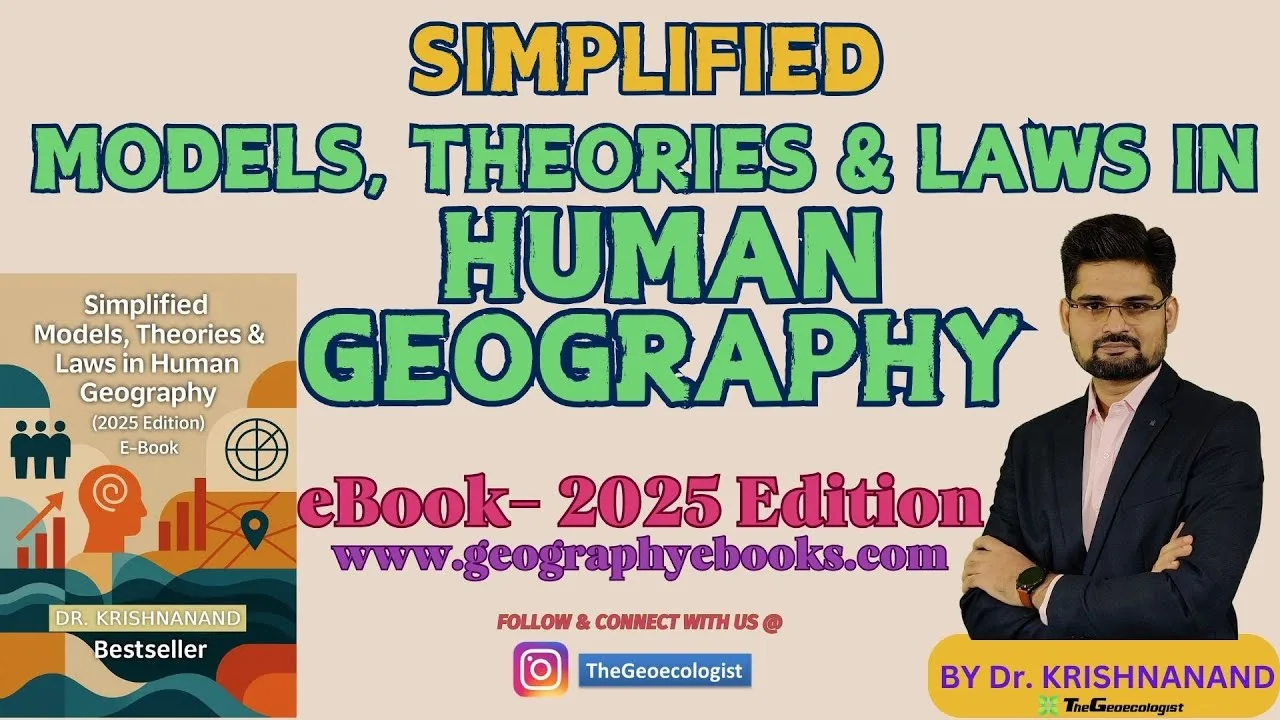
Table of Contents
- Mastering Human Geography Models: The 2025 Comprehensive Guide
- The Importance of Human Geography Models in Modern Academics
- Classical Location Theories and Spatial Organization
- Migration and Population Dynamics
- Urban Models: Understanding the Structure of Cities
- Behavioral and Time-Geography Perspectives
- Why Use Dr. Krishnanand’s 2025 Guide?
- Conclusion: Elevate Your Geography Studies
Mastering Human Geography Models: The 2025 Comprehensive Guide
Understanding Human Geography Models, theories, and laws is the cornerstone of mastering spatial science and social dynamics. Whether you are a student preparing for competitive exams or an academic researcher, grasping these frameworks is essential for analyzing how human societies interact with their environments. This 2025 edition guide simplifies complex spatial concepts into digestible insights, making it easier than ever to master Human Geography Models.
- Comprehensive Coverage: From classical location theories to modern behavioral models.
- Exam-Focused: Aligned with UPSC, UGC NET, GATE, and State PCS syllabi.
- Visual Learning: Designed with conceptual clarity and structural flow.
- Expert Guidance: Curated by Dr. Krishnanand to ensure academic excellence.
The Importance of Human Geography Models in Modern Academics
Human geography is not merely about studying maps; it is about understanding the underlying logic of human existence across space. The application of various Human Geography Models allows researchers to predict urban growth, migration patterns, and economic shifts. As global populations shift and urban centers expand, these theoretical frameworks provide the necessary tools to interpret complex spatial data. For instance, understanding how a city expands or why certain industries locate in specific regions requires a deep dive into classical and contemporary theories.
For those pursuing advanced degrees, a deep understanding of these models is vital. Many students struggle with the abstraction of these concepts, which is why Dr. Krishnanand’s 2025 guide is designed to bridge the gap between theoretical complexity and practical application. By using Human Geography principles, one can decode the intricate relationship between social structures and the physical landscape.
Classical Location Theories and Spatial Organization
To understand how human activities are organized, we must first look at the foundational Human Geography Models related to location and economic activity. These theories explain why certain activities happen where they do.
1. Von Thünen’s Agricultural Land Use Model
Johann Heinrich von Thünen was a pioneer in spatial economics. His model explains how agricultural patterns emerge based on the distance from a central market. The model suggests that land use is determined by transport costs and land rent, creating concentric rings of different agricultural products. This remains a fundamental concept for anyone studying rural spatial organization.
2. Christaller’s Central Place Theory
Walter Christaller introduced a revolutionary way to look at urban hierarchies. His theory analyzes how services and goods are distributed across a landscape to ensure optimal coverage. By understanding the concept of ‘range’ and ‘threshold,’ students can grasp how small towns and large cities form a functional network of service delivery.
3. Weber’s Industrial Location Theory
Alfred Weber’s work focuses on the economic logic of industrial placement. He explores how transport costs, labor costs, and agglomeration economies influence where a factory should be built to minimize expenses. This is a crucial component of economic geography and a staple in many competitive examinations.
Migration and Population Dynamics
Population movement is a key driver of spatial change. The Human Geography Models governing migration and population growth help us predict future demographic shifts.
Ravenstein’s Laws of Migration
E.G. Ravenstein’s observations on migration patterns, including the push-pull factors and the concept of distance decay, provide the groundwork for modern migration studies. His laws explain why people move and the typical routes they take, which is essential for urban planning and social policy.
Malthusian Theory and the Demographic Transition Model
Thomas Malthus famously argued that population growth would eventually outpace food production. While his specific predictions have been debated, his focus on the relationship between resources and population remains relevant. This is further expanded by the Demographic Transition Model, which tracks the shift from high birth and death rates to low birth and death rates as a society industrializes.
Understanding these shifts is vital for analyzing global trends. For more in-depth demographic studies, one can refer to official data provided by United Nations population reports to see these theories in action.
Urban Models: Understanding the Structure of Cities
As urbanization accelerates, understanding the internal structure of cities becomes paramount. Several Human Geography Models attempt to explain the layout of metropolitan areas.
- Burgess’s Concentric Zone Model: Proposes that cities grow outward from a central business district in rings.
- Hoyt’s Sector Model: Suggests that cities develop in sectors rather than rings, often following transportation lines.
- Harris and Ullman’s Multiple Nuclei Model: A more modern approach suggesting that cities have multiple centers or ‘nuclei’ rather than just one.
Behavioral and Time-Geography Perspectives
Modern geography has moved beyond just physical and economic factors to include human perception and time. Human Geography Models such as Hägerstrand’s Time Geography explore the constraints of time and space on human movement. It looks at how our daily schedules and physical limitations dictate where and when we can travel.
Additionally, the Behavioral Matrix developed by Golledge and Brown explores how human decision-making processes influence spatial behavior. This shift toward behavioral geography allows for a more nuanced understanding of why humans make specific spatial choices in their daily lives.
Why Use Dr. Krishnanand’s 2025 Guide?
The complexity of these Human Geography Models can be overwhelming. Dr. Krishnanand’s eBook is specifically engineered to simplify these concepts for students aiming for top ranks in UPSC, UGC NET, and GATE. Instead of dense, academic jargon, the guide provides:
- Structured Learning: Concepts are broken down into logical segments.
- Visual Aids: Diagrams and tables make the Human Geography Models easy to visualize.
- Exam Readiness: Includes application notes and past year questions to ensure you are prepared for the actual exam format.
Whether you are studying the nuances of Lösch’s Market Area Analysis or the complexities of urban growth patterns, this guide is your ultimate companion. It transforms abstract theories into practical knowledge that can be applied to real-world scenarios.
Conclusion: Elevate Your Geography Studies
Mastering Human Geography Models is not just about memorizing names and dates; it is about understanding the logic of our world. By studying these theories, you gain the ability to interpret the complex patterns of human existence. Dr. Krishnanand’s 2025 edition provides the clarity and depth required to excel in your academic and professional journey. Don’t let complex theories hold you back—embrace the simplified approach and ace your exams today!
Frequently Asked Questions
Key models include Von Thünen's Agricultural Model, Christaller's Central Place Theory, Weber's Industrial Location Theory, and Ravenstein's Laws of Migration.
Yes, the 2025 Edition is specifically aligned with the latest UPSC, UGC NET, and GATE syllabi to ensure exam-oriented learning.
While classical models focus on economic and spatial location, Time Geography (Hägerstrand) focuses on the constraints of time and space on human movement and daily activities.