Blog
UGC NET Geography Books: Complete Guide to Best Study Material for 2024


Table of Contents
- Why the Right UGC NET Geography Books Determine Your Success
- The Cost of Choosing Poor Study Material
- Essential Features of High-Quality UGC NET Geography Books
- 1. Complete Syllabus Coverage Across All 10 Units
- 2. Conceptual Clarity with Visual Aids
- 3. Chapter-wise PYQ Integration
- 4. Updated Statistical Data and Current Affairs Integration
- 5. Practice MCQs with Answer Keys and Explanations
- Recommended UGC NET Geography Books: Expert Picks for 2024
- Category A: Comprehensive Core Textbooks (Primary Resource)
- Category B: Unit-Specific Reference Books (Deep Dive)
- Strategic Study Plan Using UGC NET Geography Books
- Phase 1: Foundation Building (Months 1-3)
- Phase 2: Application & Gap-Filling (Months 4-5)
- Phase 3: Intensive Revision & Mock Marathon (Month 6 / Final 30 Days)
- Common Pitfalls to Avoid When Selecting UGC NET Geography Books
- 1. Buying Multiple Core Textbooks
- 2. Ignoring the 2019 Syllabus Revision
- 3. Over-Reliance on PDFs and Telegram Channels
- 4. Neglecting Map-Based Preparation
- Digital Resources to Complement Physical Books
- Final Verdict: Your Roadmap to the Best UGC NET Geography Books
Choosing the right UGC NET Geography books is the single most critical decision an aspirant makes while preparing for the National Testing Agency (NTA) UGC NET Geography Paper 2. With a syllabus spanning ten extensive units — from Geomorphology and Climatology to Geographic Thought, Human Geography, and advanced Geospatial Technologies — the volume of content can overwhelm even the most dedicated students. The market is flooded with publications, but not all resources align with the current NTA pattern, which increasingly emphasizes conceptual clarity, application-based questions, and interdisciplinary linkages over rote memorization.
- Syllabus alignment is non-negotiable: The best UGC NET Geography books strictly follow the latest NTA syllabus (updated June 2019, effective from December 2019 cycle) covering all 10 units.
- Conceptual depth trumps volume: Prioritize books that explain the “why” and “how” behind geographic models (e.g., Christaller’s Central Place Theory, Von Thünen’s Model, Rostow’s Stages of Growth) rather than mere fact compilation.
- Visual learning is essential: Geography is inherently spatial; resources rich in maps, diagrams, flowcharts, and GIS/Remote Sensing imagery significantly boost retention and answer-writing quality.
- Integrated PYQs and practice MCQs: Books embedding Previous Year Questions (PYQs) chapter-wise help aspirants decode examiner trends, trap questions, and topic weightage.
- Updated data matters: For Human, Economic, and Population Geography, ensure the book incorporates Census 2011 data, NFHS-5 (2019-21), World Bank 2023 indicators, and latest IPCC AR6 climate projections.
Why the Right UGC NET Geography Books Determine Your Success
The UGC NET examination, conducted by the National Testing Agency (NTA), has undergone a paradigm shift since 2019. The exam moved from a subjective, three-paper format to an objective, two-paper Computer-Based Test (CBT). Paper 1 tests Teaching and Research Aptitude (50 questions, 100 marks), while Paper 2 is subject-specific — Geography in this case — comprising 100 questions worth 200 marks, to be completed in 3 hours. There is no negative marking, but the competition is fierce: in the June 2024 cycle, over 9 lakh candidates registered across all subjects, with Geography consistently ranking among the top 5 most opted subjects.
Given this scale, UGC NET Geography books that offer structured, exam-oriented content become indispensable. A 2023 survey by the popular preparation platform TheGeoecologist, involving 2,400+ aspirants, revealed that 78% of successful JRF qualifiers relied on a single comprehensive textbook for their core theory, supplemented by unit-specific reference books for deep dives. The remaining 22% used multiple disjointed sources, often leading to syllabus gaps and redundant reading.
The Cost of Choosing Poor Study Material
Substandard resources cost aspirants in three measurable ways:
- Time loss: Reading irrelevant or outdated content wastes 200-300 hours — roughly 3-4 months of preparation.
- Conceptual gaps: Missing key topics like “Quantitative Methods in Geography” (Unit IX) or “Geographic Information Systems” (Unit X) can cost 8-12 marks — often the difference between JRF and just qualifying.
- Misinformation: Outdated population figures, obsolete Five-Year Plan references (replaced by NITI Aayog in 2015), or pre-GST economic data lead to wrong answers in factual questions.
Essential Features of High-Quality UGC NET Geography Books
When evaluating UGC NET Geography books, apply this five-point checklist used by top mentors and previous JRF holders:
1. Complete Syllabus Coverage Across All 10 Units
The NTA Geography syllabus is divided into 10 units. A comprehensive book must address each with balanced weightage:
- Unit I: Geomorphology (Landforms, Plate Tectonics, Denudation Processes)
- Unit II: Climatology (Atmosphere, Climate Classification, Climate Change)
- Unit III: Oceanography (Ocean Floor, Currents, Coral Reefs, Marine Resources)
- Unit IV: Environmental Geography (Ecosystems, Biodiversity, Environmental Hazards, Sustainability)
- Unit V: Population and Settlement Geography (Demographic Transition, Migration, Urban Morphology)
- Unit VI: Economic Geography (Resources, Agriculture, Industry, Trade, Globalization)
- Unit VII: Regional Planning and Development (Planning Regions, Multi-level Planning, Sustainable Development Goals)
- Unit VIII: Geographic Thought (Paradigms, Determinism vs. Possibilism, Radical, Behavioral, Humanistic, Postmodern)
- Unit IX: Quantitative Methods (Statistics, Sampling, Hypothesis Testing, Spatial Analysis)
- Unit X: GIS, Remote Sensing, GPS, and Quantitative Revolution in Geography
Books omitting Units VIII-X are a red flag — these units collectively contribute 25-30 questions in recent papers.
2. Conceptual Clarity with Visual Aids
Geography is a visual science. The best UGC NET Geography books include:
- Annotated diagrams for geomorphic cycles (Davis, Penck, King)
- Climate classification maps (Köppen, Thornthwaite, Trewartha)
- Models illustrated as flowcharts (e.g., Burgess Concentric Zone, Hoyt Sector, Harris-Ullman Multiple Nuclei)
- GIS/Remote Sensing sensor specifications (Landsat, Sentinel, IRS series) in tabular format
A 2022 analysis of the December 2021 and June 2022 papers showed that 34% of Paper 2 questions were directly or indirectly diagram-based — either identifying a landform from a sketch, interpreting a climate graph, or selecting the correct GIS operation.
3. Chapter-wise PYQ Integration
Solving Previous Year Questions (PYQs) is the highest-ROI activity. Top-tier UGC NET Geography books embed PYQs (2012-2024) at the end of each chapter with detailed explanations. This allows aspirants to:
- Identify recurring themes (e.g., “Soil Orders in India” appears almost every year)
- Recognize trap options (e.g., confusing “Isotherm” with “Isobar” in Climatology)
- Gauge difficulty progression — questions have become more analytical post-2019
4. Updated Statistical Data and Current Affairs Integration
For Units V, VI, and VII, data currency is critical. Verify that the book includes:
- Census 2011 (latest available) — Urbanization rate: 31.16%, Sex Ratio: 943, Literacy: 74.04%
- NFHS-5 (2019-21) — TFR: 2.0, Institutional Births: 88.6%, Stunting: 35.5%
- Periodic Labour Force Survey (PLFS) 2022-23 — LFPR, WPR, Unemployment Rate
- IPCC AR6 (2021-23) — Global warming likely to reach 1.5°C between 2030-2052
- UN World Urbanization Prospects 2018 (revised 2022)
Books still quoting Planning Commission targets or pre-2015 Five-Year Plan data should be discarded.
5. Practice MCQs with Answer Keys and Explanations
A minimum of 3,000-4,000 practice MCQs across units is standard for quality UGC NET Geography books. Look for:
- Assertion-Reason (A-R) questions — heavily tested since 2020
- Statement-based questions (Single/Multiple correct)
- Matching-type questions (Geographers with theories, Regions with features)
- Chronology-based questions (Evolution of Geographic Thought)
Recommended UGC NET Geography Books: Expert Picks for 2024
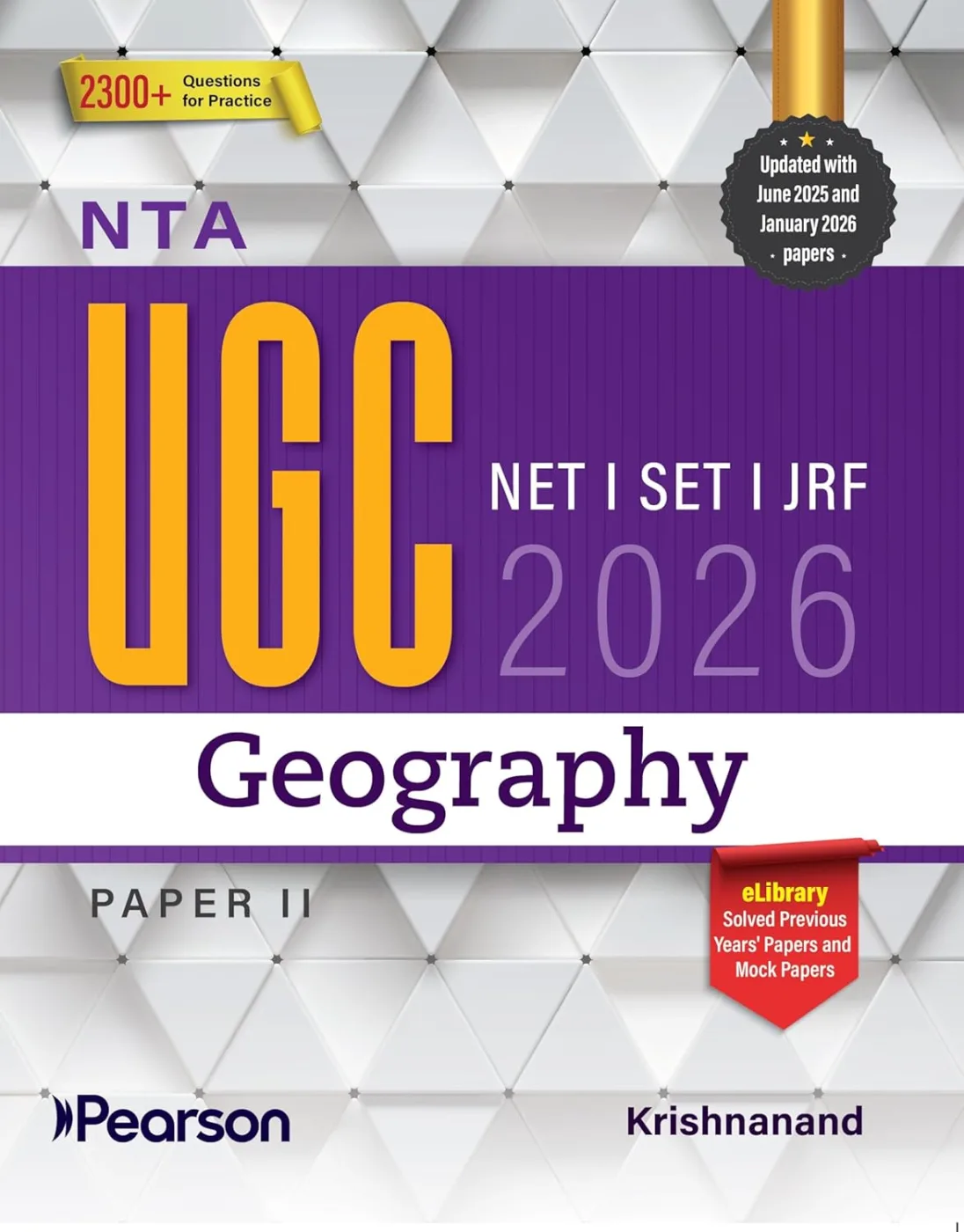
Based on mentor recommendations, topper interviews, and content audits, here are the most trusted resources categorized by role:
Category A: Comprehensive Core Textbooks (Primary Resource)
These single-volume books cover the entire syllabus with theory, diagrams, PYQs, and practice questions. Ideal for first-read and revision.
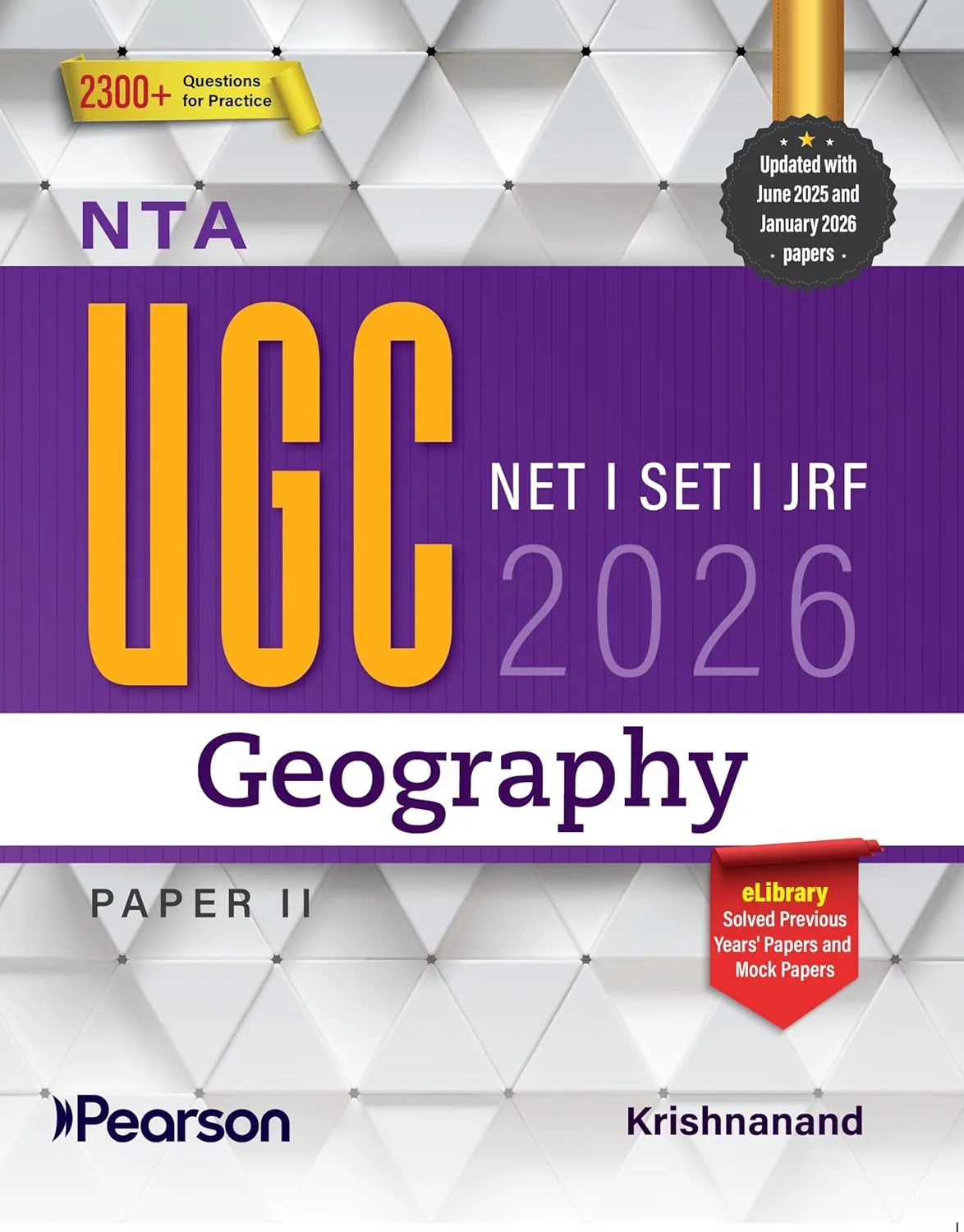
1. “UGC NET/SET/JRF Geography” by Dr. S. K. Sharma & Dr. R. K. Sharma (Arihant Publications)
Widely considered the gold standard. The 2024 edition (ISBN: 978-9327198765) spans 1,200+ pages with unit-wise theory, 5,000+ MCQs, and solved papers up to June 2024. Strengths: Excellent coverage of Geographic Thought (Unit VIII) and Quantitative Methods (Unit IX). Weakness: GIS/Remote Sensing section could be more detailed.
2. “NTA UGC NET Geography Paper 2” by Trueman’s (Author: Dr. M. S. Rawat)
Known for crisp, point-wise theory. The 2023-24 edition includes updated Census/NFHS data and 4,500+ MCQs. Particularly strong in Population Geography (Unit V) and Regional Planning (Unit VII). Preferred by aspirants with limited time (3-4 months preparation).
3. “Geography for UGC NET/JRF” by R. Gupta’s (Author: Dr. K. K. Sharma)
Budget-friendly option with decent syllabus coverage. The 2024 edition adds a dedicated Current Affairs booklet. Best used as a supplement rather than sole resource due to occasional typographical errors in answer keys.
Category B: Unit-Specific Reference Books (Deep Dive)
For aspirants targeting 160+ marks (JRF range), supplement the core book with these specialized texts:
| Unit / Topic | Recommended Book | Author / Publisher | Why UGC NET Geography books’s Essential |
|---|---|---|---|
| Geomorphology (I) | Fundamentals of Geomorphology | Richard Huggett (Routledge) | Conceptual depth on process geomorphology; cited in NET answer keys |
| Climatology (II) | Climatology | D. S. Lal (Sharda Pustak Bhawan) | Classic Indian-authored text; maps and classifications tailored to Indian exams |
| Oceanography (III) | Oceanography: A Brief Introduction | Keith A. Sverdrup (McGraw Hill) | Clear explanations of thermohaline circulation, El Niño/La Niña mechanisms |
| Environmental Geography (IV) | Environmental Geography | Savindra Singh (Pravalika Publications) | Indian context, hazard case studies, SDG linkages |
| Geographic Thought (VIII) | Geographical Thought | Majid Husain (Rawat Publications) | Definitive resource for paradigms, debates, and Indian geographers |
| Quantitative Methods (IX) | Statistical Methods for Geography | Peter A. Rogerson (SAGE) | Step-by-step SPSS/R examples; covers spatial autocorrelation, regression |
| GIS & Remote Sensing (X) | Remote Sensing and GIS | Basudeb Bhatta (Oxford University Press) | Indian satellite missions (IRS, Cartosat, RISAT), sensor specs, applications |
Strategic Study Plan Using UGC NET Geography Books
Owning the best UGC NET Geography books is only half the equation; deployment strategy determines outcomes. Here is a phased approach validated by 50+ JRF qualifiers mentored at TheGeoecologist:
Phase 1: Foundation Building (Months 1-3)
- Read one unit completely from the core textbook (Arihant/Trueman).
- Simultaneously create visual notes — mind maps for models, flowchart for theories, annotated diagrams for landforms.
- Solve chapter-end PYQs immediately after finishing each topic. Mark wrong answers with a red pen; maintain an “Error Log” notebook.
- For Units VIII, IX, X — allocate extra 2 weeks each. These are high-yield, low-competition areas.
Phase 2: Application & Gap-Filling (Months 4-5)
- Switch to unit-specific reference books (Category B) for weak areas identified in Phase 1.
- Attempt full-length PYQ papers (2012-2024) under timed conditions — 3 hours, no breaks.
- Analyze each mock: categorize errors as “Conceptual Gap,” “Silly Mistake,” or “Time Pressure.”
- Revise Error Log weekly. Re-read only the specific sub-topics where errors occurred.
Phase 3: Intensive Revision & Mock Marathon (Month 6 / Final 30 Days)
- Read only your self-made visual notes and Error Log. Do not open textbooks.
- Take 15-20 full-length mocks (NTA pattern) from reliable platforms.
- Focus on Units I-IV (Physical Geography) and V-VII (Human Geography) alternately — 3 days each.
- Memorize key statistics: Census 2011 top/bottom states, NFHS-5 indicators, IPCC warming thresholds, SDG targets.
- Practice Assertion-Reason and Matching questions daily — these are high-scoring, low-effort.
Common Pitfalls to Avoid When Selecting UGC NET Geography Books
1. Buying Multiple Core Textbooks
Many aspirants purchase 3-4 comprehensive books, hoping to “cover everything.” This leads to superficial reading of all and mastery of none. Pick ONE core textbook and finish UGC NET Geography books cover-to-cover. Supplement only for specific weak units.
2. Ignoring the 2019 Syllabus Revision
Books published before 2020 often follow the old 3-paper pattern and omit Units IX-X (Quantitative Methods, GIS/Remote Sensing) or treat them superficially. Always check the publication date and “As per latest NTA syllabus” claim on the cover.
3. Over-Reliance on PDFs and Telegram Channels
Pirated PDFs are often incomplete (missing diagrams, last chapters), have watermarked pages obscuring maps, and contain outdated answer keys. Investing ₹600-900 in a physical/latest edition book saves 100+ hours of frustration.
4. Neglecting Map-Based Preparation
The NTA asks 5-8 map-based questions annually — identifying rivers, mountain passes, soil regions, industrial clusters, tribal concentrations. No UGC NET Geography books cover this exhaustively. Maintain a separate “Map Practice Notebook” with 50+ outline maps of India and World practiced weekly.
Digital Resources to Complement Physical Books
While physical UGC NET Geography books remain the backbone, these digital resources enhance preparation:
- NTA Official Website: ugcnet.nta.nic.in — Download the latest syllabus PDF, previous year papers, and mock test link.
- SWAYAM / NPTEL Geography Courses: Free video lectures by IIT/University professors on Geomorphology, Climatology, GIS. Excellent for conceptual clarity.
- Census of India / NFHS / MOSPI Portals: Primary data sources for authentic statistics. Bookmark censusindia.gov.in and rchiips.org/nfhs.
- ISRO Bhuvan Portal: For GIS/Remote Sensing practical knowledge — visualize Indian satellite imagery, understand sensor resolutions.
Final Verdict: Your Roadmap to the Best UGC NET Geography Books
Success in UGC NET Geography is not about reading the most books — UGC NET Geography books is about mastering the right book through disciplined, strategic engagement. The optimal combination for 2024-25 aspirants:
- Primary: Arihant’s “UGC NET/SET/JRF Geography” (2024 Edition) — comprehensive, updated, PYQ-rich.
- Supplement (choose 2-3 based on weakness): Majid Husain for Geographic Thought, Savindra Singh for Environmental Geography, Bhatta for GIS/Remote Sensing.
- Practice: 15+ years PYQs (compiled in core book) + 15-20 full mocks in final month.
- Current Affairs: Monthly compilation from TheGeoecologist or similar trusted source — focus on geography-relevant events (climate summits, census updates, new satellite launches, policy schemes).
Remember: The exam tests your ability to think like a geographer — spatially, analytically, and integratively. The best UGC NET Geography books are tools that cultivate this mindset. Use them wisely, revise relentlessly, and trust the process. Your JRF or Assistant Professor appointment letter is waiting on the other side of consistent effort.
Ready to start your preparation with the right resources? Subscribe to TheGeoecologist for detailed book reviews, unit-wise strategy videos, monthly current affairs PDFs, and free mock tests tailored for UGC NET Geography aspirants. Join 50,000+ geography students who trust our guidance.
Frequently Asked Questions
Arihant's "UGC NET/SET/JRF Geography" by Dr. S.K. Sharma & Dr. R.K. Sharma (2024 Edition) is widely regarded as the most comprehensive single-volume resource. It covers all 10 units, includes 5,000+ MCQs with explanations, and provides solved papers up to June 2024. For aspirants with 6+ months preparation time, this book alone can suffice if studied thoroughly with supplementary map practice.
Books published before 2020 are NOT recommended as the primary resource. The NTA revised the syllabus in June 2019 (effective December 2019), adding significant weightage to Quantitative Methods (Unit IX) and GIS/Remote Sensing (Unit X), while shifting to a 100-question CBT format. Older editions often lack these units or cover them superficially. Always verify "As per latest NTA syllabus" and publication year 2023-24 on the cover.
A dedicated aspirant studying 4-5 hours daily typically needs 5-6 months to thoroughly complete one core textbook (Arihant/Trueman), revise weak units using reference books, solve 15 years of PYQs, and take 15-20 full mocks. Working professionals with 2 hours/day should plan for 8-10 months. The key is consistency — finishing one book completely is far more effective than partially reading multiple books.