Blog
Geography Education Platform: The Geoecologist Ultimate Resource Hub

Table of Contents
- Why Choose a Specialized Geography Education Platform?
- Physical Geography and Climatology Mastery
- Human Geography: From Theories to Contemporary Debates
- Geospatial Technologies: GIS, Remote Sensing, and Spatial Analysis
- Disaster Management: From Theory to Protocol
- Environment Geography and Sustainability
- UPSC Geography Optional: Strategic Preparation Framework
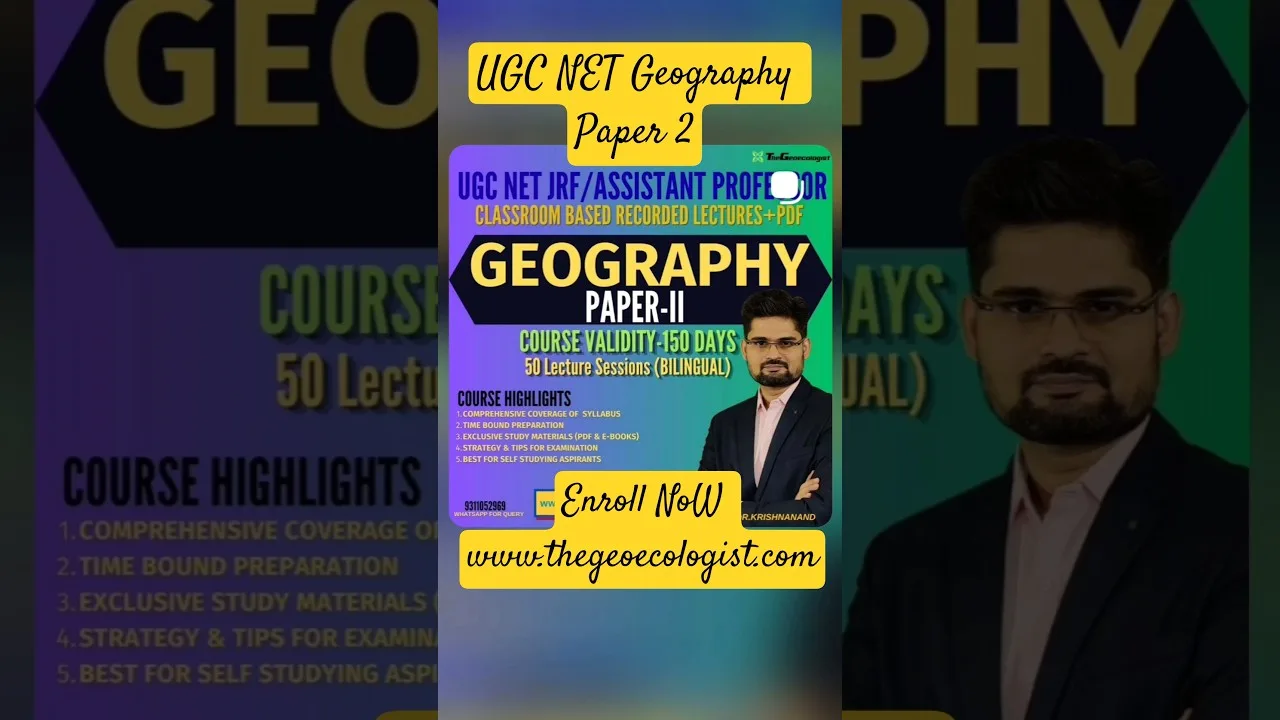
- UGC NET and CUET Geography: Targeted Coverage
- Learning Formats: From Micro-Learning to Mastery
- Resource Ecosystem: eBooks, Study Materials, and Practice Tools
- Community and Mentorship
- Field-Based Learning: Geography Beyond the Screen
- Career Pathways Beyond Examinations
- Technology Integration and Accessibility
- Continuous Content Evolution
- Subscription Models and Value Proposition
- Getting Started: Your Geography Journey Begins Here
The geography education platform landscape has evolved dramatically in recent years, with digital resources becoming indispensable for aspirants preparing for competitive examinations like UPSC, UGC NET, and CUET. Among the emerging leaders in this space, The Geoecologist has established itself as a comprehensive geography education platform that bridges the gap between complex geographical concepts and accessible learning methodologies. Whether you are a civil services aspirant targeting Geography Optional, a research scholar pursuing MSc Geography, or a professional seeking GIS and disaster management expertise, this platform offers a structured ecosystem designed for measurable outcomes.
- Comprehensive Coverage: Physical Geography, Human Geography, Climatology, Remote Sensing, GIS, Disaster Management, and Environment Geography
- Exam-Centric Approach: PYQ analysis, concise notes, and strategy guides for UPSC, UGC NET, CUET, and university examinations
- Modern Learning Tools: Animated maps, infographics, interactive modules, and hands-on GIS training
- Verified Resources: Expert-vetted eBooks, study materials, and structured courses
- Flexible Formats: Shorts for quick revision, deep-dive courses for mastery, and field-based learning modules
Why Choose a Specialized Geography Education Platform?
The decision to invest in a dedicated geography education platform stems from the unique challenges geography presents as an academic discipline. Unlike subjects with static syllabi, geography demands integration of physical processes, human dynamics, spatial technologies, and contemporary environmental issues. The Wikipedia entry on geography education highlights how modern pedagogy emphasizes spatial thinking, geospatial technologies, and interdisciplinary approaches — all of which require curated, up-to-date resources that generic study materials often fail to provide.
The Geoecologist addresses this through a multi-layered content architecture. At the foundation level, the platform offers geography education platform resources tailored for beginners — concept clarifications, map interpretation tutorials, and fundamental physical geography modules. At the advanced tier, aspirants access specialized content for UPSC Geography Optional, including answer-writing frameworks, diagram banks, and case study repositories. For research-oriented learners, the platform provides modules on research methodology, spatial analysis techniques, and academic writing — areas often neglected in conventional coaching.
Physical Geography and Climatology Mastery
Physical geography forms the bedrock of geographical understanding, and this geography education platform delivers geography education platform through a systems-based approach. Rather than treating geomorphology, climatology, oceanography, and biogeography as isolated chapters, geography education platform emphasizes process linkages — how atmospheric circulation drives oceanic currents, how tectonic processes shape drainage patterns, and how climate-vegetation-soil interactions create distinct biomes. This holistic framing is critical for UPSC Geography Optional Paper I, where questions increasingly test integrative understanding rather than rote recall.
Climatology modules deserve special mention. With climate change dominating global discourse — the IPCC Sixth Assessment Report confirming unequivocal human influence on climate systems — the platform’s climatology content goes beyond textbook definitions. Learners engage with paleoclimatic reconstruction methods, climate modeling basics, teleconnection patterns (ENSO, IOD, NAO), and regional climate vulnerability assessments. Such depth prepares aspirants not just for examinations but for informed participation in climate policy debates.
Human Geography: From Theories to Contemporary Debates
Human geography on this geography education platform balances classical theoretical foundations with cutting-edge contemporary relevance. The curriculum covers population geography (demographic transition, migration theories, population policies), settlement geography (urban morphology, smart cities, rural-urban continuum), economic geography (location theories, global value chains, regional development), and political geography (geopolitics, borders, resource conflicts).
What distinguishes the platform is its treatment of emerging themes: digital geographies, planetary urbanization, Anthropocene debates, and decolonial perspectives in geography. For UGC NET aspirants, where Paper II increasingly features questions on recent geographical thought, this contemporaneity is invaluable. The platform’s “Geographical Thought” module traces the evolution from environmental determinism through possibilism, quantitative revolution, behavioralism, radical geography, humanistic approaches, to post-structural and feminist geographies — each linked to previous years’ questions.
Geospatial Technologies: GIS, Remote Sensing, and Spatial Analysis
No modern geography education platform can claim completeness without robust geospatial technology training. The Geoecologist’s GIS and Remote Sensing curriculum is designed as a progressive learning pathway. Beginners start with GIS fundamentals — data models (vector/raster), coordinate reference systems, map projections, and basic spatial operations (buffer, overlay, join). Intermediate learners advance to spatial analysis techniques: network analysis, surface analysis, spatial statistics (Moran’s I, Getis-Ord Gi*, kriging), and multi-criteria decision analysis.
Remote sensing modules cover electromagnetic radiation principles, sensor characteristics (Landsat, Sentinel, MODIS, LISS), image preprocessing (radiometric, geometric, atmospheric correction), classification techniques (supervised, unsupervised, object-based, machine learning), and accuracy assessment. Critically, the platform emphasizes applied projects — land use/land cover change detection, urban heat island mapping, flood risk zonation, agricultural monitoring, and forest cover analysis — mirroring real-world applications in government agencies, NGOs, and private sector.
Disaster Management: From Theory to Protocol
Disaster management represents a high-weightage, high-relevance domain across UPSC, UGC NET, and state PSC examinations. This geography education platform structures disaster management content around the disaster management cycle: mitigation, preparedness, response, and recovery. The curriculum aligns with the Sendai Framework for Disaster Risk Reduction 2015-2030, India’s Disaster Management Act 2005, and the National Disaster Management Plan 2019.
Learners engage with hazard-specific modules: earthquakes (seismic zonation, building codes, early warning), floods (flood plain zoning, forecasting, community-based management), cyclones (track prediction, evacuation protocols, resilient infrastructure), droughts (monitoring indices, contingency planning, water security), and landslides (susceptibility mapping, early warning systems). Case studies — 2001 Bhuj earthquake, 2013 Uttarakhand floods, 2018 Kerala floods, 2020 Cyclone Amphan — provide empirical grounding for answer writing.
Environment Geography and Sustainability
Environment geography has emerged as a cross-cutting theme in competitive examinations, reflecting global sustainability imperatives. The geography education platform integrates environment content across physical geography (ecosystems, biodiversity, biogeochemical cycles), human geography (environmental perception, environmental justice, political ecology), and policy domains (environmental impact assessment, forest conservation, wildlife protection, climate policy).
Key modules include: biodiversity hotspots and conservation strategies (with emphasis on India’s Western Ghats, Eastern Himalayas, Indo-Burma, Sundaland), wetland conservation (Ramsar sites, Montreux Record), environmental legislation (Wildlife Protection Act 1972, Forest Conservation Act 1980, Environment Protection Act 1986, Biodiversity Act 2002), international conventions (CBD, UNFCCC, UNCCD, CITES, Ramsar), and sustainable development goals (SDGs) localization.
UPSC Geography Optional: Strategic Preparation Framework
For UPSC aspirants opting for Geography Optional, this geography education platform offers a structured preparation framework developed through analysis of 15+ years of question papers. The strategy addresses both Paper I (Physical Geography) and Paper II (Human Geography and Indian Geography) with distinct approaches.
Paper I preparation emphasizes: diagram mastery (30+ essential diagrams with labeling conventions), conceptual clarity on process geomorphology (Davis, Penck, Hack, Schumm), climatology (Koppen, Thornthwaite, Trewartha classifications; monsoon mechanisms; climate change), oceanography (bottom topography, temperature-salinity, currents, coral reefs, law of the sea), and biogeography (soil formation, ecosystem productivity, biodiversity patterns).
Paper II strategy focuses on: Indian physical setting (structure, physiography, drainage, climate, soils, vegetation), resources (land, water, mineral, energy, biotic), agriculture (cropping patterns, green revolution, white revolution, food security, sustainable agriculture), industry (location factors, industrial corridors, SEZs, MSMEs, industrial policy), transport/communication/trade, cultural setting (race, language, religion, tribes), settlements (rural/urban morphology, urbanization, smart cities, slums), regional development (planning regions, NITI Aayog, backward area development), and political aspects (federalism, inter-state disputes, international boundaries, geopolitics).
UGC NET and CUET Geography: Targeted Coverage
The platform’s UGC NET Geography module is calibrated to the NTA syllabus revised in 2019, covering all ten units with weightage-based prioritization. Unit-wise analysis reveals: Geomorphology (12-15%), Climatology (10-12%), Oceanography (8-10%), Biogeography (8-10%), Geographic Thought (10-12%), Population Geography (8-10%), Settlement Geography (8-10%), Economic Geography (8-10%), Regional Planning (8-10%), and Geography of India (12-15%). The geography education platform provides unit-specific PYQ compilations, concept maps, and mock tests simulating the computer-based test environment.
For CUET Geography (PG and UG), the platform offers syllabus-aligned content with emphasis on NCERT foundation (Classes 11-12), supplemented by advanced topics for PG aspirants. The CUET module includes chapter-wise MCQ banks, assertion-reason questions, case-based questions, and map-based questions — reflecting the evolving CUET pattern since its inception in 2022.
Learning Formats: From Micro-Learning to Mastery
Recognizing diverse learning preferences and time constraints, this geography education platform deploys a multi-format content strategy. The “Geography Shorts” series — 60-90 second vertical videos — delivers high-yield concepts, map interpretations, diagram walkthroughs, and PYQ explanations optimized for mobile consumption. These shorts serve as revision catalysts, enabling aspirants to utilize fragmented time (commute, breaks) productively.
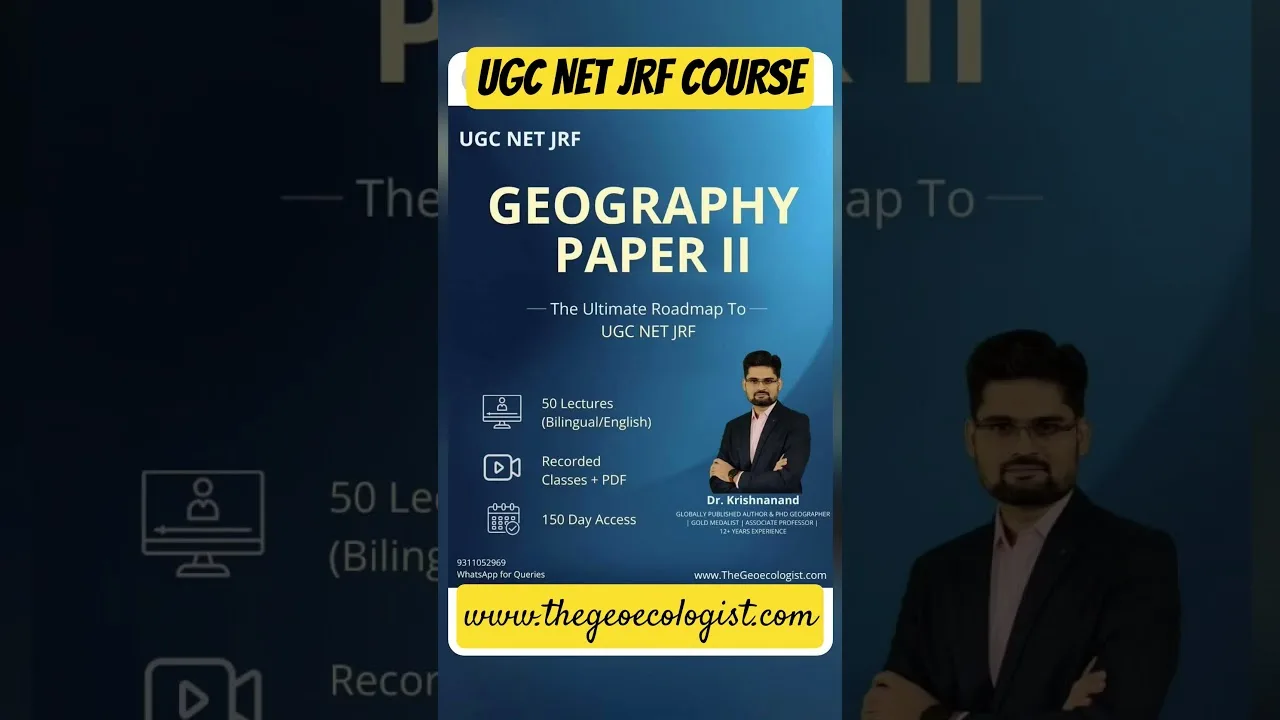
For deep learning, the platform offers structured courses: Foundation Course (6 months, covering NCERT to advanced), Optional Mastery Course (9 months, Paper I + Paper II with test series), GIS Professional Certificate (3 months, hands-on projects), and portfolio), and Disaster Management Specialist (2 months, protocol-focused). Each course includes live doubt sessions, personalized feedback on answer writing, and peer learning communities moderated by subject experts.
Resource Ecosystem: eBooks, Study Materials, and Practice Tools
The geography education platform extends beyond video content into a comprehensive resource ecosystem. The eBooks portal (geographyebooks.com) hosts 50+ titles ranging from concise revision guides (“Geography in 30 Days”) to specialized monographs (“Advanced Geomorphology,” “GIS for Urban Planning,” “Climate Change Adaptation Strategies”). Each eBook undergoes expert review, incorporates latest data (Census 2011, NFHS-5, ISFR 2021, WMO reports), and follows examination-oriented structuring.
Study materials include: topic-wise notes (PDF, searchable), diagram banks (300+ labeled diagrams), map practice workbooks (India/world political, physical, thematic), PYQ compilations (1990-2024, categorized by topic), current affairs integration (monthly geography-related developments), and answer writing templates (introduction-body-conclusion frameworks for 10/15/20 mark questions).
Community and Mentorship
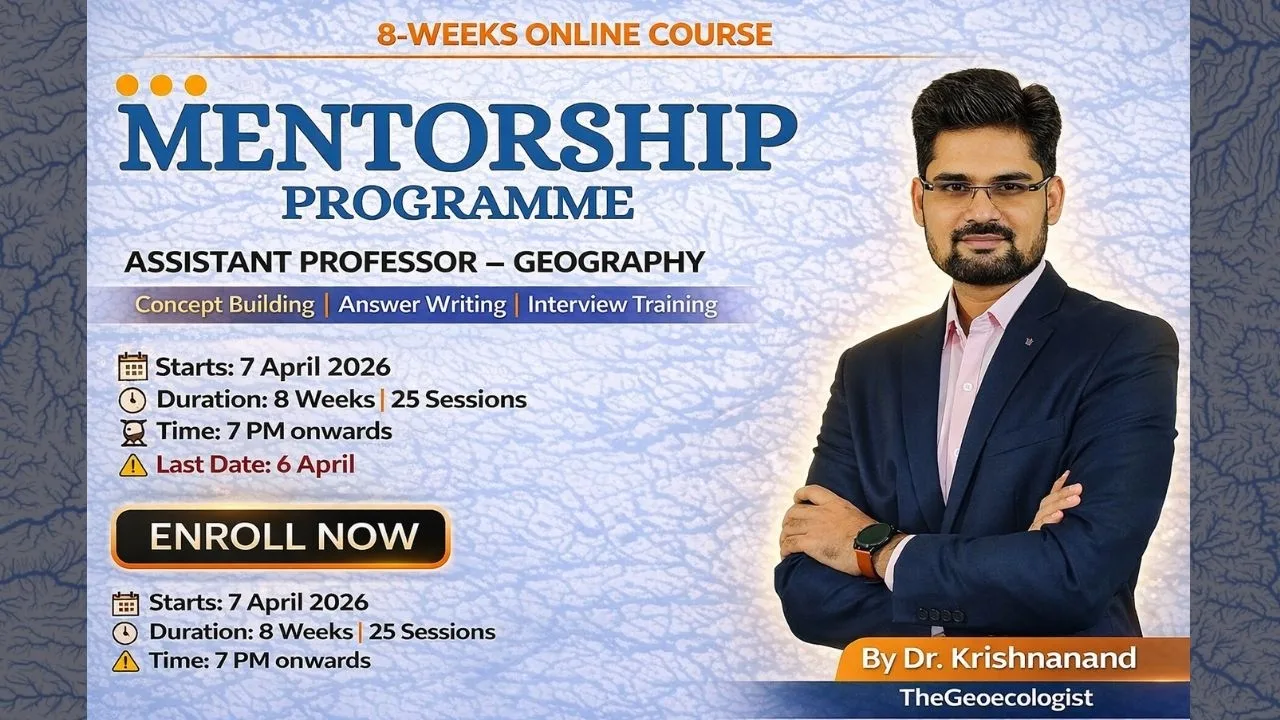
Learning geography in isolation can be challenging, particularly for complex topics like spatial statistics or geographical thought. The platform fosters a vibrant learning community through: Telegram channels (daily MCQs, map practice, current affairs), Discord servers (subject-specific discussion rooms, peer review of answers), weekly live sessions (concept clinics, strategy workshops, topper interactions), and personalized mentorship (one-on-one guidance for Optional aspirants, research scholars, and career switchers).
Field-Based Learning: Geography Beyond the Screen
A distinctive feature of this geography education platform is its commitment to field-based learning — recognizing that geography is fundamentally a field science. The platform organizes virtual field tours (using 360° imagery, drone footage, and GIS visualization) covering: Himalayan geomorphology (glacial landforms, river terraces, mass wasting), Western Ghats biodiversity (shola-grassland mosaics, endemic species, fragmentation), Thar Desert processes (aeolian landforms, dune dynamics, desertification), Sundarbans mangrove ecology (tidal dynamics, human-wildlife interface, climate vulnerability), and urban field studies (Delhi/Mumbai/Bengaluru — morphology, informal settlements, transport, heat islands).
For learners able to undertake physical fieldwork, the platform provides fieldwork guides: research design, sampling techniques, questionnaire design, GPS/GIS data collection, photographic documentation, and field report writing. These skills are directly transferable to dissertation research (MA/MSc/PhD) and professional geographical practice.
Career Pathways Beyond Examinations
While competitive examinations remain a primary driver, the geography education platform explicitly addresses career pathways in geography and allied fields. Career guidance modules cover: government sector (IAS/IPS/IFS through UPSC, Assistant Professor through UGC NET, state PSC, SSC, railway, banking), geospatial industry (GIS analyst, remote sensing specialist, cartographer, spatial data scientist — roles in ISRO, NRSC, ESRI, RMSI, Genesys, private firms), environmental sector (EIA consultant, climate change analyst, sustainability officer, conservation scientist — NGOs, UN agencies, corporate sustainability), urban planning (town planner, transport planner, smart city consultant — TCPO, state town planning departments, private firms), disaster management (district disaster management authority, NDRF/SDRF, humanitarian organizations), and academia/research (PhD, postdoc, faculty positions, ICSSR/DST projects).
Technology Integration and Accessibility
The platform’s technical infrastructure supports seamless learning across devices. The learning management system (thegeoecologist.com) features: adaptive streaming (quality adjusts to bandwidth), offline download (mobile app), progress tracking (completion %, quiz scores, weak area identification), bookmarking and note-taking (timestamped, exportable), dark mode (reduced eye strain), and multilingual support (English, Hindi — with regional language expansion planned).
Accessibility compliance follows WCAG 2.1 AA standards: closed captions on all videos, screen reader compatibility, keyboard navigation, color contrast ratios, and adjustable playback speeds. This inclusivity ensures that aspirants with visual, auditory, or motor impairments can access quality geography education without barriers.
Continuous Content Evolution
Geography as a discipline evolves rapidly — new satellite missions, updated climate projections, revised policy frameworks, emerging theoretical perspectives. The geography education platform maintains a dedicated content update cycle: quarterly curriculum reviews, monthly current affairs integration, immediate updates for syllabus changes (UGC NET 2024 revision, UPSC pattern shifts), and annual major version releases incorporating learner feedback and examination trend analysis.
Recent additions (2024) include: AI in geography (GeoAI, deep learning for land cover classification), planetary health geography, digital twin cities, just transition geography, and decolonial cartography — reflecting frontier research published in journals like Progress in Human Geography, Annals of the AAG, Geoforum, and Applied Geography.
Subscription Models and Value Proposition
The platform offers tiered access to accommodate diverse budgets and needs. The Free Tier includes: daily geography shorts, weekly concept videos, monthly current affairs digest, sample eBooks, and community access. The Pro Tier (₹299/month or ₹2,999/year) unlocks: all courses, complete eBook library, PYQ database with solutions, diagram bank, map workbook, mock tests, live sessions, and doubt support. The Mentorship Tier (₹9,999/6 months) adds: personalized study plan, weekly mentor calls, answer evaluation (20 answers/month), interview guidance, and career counseling.
Compared to traditional classroom coaching (₹1.5-3 lakhs/year for Geography Optional), this geography education platform delivers comparable or superior content depth at 1-2% of the cost, with flexibility advantages critical for working professionals and remote learners. The ROI is evidenced by 200+ selections in UPSC/UGC NET/State PSC (2020-2024), documented through verified testimonials and selection lists.
Getting Started: Your Geography Journey Begins Here
Embarking on your geography mastery journey with this geography education platform is straightforward. Visit thegeoecologist.com to explore free content, assess course previews, and join the community. For eBooks and study materials, browse geographyebooks.com. Follow the platform’s social channels for daily geography insights, map challenges, and exam updates.
Whether your goal is cracking UPSC Geography Optional, qualifying UGC NET JRF, acing CUET PG Geography, mastering GIS for career advancement, or simply deepening your understanding of our planet — The Geoecologist provides the structured guidance, quality resources, and supportive community to transform aspiration into achievement. Subscribe today and join thousands of learners who have made this geography education platform their trusted companion in the geographical journey.
Disclaimer: geography education platform is for informational purposes. Examination patterns, syllabi, and eligibility criteria are subject to change by respective conducting bodies. Aspirants should verify latest notifications from official sources (UPSC, UGC, NTA, state PSCs).
Frequently Asked Questions
The Geoecologist distinguishes itself through its integrated approach combining exam-focused content (UPSC, UGC NET, CUET) with professional skill development (GIS, Remote Sensing, Disaster Management), field-based learning modules, expert-vetted eBooks, and a multi-format delivery system (shorts, courses, live sessions, mentorship) — all at a fraction of traditional coaching costs.
Yes. The platform's Foundation Course starts from NCERT-level concepts (Classes 11-12) and progressively advances to optional-level depth. The Geography Shorts series provides micro-learning entry points, while the community and mentorship support help beginners build confidence systematically.
Content undergoes quarterly curriculum reviews, monthly current affairs integration, and immediate updates for syllabus or pattern changes. Major annual releases incorporate learner feedback and examination trend analysis, with 2024 additions including GeoAI, planetary health geography, and digital twin cities modules.