Blog
UGC NET Assistant Professor: Why Qualifying Isn’t Enough for Selection

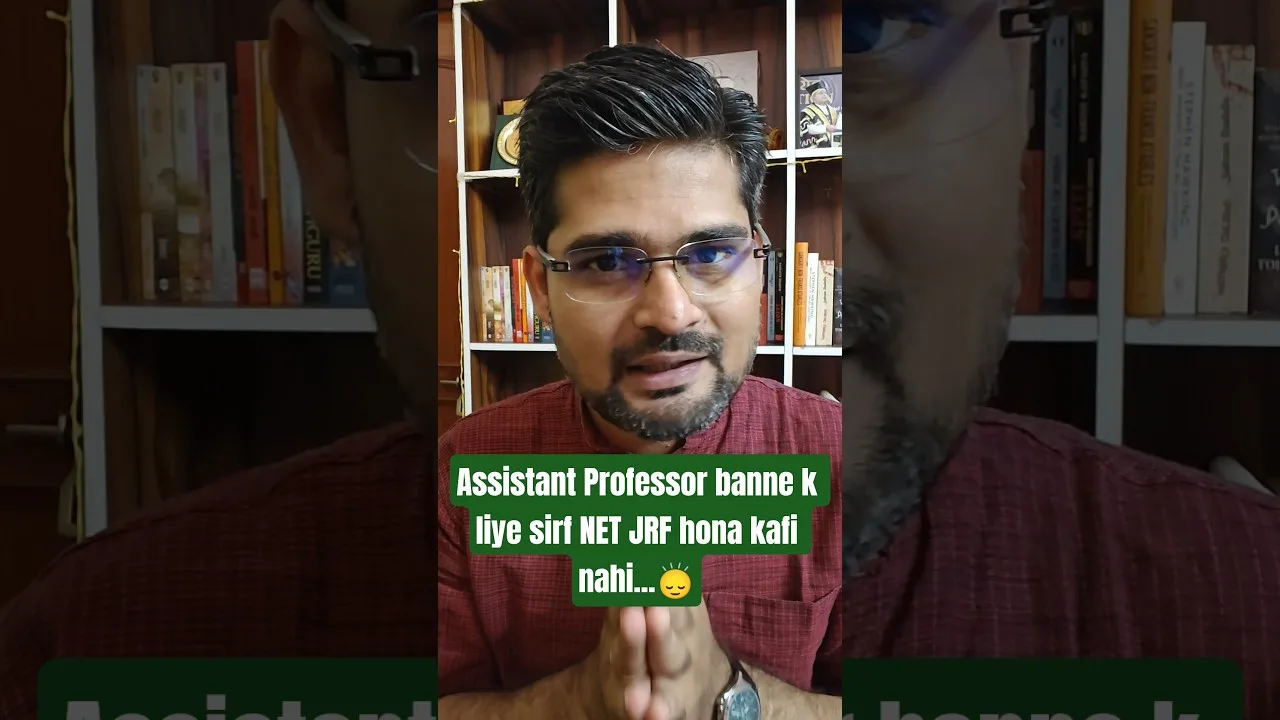
Table of Contents
- The Reality Check: UGC NET Assistant Professor Eligibility vs. Employability
- Why the Examination Falls Short
- Gauntlet 1: Mastering the Art of Answer Writing for Geography
- Gauntlet 2: The Interview Room – Beyond Subject Mastery
- Common Interview Pitfalls
- Gauntlet 3: Presentation Mastery & The Demo Lecture
- TheGeoecologist Blueprint: From Qualification to Selection
- Program Pillars
- Statistical Perspective: The Selection Funnel
- Building Your Academic Profile Proactively
- Frequently Asked Questions
- Is a PhD mandatory for Assistant Professor recruitment in 2026?
- How much weightage does the written test carry vs. the interview?
- Can I prepare for answer writing and interviews simultaneously?
- Conclusion: Your Next Step Starts Today
Cracking the UGC NET Assistant Professor eligibility test is a monumental achievement for any aspiring academic in India. However, thousands of candidates discover each year that holding a JRF award or NET certificate is merely the entry ticket to a far more competitive arena. The journey from a qualified candidate to a selected UGC NET Assistant Professor demands a completely different skill set—one that the examination itself does not test. This comprehensive guide explores the hidden curriculum of academic recruitment and provides a strategic roadmap to bridge the gap between qualification and appointment.
- Qualification ≠ Selection: Clearing UGC NET/JRF is a mandatory eligibility criterion, not a guarantee of appointment.
- Answer Writing is a Distinct Skill: University exams require analytical, map-integrated, and structured responses, not just textbook recall.
- Interview Panels Assess Holistic Potential: Teaching aptitude, research vision, and communication skills outweigh rote knowledge.
- Presentation & Demo Lectures Are Critical: Practical teaching demonstrations often carry higher weightage than written scores.
- Strategic Mentorship Accelerates Success: Structured programs like TheGeoecologist address the specific gaps left by self-study.
The Reality Check: UGC NET Assistant Professor Eligibility vs. Employability
According to data from the University Grants Commission (UGC), over 5 lakh candidates appear for the National Eligibility Test annually, with roughly 6-9% qualifying for Assistant Professor eligibility and a mere 1-2% securing JRF. Yet, the number of vacant positions across Indian universities and colleges remains a fraction of this qualified pool. As of the 2023-24 academic session, the University Grants Commission (India) reported over 6,000 vacant faculty positions in central universities alone, while state universities face even higher vacancy rates. This paradox—high vacancy yet high unemployment among qualified candidates—stems from a fundamental mismatch: UGC NET Assistant Professor eligibility tests subject knowledge, but selection committees evaluate professional competence.
Why the Examination Falls Short
The NET syllabus covers Paper I (Teaching & Research Aptitude) and Paper II (Subject Specific). While Paper I touches on teaching methodology, UGC NET Assistant Professor is theoretical. It does not simulate a classroom environment, evaluate a candidate’s ability to handle diverse student cohorts, or test the integration of ICT tools—standard expectations in modern Indian academia. Furthermore, the shift to Computer Based Testing (CBT) has made the exam more about speed and accuracy than deep analytical writing, a skill that becomes paramount in the subsequent stages of recruitment.
Gauntlet 1: Mastering the Art of Answer Writing for Geography
For UGC NET Assistant Professor aspirants in Geography, the written test (often conducted by state PSCs or universities post-NET) is the first major filter. Examiners are not looking for data dumps. They seek structured, analytical answers that demonstrate:
- Conceptual Integration: Linking Geomorphology with Climatology, or Population Geography with Settlement Patterns.
- Cartographic Proficiency: Sketch maps, schematic diagrams, and GIS-based representations are non-negotiable for high scores.
- Contemporary Relevance: Citing recent IPCC reports, Census 2011/2021 projections, or government schemes (e.g., Jal Jeevan Mission, Smart Cities Mission) as case studies.
- Framework Adherence: Introduction → Body (Thematic headers) → Critical Analysis → Conclusion with forward-looking suggestions.
Many UGC NET Assistant Professor candidates fail here because they write “university exam answers”—descriptive, lengthy, and diagram-free. Competitive recruitment answers must be concise, visual, and argumentative. TheGeoecologist’s mentorship program specifically deconstructs previous years’ question papers from UPSC, UGC, and State PSCs to build this muscle memory.
Gauntlet 2: The Interview Room – Beyond Subject Mastery
If the written test filters for knowledge, the interview filters for persona and potential. Selection committees for UGC NET Assistant Professor roles typically comprise the Vice-Chancellor/Principal, subject experts, and a UGC nominee. Their evaluation matrix usually weights:
- Domain Knowledge: 30-40%
- Teaching Aptitude & Pedagogy: 25-30%
- Research Potential & Publications: 20-25%
- Communication, Confidence & Personality: 10-15%
Common Interview Pitfalls
- Vague Research Proposals: Candidates often propose topics that are either too broad (“Climate Change in India”) or lack methodological clarity. A strong proposal defines the research gap, hypothesis, methodology (qualitative/quantitative/mixed), and expected contribution.
- Inability to Teach a Concept: “Teach me the concept of Plate Tectonics in 5 minutes” is a standard request. Candidates who lecture rather than teach (engage, question, use analogies, check understanding) fail this segment.
- Weak Interdisciplinary Links: Geography is inherently interdisciplinary. Failing to connect a question on Urban Heat Islands to Public Policy, Remote Sensing, and Sociology signals a siloed mindset.
- Nervousness & Poor Articulation: Knowledge trapped by anxiety is invisible. Mock interviews under simulated pressure are the only antidote.
Gauntlet 3: Presentation Mastery & The Demo Lecture
An increasing number of universities (especially Central Universities and IITs) mandate a seminar presentation or a demo lecture before the formal interview. This is where the UGC NET Assistant Professor candidate transitions from a student to a colleague. Evaluators assess:
- Slide Design: Visual hierarchy, minimal text, high-quality maps/figures, citation discipline.
- Narrative Flow: Storytelling with data—Problem → Literature Gap → Methodology → Findings → Implication.
- Audience Engagement: Eye contact, voice modulation, handling interruptions/questions gracefully.
- Time Management: Finishing a 20-minute slot in 19:30, not 25 minutes.
This skill is rarely self-taught. UGC NET Assistant Professor requires iterative practice, expert feedback, and video analysis—core components of professional mentorship.
TheGeoecologist Blueprint: From Qualification to Selection
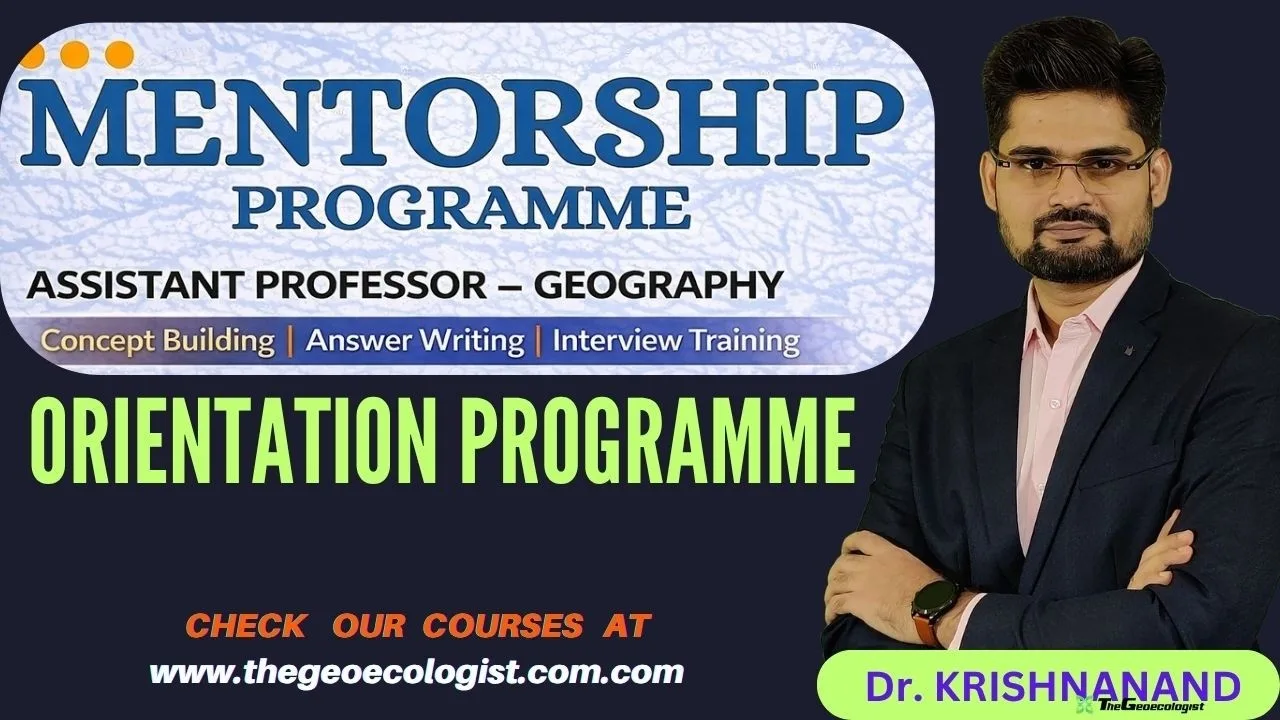
Recognizing these systemic gaps, TheGeoecologist has designed a targeted Mentorship Program launching 7 April 2026. Unlike generic coaching, this program is built exclusively for UGC NET Assistant Professor aspirants in Geography who have already cleared the eligibility hurdle.
Program Pillars
1. Structured Answer Writing Laboratory
- Weekly timed tests mimicking UPSC/State PSC patterns.
- Personalized evaluation focusing on structure, map integration, and keyword optimization.
- Model answers with “Examiner’s Comments” explaining why marks are awarded/deducted.
2. Interview Excellence Workshop
- 3 Full-length Mock Interviews with panels comprising retired professors and subject experts.
- Research Proposal Clinic: One-on-one refinement of your proposal to publication-ready standard.
- Teaching Aptitude Module: Micro-teaching sessions with peer and mentor feedback.
3. Presentation Mastery Bootcamp
- Slide design templates for Geography seminars.
- Two recorded demo lectures with detailed feedback on pedagogy, tech-use, and delivery.
- Q&A simulation for handling hostile or tricky questions.
Batch Size: Strictly limited to ensure personalized attention. Registration: Register Now | Queries: WhatsApp 9311052969.
Statistical Perspective: The Selection Funnel
Understanding the funnel helps allocate effort efficiently. Consider a typical Central University recruitment for one UGC NET Assistant Professor position in Geography:
- Applications Received: 300-500 (All NET/JRF qualified)
- Shortlisted for Written Test (if applicable): 150-200
- Qualify Written Test: 30-50
- Called for Interview/Presentation: 10-15 (1:10 or 1:15 ratio)
- Final Selection: 1
The attrition is highest at the Interview/Presentation stage. Candidates often score similarly in written exams (e.g., 65-75%), but interview scores range wildly from 40% to 85%. This variance is where mentorship yields the highest ROI.
Building Your Academic Profile Proactively
While waiting for vacancies, strategic UGC NET Assistant Professor aspirants build an “unrejectable” profile:
- Publications: Target 2-3 papers in UGC-CARE List / Scopus / Web of Science journals. Focus on your specialization.
- Conferences: Present papers at national/international seminars (e.g., IGU, NAGI, ISPRS). Network with potential referees.
- Skill Certifications: GIS (ArcGIS/QGIS), Remote Sensing, Python/R for Spatial Analysis, MOOCs (SWAYAM/NPTEL) on Pedagogy.
- Teaching Experience: Guest faculty, contractual, or even voluntary teaching at NGOs/coaching centers counts. Document UGC NET Assistant Professor formally.
Frequently Asked Questions
Is a PhD mandatory for Assistant Professor recruitment in 2026?
As per the latest UGC Regulations (2018 and subsequent amendments), a PhD is mandatory for direct recruitment to Assistant Professor in universities. However, for colleges, NET/SET/SLET remains the minimum eligibility, though a PhD is a preferred qualification and carries weightage in the API score. Candidates pursuing PhD should aim to submit/thesis before the interview stage.
How much weightage does the written test carry vs. the interview?
It varies by institution. Central Universities often follow a 70:30 or 80:20 (Written:Interview) ratio. Many State PSCs use 85:15 or 90:10. However, the interview is the differentiator because written scores cluster tightly. A 10% interview weightage can swing the final rank by 50 positions.
Can I prepare for answer writing and interviews simultaneously?
Yes, and you must. They reinforce each other. Answer writing structures your thought process, which directly improves interview articulation. TheGeoecologist program runs these modules in parallel with integrated feedback loops.
Conclusion: Your Next Step Starts Today
Clearing the UGC NET Assistant Professor eligibility test proves you have the potential to be an academic. Converting that potential into an appointment letter requires treating the post-NET phase with the same rigor, strategy, and expert guidance you gave the exam itself. The competition is not just “other qualified candidates”; it is the gap between your current preparation and the selector’s expectations. Bridge that gap deliberately. TheGeoecologist Mentorship Program starting 7 April 2026 is your structured pathway to stand out, speak up, and get selected. Register now to secure your seat in the limited batch.
Frequently Asked Questions
As per the latest UGC Regulations (2018 and subsequent amendments), a PhD is mandatory for direct recruitment to Assistant Professor in universities. However, for colleges, NET/SET/SLET remains the minimum eligibility, though a PhD is a preferred qualification and carries weightage in the API score. Candidates pursuing PhD should aim to submit/thesis before the interview stage.
It varies by institution. Central Universities often follow a 70:30 or 80:20 (Written:Interview) ratio. Many State PSCs use 85:15 or 90:10. However, the interview is the differentiator because written scores cluster tightly. A 10% interview weightage can swing the final rank by 50 positions.
Yes, and you must. They reinforce each other. Answer writing structures your thought process, which directly improves interview articulation. TheGeoecologist program runs these modules in parallel with integrated feedback loops.