Blog
assistant professor jobs: The Brutal Reality Behind UGC NET Qualification

Table of Contents
- The Myth of "One Clearance Wins All" in assistant professor jobs
- Why the Gap Between Eligibility and Appointment Exists
- Three Critical Gaps That Derail Aspirants Beyond NET/JRF
- 1. Unrealistic Expectations and Market Blindness
- 2. Poor Interview Performance: The Silent Eliminator
- 3. Ineffective Answer Writing in Descriptive Stages
- The Hidden Hurdles: Psychological, Structural, and Systemic
- Psychological Strain of Repeated Rejection
- Portfolio Pressure: The Publication Arms Race
- Systemic Biases and Opacity
- The Solution: Strategic Mentorship That Bridges the Gap
- Program Architecture: Three Pillars of Preparation
- Program Details and Enrollment
- Why This Approach Works: Evidence from Alumni
- Closing Thought: Make NET Your Launchpad, Not Your Peak
- Connect for Instant Guidance
The journey to securing assistant professor jobs in India is often romanticized as a straightforward path: clear the UGC NET exam, and a permanent academic position awaits. However, the ground reality for thousands of aspirants tells a drastically different story. Qualifying the National Eligibility Test (NET) or Junior Research Fellowship (JRF) is merely the first checkpoint in a marathon, not the finish line. The real battle for assistant professor jobs begins the moment the certificate is in hand, where subject knowledge alone proves insufficient against fierce competition, systemic biases, and evolving selection criteria.
- UGC NET/JRF is a qualifying eligibility criterion, not a job guarantee. It opens the door to apply, but does not ensure selection.
- Competition has intensified exponentially. For a single assistant professor jobs vacancy, universities often receive 200–500 applications from NET-qualified candidates.
- Interview performance and answer writing skills are decisive differentiators, yet rarely taught in standard curricula.
- Research publications, PhD completion, and teaching experience now act as primary filters during shortlisting.
- Psychological resilience and strategic mentorship are critical for navigating repeated rejections and systemic opacity.
The Myth of “One Clearance Wins All” in assistant professor jobs
Coaching institutes and social media narratives frequently propagate the idea that cracking UGC NET is the ultimate victory. Aspirants invest months, sometimes years, mastering Paper 1 and their subject-specific syllabus, believing the credential alone unlocks assistant professor jobs across central, state, and private universities. Data from the University Grants Commission (UGC) reveals a sobering statistic: while over 6 lakh candidates appear for NET annually across disciplines, the actual number of sanctioned assistant professor jobs advertised nationwide hovers between 5,000–8,000 in a good year. This demand-supply mismatch creates a buyer’s market where selection committees can impose stringent, often unwritten, criteria.
Why the Gap Between Eligibility and Appointment Exists
The UGC’s 2018 regulations mandated a PhD for direct recruitment to assistant professor jobs in universities, though a temporary relaxation was granted until 2023–24 due to the pandemic. Even with the PhD mandate, the quality and indexing of publications (SCI, Scopus, UGC-CARE listed journals) have become non-negotiable benchmarks. A 2022 study by the University Grants Commission (India) highlighted that over 68% of shortlisted candidates for university-level assistant professor jobs held at least 5–10 peer-reviewed publications. For aspirants from resource-constrained institutions without access to labs, funding, or mentorship, this publication barrier is often insurmountable.
Three Critical Gaps That Derail Aspirants Beyond NET/JRF
1. Unrealistic Expectations and Market Blindness
Many candidates operate under the assumption that a good NET score (e.g., 95th percentile) translates directly to interview calls. In reality, universities use API (Academic Performance Indicator) scores — a weighted matrix of publications, teaching experience, awards, and research projects — to shortlist candidates. A candidate with a modest NET score but 15 Scopus-indexed papers and two years of contractual teaching experience will almost always outrank a top-percentile NET qualifier with zero publications. Understanding this scoring matrix is essential for anyone targeting assistant professor jobs strategically.
2. Poor Interview Performance: The Silent Eliminator
Academic interviews for assistant professor jobs are not mere Q&A sessions. Panels evaluate teaching aptitude through demo lectures, research potential via proposal discussions, and clarity of thought under pressure. Candidates often falter because:
- They cannot articulate their research contribution in 3 minutes.
- They lack pedagogical frameworks for structuring a 45-minute lecture.
- They fail to handle cross-questioning on methodology or theoretical gaps.
These are skills honed through mock panels and expert feedback, not self-study.
3. Ineffective Answer Writing in Descriptive Stages
Several state-level eligibility tests (SET/SLET) and university-specific written exams for assistant professor jobs include descriptive papers. Aspirants with deep subject knowledge frequently score poorly because they write “knowledge dumps” instead of structured, examiner-friendly answers. Strategic answer writing — using frameworks like PEEL (Point, Evidence, Explanation, Link), incorporating diagrams, citing recent studies, and adhering to word limits — is a learnable skill that dramatically improves scores.
The Hidden Hurdles: Psychological, Structural, and Systemic
Psychological Strain of Repeated Rejection
The average aspirant applies to 30–50 assistant professor jobs over 2–3 years before securing a permanent position, if at all. Each rejection — often automated, without feedback — erodes confidence. A 2023 survey by the Indian Council of Social Science Research (ICSSR) found that 42% of NET-qualified aspirants reported symptoms of anxiety and depression linked to prolonged unemployment. The absence of a structured support system exacerbates this crisis.
Portfolio Pressure: The Publication Arms Race
“Publish or perish” has trickled down from tenured faculty to entry-level aspirants. For assistant professor jobs in competitive disciplines like Geography, Economics, or Commerce, candidates now enter interviews with 10–20 publications. This creates a paradox: you need a job to get research funding, but you need publications to get the job. Aspirants from non-research-intensive colleges are disproportionately disadvantaged.
Systemic Biases and Opacity
Allegations of favoritism, regional quotas, and preference for candidates from “brand-name” institutions (IITs, JNU, DU, central universities) persist. While UGC guidelines mandate transparency, the weightage assigned to “domain knowledge” vs. “API score” vs. “interview performance” varies wildly across institutions. This opacity makes strategic preparation difficult without insider guidance.
The Solution: Strategic Mentorship That Bridges the Gap
Recognizing these structural gaps, TheGeoecologist has designed a dedicated Assistant Professor Mentorship Program specifically for Geography aspirants. Unlike generic coaching that ends at NET clearance, this program operates on a “NET-to-Appointment” continuum, addressing every stage of the selection pipeline for assistant professor jobs.
Program Architecture: Three Pillars of Preparation
1. Personalized Coaching for High-Stakes Components
- Answer Writing Labs: Weekly descriptive tests evaluated by subject experts with line-by-line feedback on structure, terminology, and examiner appeal.
- Research Proposal Development: Guidance on drafting PhD synopses, major/minor project proposals, and publication strategies targeting UGC-CARE/Scopus journals.
- Interview Simulations: Full-panel mock interviews replicating university selection committees, including demo lectures and research defense.
2. Real-Time Mock Tests and Viva Voce Scenarios
The program includes 12+ full-length mock interviews per cohort, recorded for self-review. Panelists include retired professors and current selection committee members who understand the unwritten rubrics of assistant professor jobs interviews. Candidates receive a competency radar chart mapping strengths across: Subject Mastery, Teaching Aptitude, Research Articulation, and Confidence.
3. Strategic Career Mapping: From NET Clearance to Job Placement
Each mentee receives a customized roadmap identifying:
- Target universities based on vacancy history, specialization fit, and API score competitiveness.
- Publication timeline: which journals, what topics, and co-authorship strategies to hit 5+ quality papers within 12 months.
- Contractual/guest faculty opportunities that build teaching experience API points while preparing for permanent assistant professor jobs.
Program Details and Enrollment
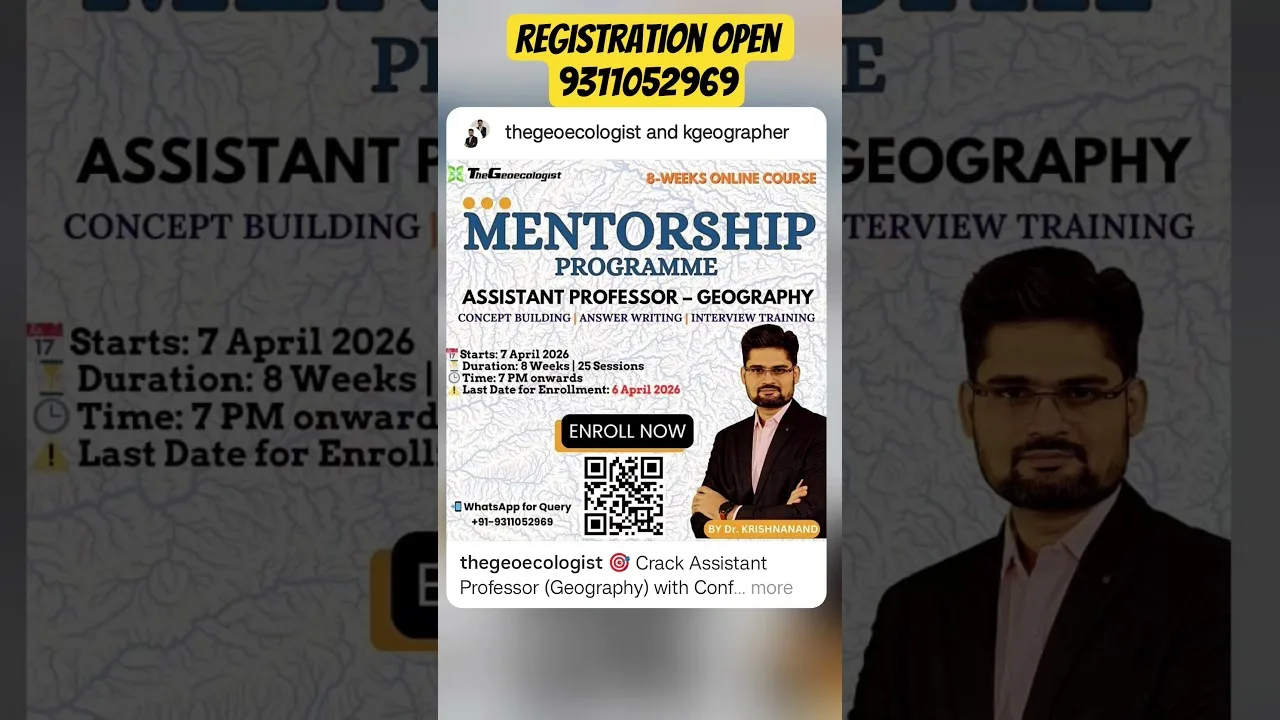
Batch Start Date: 7 April 2026
Seats: Strictly limited to 30 aspirants to ensure 1:1 mentor attention
Eligibility: UGC NET/JRF qualified (or appearing) in Geography
Registration: https://forms.gle/ViWsVxoeAY2Qf1sDA
This is not a mass-market course. It is a high-touch mentorship for serious aspirants who recognize that assistant professor jobs demand more than subject knowledge — they demand selection readiness.
Why This Approach Works: Evidence from Alumni
Since its inception, TheGeoecologist’s mentorship has guided over 120 Geography aspirants. As of 2024, 47 alumni hold permanent assistant professor jobs in central universities (including Delhi University, BHU, JNU), state universities, and reputed private institutions. Another 38 serve as contractual/guest faculty while completing PhDs — a strategic stepping stone. The common thread? None relied solely on NET qualification. All built portfolios, mastered interviews, and executed a plan.
Closing Thought: Make NET Your Launchpad, Not Your Peak
The truth about assistant professor jobs is harsh: the system rewards preparation, not just potential. UGC NET is a necessary gatekeeper, but the real race begins after. Aspirants who treat NET as the destination risk years of frustration. Those who treat it as a launchpad — investing in publications, interview craft, answer writing, and strategic mentorship — convert obstacles into appointments.
Your dream academic career isn’t luck. It’s a project. Execute it with precision.
Connect for Instant Guidance
WhatsApp: 9311052969
Follow TheGeoecologist for:
- UGC NET Geography Strategy
- Assistant Professor Preparation Frameworks
- Answer Writing Mastery Sessions
Download free e-books and study materials from our Shop Page.
Frequently Asked Questions
No. UGC NET/JRF is only an eligibility criterion to apply for assistant professor jobs. Actual selection depends on API scores (publications, teaching experience, research projects), interview performance, and often a PhD. Competition is extreme, with 200–500 applicants per vacancy.
For competitive disciplines and central universities, shortlisted candidates often have 5–15+ peer-reviewed publications in UGC-CARE, Scopus, or SCI-indexed journals. However, requirements vary by institution and state; some state universities may accept fewer if teaching experience is strong.
Teaching demonstration (demo lecture) and research proposal defense. Panels evaluate pedagogical clarity, ability to structure a 45-minute class, and how well you articulate your research contribution under cross-questioning. These are rarely taught in standard curricula but are decisive in final selection.