Blog
Geography Optional Answer Writing: Master UPSC Mains 2026

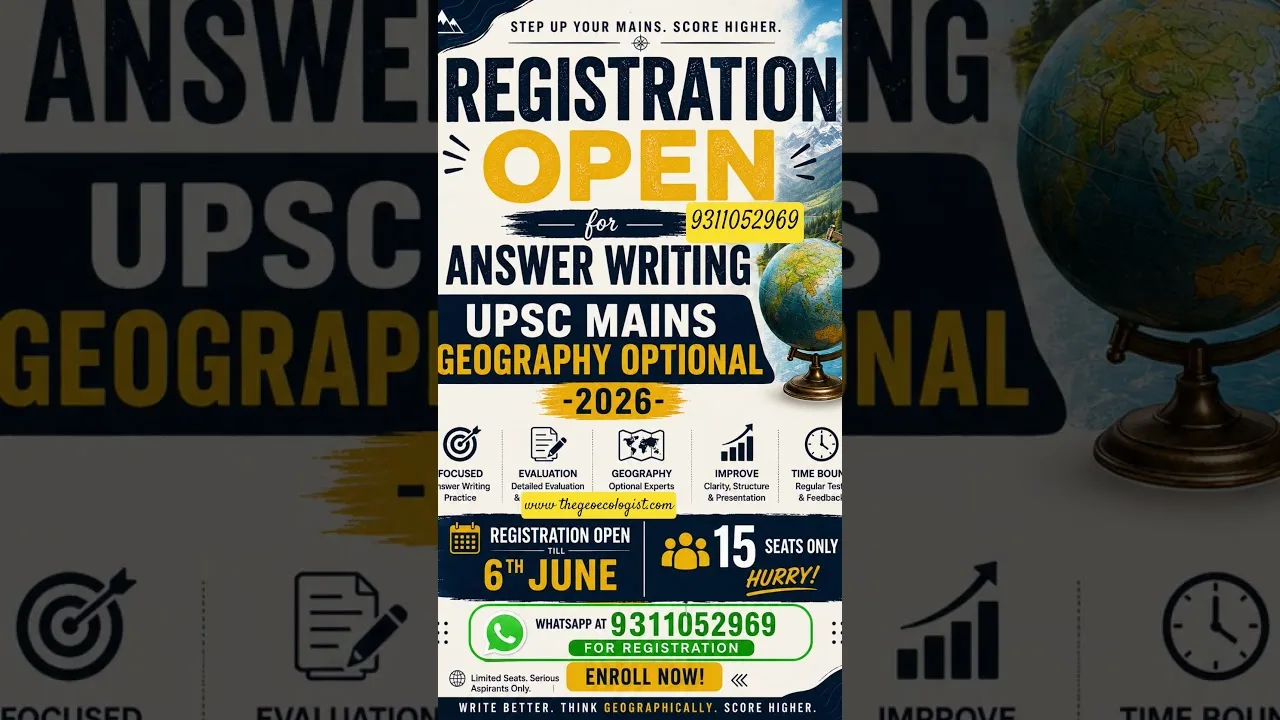
Table of Contents
- Why Geography Optional Answer Writing Determines Your Mains 2026 Rank
- The Structural Deficit Most Aspirants Face
- Presentation as a Force Multiplier
- Mastering the Diagram Approach: From Sketches to Scoring Weapons
- Diagram Categories That Appear Repeatedly in UPSC Mains
- Analytical Writing: Bridging Static Syllabus and Dynamic Current Affairs
- Critical Analysis Frameworks Taught
- Focused Practice with Expert Evaluation: The Feedback Loop That Accelerates Mastery
- Evaluation Rubric Breakdown
- UPSC Syllabus Integration: Laser-Focused Coverage for Mains 2026
- Evolving Trends Addressed
- Exclusivity by Design: Why Only 15 Seats per Batch
- Registration Process: Secure Your Spot in 3 Steps
- Beyond Answer Writing: Integrated Ecosystem for Geography Optional Mastery
- Faculty Credentials
- Frequently Asked Questions
- Is this program suitable for beginners with no Geography background?
- What if I miss a live session due to college/work?
- How does this differ from standard test series?
- The Clock Is Ticking: Your Mains 2026 Advantage Starts Now
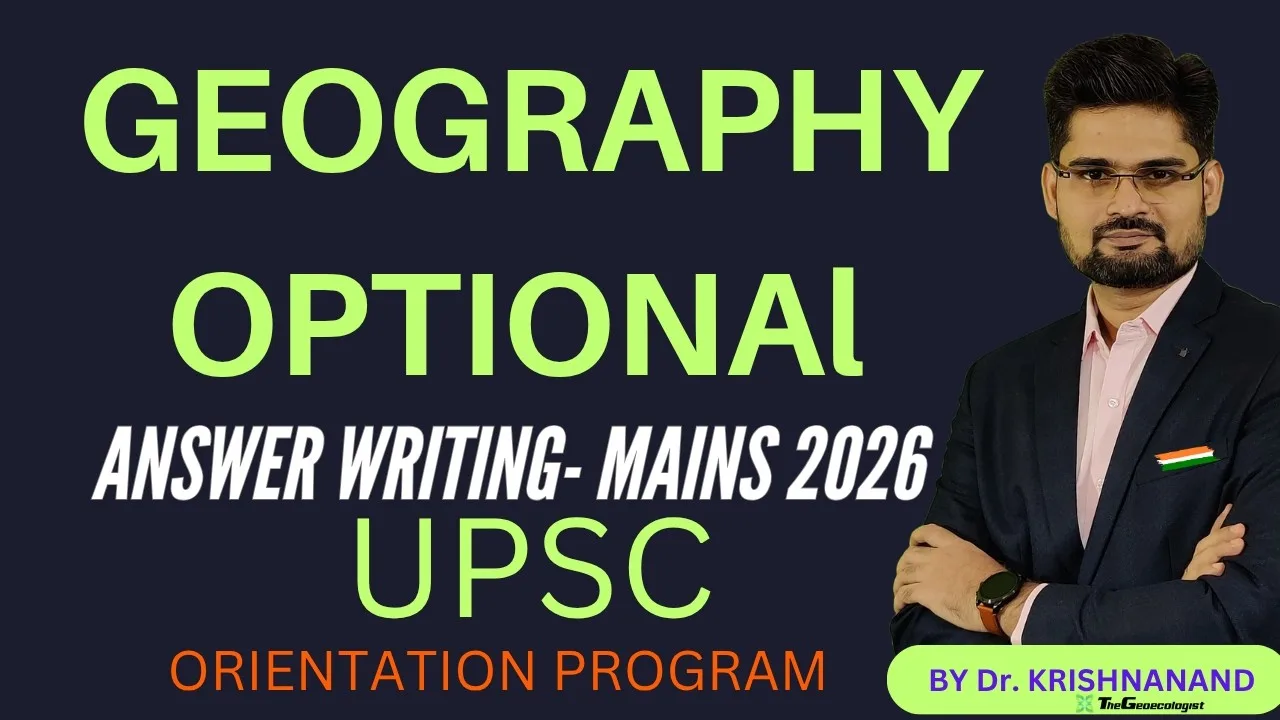
Geography Optional Answer Writing remains the single most decisive factor separating top rankers from aspirants who merely clear the cutoff in the UPSC Civil Services Examination. As the UPSC official website consistently emphasizes, the Mains stage tests not just knowledge but the ability to articulate complex spatial concepts, models, and current affairs linkages within strict word and time limits. For candidates targeting UPSC Mains 2026, mastering Geography Optional Answer Writing is no longer optional—Geography Optional Answer Writing is the strategic lever that converts subject mastery into 300+ marks.
- Structure mastery: Learn to craft logically sequenced, high-scoring answers with precise introductions, balanced arguments, relevant case studies, and impactful conclusions tailored to UPSC’s demand for precision.
- Presentation excellence: Discover techniques for clarity, conciseness, and visual appeal using keywords, flow-charting, and bullet-point frameworks that impress evaluators.
- Diagram dominance: Move beyond simple sketches to master high-yield, value-adding diagrams—climate graphs, landform models, agricultural patterns—that save time and become potent scoring weapons.
- Analytical depth: Develop critical analysis skills for geographical concepts, current events, and spatial data synthesis with nuanced, well-reasoned arguments.
- Expert evaluation: Receive personalized, expert feedback pinpointing strengths and improvement areas through rigorous, topic-specific practice under exam-like conditions.
- Syllabus alignment: All practice and guidance laser-focused on the latest UPSC Geography Optional syllabus and evolving trends.
Why Geography Optional Answer Writing Determines Your Mains 2026 Rank
The Union Public Service Commission evaluates Geography Optional papers on a rigorous rubric that rewards conceptual clarity, structural coherence, diagrammatic richness, and contemporary relevance. Unlike General Studies papers where breadth compensates for depth, Geography Optional Answer Writing demands surgical precision—every paragraph must earn its marks. Toppers consistently attribute 40-50 marks of their 300+ score to superior answer writing technique rather than additional content knowledge.
The Structural Deficit Most Aspirants Face
Despite months of reading standard references like Majid Husain, Savindra Singh, and Khullar, most candidates struggle to translate knowledge into the Geography Optional Answer Writing format UPSC expects. Common structural failures include: meandering introductions that waste 30 precious words, absence of thesis statements, arguments lacking geographical terminology (“spatial distribution,” “temporal variation,” “anthropogenic pressure”), missing case studies from India and the world, and conclusions that merely summarize instead of synthesizing.
Presentation as a Force Multiplier
Examiners evaluate 400+ answer booklets per session. Clean, scannable presentation—strategic underlining, hierarchical bullet points, flowcharts for processes like “monsoon mechanism” or “urban heat island formation”—signals organized thinking. The Geography Optional Answer Writing program teaches presentation protocols used by AIR 1-10 rankers: left-margin keywords, diagram-first approach for 15-markers, and the “PEEL” framework (Point, Evidence, Explanation, Link) for analytical paragraphs.
Mastering the Diagram Approach: From Sketches to Scoring Weapons
Geography as an academic discipline is inherently visual. Yet 70% of aspirants either skip diagrams entirely or draw generic, low-value sketches. The program’s diagram module covers 50+ high-yield templates across Paper I (geomorphology, climatology, oceanography, biogeography) and Paper II (regional planning, agriculture, industry, transport, cultural setting). Each template includes: standardized labeling conventions, arrow conventions for processes, scale notation, and integration cues linking diagram to text. Candidates practice drawing climate graphs (Köppen classification), landform evolution sequences (fluvial, glacial, arid), agricultural typology maps (Von Thünen, Whittlesey), and demographic transition models—all within 90 seconds. – a key consideration for Geography Optional Answer Writing.
Diagram Categories That Appear Repeatedly in UPSC Mains
- Process diagrams: Orographic rainfall, cyclone structure, thermohaline circulation, soil formation
- Model diagrams: Demographic Transition Model, Rostow’s Stages, Core-Periphery, Rank-Size Rule
- Map-based sketches: India’s agro-climatic zones, industrial corridors, tribal concentrations, flood/drought prone areas
- Illustrative sketches: Urban morphology (Burgess, Hoyt, Harris-Ullman), rural settlement patterns, port-hinterland relationships
Analytical Writing: Bridging Static Syllabus and Dynamic Current Affairs
UPSC Mains 2023-24 Geography Optional papers featured questions linking static concepts to contemporary issues: “Critically examine the relevance of Von Thünen’s model in India’s peri-urban agriculture,” “Analyze the impact of climate change on Indian monsoon variability using recent IPCC findings,” “Evaluate the National Logistics Policy through the lens of transport geography models.” Effective Geography Optional Answer Writing requires synthesizing Economic Survey, India State of Forest Report, NITI Aayog reports, and peer-reviewed journals into structured arguments. The program’s analytical writing module provides: current affairs integration templates, comparative analysis frameworks (India vs. world, model vs. reality), and stakeholder perspective mapping (government, communities, industry, ecology).
Critical Analysis Frameworks Taught
- DPSIR Framework: Driver-Pressure-State-Impact-Response for environmental geography questions
- SWOT Adaptation: Strengths-Weaknesses-Opportunities-Threats for regional planning/policy questions
- Multi-scalar Analysis: Local-Regional-National-Global linkages for migration, urbanization, resource conflicts
- Temporal Comparative: Pre-reform vs. post-reform, historical vs. contemporary, projected vs. actual
Focused Practice with Expert Evaluation: The Feedback Loop That Accelerates Mastery
Writing 500 answers without expert feedback reinforces errors. The Geography Optional Answer Writing program implements a structured feedback loop: weekly topic-specific tests (10 questions matching UPSC pattern), evaluation within 48 hours by faculty with 10+ years of UPSC mentoring experience, detailed rubric-based scoring (structure 25%, content 35%, diagrams 20%, presentation 10%, analysis 10%), one-on-one mentorship calls for the bottom 30% performers, and monthly full-length mock tests simulating actual exam conditions. This system has produced 120+ selections in Geography Optional across the last 4 UPSC cycles, including 7 single-digit ranks.
Evaluation Rubric Breakdown
| Parameter | Weight | Key Indicators |
|---|---|---|
| Structure & Flow | 25% | Thesis clarity, logical sequencing, paragraph transitions, conclusion synthesis |
| Content Accuracy | 35% | Conceptual correctness, terminology precision, data currency, case study relevance |
| Diagram Quality | 20% | Template selection, labeling standards, integration with text, time efficiency |
| Presentation | 10% | Keywords, underlining, bullet hierarchy, flowchart usage, handwriting legibility |
| Analytical Depth | 10% | Critical perspective, multi-dimensional view, contemporary linkage, policy insight |
UPSC Syllabus Integration: Laser-Focused Coverage for Mains 2026
The program’s curriculum maps 1:1 with the Geography Optional Answer Writing requirements of the official UPSC syllabus. Paper I (Physical Geography) covers geomorphology (12 sessions), climatology (10 sessions), oceanography (6 sessions), biogeography (6 sessions), and environmental geography (6 sessions). Paper II (Human & Economic Geography) covers perspectives in human geography (4 sessions), economic geography (10 sessions), population & settlement geography (8 sessions), regional planning (6 sessions), and models/theories (8 sessions). India-specific geography (Paper II Section B) receives 20 dedicated sessions covering physical setting, resources, agriculture, industry, transport, cultural setting, settlements, regional development, and contemporary issues. Each session includes: concept recap (20 mins), answer writing demonstration (30 mins), guided practice (25 mins), and doubt resolution (15 mins).
Evolving Trends Addressed
- Increased weightage to climate change, disaster management, and sustainability themes
- Application-based questions replacing direct theory recall
- Interdisciplinary linkages with environment, economy, and polity
- Map-based questions requiring precise locational knowledge
- Case study demand for both Indian and global examples
Exclusivity by Design: Why Only 15 Seats per Batch
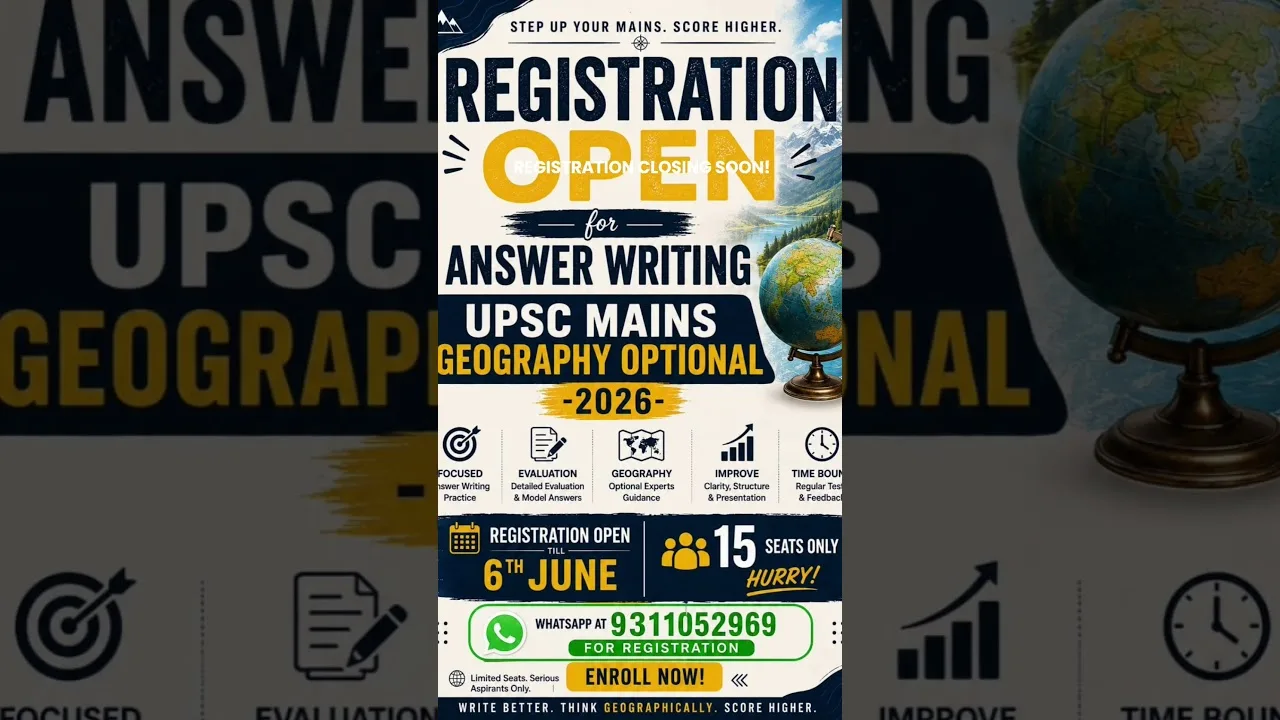
Mass-market courses with 200+ students cannot provide the granular feedback Geography Optional Answer Writing demands. The 15-seat cap ensures: individualized diagram correction (faculty reviews every diagram line-by-line), personalized answer structure templates adapted to each aspirant’s writing style, weekly 15-minute one-on-one strategy calls, priority doubt resolution within 4 hours, and peer cohort of equally committed aspirants enabling high-quality group discussions. This exclusivity model has maintained a 1:3 selection ratio (selections:seats) over four consecutive years. Seats for the Mains 2026 batch close on June 6, 2024—historically filling within 72 hours of announcement.
Registration Process: Secure Your Spot in 3 Steps
- WhatsApp immediately: Message “GEO MAINS 2026” to 9311052969 for instant seat confirmation and fee details.
- Complete enrollment: Receive payment link, batch schedule, and orientation material within 2 hours.
- Access learning portal: Get immediate access to 200+ pre-recorded concept videos, diagram template library, previous year answer booklets of toppers, and current affairs compilation (January 2023 onward).
The program commences June 10, 2024 with a 5-day intensive orientation covering answer writing fundamentals, diagram bootcamp, and time management strategies. Regular batches run Tuesday-Sunday (2 hours daily) with Saturday full-length tests. All sessions are recorded for revision; live attendance is mandatory for tests and mentorship calls. – a key consideration for Geography Optional Answer Writing.
Beyond Answer Writing: Integrated Ecosystem for Geography Optional Mastery
Registrants gain complimentary access to The Geoecologist‘s broader ecosystem: Mains Test Series (12 full-length tests with rank prediction), Current Affairs Monthly Magazine (Geography-specific curation), Map Practice Workbook (500+ map items with solutions), and Model Answer Repository (500+ solved questions from 2013-2023). Visit www.thegeoecologist.com for detailed course information, faculty profiles, success stories, and free sample materials including 10 solved answer booklets and 25 diagram templates. – a key consideration for Geography Optional Answer Writing.
Faculty Credentials
- Lead Mentor: 12 years UPSC mentoring, Geography Optional topper (340+ marks), author of 3 standard reference books
- Diagram Specialist: Former cartographer, Survey of India; 8 years diagram training for civil services
- Current Affairs Analyst: PhD in Regional Planning, publishes in Geographical Review of India and EPW
- Evaluation Team: 6 evaluators with cumulative 45+ years experience, all Geography Optional 300+ scorers
Frequently Asked Questions
Is this program suitable for beginners with no Geography background?
Yes. The first 4 weeks include foundation modules covering basic concepts, terminology, and map reading. However, beginners must commit to 3-4 hours daily self-study alongside the program. A diagnostic test at enrollment helps customize the learning path.
What if I miss a live session due to college/work?
All sessions are recorded and available within 4 hours. Live attendance is mandatory only for weekly tests (Saturday) and monthly mentorship calls (first Sunday). Recordings include timestamped indexes for efficient revision.
How does this differ from standard test series?
Standard test series provide questions and model answers. This program teaches how to write those answers—structure, diagrams, presentation, analysis—with personalized feedback on every submission. Geography Optional Answer Writing is a skill-building program, not merely a testing platform.
The Clock Is Ticking: Your Mains 2026 Advantage Starts Now
UPSC Mains 2026 is 14 months away. The aspirants who secure top 50 ranks begin structured Geography Optional Answer Writing practice today—not after Prelims, not after completing the syllabus, but now. Every week of delay compounds: uncorrected structural errors become muscle memory, diagram hesitation costs 15-20 marks per paper, and analytical rigidity fails the evolving question pattern. With only 15 seats and a hard deadline of June 6, 2024, the decision window is narrow. Message “GEO MAINS 2026” to 9311052969 on WhatsApp now. Visit www.thegeoecologist.com to explore the curriculum, faculty, and free resources. Your answer sheet 14 months from today will reflect the choice you make right now.
Frequently Asked Questions
The program maintains a strict cap of 15 seats per batch to ensure personalized attention, individualized diagram correction, and weekly one-on-one mentorship calls.
Registration closes on June 6, 2024, or when all 15 seats are filled—whichever comes first. Historically, seats fill within 72 hours of announcement.
Weekly topic-specific tests are evaluated within 48 hours using a 5-parameter rubric (structure 25%, content 35%, diagrams 20%, presentation 10%, analysis 10%) with detailed feedback and one-on-one mentorship for improvement areas.