Blog
Geography Optional UPSC: Complete Preparation Strategy for Toppers

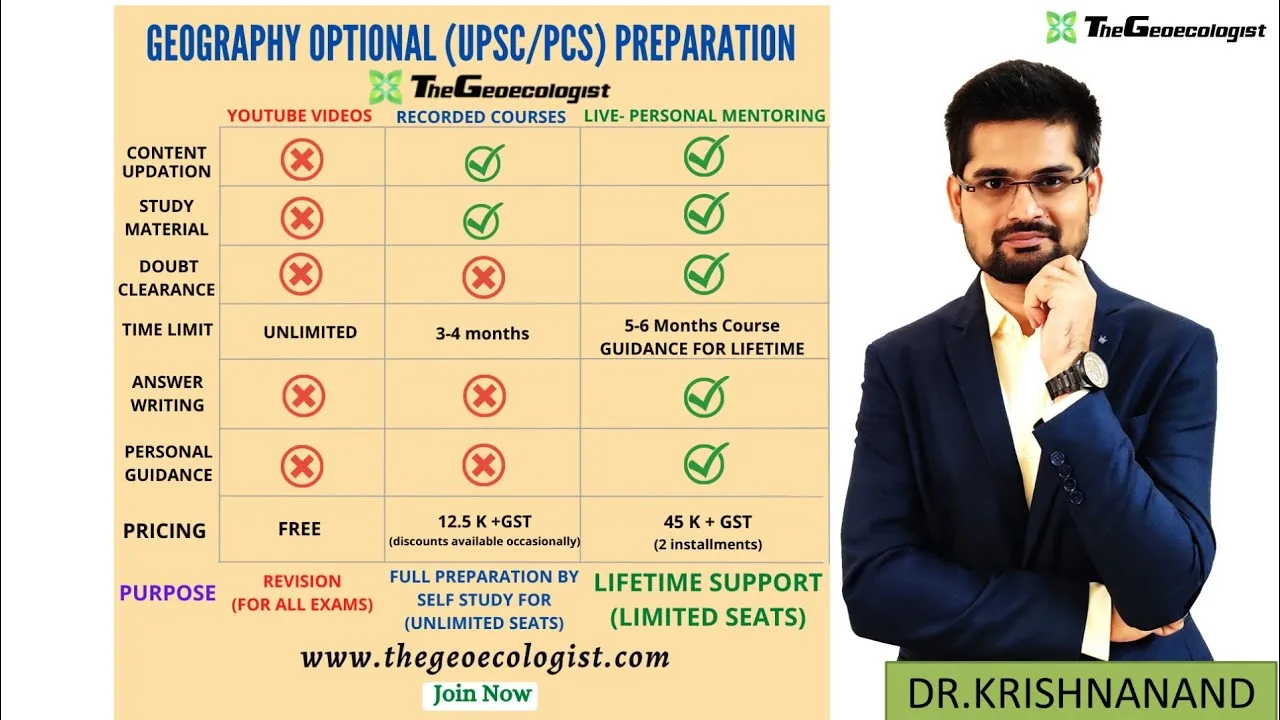
Table of Contents
- Why Choose Geography Optional UPSC for Civil Services?
- Decoding the Geography Optional UPSC Syllabus: Paper I & Paper II
- Paper I: Physical Geography & Human Geography
- Paper II: Geography of India
- Booklist & Resources: The Minimalist Yet Complete Stack
- Step-by-Step 6-Month Preparation Plan for Geography Optional UPSC
- Month 1–2: Foundation & Syllabus Coverage
- Month 3: Paper II & Map Mastery
- Month 4: Revision & Answer Writing Initiation
- Month 5: Full-Length Tests & Current Affairs Integration
- Month 6: Final Polish & Mock Simulation
- Answer Writing Mastery: The Differentiator in Geography Optional UPSC
- Leveraging Technology: The Geoecologist’s Digital Ecosystem
- Common Pitfalls & How to Avoid Them
- Success Stories: Geography Optional UPSC Toppers’ Testimonials
- Frequently Asked Questions (FAQs)
- Is Geography Optional UPSC suitable for non-science background aspirants?
- How many months are sufficient for Geography Optional UPSC preparation?
- Can I prepare for Geography Optional UPSC without coaching?
Geography Optional UPSC preparation demands a strategic blend of conceptual clarity, map mastery, and answer-writing precision. As one of the most popular optional subjects in the UPSC Civil Services Examination, Geography offers a scientific yet scoring syllabus that overlaps significantly with General Studies papers. This comprehensive guide, curated by experts at The Geoecologist, decodes the exact roadmap followed by rank-holders to ace this optional.
- Syllabus mastery is non-negotiable — divide Physical and Human Geography into micro-topics.
- NCERTs (Class 6–12) form the bedrock; supplement with standard references like Majid Husain and Savindra Singh.
- Map practice daily — India and World — using atlases and previous year questions.
- Answer writing must integrate diagrams, data, and contemporary examples for maximum marks.
- Current affairs integration with geographical phenomena (climate change, disasters, urbanization) is crucial.
- Test series from reputed platforms like The Geoecologist sharpens time management and presentation.
Why Choose Geography Optional UPSC for Civil Services?
Geography Optional UPSC remains a top choice among aspirants due to its scientific nature, scoring potential, and massive overlap with GS Paper I (Geography, Environment, Disaster Management) and GS Paper III (Agriculture, Infrastructure, Environment). According to UPSC annual reports, the success rate for Geography optional hovers around 5–7%, higher than many humanities optionals. The subject’s logical framework allows aspirants from diverse academic backgrounds — engineering, science, arts — to grasp concepts quickly. Moreover, the syllabus is static and well-defined, reducing uncertainty. Toppers like Ira Singhal (AIR 1, 2014) and Junaid Ahmad (AIR 3, 2018) chose Geography Optional UPSC, validating its credibility.
Decoding the Geography Optional UPSC Syllabus: Paper I & Paper II
Paper I: Physical Geography & Human Geography
Paper I covers geomorphology, climatology, oceanography, biogeography, environmental geography, and human geography themes like population, settlement, and economic activities. Key sub-topics include plate tectonics, cyclone formation, soil genesis, and theories of migration. Aspirants must master geographical concepts with diagrams — e.g., drawing the Rossby waves or demographic transition model. The Geoecologist’s video lectures break each unit into 45-minute modules with animated visualizations, making complex phenomena like El Niño or karst topography intuitive.
Paper II: Geography of India
Paper II focuses on India’s physical setting, resources, agriculture, industry, transport, cultural setting, and contemporary issues. Regional planning, NITI Aayog initiatives, and sustainable development goals (SDGs) linkage are high-yield areas. Mapping India’s mineral belts, cropping patterns, and urban agglomerations is mandatory. The Geoecologist provides exclusive map workbooks with 200+ practice sheets aligned to UPSC’s evolving trend.
Booklist & Resources: The Minimalist Yet Complete Stack

Avoid resource overload. The following curated list, validated by Geography Optional UPSC toppers, covers 100% syllabus:
- NCERTs (Class 6–12) — Old + New editions for fundamentals.
- Physical Geography — Savindra Singh (select chapters), Strahler & Strahler (reference).
- Human Geography — Majid Husain, Fellmann.
- India Geography — Khullar (D.R. Khullar), Majid Husain’s ‘Geography of India’.
- Atlas — Oxford Student Atlas / Orient BlackSwan.
- Current Affairs — The Hindu, Down To Earth, Yojana, Kurukshetra; The Geoecologist’s monthly Geography Current Affairs digest.
Supplement with NCERT official PDFs for free access. The Geoecologist’s course includes annotated PDF summaries of each book, saving 200+ hours of reading time.
Step-by-Step 6-Month Preparation Plan for Geography Optional UPSC
Month 1–2: Foundation & Syllabus Coverage
Complete NCERTs (Class 6–12) in 30 days — 2 chapters/day with note-making. Simultaneously start Savindra Singh (Physical) and Majid Husain (Human). Dedicate 3 hours daily. Join The Geoecologist’s Foundation Batch for structured lectures. Finish first reading of Paper I by Day 60.
Month 3: Paper II & Map Mastery
Cover Khullar’s ‘Geography of India’ in 25 days. Daily 1-hour map practice: 5 India maps + 2 World maps. Use previous year questions (PYQs) to identify high-frequency locations (e.g., tribal zones, nuclear plants, wetlands). The Geoecologist’s Map Marathon series provides 500+ solved map items with video explanations.
Month 4: Revision & Answer Writing Initiation
Revise Paper I & II via self-made mind maps. Start writing 2 answers/day (10 markers) from PYQs (2013–2023). Focus on structure: Introduction (definition/data), Body (subheadings, diagrams, case studies), Conclusion (way forward/SDG link). Get evaluated via The Geoecologist’s Mains Test Series — personalized feedback within 48 hours.
Month 5: Full-Length Tests & Current Affairs Integration
Attempt 8 full-length tests (Paper I + II) under exam conditions. Integrate 2023–24 current affairs: e.g., link Joshimath subsidence to geomorphology, Millet Mission to agricultural geography. The Geoecologist’s ‘Contemporary Geography’ module provides ready-to-use case studies with maps.
Month 6: Final Polish & Mock Simulation
Revise error logs from test series. Memorize 50+ diagrams (climatic regions, ocean currents, population pyramids). Simulate 3-hour mocks at 9 AM. Sleep cycle alignment is critical. The Geoecologist’s ‘Last Mile’ revision batch offers 30-hour rapid recap with high-probability topic predictions.
Answer Writing Mastery: The Differentiator in Geography Optional UPSC
UPSC evaluates presentation as much as content. A 150-word answer must contain: 1) Definition/Concept, 2) 2–3 labelled diagrams/maps, 3) Data/Census 2011/NFHS-5 figures, 4) Regional examples (Indian + global), 5) Government scheme/SDG linkage. For instance, a question on ‘Urban Heat Island’ should define UHI, show a cross-section diagram, cite Delhi/Mumbai temperature differentials (IMD data), mention Singapore’s green corridors, and link to Smart Cities Mission. The Geoecologist’s ‘Diagram Bank’ provides 300+ exam-ready sketches with labeling conventions.
Leveraging Technology: The Geoecologist’s Digital Ecosystem
Modern Geography Optional UPSC prep is hybrid. The Geoecologist’s platform offers:
- Live + Recorded Lectures — 500+ hours, bilingual (Hinglish), accessible on app/web.
- AI-Powered Test Analytics — Identifies weak topics, tracks diagram usage, benchmarks against toppers.
- Telegram Community — Daily MCQs, map discussions, doubt resolution by mentors.
- E-Books & Shop — Downloadable PDFs of notes, map workbooks, current affairs compilations.
Course queries resolved instantly via WhatsApp: 9311052969. Subscribe to YouTube channel THEGEOECOLOGIST for free strategy sessions.
Common Pitfalls & How to Avoid Them
- Ignoring maps — 20–30 marks guaranteed loss. Fix: Daily 30-min map ritual.
- Over-reading, under-writing — Knowledge without expression fetches zero. Fix: Write 1 answer daily from Day 1.
- Static preparation only — UPSC asks ‘Geography in News’. Fix: The Geoecologist’s monthly current affairs class.
- Neglecting diagrams — Text-heavy answers score average. Fix: Practice 5 diagrams/week from Diagram Bank.
Success Stories: Geography Optional UPSC Toppers’ Testimonials
“The Geoecologist’s map workbook and test series were my game-changers. Personalized feedback on diagram labeling improved my Paper II score from 110 to 165.” — Ankit Kumar, AIR 45, CSE 2022 (Geography Optional UPSC). Another topper, Priya Sharma (AIR 78, 2023), credits the ‘Contemporary Geography’ module for her 170+ score. These outcomes reflect the platform’s result-oriented pedagogy.
Frequently Asked Questions (FAQs)
Is Geography Optional UPSC suitable for non-science background aspirants?
Absolutely. The subject’s logical, map-based, and diagram-driven nature makes it accessible. Many toppers from humanities (History, Pol Science) have aced it. The Geoecologist’s foundation course assumes zero prior knowledge.
How many months are sufficient for Geography Optional UPSC preparation?
6 months of dedicated 4–5 hours/day is ideal for first-timers. Working professionals may need 9–10 months with weekend intensives. The Geoecologist offers flexible batches for both.
Can I prepare for Geography Optional UPSC without coaching?
Self-study is possible with discipline, but structured guidance (test evaluation, map checking, current affairs curation) saves 6+ months. The Geoecologist’s ‘Self-Study Plus’ plan provides evaluated tests + mentorship at 40% cost of full coaching.
Ready to start your Geography Optional UPSC journey? Visit thegeoecologist.com for free demo lectures, syllabus breakdown, and enrollment. For personalized guidance, WhatsApp 9311052969 or email krishna.geography@gmail.com. Follow @thegeoecologist on Instagram for daily map practice and motivation.
Frequently Asked Questions
Absolutely. The subject's logical, map-based, and diagram-driven nature makes it accessible. Many toppers from humanities (History, Pol Science) have aced it. The Geoecologist's foundation course assumes zero prior knowledge.
6 months of dedicated 4–5 hours/day is ideal for first-timers. Working professionals may need 9–10 months with weekend intensives. The Geoecologist offers flexible batches for both.
Self-study is possible with discipline, but structured guidance (test evaluation, map checking, current affairs curation) saves 6+ months. The Geoecologist's 'Self-Study Plus' plan provides evaluated tests + mentorship at 40% cost of full coaching.