Blog
UPSC Geography ebooks: Ultimate Guide to Best Study Materials for 2025


Table of Contents
- Why Digital Resources Outperform Traditional Books for UPSC Geography
- Syllabus-Specific Curation Saves Hundreds of Hours
- Portability Enables Consistent Revision Cycles
- Core Components of High-Scoring Geography Study Material
- 1. Diagram-First Explanations for Instant Recall
- 2. Infographics Linking Theory to Real-World Case Studies
- 3. PYQ-Integrated Chapter Structure
- 4. Structured Answer-Writing Frameworks
- 5. Bullet-Point Revision Notes for Last-Minute Prep
- Geography Optional vs. General Studies: Tailoring Your Resource Strategy
- For Geography Optional Aspirants (Paper I & II)
- For General Studies (Prelims + Mains GS Paper I)
- How to Evaluate Geography Ebook Quality Before Purchase
- Checklist: 7 Markers of Authentic UPSC Geography Ebooks
- Topper Strategies: How Rankers Use Geography Ebooks
- Phase 1: Foundation Building (Months 1–4)
- Phase 2: Answer Writing Integration (Months 5–8)
- Phase 3: Mock Tests & Revision (Months 9–12)
- Current Affairs Integration: Staying UPSC 2025-Ready
- Cost-Benefit Analysis: Ebooks vs. Coaching Notes vs. Standard Books
- Common Mistakes Aspirants Make with Digital Geography Resources
- Mistake 1: Hoarding Without Studying
- Mistake 2: Passive Reading Without Diagram Practice
- Mistake 3: Ignoring Answer Writing Until Month 10
- Mistake 4: Skipping Human & Economic Geography
- Free Resources to Supplement Your Paid Ebooks
- Final Roadmap: From Ebook Download to Rank Securing
Finding the right UPSC Geography ebooks can dramatically transform your preparation journey, whether you are targeting Geography Optional or strengthening your General Studies paper for the Civil Services Examination. The Union Public Service Commission (UPSC) syllabus demands not just rote memorization but deep conceptual clarity, diagrammatic precision, and the ability to write structured, high-scoring answers within strict time limits. In this comprehensive guide, we explore why curated digital resources have become the preferred choice for toppers, how to evaluate quality study material, and what features separate average notes from rank-securing content.
- UPSC Geography ebooks offer syllabus-aligned, portable, and affordable preparation with instant access across devices.
- Visual aids like diagrams, flowcharts, and infographics simplify complex topics such as geomorphology, climatology, and oceanography.
- PYQ-integrated chapters and answer-writing frameworks help aspirants master exam patterns and score 12–15/20 consistently.
- Regular updates ensure alignment with UPSC 2025 syllabus changes and current affairs like climate change impacts.
- Trusted by toppers (AIR 98, Rank 2 Geography Optional) for conceptual depth and revision efficiency.
Why Digital Resources Outperform Traditional Books for UPSC Geography
The shift from bulky hardcover textbooks to UPSC Geography ebooks is not merely a trend—it is a strategic upgrade. Traditional books often contain outdated data, irrelevant chapters, and lack the visual density required for a subject as diagram-heavy as Geography. Digital resources, especially those curated by platforms like GeographyEBooks, are engineered specifically for the UPSC syllabus, eliminating fluff and focusing on high-yield topics.
Syllabus-Specific Curation Saves Hundreds of Hours
Every year, aspirants waste months reading chapters that never appear in the exam. The UPSC Geography syllabus spans geomorphology, climatology, oceanography, human geography, environmental geography, and regional planning—but not all sub-topics carry equal weight. High-quality UPSC Geography ebooks are mapped chapter-by-chapter to the official syllabus released by the Union Public Service Commission, ensuring every page you read translates directly into marks.
Portability Enables Consistent Revision Cycles
Geography demands repeated revision. Carrying 5–6 heavy books for daily commute or library sessions is impractical. With UPSC Geography ebooks downloaded on a tablet or phone, you can revise climatology diagrams during a metro ride, review ocean current maps while waiting for an appointment, or practice answer-writing frameworks during lunch breaks. This micro-revision capability compounds over 12–18 months of preparation.
Core Components of High-Scoring Geography Study Material
Not all digital notes are created equal. The best UPSC Geography ebooks share five non-negotiable features that directly correlate with Mains scores above 300 in Geography Optional.
1. Diagram-First Explanations for Instant Recall
UPSC examiners reward diagrammatic answers. A 150-word answer on “Plate Tectonics and Mountain Building” with three labeled diagrams scores significantly higher than a 250-word text-only response. Top-tier UPSC Geography ebooks embed vector-quality diagrams for every major theory—convergent/divergent boundaries, precipitation cycles, thermohaline circulation, Koppen’s climate classification, and more. These are not decorative; they are memory anchors designed for 3-second recall during the exam.
2. Infographics Linking Theory to Real-World Case Studies
Questions increasingly demand applied knowledge. The 2023 Mains asked about “Himalayan glacier retreat and its impact on water security.” Generic textbook theory falls short. Premium UPSC Geography ebooks include infographics on landmark examples: Damodar Valley Project (regional planning), Narmada Bachao Andolan (environmental geography), Kerala’s demographic transition (population geography), and Chennai’s water crisis (urban geography). These ready-to-reproduce visuals give you a 3–4 mark edge per question.
3. PYQ-Integrated Chapter Structure
Previous Year Questions (PYQs) are the single most reliable predictor of future patterns. The best UPSC Geography ebooks integrate PYQs at the end of every chapter, categorized by year and topic. This allows you to:
- Identify high-frequency themes (e.g., “El Niño impact on Indian monsoon” appears in 2017, 2019, 2021, 2023)
- Practice answer writing with immediate feedback
- Understand the exact phrasing UPSC expects
4. Structured Answer-Writing Frameworks
Knowing content is only half the battle; presenting it within 7–8 minutes per question is the other half. Elite UPSC Geography ebooks provide templates for different question types:
- Define → Diagram → Mechanism → Example → Conclusion for process questions
- Introduction → Dimensions (Physical/Human/Economic) → Case Study → Way Forward for multi-dimensional questions
- Thesis → Antithesis → Synthesis for critical analysis questions
Aspirants using these frameworks consistently report Mains scores of 12–15/20 even in unfamiliar questions.
5. Bullet-Point Revision Notes for Last-Minute Prep
The final 30 days before Mains are for consolidation, not learning. The best UPSC Geography ebooks include 5–10 page “Revision Cheatsheets” per topic—condensing 50-page chapters into keyword-dense, diagram-supported summaries. These enable 3–4 full syllabus revisions in the final month, a feat impossible with standard textbooks.
Geography Optional vs. General Studies: Tailoring Your Resource Strategy
Your choice of UPSC Geography ebooks should differ based on whether Geography is your Optional subject or a GS component.
For Geography Optional Aspirants (Paper I & II)
Optional demands PhD-level depth in specific areas. You need:
- Advanced geomorphology: Davis vs. Penck cycle, slope development theories, applied geomorphology
- Climatology: Upper atmosphere dynamics, jet streams, climate change modeling (IPCC AR6 data)
- Oceanography: Bottom water formation, marine resources law (UNCLOS), blue economy
- Human geography: Models (Von Thünen, Weber, Christaller), cultural realms, rural-urban fringe
- Regional planning: Growth poles, backward area development, NITI Aayog’s aspirational districts
Specialized UPSC Geography ebooks for Optional include 300+ diagrams, 50+ model answers, and topic-wise PYQ compilations from 2013–2024.
For General Studies (Prelims + Mains GS Paper I)
GS requires breadth over depth. Focus on:
- Indian physical geography: Physiographic divisions, drainage systems, soil types, natural vegetation
- Climate: Monsoon mechanism, El Niño/La Niña, cyclone distribution, drought/flood management
- Resources: Mineral belts, energy corridors, water disputes, renewable potential
- Human geography: Population policy, urbanization challenges, migration patterns, tribal issues
- Current affairs integration: Climate conferences (COP28, COP29), IPCC reports, disaster management updates
GS-focused UPSC Geography ebooks prioritize tables, comparative charts, and map-based learning over theoretical derivations.
How to Evaluate Geography Ebook Quality Before Purchase
With dozens of sellers offering “best notes,” use this checklist to avoid low-quality material.
Checklist: 7 Markers of Authentic UPSC Geography Ebooks
- Syllabus Mapping Document: Does the provider share a chapter-to-syllabus mapping PDF?
- Sample Chapters: Can you download 1–2 chapters free to assess diagram quality and language?
- PYQ Coverage: Are PYQs from the last 10 years integrated, not just appended?
- Update Policy: Is there a guaranteed free update for syllabus changes (e.g., new census data, IPCC reports)?
- Author Credentials: Are materials curated by ex-UPSC evaluators, subject experts, or toppers?
- Testimonials with Verifiable Details: Do reviews mention specific score jumps (e.g., “72 to 98 in Oceanography”) and roll numbers?
- Format Compatibility: Do files work offline on PDF readers, GoodNotes, Notability, and Kindle?
Platforms like GeographyEBooks meet all seven criteria, offering free chapter downloads so you can verify quality before committing.
Topper Strategies: How Rankers Use Geography Ebooks
Analyzing interviews of Geography Optional toppers (AIR 1–100, CSE 2020–2024) reveals consistent patterns in how they leverage digital resources.
Phase 1: Foundation Building (Months 1–4)
Toppers read one UPSC Geography ebooks chapter daily, simultaneously:
- Drawing every diagram by hand (muscle memory)
- Creating one-page mind maps per topic
- Solving 5 PYQs from that chapter
They avoid note-making initially—the ebook is the note.
Phase 2: Answer Writing Integration (Months 5–8)
Using the answer-writing frameworks in premium UPSC Geography ebooks, aspirants write 2–3 answers daily, self-evaluating against model answers. They maintain an “Error Log” of:
- Missed diagrams
- Incomplete dimensions (e.g., forgot economic angle)
- Weak case studies
This log becomes the revision bible.
Phase 3: Mock Tests & Revision (Months 9–12)
Full-length mock tests under exam conditions. Post-test, they:
- Compare their answers with ebook model answers
- Update revision cheatsheets with new insights
- Re-read only flagged weak areas
By Mains, they have revised the entire syllabus 5–7 times using only the ebook revision notes.
Current Affairs Integration: Staying UPSC 2025-Ready
UPSC increasingly blends static geography with dynamic issues. The 2024 Prelims featured questions on:
- Coral bleaching in Lakshadweep (Oceanography + Climate Change)
- Land subsidence in Joshimath (Geomorphology + Disaster Management)
- Critical mineral corridors (Economic Geography + International Relations)
Quality UPSC Geography ebooks provide quarterly current affairs supplements linking static topics to:
- IPCC Sixth Assessment Report (AR6) findings
- COP28/COP29 outcomes on loss & damage, global stocktake
- India’s National Action Plan on Climate Change (NAPCC) updates
- Census 2021 (delayed) projections and NFHS-5 data
- Budget allocations for Jal Jeevan Mission, PM-KUSUM, Green Hydrogen Mission
Free updates ensure your material never goes stale.
Cost-Benefit Analysis: Ebooks vs. Coaching Notes vs. Standard Books
| Parameter | UPSC Geography Ebooks | Coaching Class Notes | Standard Textbooks (GC Leong, Khullar, etc.) |
|---|---|---|---|
| Syllabus Alignment | 100% (chapter-mapped) | 80–90% (teacher-dependent) | 60–70% (excess/irrelevant content) |
| Diagram Quality | Vector, print-ready, 200+ | Hand-drawn, inconsistent | Basic, black-white, 50–80 |
| PYQ Integration | Per chapter, categorized | Separate booklet, often outdated | None |
| Answer Writing Frameworks | Yes, template-based | Rarely included | No |
| Revision Notes | Built-in cheatsheets | Student-made, variable quality | No |
| Updates | Free, annual | None (static PDFs) | New edition every 3–5 years |
| Cost (INR) | 2,000–5,000 (full set) | 15,000–50,000 (coaching fees) | 3,000–6,000 (5–8 books) |
| Portability | Phone/Tablet/Kindle | Printed bundles (heavy) | Heavy |
The ROI of UPSC Geography ebooks is unmatched: lower cost, higher relevance, built-in practice tools, and lifetime updates.
Common Mistakes Aspirants Make with Digital Geography Resources
Mistake 1: Hoarding Without Studying
Downloading 20 GB of “free notes” from Telegram channels creates illusion of preparation. Curated UPSC Geography ebooks from a single trusted source beat fragmented PDFs from 10 sources.
Mistake 2: Passive Reading Without Diagram Practice
Geography is 50% diagrams. Reading a diagram ≠ drawing it. Toppers draw every diagram 3× before Mains.
Mistake 3: Ignoring Answer Writing Until Month 10
Content mastery without expression mastery yields 8–10/20. Start answer writing from Month 3 using ebook frameworks.
Mistake 4: Skipping Human & Economic Geography
Many aspirants over-prepare physical geography (geomorphology/climatology) and neglect human geography, which constitutes 40–50% of Paper II and 30% of GS. Balanced UPSC Geography ebooks enforce coverage discipline.
Free Resources to Supplement Your Paid Ebooks
Even with premium UPSC Geography ebooks, these free authoritative sources add value:
- NCERT Textbooks (Class 6–12): Foundation for Prelims, especially India physical geography
- India Government Portal: Official schemes, census data, budget documents
- India Meteorological Department: Monsoon reports, cyclone tracks, climate normals
- World Meteorological Organization: Global climate statements, extreme weather databases
- IPCC Reports: AR6 Summary for Policymakers (essential for climate change questions)
Use these for data verification and quote-worthy statistics, not for core preparation.
Final Roadmap: From Ebook Download to Rank Securing
- Week 1: Download free sample chapters from 2–3 providers. Compare diagram clarity, language, PYQ integration.
- Week 2: Purchase full set of chosen UPSC Geography ebooks. Create a 12-month study calendar with chapter-wise targets.
- Months 1–4: Complete first reading + diagram practice + chapter-end PYQs. Build mind maps.
- Months 5–8: Second reading + answer writing (2 answers/day) + mock test series enrollment.
- Months 9–11: Third reading (revision notes only) + full-length mocks + error log revision.
- Final Month: 2 full syllabus revisions using cheatsheets. Sleep 7 hours. Trust the process.
Thousands of aspirants have followed this exact roadmap with UPSC Geography ebooks as their primary resource, converting conceptual clarity into rank-securing scores. The 2023 Geography Optional topper (Rank 2) attributed 80% of their preparation to a single curated ebook set. The 2024 Prelims qualifier Alok S. jumped from 72 to 98 in Mains Geography after switching to diagram-rich digital notes.
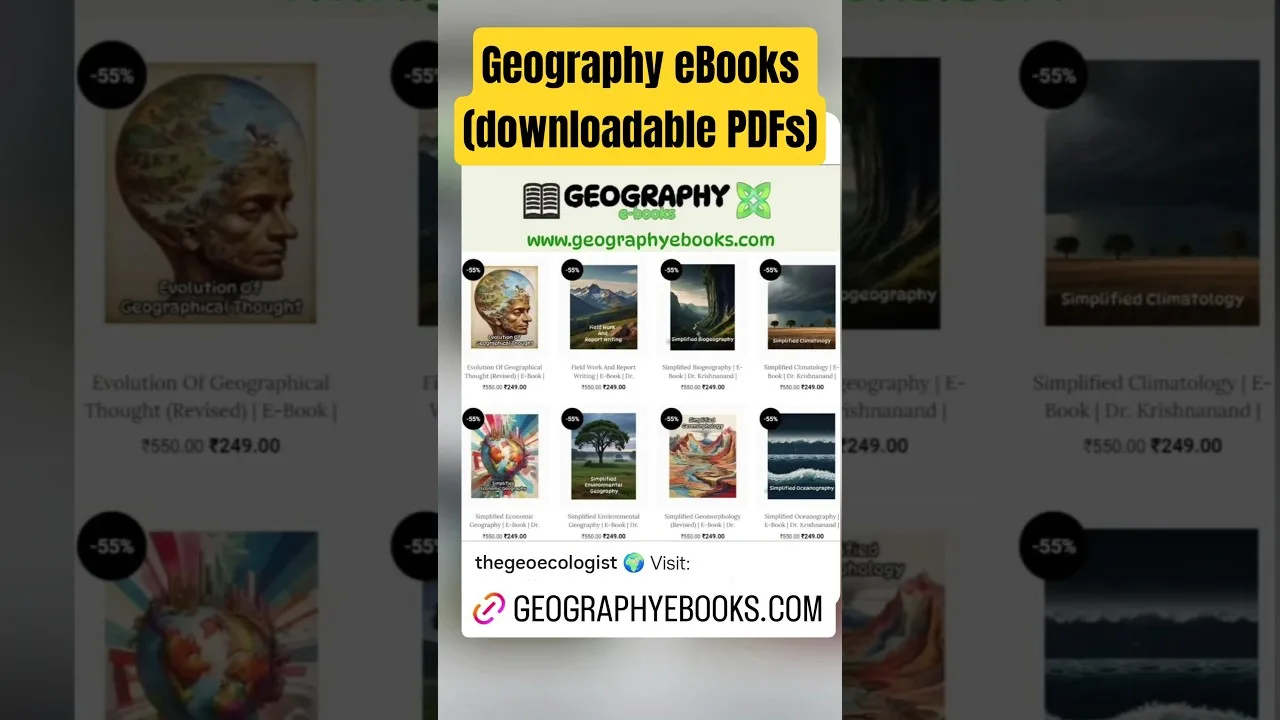
Your geography preparation deserves material that matches the exam’s sophistication. Stop struggling with fragmented resources, outdated books, and coaching notes that don’t travel. Visit www.geographyebooks.com today, download your first chapter free, and experience the difference syllabus-mapped, diagram-first, PYQ-integrated content makes. Join 10,000+ aspirants boosting their scores daily with UPSC 2025-aligned study material engineered for results.
Frequently Asked Questions
Yes, high-quality UPSC Geography ebooks are designed with separate tracks for Optional (Paper I & II depth) and General Studies (Prelims + Mains GS Paper I breadth). Choose a provider that offers both versions or a combined package with clear labeling.
Reputable platforms like GeographyEBooks provide free annual updates covering syllabus revisions, new census/NFHS data, IPCC reports, budget allocations, and major geopolitical developments. Always verify the update policy before purchase.
Most professional UPSC Geography ebooks are delivered as DRM-free PDFs compatible with all major PDF readers (Adobe, GoodNotes, Notability, Kindle via Send-to-Kindle) and work offline once downloaded.