Blog
Simplified Disaster Management: Complete 2025 Edition Guide for UPSC & Professionals

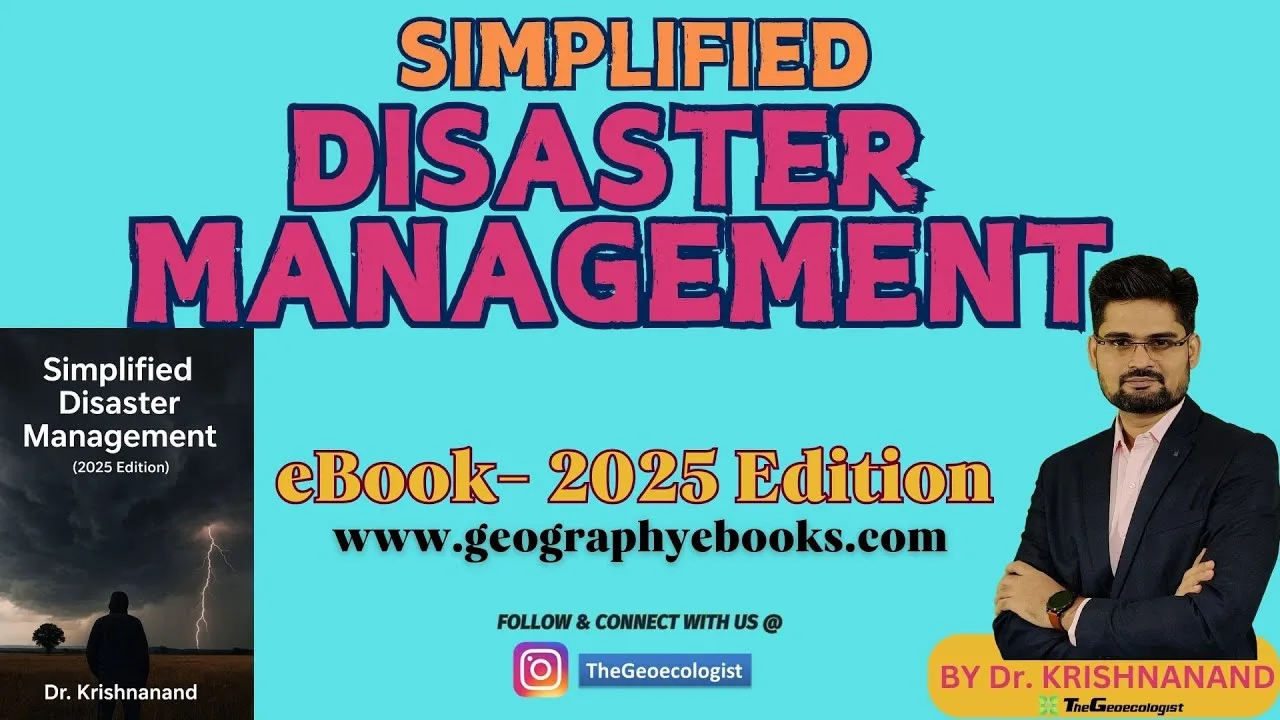
Table of Contents
- Why the 2025 Edition of Simplified Disaster Management Matters Now
- Comprehensive Coverage of Core Concepts in Simplified Disaster Management
- Foundational Definitions: Hazard, Vulnerability, Exposure, and Resilience
- Disaster Risk Assessment and Mitigation Frameworks
- Updated Policies and Global Frameworks: 2025 Edition Highlights
- National Disaster Management Authority (NDMA) Guidelines
- International Agreements: Sendai, Hyogo, SDGs, and Climate Accords
- Case Studies: Bridging Theory and Practice in Simplified Disaster Management
- Exam-Oriented Approach: Cracking UPSC, UGC NET, and State PCS
- Who Should Read the Simplified Disaster Management eBook?
- How to Access the Simplified Disaster Management (2025 Edition) eBook
- Final Thoughts: Preparedness Is the Only Sustainable Strategy
Simplified Disaster Management has become an essential discipline in our increasingly volatile world. As climate change accelerates and urbanization expands into vulnerable zones, the frequency and intensity of both natural and anthropogenic disasters continue to rise. Whether you are a UPSC Civil Services aspirant, a UGC NET/JRF candidate, a state PSC examinee, or a working professional in public administration, mastering the principles of disaster risk reduction (DRR) is no longer optional—it is imperative. The Simplified Disaster Management eBook – 2025 Edition by Dr. Krishnanand (TheGeoecologist) emerges as a definitive, exam-oriented resource that bridges theoretical frameworks with actionable insights, updated policies, and real-world case studies.
- Comprehensive coverage of foundational concepts, risk frameworks, disaster typologies, and mitigation strategies.
- 2025 Edition updates include latest NDMA guidelines, Sendai Framework mid-term review insights, and SDG alignment.
- Exam-focused design with diagrams, flowcharts, structured revision notes, and previous-year question analysis.
- Real-world case studies from Indian and global disasters (Kerala floods, Odisha cyclones, Turkey-Syria earthquake, COVID-19).
- Authored by Dr. Krishnanand, a recognized geography educator and TheGeoecologist channel founder with 10+ years of mentoring aspirants.
Why the 2025 Edition of Simplified Disaster Management Matters Now
The Simplified Disaster Management landscape has shifted dramatically since the last major policy updates. The Sendai Framework for Disaster Risk Reduction 2015–2030 reached its mid-term review in 2023, prompting nations to recalibrate targets. India’s National Disaster Management Authority (NDMA) released revised guidelines for heat waves, urban flooding, and biological disasters between 2022–2024. The 2025 Edition captures these developments, ensuring aspirants study current frameworks—not outdated syllabi. For UPSC Mains GS Paper III and UGC NET Environmental Sciences, questions increasingly demand awareness of recent policy shifts, not just textbook definitions.
Comprehensive Coverage of Core Concepts in Simplified Disaster Management
Foundational Definitions: Hazard, Vulnerability, Exposure, and Resilience
The eBook opens with crystal-clear distinctions between hazard (a potential threat), vulnerability (susceptibility to harm), exposure (people/assets in harm’s way), and resilience (capacity to absorb and recover). These four pillars form the risk equation: Risk = Hazard × Vulnerability × Exposure / Capacity. Dr. Krishnanand illustrates each with Indian examples—e.g., the Himalayan seismic hazard (Zone IV/V), coastal vulnerability in Odisha and Andhra Pradesh, and urban exposure in Mumbai’s flood-prone informal settlements. This conceptual clarity is critical for answering UPSC’s “explain the difference” and “critically examine” directives.
Disaster Risk Assessment and Mitigation Frameworks
Moving beyond definitions, the Simplified Disaster Management guide details the disaster management cycle: Prevention → Mitigation → Preparedness → Response → Recovery. It maps each phase to institutional mechanisms—National/State/District Disaster Management Authorities (NDMA, SDMAs, DDMAs), the National Disaster Response Force (NDRF), and State Disaster Response Forces (SDRFs). Flowcharts depict the Incident Response System (IRS) adapted from the US Incident Command System, now mandatory for all Indian disaster operations. The 2025 Edition adds a dedicated section on Forecast-based Financing (FbF) and Early Warning Systems (EWS) for cyclones, floods, and heat waves, referencing IMD’s impact-based forecasting launched in 2023.
Updated Policies and Global Frameworks: 2025 Edition Highlights
National Disaster Management Authority (NDMA) Guidelines
India’s policy architecture has evolved rapidly. The 2025 Edition incorporates NDMA’s 2022–2024 guidelines on: Heat Wave Action Plans (now adopted by 23+ states), Urban Flooding Mitigation (post-2020 Hyderabad, 2022 Bengaluru, 2023 Delhi floods), Biological Disaster Management (lessons from COVID-19), and Landslide Risk Reduction in the Western Ghats and Himalayas. It also covers the Disaster Management (Amendment) Bill, 2024, which proposes statutory status for DDMAs and mandatory disaster insurance for public infrastructure. These updates are gold for UPSC Mains answers requiring “recent government initiatives.”
International Agreements: Sendai, Hyogo, SDGs, and Climate Accords
The eBook aligns each Sendai Framework priority (Understanding Risk, Strengthening Governance, Investing in DRR, Enhancing Preparedness) with Indian implementations. It traces the evolution from the Yokohama Strategy (1994) → Hyogo Framework (2005–2015) → Sendai Framework (2015–2030). Crucially, it maps Sendai targets to Sustainable Development Goals (SDGs)—especially SDG 1 (No Poverty), SDG 11 (Sustainable Cities), SDG 13 (Climate Action). The 2025 Edition includes the Mid-Term Review of the Sendai Framework (2023) findings: only 40% of countries have multi-hazard early warning systems; India is among the leaders with its Common Alerting Protocol (CAP) integration.
Case Studies: Bridging Theory and Practice in Simplified Disaster Management
Nothing cements learning like real disasters. The Simplified Disaster Management eBook features 15+ detailed case studies, each structured as: Event → Hazard Profile → Vulnerability Factors → Response Gaps → Lessons Learned → Policy Outcomes. Key Indian cases include:
- 1999 Odisha Super Cyclone → 2013 Phailin → 2019 Fani → 2024 Dana: Evolution of zero-casualty evacuation models.
- 2001 Bhuj Earthquake → 2015 Nepal Earthquake → 2023 Turkey-Syria Earthquake: Building code enforcement, retrofitting, and search-and-rescue coordination.
- 2018 Kerala Floods → 2022 Assam Floods → 2023 Himachal Pradesh Flash Floods: Role of dam management, land-use change, and climate attribution.
- COVID-19 Pandemic (2020–2022): Biological disaster governance, migrant crisis, vaccine logistics, and the Epidemic Diseases Act, 1897 vs. Disaster Management Act, 2005 interplay.
Global cases cover the 2022 Pakistan Floods (climate justice discourse), 2023 Hawaii Wildfires (early warning failures), and 2024 Japan Noto Earthquake (community-based DRR). Each case includes data points—casualties, economic losses (EM-DAT figures), response timelines—ready for quotation in Mains answers.
Exam-Oriented Approach: Cracking UPSC, UGC NET, and State PCS
The Simplified Disaster Management 2025 Edition is engineered for competitive exams. Every chapter ends with:
- Quick Revision Tables: One-page summaries of frameworks, agencies, and timelines.
- Diagrams & Flowcharts: IRS structure, DM cycle, risk assessment matrix, federal disaster architecture—drawn for reproducibility in answer sheets.
- Previous Year Questions (PYQs) 2013–2024: Categorized by Prelims (factual), Mains (analytical), and Interview (opinion-based).
- Practice Questions: 50+ model questions with keyword-rich answer hints.
- Glossary of 200+ Terms: From “AAL (Average Annual Loss)” to “Zoning Regulations.”
For UGC NET Geography/Environmental Sciences, the eBook covers Paper II units on Natural Hazards and Disaster Management comprehensively, including vulnerability mapping using GIS/Remote Sensing—a recurring NET topic. State PSC aspirants (BPSC, MPPSC, RPSC, etc.) benefit from state-specific disaster profiles and SDMA case studies embedded in appendices.
Who Should Read the Simplified Disaster Management eBook?
- UPSC Civil Services Aspirants: GS Paper III (Disaster Management), Essay, and Interview.
- UGC NET/JRF Candidates: Geography, Environmental Science, Public Administration.
- State PSC Aspirants: All major state services with DM in syllabus.
- Geography/Disaster Management Students: BA/MA, B.Sc./M.Sc., PG Diploma programs.
- Researchers & Policy Analysts: Working on DRR, climate adaptation, urban resilience.
- Government Officials & NGO Professionals: Seeking updated policy compendium for field reference.
How to Access the Simplified Disaster Management (2025 Edition) eBook
The Simplified Disaster Management eBook is available for instant download at the official store:
- Website: geographyebooks.com
- Technical Support: +91 9709646047 (WhatsApp/Call)
- YouTube Channel: TheGeoecologist – Free lectures, PYQ discussions, and strategy videos.
- Instagram: @TheGeoecologist – Daily current affairs, map-based facts, and motivation.
The eBook is delivered in high-resolution PDF format, compatible with all devices (laptop, tablet, smartphone). Print-friendly layout allows hard-copy binding. Lifetime access includes free updates for minor corrections and policy addenda issued during the 2025–2026 cycle.
Final Thoughts: Preparedness Is the Only Sustainable Strategy
Disaster management is not merely about responding to crises—it is about anticipating, mitigating, and building systemic resilience. The Simplified Disaster Management (2025 Edition) eBook by Dr. Krishnanand provides a rare blend of academic depth, policy currency, and exam utility. In a syllabus area where most candidates rely on fragmented notes or outdated PDFs, this resource offers a single, authoritative, structured companion. Whether your goal is to clear UPSC CSE 2025, ace UGC NET June 2025, or strengthen your professional DRR toolkit, investing in this guide is investing in clarity, confidence, and competence.
Visit now and elevate your disaster management preparation: https://geographyebooks.com
Frequently Asked Questions
Yes. The eBook includes Mains-oriented structure: diagrams, flowcharts, keyword-rich model answers, PYQ analysis (2013–2024), and practice questions with answer hints—specifically designed for GS Paper III and Essay.
Absolutely. The 2025 Edition incorporates NDMA guidelines released 2022–2024 (heat waves, urban flooding, biological disasters, landslides) and the 2023 Sendai Framework Mid-Term Review findings with India-specific implementation mapping.
Yes. The content covers the entire 'Natural Hazards and Disaster Management' unit of UGC NET Geography/Environmental Science Paper II, including vulnerability mapping using GIS/Remote Sensing, disaster typologies, and policy frameworks.