Blog
Bihar Mineral Resources: Comprehensive Guide for BPSC Aspirants

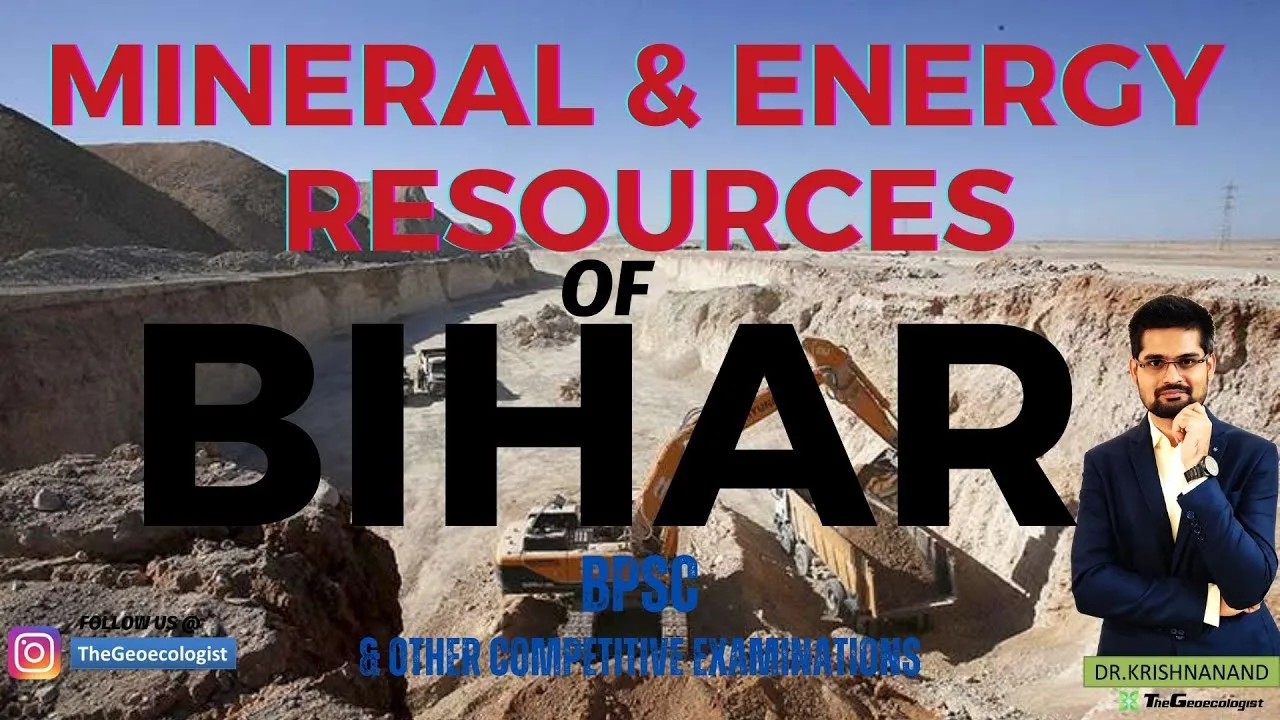
Table of Contents
- Overview of Bihar Mineral Resources
- Major Minerals in Bihar Mineral Resources
- Minor Construction Minerals
- Energy Resources of Bihar
- Coal – The Conventional Backbone
- Renewable Energy – Solar, Hydro, and Biomass
- Natural Gas
- Challenges in Harnessing Bihar Mineral Resources
- Government Initiatives to Boost Bihar Mineral Resources
- Why Study Bihar Mineral Resources for BPSC?
- Conclusion
Bihar Mineral Resources play a vital role in the state’s economy and are a crucial topic for BPSC aspirants aiming to master geography sections. This comprehensive guide explores the distribution, utilization, and challenges associated with Bihar’s mineral wealth and energy potential, integrating insights from Dr. Krishnanand’s bilingual lectures and the Geography of Bihar eBook.
- Key minerals: Mica, limestone, quartz/silica sand, bauxite, pyrite, plus minor granite, sand, and gravel.
- Energy mix: Limited coal reserves, growing solar (target 3 GW by 2025), modest hydropower on Gandak/Kosi, biomass, and small natural‑gas pockets.
- Challenges: Post‑2000 Jharkhand bifurcation loss of major reserves, outdated mining tech, infrastructure gaps, environmental concerns, and policy implementation hurdles.
- Government response: Bihar Mineral Development Policy (2020), solar power subsidies, bioenergy promotion, and private‑investment incentives.
Overview of Bihar Mineral Resources
Bihar Mineral Resources encompass a diverse suite of metallic and non‑metallic minerals spread across its geological formations. Despite the 2000 bifurcation that transferred rich coal belts to Jharkhand, the state retains significant deposits that support industries such as cement, electronics, glass, and metallurgy. Understanding the spatial distribution and economic relevance of these resources is essential for answering geography‑based questions in the BPSC examination.
Major Minerals in Bihar Mineral Resources
The core of Bihar Mineral Resources lies in five principal minerals: mica, limestone, quartz/silica sand, bauxite, and pyrite. Each occurs in specific districts and feeds distinct industrial value chains.
Mica – The Mica
Bihar Mineral Resources include extensive mica reserves, historically making the state a leading producer in India. The Nawada district remains a hotspot for high‑quality sheet mica used in electronics and insulation. According to mica Wikipedia, India accounts for about 60 % of global mica output, with Bihar contributing a notable share before the Jharkhand split. Post‑2000, Nawada’s output has stabilized around 15 000 tonnes annually, supporting local employment and export earnings.
Limestone
Limestone forms another cornerstone of Bihar Mineral Resources, primarily extracted from Kaimur, Rohtas, and Munger districts. The Banjari and Kakoleri mines supply calcium carbonate to cement plants in Patna and nearby regions. Limestone’s chemical purity (CaCO₃ > 90 %) makes it suitable for steel flux and agro‑based industries. Official data from the Indian Bureau of Mines indicate that Bihar’s limestone reserves exceed 120 million tonnes, ensuring a multi‑decade supply horizon.
Quartz and Silica Sand
Quartz and silica sand deposits, vital for glass manufacturing and ceramics, are scattered across Banka, Bhagalpur, and Jamui. These sediments exhibit high SiO₂ content (often > 98 %), meeting the stringent specifications of float‑glass and fiberglass producers. The state’s quartz output averages 80 000 tonnes per year, feeding industries in Kolkata and Bengaluru.
Bauxite
Though limited, traces of bauxite (the primary aluminium ore) exist in Jamui and Munger, adding a strategic dimension to Bihar Mineral Resources. The ore grades range from 45 % to 55 % Al₂O₃, sufficient for beneficiation and downstream aluminium extraction. Pilot projects by the Ministry of Mines have explored upgrading these deposits via washing and magnetic separation.
Pyrite
Pyrite (iron sulfide) reserves in Bihar Sharif and Nawada support sulfuric acid production, a key input for fertilizers and chemical industries. Estimated pyrite resources stand at roughly 30 million tonnes, with current extraction rates of 2 000–3 000 tonnes annually. The mineral’s association with coal seams also offers potential for integrated mining‑processing complexes.
Minor Construction Minerals
Beyond the major minerals, Bihar Mineral Resources include abundant granite, sand, and gravel that fuel the state’s construction boom. Districts such as Gaya and Aurangabad host quarries supplying dimension stone for infrastructure projects, while riverine sand from the Ganga and its tributaries meets urban housing demand. Sustainable extraction practices are increasingly promoted to mitigate ecological impacts.
Energy Resources of Bihar
While Bihar Mineral Resources dominate the solid‑mineral sector, the state’s energy portfolio combines conventional fuels with emerging renewables. This mix is critical for powering industries, agriculture, and households, and frequently appears in BPSC questions on energy geography.
Coal – The Conventional Backbone
Bihar’s coal reserves are modest compared to neighboring Jharkhand, mainly confined to the Dariapur‑Rajhara belt in Rohtas district. The coal is of non‑coking grade, used primarily in thermal power plants such as the Barauni and Muzaffarpur units. According to Coal India Limited, Bihar’s extractable coal stands at about 500 million tonnes, sufficient for limited domestic consumption but necessitating imports for larger power projects.
Renewable Energy – Solar, Hydro, and Biomass
Solar Energy: With approximately 250–300 sunny days per year, Bihar is aggressively pursuing solar power. The Bihar Renewable Energy Development Agency (BREDA) has commissioned projects in Gaya, Bhagalpur, and West Champaran, targeting a cumulative capacity of 3 GW by 2025. Solar parks now occupy over 1 500 hectares of fallow land, reducing reliance on fossil fuels.
Hydropower: The Gandak and Kosi rivers offer modest hydropower potential, with identified sites capable of generating 50–80 MW combined. Small‑scale run‑of‑the‑river installations already power remote villages in Madhubani and Supaul.
Biomass and Biogas: Agricultural residues—rice husk, wheat straw, and sugarcane bagasse—are increasingly converted into biogas and biofuels. Subsidized biogas plants under the Bihar Bioenergy Promotion Scheme have installed over 12 000 units in rural blocks, providing clean cooking fuel and reducing indoor air pollution.
Natural Gas
Small natural‑gas pockets in the Ganga Basin contribute to domestic and industrial consumption. Though not a major contributor, these reserves support peak‑load gas turbines and serve as feedstock for fertilizer plants in Barauni.
Challenges in Harnessing Bihar Mineral Resources
Despite its wealth, the exploitation of Bihar Mineral Resources faces several structural impediments:
- Limited Reserves: The 2000 Jharkhand bifurcation stripped Bihar of its most prolific coal and high‑grade mica zones, reducing overall resource potential by roughly 40 %.
- Infrastructure Gaps: Outdated mining techniques, inadequate road connectivity to remote quarries, and limited processing facilities hinder value addition.
- Environmental Concerns: Unregulated sand mining along the Ganga has led to riverbank degradation and groundwater contamination, prompting judicial interventions.
- Policy Implementation: While the Bihar Mineral Development Policy (2020) outlines incentives, bureaucratic delays and unclear royalty structures deter private investors.
Government Initiatives to Boost Bihar Mineral Resources
Recognizing the strategic importance of Bihar Mineral Resources, the state administration has launched several targeted programmes:
- Bihar Mineral Development Policy (2020): Offers tax holidays, streamlined clearances, and revenue‑sharing models to attract exploration and mining investments.
- Solar Power Expansion: Through the Bihar Solar Energy Policy, the state aims to install 3 GW of solar capacity by 2025, leveraging wasteland and rooftop installations.
- Bioenergy Promotion: Subsidies of up to 40 % for biogas plant construction, coupled with training programmes for rural entrepreneurs, have accelerated adoption.
- Skill Development: Partnerships with the Indian School of Mines (ISM) and IIT‑ISM Dhanbad provide vocational training in modern mining techniques, safety, and environmental management.
Why Study Bihar Mineral Resources for BPSC?
Questions on the distribution, economic significance, and policy frameworks surrounding Bihar Mineral Resources appear regularly in both the preliminary and mains stages of the BPSC examination. Aspirants who master this topic can:
- Accurately answer map‑based questions on mineral locations.
- Analyze the impact of resource‑based industries on regional development.
- Evaluate government schemes and suggest improvements for sustainable utilization.
- Link mineral and energy geography to broader socio‑economic themes such as employment, migration, and environmental stewardship.
Dr. Krishnanand’s bilingual lectures on TheGeoecologist platform break down complex geological data into easy‑to‑digest visuals, case studies, and mnemonics specifically tailored for BPSC aspirants. Complementing these videos, the Geography of Bihar eBook offers chapter‑wise summaries, practice questions, and updated statistics (as of 2024) that reinforce conceptual clarity.
Conclusion
Bihar Mineral Resources remain a linchpin of the state’s economic narrative, intertwining traditional mining with modern renewable energy initiatives. For BPSC candidates, a thorough grasp of mineral distribution, extraction challenges, and policy responses is indispensable for scoring well in geography‑related papers. Leveraging authoritative resources such as Dr. Krishnanand’s lectures, the Geography of Bihar eBook, and official government reports will provide a competitive edge and deepen appreciation of Bihar’s natural endowment.
Follow TheGeoecologist on Instagram and subscribe to their courses for the latest updates, video lectures, and study material!
Frequently Asked Questions
Nawada district is the primary source of mica within Bihar Mineral Resources, historically contributing high‑quality sheet mica used in electronics and insulation industries.
Bihar aims to achieve 3 GW of solar power capacity by 2025, leveraging its 250–300 sunny days annually to expand solar parks in Gaya, Bhagalpur, and West Champaran.
The 2000 Jharkhand bifurcation caused Bihar to lose significant coal and mica zones, reducing its overall mineral reserves by approximately 40 % and shifting focus to remaining deposits in districts like Nawada, Rohtas, and Jamui.