
Blog
How Seasons Occur: The Science of Earth’s Axial Tilt

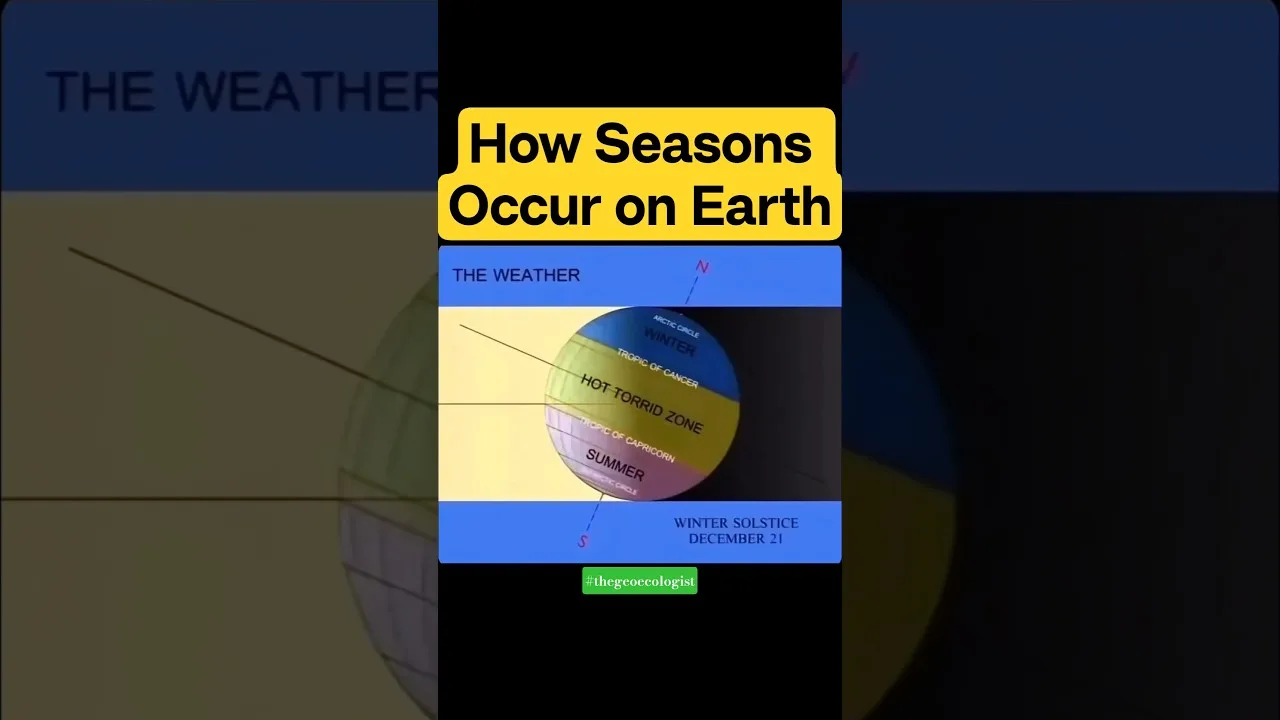
Table of Contents
- The Science of Earth's Axial Tilt
- Why Distance from the Sun is Not the Cause
- The Mechanics of Seasonal Shifts
- 1. Summer: The Period of Direct Solar Radiation
- 2. Winter: The Period of Slanted Solar Radiation
- 3. Spring and Autumn: The Transitional Periods
- How Seasons Occur and Their Impact on Global Climate
- The Role of the Tropics
- The Biological and Cultural Significance of Seasonal Cycles
- Summary of Seasonal Dynamics
Understanding how seasons occur is fundamental to grasping the complex dynamics of our planet’s climate and ecosystem. Many people mistakenly believe that the changing weather patterns we experience throughout the year are caused by the Earth’s varying distance from the Sun, but this is a common scientific misconception. In reality, the mechanism behind how seasons occur is a sophisticated interplay between Earth’s axial tilt and its orbital path around the Sun.
- Axial Tilt: Earth is tilted at an angle of approximately 23.5 degrees.
- Orbital Motion: The Earth’s revolution around the Sun creates seasonal variations.
- Solar Intensity: The angle of sunlight hitting the Earth determines temperature changes.
- Daylight Duration: Seasonal shifts directly affect the length of day and night.
The Science of Earth’s Axial Tilt
To truly understand how seasons occur, we must look at the geometry of our planet. Earth does not sit upright in its orbit; instead, it possesses an axial tilt, also known as obliquity. This tilt is maintained by the angular momentum of the planet and is currently measured at roughly 23.5 degrees relative to its orbital plane. This tilt is the primary driver of the seasonal cycles that dictate life on Earth.
As the Earth orbits the Sun, this fixed tilt means that different parts of the planet receive varying amounts of solar radiation at different times of the year. When the Northern Hemisphere is tilted toward the Sun, it experiences summer, while the Southern Hemisphere experiences winter. This phenomenon is a core concept in Earth science and planetary mechanics.
Why Distance from the Sun is Not the Cause
A frequent myth regarding how seasons occur is the idea that Earth is closer to the Sun during the summer. However, astronomical observations show that Earth’s orbit is nearly circular (an ellipse with low eccentricity). In fact, for many parts of the world, the Earth is actually at its farthest point from the Sun, known as aphelion, during the Northern Hemisphere’s summer. This proves that distance is not the determining factor for the warmth we feel during the summer months.
The Mechanics of Seasonal Shifts

When analyzing how seasons occur, we must examine the three distinct phases of the Earth’s tilt relative to its solar path:
1. Summer: The Period of Direct Solar Radiation
Summer occurs when a specific hemisphere is tilted toward the Sun. During this period, the sunlight hits the Earth at a more direct, perpendicular angle. This concentration of energy means that more heat is absorbed per square meter of the Earth’s surface. Additionally, the tilt causes the sun to stay above the horizon for longer periods, resulting in longer days and more total solar energy absorption.
2. Winter: The Period of Slanted Solar Radiation
Conversely, winter happens when a hemisphere is tilted away from the Sun. In this position, the sunlight must pass through more of the Earth’s atmosphere, which scatters and weakens the energy. The rays hit the surface at a shallow, slanted angle, spreading the same amount of solar energy over a much larger area. This reduction in intensity, combined with shorter daylight hours, leads to the drop in temperature characteristic of the winter season.
3. Spring and Autumn: The Transitional Periods
The transitional seasons—spring and autumn—occur when the Earth’s tilt is neither directed toward nor away from the Sun. During these times, the sunlight hits the Earth more directly at the equator, and the tilt is balanced across the hemispheres. This leads to moderate temperatures and roughly equal day and night lengths, providing a vital bridge between the extremes of summer and winter.
How Seasons Occur and Their Impact on Global Climate
The process of how seasons occur has profound implications for global climate patterns. The axial tilt dictates several critical environmental variables:
- Solar Intensity: As discussed, the angle of incidence determines the thermal energy received.
- Daylight Duration: The variation in day length (photoperiod) affects everything from plant growth to human circadian rhythms.
- Latitudinal Climate Zones: The tilt creates the distinct zones of the tropics, temperate regions, and polar regions.
The NASA Earth Observatory provides extensive data showing how these solar variations drive atmospheric circulation and ocean currents, which in turn regulate the global climate system.
The Role of the Tropics
The Tropic of Cancer and the Tropic of Capricorn are geographic markers that define the limits of direct sunlight. These lines are a direct result of how seasons occur; they represent the points where the Sun reaches its highest and lowest declination throughout the year. These zones are essential in defining the tropical climate, where the sun is often nearly overhead, creating high-energy environments.
The Biological and Cultural Significance of Seasonal Cycles
Beyond the physics, the way how seasons occur serves as the heartbeat of life on Earth. Ecosystems have evolved to respond to these cycles. For example, many plant species use the increasing daylight of spring as a signal to begin germination and flowering. Animals, too, have adapted through migration, hibernation, or changes in breeding patterns to survive the seasonal shifts.
Human civilization has been shaped by these cycles for millennia. Agriculture, the foundation of most human societies, is entirely dependent on the predictability of seasonal changes. The timing of planting and harvesting is a direct response to the patterns established by Earth’s tilt. Without the rhythmic cycle of how seasons occur, our food security and cultural traditions would be unrecognizable.
Summary of Seasonal Dynamics
To conclude, the mystery of how seasons occur is solved by looking at the 23.5-degree tilt of our planet. This tilt, combined with our annual orbit, ensures a diverse and dynamic environment. It regulates the intensity of sunlight, the length of our days, and the overall temperature of our planet. Understanding this fundamental concept is key to understanding the broader context of climate change and the delicate balance of our biosphere.
Whether we are looking at the extreme cold of the poles or the lush growth of a temperate forest, every aspect of our natural world is a testament to the predictable and fascinating way how seasons occur on this blue marble we call home.
Frequently Asked Questions
No, the distance from the Sun does not cause seasons. The seasons are caused by the 23.5-degree tilt of Earth's axis and its orbit around the Sun.
The primary driver is Earth's axial tilt, which causes different parts of the planet to receive varying amounts of sunlight throughout the year.
In summer, the hemisphere is tilted toward the Sun, receiving more direct sunlight and longer daylight hours, which increases heat absorption.