Blog
River Meander Formation: The Science of Sinuous Curves

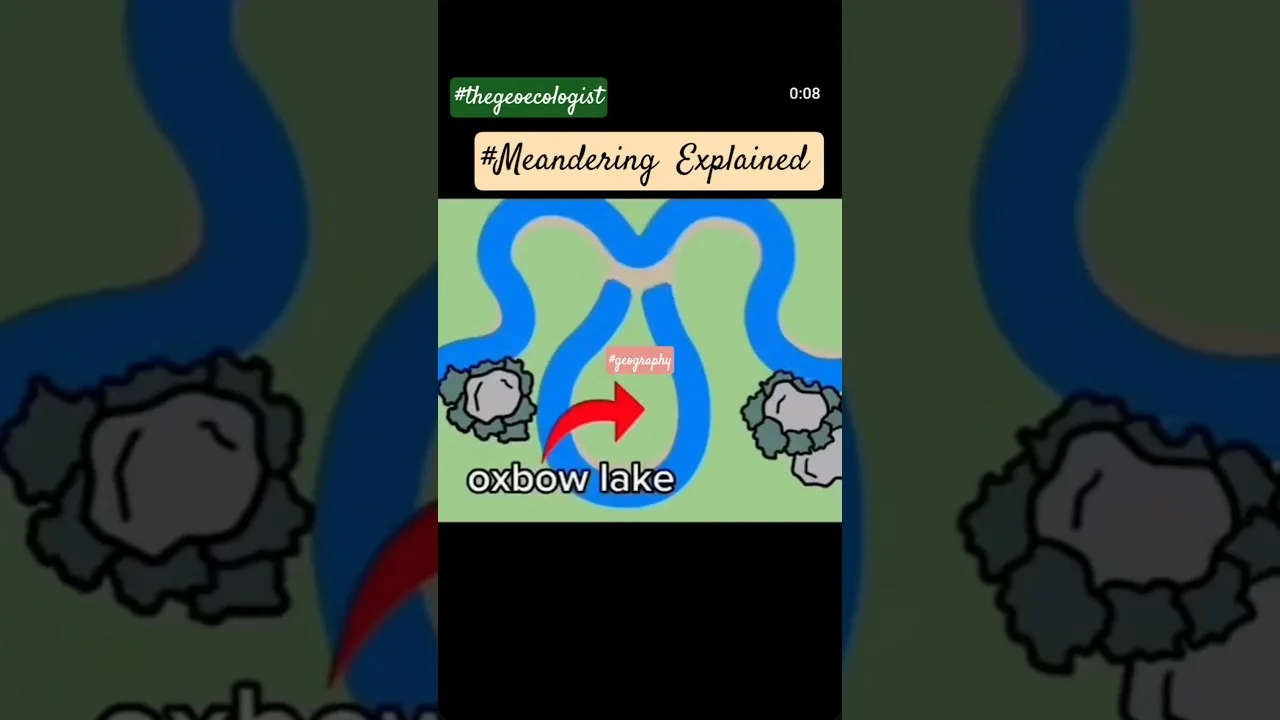
Table of Contents
Understanding River Meander Formation and Fluvial Dynamics
River meander formation is one of the most captivating examples of geomorphological processes in action. While a river might appear to be a simple, straight conduit for water, it is actually a dynamic, living system that constantly reshapes the landscape through a complex interplay of erosion and deposition. These sinuous curves, known as meanders, are not random accidents of nature; they are the predictable result of hydraulic energy, sediment transport, and the physics of fluid motion. Understanding how these bends develop is essential for geographers, civil engineers, and environmental scientists alike.
- Erosion vs. Deposition: The continuous cycle of bank erosion and sediment buildup.
- Helicoidal Flow: The spiral motion that drives lateral migration.
- Oxbow Lake Creation: How meanders eventually cut themselves off from the main channel.
- Geographical Significance: The impact of fluvial processes on floodplains and human infrastructure.
The Fundamental Drivers of River Meander Formation
The process of river meander formation begins with a subtle irregularity. No riverbed is perfectly smooth; every channel contains obstacles such as large boulders, fallen timber, or varying sediment densities. When water encounters such an obstacle, it is forced to deviate from a straight path. This minor deviation creates a slight angle in the flow, which initiates a feedback loop of energy distribution.
As the water moves around an obstacle, the velocity of the current is not uniform across the width of the channel. According to the principles of fluid mechanics, water traveling toward the outer edge of a curve experiences higher velocity and greater centrifugal force. This increased kinetic energy allows the water to exert more force against the riverbank, leading to lateral erosion. This is the primary catalyst in river meander formation.
The Dual Mechanism: Erosion and Deposition
To understand the evolution of a river’s path, one must examine the simultaneous processes occurring on opposite banks. The river operates through a dual mechanism that ensures the curve grows more pronounced over time.
1. Erosion on the Cut Bank (Outer Bend)
On the outer curve of a bend, the water flows at its maximum velocity. This area is known as the cut bank. The high-energy water scours the bank, removing soil and rock particles through hydraulic action and abrasion. As the bank retreats, the channel widens and deepens on the outside of the loop, contributing significantly to river meander formation. You can read more about these specific fluvial processes on the Wikipedia page for meanders to see how they relate to larger hydrological cycles.
2. Deposition on the Point Bar (Inner Bend)
Conversely, the inner curve of the bend experiences much slower water velocity. As the flow decelerates, the water loses the energy required to transport its sediment load. Consequently, sand, silt, and gravel are deposited along the inner edge. This accumulation of sediment is known as a point bar. While the outer bank is being eaten away, the inner bank is being built up, a process fundamental to river meander formation.
The Role of Helicoidal Flow
Why does the river move sideways rather than just widening the channel? The answer lies in a phenomenon called helicoidal flow. Imagine a corkscrew-shaped movement of water within the channel. As water flows around a bend, the centrifugal force pushes the faster surface water toward the outer bank. To compensate, a secondary, slower current flows along the riverbed from the outer bank toward the inner bank.
This spiral, or helicoidal flow, is the ‘engine’ of river meander formation. It picks up sediment from the eroded outer bank and carries it toward the inner bank, where it is deposited. This continuous, spiral-driven movement ensures that the river doesn’t just grow wider, but actually migrates across its entire floodplain over time.
The Lifecycle of a Meander: From Sinuosity to Oxbow Lakes
As the process of river meander formation continues over decades or centuries, the loops become increasingly exaggerated. The ‘neck’ of the meander—the narrow strip of land separating two adjacent loops—becomes thinner and thinner due to continuous erosion on both sides of the neck.
During periods of high discharge, such as a flood, the river has sufficient energy to break through this narrow neck. The water takes the shortest, straightest path possible, bypassing the loop entirely. Once the river has established this new, straighter course, the old loop is abandoned. The abandoned loop becomes a crescent-shaped body of water known as an oxbow lake. These lakes are vital ecosystems and serve as geological records of the river’s former path. The transition from a winding stream to an oxbow lake is the ultimate stage in the evolution of river meander formation.
Geographical Importance and Human Impact
For students preparing for competitive exams like UPSC or UGC NET, understanding these patterns is crucial for mastering geomorphology. Meanders are not just aesthetic features; they dictate how floodplains are shaped and how levees are formed.
However, human intervention often disrupts the natural rhythm of river meander formation. Channelization—the process of straightening a river to improve navigation or reduce flood risk—can have unintended consequences. By preventing the natural process of river meander formation, we often increase the velocity of the water, which can lead to more severe downstream flooding and increased erosion in other areas. Protecting the natural sinuosity of rivers is a key component of modern river management and environmental conservation.
Summary of Key Concepts
To summarize the complex science of river meander formation:
- Obstacles: Start the process by forcing water out of a straight line.
- Cut Banks: High-velocity erosion on the outer curve.
- Point Bars: Low-velocity deposition on the inner curve.
- Helicoidal Flow: The spiral motion that drives lateral migration.
- Oxbow Lakes: The final stage when a loop is cut off.
By studying the intricate patterns of river meander formation, we gain a deeper appreciation for the power of water to sculpt the Earth’s surface. Whether it is a small stream or a massive river like the Mississippi, the principles of river meander formation remain a constant force in our changing world.
Frequently Asked Questions

River meanders are caused by the combination of erosion on the outer banks and deposition on the inner banks, driven by the water's tendency to take the path of least resistance around obstacles.
A cut bank is the outer curve of a meander where high-velocity water erodes the bank, while a point bar is the inner curve where slower water deposits sediment.
An oxbow lake forms when a river meander becomes so extreme that the river cuts through the neck of the loop, abandoning the old bend and creating a crescent-shaped lake.