Blog
Rimland Theory Spykman: Complete Guide to Spykman’s Geopolitical Model

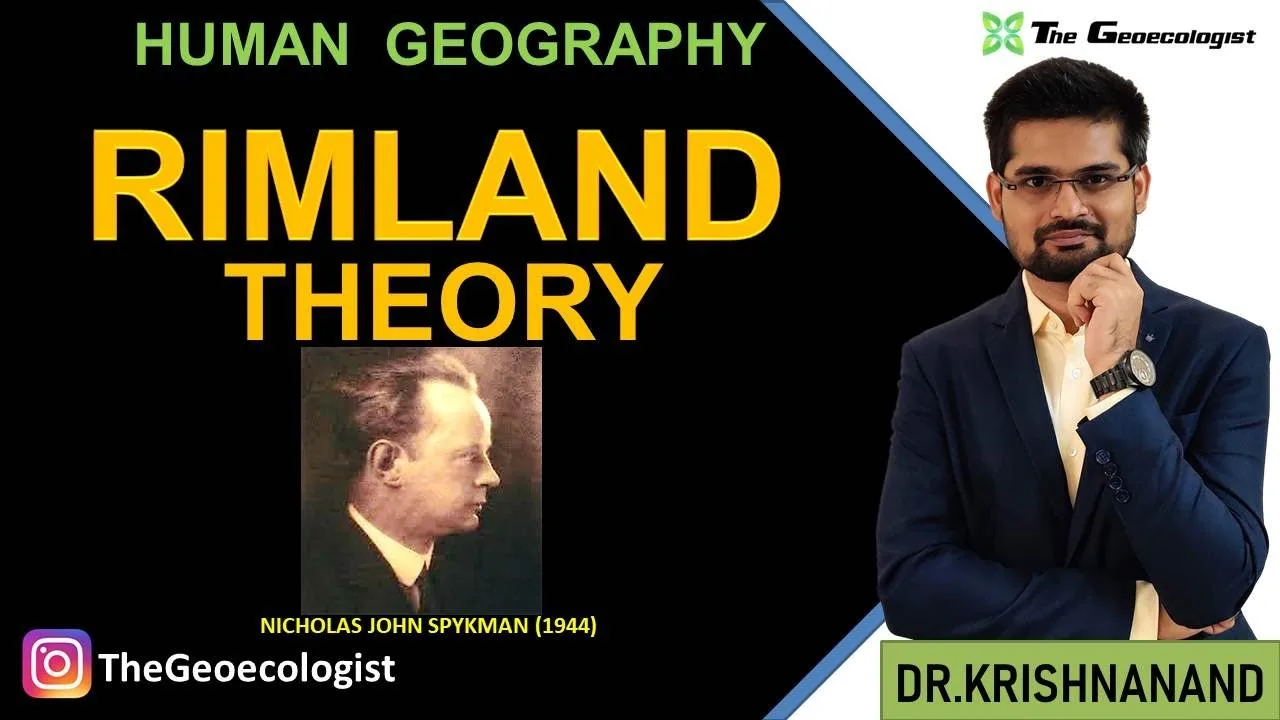
Table of Contents
- What Is the Rimland Theory Spykman?
- Nicholas John Spykman: The Architect of Rimland Theory
- Heartland vs Rimland: The Core Geopolitical Debate
- Mackinder's Heartland Theory Recap
- Spykman's Critique of Heartland Theory
- The Two-Tier System: Inner Core and Rimland
- Why Rimland Is More Important Than Heartland
- Strategic Geography of the Rimland
- Maritime Power vs Land Power
- The Geography of Peace: Spykman's Vision
- Criticism of Rimland Theory
- Application of Rimland Theory in Modern Geopolitics
- Indo-Pacific Strategy
- European Security Architecture
- Middle East Geopolitics
- Rimland Theory Spykman for UPSC Geography Optional Preparation
- Conclusion
The Rimland Theory Spykman represents one of the most influential geopolitical frameworks of the 20th century, fundamentally reshaping how scholars and policymakers understand global power dynamics. Developed by Nicholas John Spykman in the 1940s, this theory emerged as a direct intellectual challenge to Halford Mackinder’s Heartland Theory, arguing that the coastal fringes of Eurasia—not its interior—hold the key to world domination. For UPSC Geography Optional aspirants and students of human geography, mastering the Rimland Theory Spykman is essential for answering questions on political geography, geopolitics, and international relations with analytical depth.
- Rimland Theory Spykman prioritizes the maritime periphery of Eurasia over the continental interior as the decisive geopolitical zone.
- Nicholas Spykman formulated this theory during World War II, publishing his seminal work The Geography of the Peace in 1944.
- The theory introduces a two-tier system: the Inner Core (Heartland) and the Rimland, with the latter containing the majority of Eurasia’s population, resources, and industrial capacity.
- Spykman famously argued that “who controls the Rimland rules Eurasia; who rules Eurasia controls the destinies of the world.”
- The Rimland Theory Spykman remains highly relevant for analyzing contemporary Indo-Pacific strategy, NATO expansion, and great power competition.
What Is the Rimland Theory Spykman?
The Rimland Theory Spykman posits that the rimland—the crescent-shaped zone encircling the Eurasian heartland, encompassing Western Europe, the Middle East, South Asia, Southeast Asia, and East Asia—is the true pivot area of global geopolitics. Unlike Mackinder, who viewed the heartland as an impregnable fortress for land power, Spykman recognized that the rimland’s accessibility to both land and sea routes makes it the primary theater for great power rivalry. This amphibious character of the rimland—simultaneously continental and maritime—gives it unparalleled strategic significance.
Spykman developed his framework while serving as a professor of international relations at Yale University’s Institute of International Studies. His work was deeply influenced by the geopolitical realities of World War II, where the conflict’s outcome hinged on control of the Eurasian littoral. The Rimland Theory Spykman was first systematically presented in his 1942 book America’s Strategy in World Politics and later refined in the posthumously published The Geography of the Peace (1944). For a foundational understanding of Spykman’s life and intellectual contributions, see his biographical entry on Wikipedia.
Nicholas John Spykman: The Architect of Rimland Theory
Nicholas John Spykman (1893–1943) was a Dutch-American political scientist and geographer whose brief but brilliant career revolutionized geopolitical thought. Born in Amsterdam and educated in the Netherlands and the United States, Spykman brought a multidisciplinary approach—combining geography, history, and political science—to the study of international relations. He joined Yale University in 1928 and became the first director of the Yale Institute of International Studies in 1940.
Spykman’s intellectual legacy rests on his insistence that “geography does not argue; it simply is” and that “states cannot escape their geography.” This geographic determinism, tempered by an appreciation for technological change, distinguishes the Rimland Theory Spykman from earlier environmental determinism. Spykman died prematurely at age 49, but his ideas shaped American containment policy during the Cold War. The Encyclopædia Britannica entry on Spykman provides an authoritative overview of his academic career and lasting influence.
Heartland vs Rimland: The Core Geopolitical Debate
Mackinder’s Heartland Theory Recap
To appreciate the Rimland Theory Spykman, one must first understand the theory it sought to overturn. In 1904, Halford Mackinder presented “The Geographical Pivot of History” to the Royal Geographical Society, arguing that the Heartland—Eurasia’s vast, resource-rich interior, roughly corresponding to the Russian Empire and later the Soviet Union—was the natural seat of land power. Mackinder’s famous dictum stated: “Who rules East Europe commands the Heartland; who rules the Heartland commands the World-Island; who rules the World-Island commands the world.”
Mackinder viewed the Heartland as geographically invulnerable to sea power, protected by Arctic ice, mountains, deserts, and distance. The surrounding crescent—the “Inner Crescent” (Western Europe, Middle East, India, China) and “Outer Crescent” (Americas, Africa, Australia, Japan)—was relegated to a secondary, reactive role.
Spykman’s Critique of Heartland Theory
The Rimland Theory Spykman dismantles Mackinder’s thesis on three grounds. First, Spykman argued that the Heartland is not a fortress but a strategic liability: its harsh climate, poor transportation, and distance from major markets limit its power projection capability. Second, technological advances—railways, automobiles, aircraft, and later missiles—have eroded the Heartland’s natural defenses. Third, and most importantly, the Rimland contains the overwhelming majority of Eurasia’s population, industrial capacity, agricultural surplus, and navigable coastlines.
Spykman redefined Mackinder’s “Inner Crescent” as the Rimland proper, arguing that this zone—not the Heartland—is the true pivot area. The Wikipedia article on Rimland details this conceptual evolution and its scholarly reception.
The Two-Tier System: Inner Core and Rimland
A distinctive feature of the Rimland Theory Spykman is its two-tier geopolitical architecture. Spykman divided the World-Island (Eurasia-Africa) into:
- The Inner Core (Heartland): The vast, landlocked interior of Eurasia, characterized by extreme climates, sparse population, and limited agricultural potential. This zone corresponds roughly to the former Soviet space—Central Asia, Siberia, and parts of European Russia.
- The Rimland: The densely populated, resource-rich, industrially developed coastal belt encircling the Inner Core. The Rimland includes Western Europe, the Mediterranean littoral, the Middle East, the Indian subcontinent, Southeast Asia, China’s coastal provinces, and the Russian Far East.
This binary structure is antithetic to the Heartland Theory’s single-pivot model. In the Rimland Theory Spykman, the Inner Core is strategically passive—its geography condemns it to defensive postures—while the Rimland is the active arena where great powers compete for influence, alliances, and military bases.
Why Rimland Is More Important Than Heartland
Strategic Geography of the Rimland
The Rimland Theory Spykman identifies several geographic attributes that make the rimland decisive:
- Population concentration: Over 70% of Eurasia’s population resides in the rimland, providing manpower for armies and labor for industry.
- Industrial capacity: The rimland hosts the major industrial centers of Europe, Japan, China, and India.
- Maritime access: Unlike the landlocked Heartland, the rimland possesses thousands of kilometers of coastline, enabling trade, naval power projection, and alliance formation.
- Resource diversity: The rimland combines agricultural zones (European plain, Gangetic plain, Chinese river deltas) with energy resources (Middle East oil, Caspian Basin).
Maritime Power vs Land Power
Central to the Rimland Theory Spykman is the dialectic between sea power and land power. Spykman, influenced by Alfred Thayer Mahan, argued that sea power enjoys inherent advantages: mobility, flexibility, and the ability to project force across oceans without traversing hostile territory. The rimland’s amphibious character allows it to serve as the interface where sea power and land power collide. Control of the rimland enables a maritime power to contain a land power; conversely, a land power that penetrates the rimland threatens the maritime power’s global position.
This logic underpinned the U.S. containment strategy during the Cold War. The Rimland Theory Spykman provided the intellectual foundation for NATO, CENTO, SEATO, and the bilateral alliance system in East Asia—all designed to prevent Soviet domination of the Eurasian littoral.
The Geography of Peace: Spykman’s Vision
Spykman’s 1944 magnum opus, The Geography of the Peace, applied the Rimland Theory Spykman to postwar planning. He envisioned a world order anchored by a balance of power in the rimland, with the United States as the offshore balancer preventing any single power—whether Germany, Japan, or the Soviet Union—from achieving hegemony over the Eurasian littoral. Spykman warned that the collapse of the European colonial empires would create power vacuums in the Asian rimland, requiring sustained American engagement.
Remarkably, Spykman anticipated the rise of China and India as major rimland powers, the strategic centrality of the Middle East, and the enduring relevance of the European rimland. His prescription—”the United States must remain the dominant power in the Atlantic and Pacific to maintain the balance of power in the rimland”—continues to inform U.S. grand strategy.
Criticism of Rimland Theory
Despite its enduring influence, the Rimland Theory Spykman faces several critiques:
- Technological determinism: Critics argue that nuclear weapons, ICBMs, cyber warfare, and space-based systems have diminished the relevance of geographic position.
- Oversimplification: The binary core-rimland model may obscure intra-rimland conflicts (e.g., India-Pakistan, Iran-Saudi Arabia, China-Japan) that are not reducible to heartland-rimland dynamics.
- Neglect of non-state actors: The theory’s state-centric framework struggles to account for transnational terrorism, multinational corporations, and climate change as geopolitical forces.
- Geographic determinism: While Spykman moderated environmental determinism, critics contend the theory still overemphasizes geography at the expense of ideology, economics, and domestic politics.
Nevertheless, the Rimland Theory Spykman retains explanatory power precisely because it identifies enduring structural constraints that technology has not eliminated—only modified.
Application of Rimland Theory in Modern Geopolitics
The contemporary relevance of the Rimland Theory Spykman is evident in multiple theaters:
Indo-Pacific Strategy
The U.S. “Free and Open Indo-Pacific” framework, the Quad (U.S., Japan, India, Australia), and AUKUS all reflect Rimland Theory Spykman logic: preventing a single power (China) from dominating the Asian littoral. The “first island chain” and “second island chain” concepts are direct operationalizations of rimland containment.
European Security Architecture
NATO’s eastward expansion, the European Union’s eastern partnership, and the current Russia-Ukraine conflict illustrate the enduring contest for the European rimland. The Rimland Theory Spykman predicts that a land power (Russia) will seek to push its frontier westward into the rimland, while maritime powers (U.S., UK, EU) will resist.
Middle East Geopolitics
The Middle East—straddling Europe, Asia, and Africa—remains the quintessential rimland zone. Great power competition (U.S., Russia, China), regional rivalries (Iran vs. Saudi Arabia, Israel vs. Iran), and energy geopolitics all conform to the Rimland Theory Spykman’s prediction that this zone will be a perennial flashpoint.
Rimland Theory Spykman for UPSC Geography Optional Preparation
For UPSC Geography Optional candidates, the Rimland Theory Spykman is a high-yield topic in Paper II (Human Geography), specifically under “Political Geography” and “Geopolitics.” Previous year questions have asked aspirants to:
- Compare and contrast Heartland and Rimland theories
- Evaluate the relevance of Spykman’s theory in the post-Cold War era
- Analyze the Rimland Theory Spykman in the context of Indian Ocean geopolitics
- Discuss the concept of “shatter belt” in relation to the rimland
Effective preparation requires:
- Conceptual clarity: Master the definitions of Heartland, Rimland, World-Island, and pivot area.
- Comparative framework: Create a table contrasting Mackinder vs. Spykman on pivot area, power type (land vs. sea), strategic logic, and policy prescriptions.
- Case studies: Prepare 2-3 contemporary examples (e.g., South China Sea, Ukraine, Indo-Pacific) where Rimland Theory Spykman provides explanatory leverage.
- Critical evaluation: Be ready to discuss limitations—nuclear deterrence, globalization, climate change—while defending the theory’s structural insights.
- Maps: Practice drawing the World-Island, Heartland, and Rimland boundaries with key chokepoints (Strait of Hormuz, Malacca Strait, Turkish Straits, GIUK Gap).
The Geoecologist’s simplified human geography materials provide structured notes, diagrams, and previous year question analyses tailored for UPSC Geography Optional. Aspirants can access comprehensive e-books at geographyebooks.com.
Conclusion
The Rimland Theory Spykman endures because it captures a geopolitical reality that transcends ideological epochs: the Eurasian littoral is where the world’s population, wealth, and military potential concentrate, and where the collision between land and sea power plays out. From the Cold War containment architecture to today’s Indo-Pacific contests, Spykman’s insight—that “who controls the Rimland rules Eurasia”—remains the single most useful heuristic for understanding great power strategy. For students of geography, international relations, and strategic studies, the Rimland Theory Spykman is not merely a historical artifact but an analytical lens that brings clarity to the chaos of world politics. As Spykman himself recognized, geography does not argue; it simply is—and the geography of the rimland continues to dictate the terms of global power.
Frequently Asked Questions
Mackinder's Heartland Theory identifies the Eurasian interior (Heartland) as the global pivot area, privileging land power. Spykman's Rimland Theory argues the coastal fringe (Rimland)—containing most population, industry, and maritime access—is the true pivot, privileging sea power and amphibious strategy.
Rimland Theory Spykman is a core topic in Political Geography (Paper II). It frequently appears in questions comparing geopolitical theories, analyzing contemporary conflicts (Indo-Pacific, Ukraine, Middle East), and evaluating the relevance of classical geopolitics. Conceptual clarity on Heartland vs Rimland is essential for high-scoring answers.
The Rimland Theory Spykman directly informs the 'Free and Open Indo-Pacific' strategy, the Quad alliance, and island chain containment concepts. It explains why the U.S. and its allies seek to prevent Chinese hegemony over the Asian littoral—the modern Rimland—through forward basing, partnerships, and maritime domain awareness.