Blog
August Losch Theory: Economics of Location Guide for UPSC

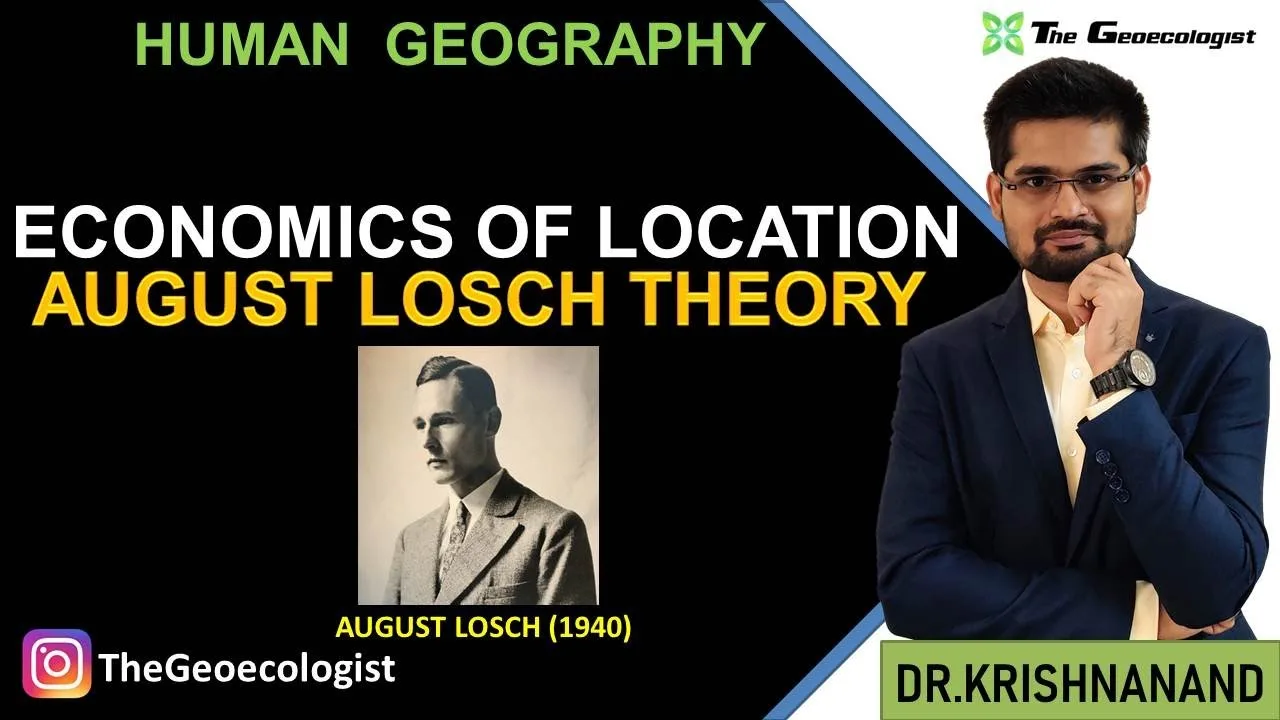
Table of Contents
- Historical Context and Intellectual Lineage of August Losch Theory
- Key Publications and Reception
- Core Concepts of the August Losch Theory
- 1. The Demand Cone: Geometry of Spatial Demand
- 2. Profit Maximization and the Optimal Location
- 3. The Hexagonal Market Lattice
- 4. Locational Margins and the Margin of Cultivation
- Mathematical Formulation in August Losch Theory
- Comparison: August Losch Theory vs. Weber vs. Christaller
- Applications and Extensions of August Losch Theory
- 1. Industrial Location and Plant Siting
- 2. Agricultural Land Use and Von Thünen Synthesis
- 3. Urban Systems and Central Place Hierarchies
- 4. Regional Planning and Policy
- Critiques and Limitations of August Losch Theory
- August Losch Theory in UPSC Geography Optional: Preparation Strategy
- Modern Relevance: August Losch Theory in the Digital Age
- Conclusion
The August Losch Theory stands as a cornerstone in the field of location economics, offering a sophisticated framework that revolutionized how geographers and economists understand the spatial distribution of economic activities. Developed by the German economist August Lösch in his seminal 1940 work The Economics of Location, this theory shifted the focus from pure cost minimization to profit maximization through optimal market area configuration. For aspirants preparing for the UPSC Geography Optional, mastering the August Losch Theory is essential, as it forms a critical component of the Economic Geography syllabus and frequently appears in examination questions on industrial location, market areas, and spatial organization.
- Profit Maximization Focus: Unlike Weber’s least-cost approach, Losch centers on maximizing profit via revenue and cost curves.
- Demand Cones: Introduces the concept of demand cones to illustrate how quantity demanded falls with distance due to transport costs.
- Hexagonal Market Lattice: Proposes a nested hierarchy of hexagonal market areas for efficient spatial coverage without gaps or overlaps.
- Locational Marginality: Identifies the margin of profitable production where total revenue equals total cost.
- UPSC Relevance: Core topic for Geography Optional Paper I (Economic Geography) and Paper II (Regional Planning).
Historical Context and Intellectual Lineage of August Losch Theory
The August Losch Theory emerged during a vibrant period in location theory development. August Lösch (1906–1945) built upon the foundational work of Johann Heinrich von Thünen (1826), Alfred Weber (1909), and Walter Christaller (1933). Von Thünen’s isolated state model established the principle of distance decay in agricultural land use. Weber’s Theory of the Location of Industries (1909) introduced the locational triangle and the concept of weight-losing vs. weight-gaining industries. Christaller’s Central Place Theory (1933) provided the hexagonal lattice geometry that Losch would adapt for market areas.
Lösch’s contribution was to synthesize these strands into a general theory of all economic location — agriculture, manufacturing, and services — grounded in the profit-maximizing behavior of individual entrepreneurs. His work was published in German in 1940 as Die räumliche Ordnung der Wirtschaft and translated into English in 1954 by W. H. Woglom with the assistance of Wolfgang F. Stolper. The translation brought the August Losch Theory to the Anglo-American academic world, influencing the emergence of Regional Science under Walter Isard at the University of Pennsylvania in the 1950s. Isard explicitly acknowledged Lösch’s influence in his landmark Location and Space-Economy (1956).
Key Publications and Reception
- 1940: Die räumliche Ordnung der Wirtschaft (Jena: Gustav Fischer).
- 1954: English translation The Economics of Location (New Haven: Yale University Press).
- 1967: Second English edition with additional notes.
The theory gained prominence in the 1950s and 1960s during the quantitative revolution in geography. Scholars like Brian Berry, William Garrison, and Peter Haggett incorporated Loschian concepts into spatial interaction models and regional synthesis. Today, the August Losch Theory remains a staple in graduate curricula for economic geography, regional science, and urban planning worldwide.
Core Concepts of the August Losch Theory
1. The Demand Cone: Geometry of Spatial Demand
The most distinctive innovation of the August Losch Theory is the demand cone. Imagine a firm located at a point on a featureless plain. At the firm’s location, the price is the factory price (mill price). As distance increases, transport cost adds to the delivered price. Assuming a linear transport cost per unit per kilometer, the delivered price rises linearly with distance. Given a downward-sloping demand curve, the quantity demanded at each distance falls as the delivered price rises.
Plotting quantity demanded against distance yields a three-dimensional cone — the demand cone. Its apex is at the firm’s location (maximum quantity at mill price), and its base intersects the plain at the margin of profitable sale, where delivered price equals the maximum price consumers are willing to pay (or where quantity demanded falls to zero). The volume of the cone represents total sales revenue. This geometric construct allows the August Losch Theory to visualize how transport costs erode market potential spatially.
2. Profit Maximization and the Optimal Location
In the August Losch Theory, the entrepreneur seeks not the least-cost location (as in Weber) but the location that maximizes total profit = total revenue − total cost. Total revenue is the volume of the demand cone. Total cost includes production costs (assumed constant per unit at all locations) and transport costs to serve the market area.
Losch demonstrates that the profit-maximizing location for a single firm serving a dispersed market is at the center of its market area. If the firm moves away from the center, the demand cone becomes asymmetric: one side steepens (higher transport costs, lower sales), the other flattens. The net effect is a reduction in total revenue that outweighs any production cost savings. Thus, the August Losch Theory proves that for a market-oriented firm, central location within its market area is optimal.
3. The Hexagonal Market Lattice
When many firms compete, the August Losch Theory predicts they will partition the plane into contiguous market areas. Following Christaller, Losch argues that the hexagon is the only polygon that tiles the plane without gaps or overlaps while minimizing the average distance from center to boundary — thus minimizing average transport cost per unit sold.
Losch extends this into a nested hierarchy of hexagons of different orders (K=3, K=4, K=7 systems), each corresponding to a different good’s threshold (minimum demand needed to support a firm) and range (maximum distance consumers will travel). Low-order goods (bread, daily needs) have small hexagons; high-order goods (cars, specialized services) have large hexagons. This hierarchy creates a spatially integrated system of central places — a direct bridge to Central Place Theory.
4. Locational Margins and the Margin of Cultivation
The August Losch Theory defines several critical margins:
- Margin of Profitable Production: Where average revenue equals average cost.
- Margin of Profitable Sale: The boundary of the demand cone (delivered price = maximum willingness to pay).
- Locational Margin: The boundary beyond which a firm cannot profitably serve customers even at zero profit.
These margins determine the size and shape of market areas and explain why economic activity thins out at the periphery of regions.
Mathematical Formulation in August Losch Theory
Lösch expressed his theory mathematically. Let:
- p = mill price (factory gate price)
- t = transport rate per unit per km
- r = distance from firm
- q(r) = quantity demanded at distance r
- c = production cost per unit (constant)
Delivered price at distance r: P(r) = p + t·r. Demand function: q = f(P), typically linear: q = a – b·P. Total revenue = ∫ q(r) · p dA over market area. Total cost = ∫ q(r) · (c + t·r) dA. Profit = Revenue – Cost. Maximizing profit with respect to location yields the central location principle. The hexagonal lattice emerges from solving the spatial optimization problem for multiple competing firms.
Comparison: August Losch Theory vs. Weber vs. Christaller
| Dimension | Weber (1909) | Christaller (1933) | August Losch Theory (1940) |
|---|---|---|---|
| Objective | Least-cost location | Efficient service provision | Profit maximization |
| Focus | Supply side (transport, labor) | Demand side (threshold, range) | Both supply & demand |
| Market Area Shape | Not explicitly modeled | Hexagonal (K=3,4,7) | Hexagonal lattice |
| Key Innovation | Locational triangle, weight-losing/gaining | Central place hierarchy | Demand cone, nested hexagons |
| Applicability | Manufacturing | Services, retail | All economic activities |
The August Losch Theory thus unifies Weber’s cost focus and Christaller’s market focus into a single profit-maximization framework applicable to agriculture, industry, and services alike.
Applications and Extensions of August Losch Theory
1. Industrial Location and Plant Siting
Firms use Loschian principles to evaluate greenfield sites. By mapping demand cones for major markets and overlaying transport cost surfaces, corporations identify locations that maximize the volume of the demand cone (revenue) relative to total cost. Modern GIS-based location-allocation models (e.g., Esri’s Business Analyst, ArcGIS Network Analyst) implement the August Losch Theory computationally for retail chain expansion, warehouse siting, and service facility planning.
2. Agricultural Land Use and Von Thünen Synthesis
Losch showed that his demand cones apply to agriculture: each crop has a demand cone centered on the market. The intersection of cones for competing crops determines the land-use rings — a dynamic, profit-based derivation of Von Thünen’s rings. This insight is crucial for UPSC questions linking agricultural geography to location theory.
3. Urban Systems and Central Place Hierarchies
The nested hexagonal lattice of the August Losch Theory provides the theoretical backbone for central place systems. It explains why cities are spaced regularly in idealized regions (e.g., the Midwest US, the North European Plain) and why higher-order centers offer more specialized goods. Losch’s K=3 (marketing), K=4 (transport), and K=7 (administrative) principles remain the standard classification for central place hierarchies.
4. Regional Planning and Policy
Governments apply Loschian logic to design growth poles, export processing zones, and rural service centers. By identifying locations where demand cones for multiple industries overlap, planners can foster agglomeration economies. The August Losch Theory informs India’s Industrial Corridor projects (e.g., Delhi-Mumbai Industrial Corridor) where transport cost reductions expand demand cones for manufacturing firms.
Critiques and Limitations of August Losch Theory
Despite its elegance, the August Losch Theory faces several critiques:
- Isotropic Plain Assumption: Real surfaces have terrain, resources, and infrastructure heterogeneities that distort hexagons.
- Static Equilibrium: The model assumes fixed demand, technology, and transport rates; it does not capture dynamic innovation cycles.
- Perfect Competition: Assumes many small firms; oligopolies and monopolies behave differently.
- Linear Transport Costs: Real freight rates are non-linear (tapering, modal shifts).
- Single-Product Firms: Multi-product firms have interdependent demand cones.
Scholars like David Harvey (Society, the City and the Social Logic of Space, 1979) and Doreen Massey (Spatial Divisions of Labour, 1984) argued that the August Losch Theory abstracts from power relations, class, and historical contingency. Nevertheless, its geometric core remains the starting point for all modern spatial economic models.
August Losch Theory in UPSC Geography Optional: Preparation Strategy
For UPSC aspirants, the August Losch Theory appears in:
- Paper I, Unit IV (Economic Geography): Location of industries, theories of industrial location, central place theory.
- Paper II, Unit III (Regional Planning): Growth centers, service centers, regional imbalances.
- Essay/General Studies: Spatial planning, smart cities, industrial corridors.
Key diagrams to practice: Demand cone (3D and 2D cross-section), hexagonal lattice (K=3, K=4, K=7), profit maximization graph (TR, TC curves), margin of cultivation.
Previous Year Questions (representative):
- “Explain the concept of demand cone in Losch’s theory of location. How does it differ from Weber’s approach?” (2018, 15 marks)
- “Critically examine the relevance of August Losch Theory in understanding the spatial pattern of industries in India.” (2020, 20 marks)
- “Compare and contrast Christaller’s and Losch’s central place models.” (2016, 10 marks)
Recommended resources: Models in Geography by Majid Husain; Economic Geography by Hartshorne & Alexander; The Economics of Location (Losch, 1954 translation); NCERT Class 12 India: People and Economy (Ch. 8). For a concise, exam-oriented summary, refer to the TheGeoecologist study material.
Modern Relevance: August Losch Theory in the Digital Age
E-commerce and platform economies have transformed but not invalidated the August Losch Theory. Digital goods have near-zero transport costs (flat demand cones), but last-mile delivery for physical goods recreates Loschian distance decay. Amazon’s fulfillment center network is a real-world hexagonal lattice optimizing demand cones for Prime delivery. Ride-hailing platforms (Uber, Ola) dynamically adjust supply to demand cones in real time. The theory’s core insight — that spatial profit maximization requires balancing revenue erosion from distance against cost savings from location — remains universally valid.
Moreover, the August Losch Theory underpins contemporary geodemographic segmentation and location intelligence tools used by firms like Esri, Pitney Bowes, and SafeGraph. These platforms compute demand cones for millions of POIs (points of interest) to guide retail expansion, real estate investment, and urban policy.
Conclusion
The August Losch Theory endures as the most comprehensive micro-founded theory of economic location. By introducing the demand cone, proving the optimality of central location within a market area, and deriving the hexagonal lattice as the spatial expression of competitive profit maximization, Lösch provided a unified framework that transcends the supply-demand dichotomy. For UPSC Geography Optional candidates, a deep grasp of the August Losch Theory — its assumptions, geometry, comparisons, critiques, and modern applications — is indispensable for high-scoring answers in Economic Geography and Regional Planning. As India pursues balanced regional development through industrial corridors, smart cities, and rural transformation missions, the policy relevance of Losch’s profit-maximizing spatial logic has only grown.
This article draws on the original 1954 English translation of Lösch’s work, standard texts in regional science (Isard, 1956; Richardson, 1973), and UPSC examination trends. For structured notes, diagrams, and practice questions tailored to the Geography Optional syllabus, visit TheGeoecologist’s Simplified Human Geography eBook.
Frequently Asked Questions
August Losch Theory introduced the concept of demand cones and a hexagonal market lattice to explain how firms maximize profit by locating at points where total revenue exceeds total cost, moving beyond Weber's least-cost approach to a demand-oriented, profit-maximization framework.
While Weber's theory focuses on minimizing transport and labor costs to find the least-cost location, August Losch Theory emphasizes profit maximization by analyzing market areas, demand cones, and the spatial arrangement of hexagonal markets, incorporating both supply and demand factors.
August Losch Theory is a core topic in the Economic Geography section of UPSC Geography Optional. It provides a theoretical foundation for understanding spatial organization, market areas, and locational decision-making, frequently appearing in both Paper I (Human Geography) and Paper II (Regional Planning) questions.