Blog
Growth Pole Theory: Perroux Model and Its Applications in Human Geography

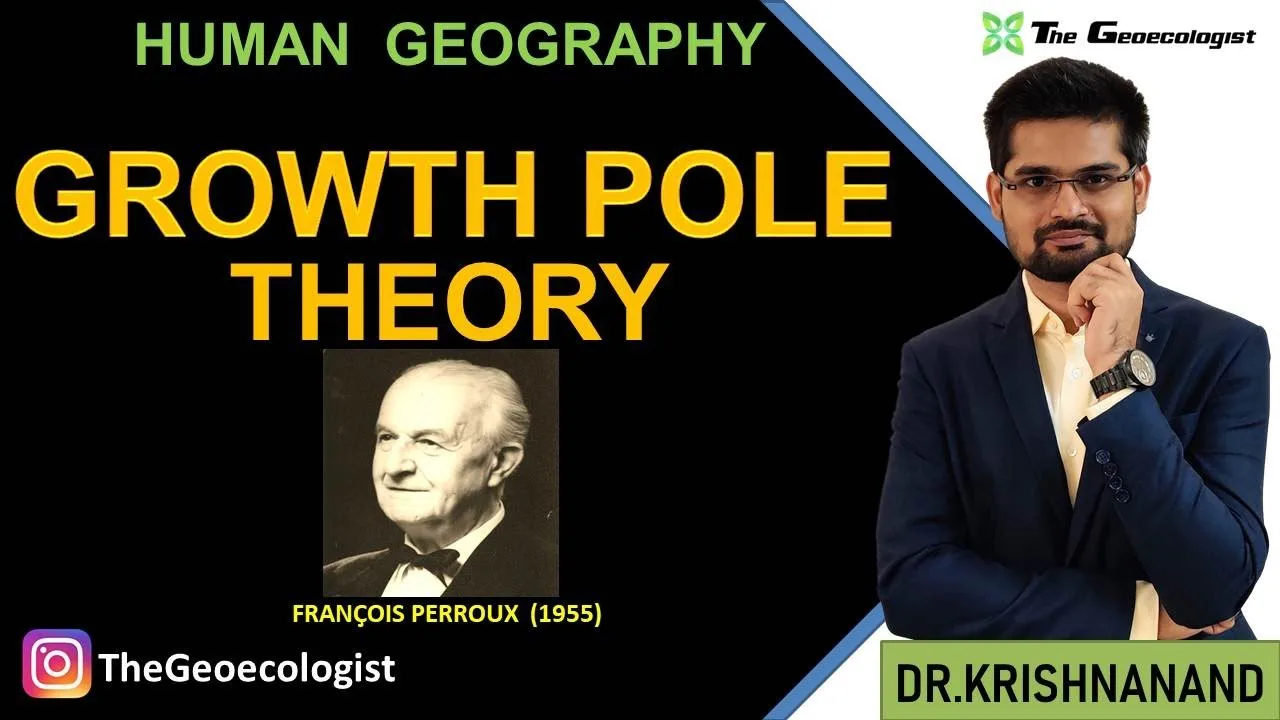
Table of Contents
- Growth Pole Theory: Core Principles
- Historical Development of Growth Pole Theory
- Key Components: Propulsive Firms and Growth Centers
- Criticisms and Limitations of Growth Pole Theory
- Applications in Indian Geography
- Growth Pole Theory in UPSC Examinations
- Modern Revisions and Digital Age Implications
- Conclusion: Why Growth Pole Theory Matters
The Growth Pole Theory, introduced by French economist François Perroux, is a cornerstone of modern human geography and regional development studies. This Growth Pole Theory explains how specific urban centers act as engines of economic growth, pulling resources, investment, and labor toward themselves while creating ripple effects across surrounding areas. For UPSC aspirants, mastering the Growth Pole Theory is essential for the Geography Optional syllabus, as it provides a framework to analyze spatial inequality and development patterns.
- Understanding the Growth Pole Theory helps decode regional disparities and development drivers.
- Perroux’s model identifies propulsive firms and growth centers as catalysts.
- Critiques highlight the theory’s limitations in uniform application.
- Indian geography exams frequently ask about Growth Pole Theory applications.
- Modern revisions incorporate digital and global supply chain influences.
Growth Pole Theory: Core Principles
At its heart, the Growth Pole Theory posits that economic activity does not spread uniformly but clusters around certain focal points, known as growth poles. These poles generate a “trickle‑down” effect, raising the developmental status of peripheral regions through linkages such as labor migration, supply chains, and infrastructure diffusion. The Growth Pole Theory emphasizes that these poles are not merely large cities; they can also be industrial hubs, technological parks, or even specific sectors within a metropolis.
Perroux differentiated between “polarization” (the concentration of activities) and “diffusion” (the spread of benefits). The Growth Pole Theory also introduces the concept of “propulsive firms” – large, innovative enterprises that initiate new production techniques and attract ancillary industries. According to the Growth Pole Theory, these firms create a “growth pole” that can be either “static” (focused on resource extraction) or “dynamic” (oriented toward innovation and diversification). Understanding the Growth Pole Theory’s nuances is vital for students preparing for UPSC Geography Optional, as the exam often probes the interplay between growth poles and regional planning.
Historical Development of Growth Pole Theory
The Growth Pole Theory emerged in the mid‑20th century, building on earlier works by economists such as Walter Isard who pioneered regional science. However, it was Perroux’s 1964 treatise that formalized the Growth Pole Theory, distinguishing between “growth poles” and “growth centers.” His research highlighted that growth poles are not just larger versions of regular cities; they are qualitatively different in terms of their economic functions and influence. The Growth Pole Theory gained traction in development planning circles, especially in post‑war Europe, where policymakers sought mechanisms to reconstruct and balance regional economies. For contemporary UPSC candidates, a solid grasp of this historical backdrop enriches answers on the evolution of regional development thought.
Key Components: Propulsive Firms and Growth Centers
Within the Growth Pole Theory framework, two interrelated concepts dominate: propulsive firms and growth centers. Propulsive firms are typically large, high‑technology enterprises that introduce new production processes, thereby attracting ancillary industries and skilled labor. The Growth Pole Theory explains that these firms generate externalities that cascade outward, creating a network of interdependent economic activities.
Growth centers, on the other hand, are the spatial manifestations of these dynamics. They may be cities, industrial zones, or specialized clusters. The Growth Pole Theory asserts that growth centers act as magnets, pulling in resources from a wider hinterland. This pull‑mechanism is reinforced by infrastructure investments, policy incentives, and the agglomeration economies that arise when firms locate near each other. The Growth Pole Theory also acknowledges that growth centers can evolve over time, sometimes transitioning from static to dynamic poles as they adopt new technologies and diversify their economic base.
Criticisms and Limitations of Growth Pole Theory
Despite its influential status, the Growth Pole Theory has faced substantial criticism. One major critique, highlighted in many academic discussions, is its assumption of a uniform “trickle‑down” effect, which often fails to materialize in practice. The Growth Pole Theory tends to underestimate the role of institutional barriers, political economy, and social inequities that can impede diffusion. Additionally, the Growth Pole Theory’s emphasis on large urban centers can marginalize peripheral regions, leading to imbalanced development.
Another limitation identified in literature is the theory’s static nature; it does not fully account for the dynamic interactions between global markets, digital platforms, and local economies. Scholars such as David Harvey have argued that the Growth Pole Theory overlooks the spatial fixes and power relations that shape regional outcomes. For UPSC aspirants, understanding these criticisms is crucial, as exam questions often ask for balanced assessments of theoretical frameworks.
Applications in Indian Geography
India provides a vivid laboratory for testing the Growth Pole Theory. Metropolitan areas such as Mumbai, Bengaluru, and Hyderabad have emerged as powerful growth poles, drawing talent, capital, and infrastructure from surrounding states. The Growth Pole Theory helps explain why these cities experience rapid urbanization while regions like the North‑East or parts of Bihar lag behind.
Policy initiatives such as the “Smart Cities Mission” and “Make in India” are designed to reinforce existing growth poles and create new ones. The Growth Pole Theory also informs the concept of “regional development councils” that aim to spread benefits from primary poles to secondary centers. UPSC candidates should be able to cite concrete examples, such as the transformation of Gurgaon from a small town into a major growth pole, illustrating the Growth Pole Theory’s predictive power in a developing context.
Growth Pole Theory in UPSC Examinations
The UPSC Geography Optional syllabus explicitly references the Growth Pole Theory as a key concept in human geography. Examiners frequently ask candidates to define the Growth Pole Theory, discuss its components, and evaluate its relevance to Indian regional development. A thorough understanding of the Growth Pole Theory, including its historical origins and contemporary critiques, can help aspirants craft comprehensive, high‑scoring answers.
Students preparing for UPSC should also familiarize themselves with related concepts such as “growth centers,” “polarization,” and “diffusion,” which are integral to the Growth Pole Theory. Practical resources, including the official UPSC website (UPSC) and the e‑book “Simplified Human Geography,” provide additional practice questions and model answers that incorporate the Growth Pole Theory.
Modern Revisions and Digital Age Implications
In recent years, scholars have revisited the Growth Pole Theory to incorporate digital transformation and global value chains. The rise of “digital corridors” and “tech hubs” has created new types of growth poles that are less dependent on physical proximity and more on connectivity. The Growth Pole Theory now includes concepts like “virtual poles” and “networked agglomerations,” reflecting how information flows can stimulate economic activity across vast distances.
Moreover, climate change and sustainability concerns have prompted a re‑examination of the Growth Pole Theory’s environmental externalities. Modern adaptations emphasize “green growth poles” that integrate renewable energy, low‑carbon transport, and sustainable urban planning. For UPSC candidates, staying updated on these revisions demonstrates a nuanced grasp of how the Growth Pole Theory evolves with changing socio‑economic contexts.
Conclusion: Why Growth Pole Theory Matters
The Growth Pole Theory remains a foundational tool for analyzing regional development, spatial inequality, and the dynamics of economic growth. Its concepts of propulsive firms, growth centers, and diffusion effects provide a robust framework for understanding why certain areas thrive while others lag behind. For UPSC aspirants, mastering the Growth Pole Theory is not just about memorizing definitions; it is about applying these insights to real‑world scenarios, from India’s metropolitan expansion to global digital transformation.
By internalizing the Growth Pole Theory, students can articulate sophisticated arguments about development policies, critique existing models, and propose innovative solutions that align with contemporary challenges. The Growth Pole Theory’s enduring relevance underscores its importance in both academic discourse and practical policymaking, making it an indispensable part of any geography curriculum.
For a deeper dive, see the Wikipedia entry on Growth Pole Theory (Growth pole) and explore additional resources on regional development available through the official The Geoecologist website.
Frequently Asked Questions
The Growth Pole Theory, introduced by François Perroux, posits that economic activity clusters around specific urban centers (growth poles) which generate ripple effects, pulling resources and labor into their orbit while influencing surrounding regions.
UPSC Geography Optional often asks candidates to define the Growth Pole Theory, discuss its components (propulsive firms, growth centers), and evaluate its relevance to Indian regional development, including criticisms and modern revisions.
Critics argue that the Growth Pole Theory overestimates trickle‑down effects, underestimates institutional and political barriers, and may neglect environmental sustainability and digital-era dynamics.