Blog
Rostow Model: 5 Stages of Economic Growth Explained for UPSC

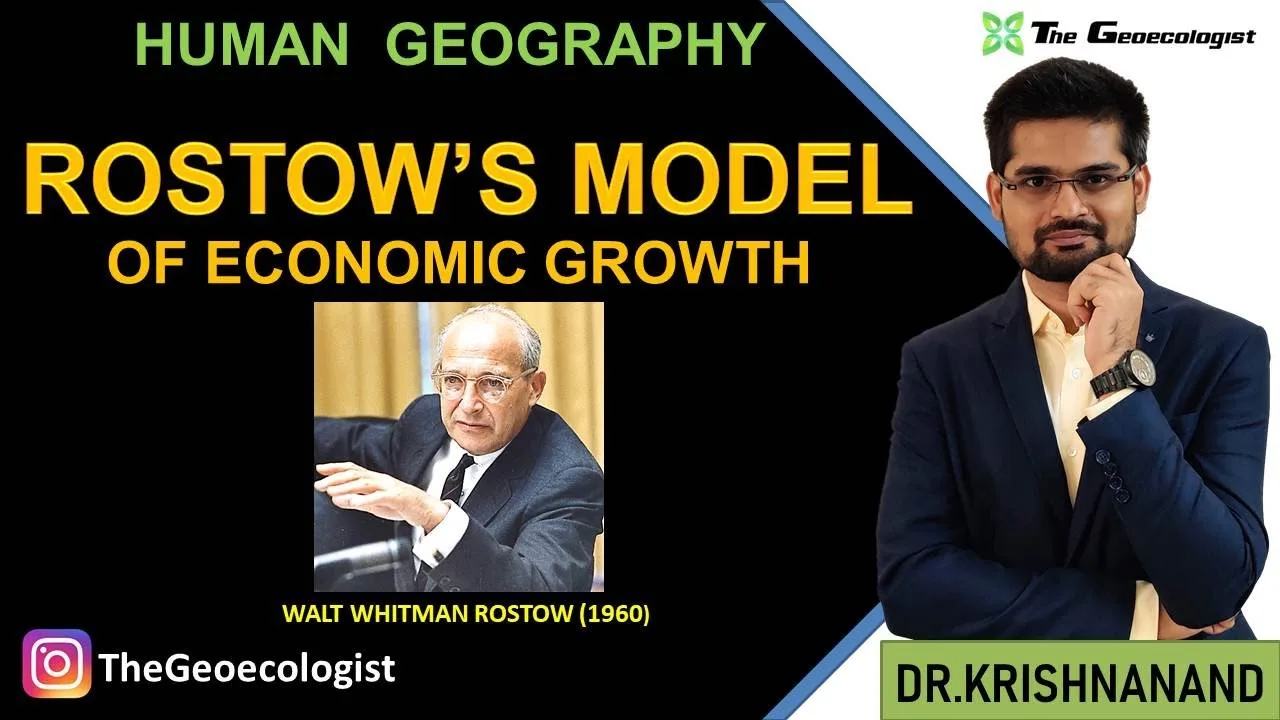
Table of Contents
- What Is the Rostow Model? Origin and Core Philosophy
- The Five Stages of the Rostow Model in Detail
- 1. Traditional Society
- 2. Preconditions for Take-off
- 3. Take-off: The Critical Threshold
- 4. Drive to Maturity
- 5. Age of High Mass Consumption
- Critical Evaluation: Strengths and Limitations of the Rostow Model
- Major Criticisms
- Enduring Contributions
- Rostow Model for UPSC Geography Optional: Preparation Strategy
- Contemporary Relevance and Alternative Frameworks
- Conclusion
The Rostow Model remains one of the most influential historical models of economic growth, widely studied in human geography and development economics. Formulated by American economist Walt Whitman Rostow in 1960, this linear theory outlines how traditional societies transform into modern industrial economies through five distinct stages. For UPSC Geography Optional aspirants, mastering the Rostow Model is essential, as it frequently appears in both Paper I (Human Geography) and Paper II (Indian Geography) examinations. This comprehensive guide breaks down each stage, evaluates critical criticisms, and explains its contemporary relevance for civil services preparation.
- Linear progression: The Rostow Model proposes five sequential stages from traditional society to high mass consumption.
- Investment threshold: Take-off requires 10-12% of national income invested in productive sectors.
- Structural transformation: Shift from agriculture to manufacturing to services defines maturity.
- Critiques include: Eurocentric bias, ignoring historical context, and oversimplifying complex development paths.
- UPSC relevance: Frequently tested in Geography Optional; useful for General Studies Paper III (Economy).
What Is the Rostow Model? Origin and Core Philosophy
Published in The Stages of Economic Growth: A Non-Communist Manifesto (1960), the Rostow Model emerged during the Cold War as a liberal-capitalist alternative to Marxist historical materialism. Walt Whitman Rostow, who later served as National Security Advisor to President Lyndon B. Johnson, argued that all societies pass through identical developmental phases regardless of culture, geography, or political system. The model reflects modernization theory’s core premise: development is a universal, linear process driven by technological innovation, capital accumulation, and institutional change.
Unlike dependency theorists who emphasized structural inequality, Rostow viewed underdevelopment as a temporary stage. His framework became a blueprint for Western foreign aid programs in the 1960s, particularly through institutions like the World Bank and USAID. For a primary source perspective, you can read Rostow’s original arguments on Wikipedia’s Walt Whitman Rostow page.
The Five Stages of the Rostow Model in Detail
1. Traditional Society
The first stage of the Rostow Model characterizes pre-Newtonian societies where production functions rely on pre-scientific technology. Agriculture dominates (75%+ of workforce), social hierarchy is rigid, and political power rests with landowning elites. Output per capita remains stagnant due to technological ceilings — think of feudal Europe, Mughal India, or pre-Meiji Japan. Limited surplus extraction prevents capital formation, while fatalistic values discourage innovation. Rostow estimated this stage persisted for millennia until the scientific revolution disrupted the equilibrium.
2. Preconditions for Take-off
This transitional phase (roughly 1760-1840 in Britain) sees the erosion of traditional constraints. Key developments include: (a) agricultural revolution releasing labor, (b) expansion of trade and markets, (c) emergence of banking and credit systems, (d) secular education spreading, and (e) entrepreneurial class formation. The Rostow Model emphasizes that external intrusion — colonization or trade — often triggers this stage in latecomer nations. Infrastructure investments (railways, ports) and political centralization create the physical and institutional scaffolding for industrialization.
3. Take-off: The Critical Threshold
The take-off stage represents the Rostow Model‘s most famous concept. Lasting 20-30 years, it requires: (1) investment rate rising from 5% to 10-12% of national income, (2) one or two leading sectors (textiles, railways, steel) driving growth, and (3) institutional framework supporting modern industry. Britain took off 1780-1800 (cotton, iron); USA 1843-1860 (railways); Japan 1878-1900 (silk, shipbuilding); India 1952-1965 (post-independence planning). The Rostovian take-off transforms growth from episodic to self-sustaining.
4. Drive to Maturity
Over 40-60 years, the economy diversifies beyond initial leading sectors. Technology becomes complex; new industries (chemicals, electrical, automotive) replace old ones. Investment exceeds 10% consistently. The workforce shifts from agriculture to industry; urbanization accelerates. Professional managers replace entrepreneurs. The Rostow Model predicts society applies technology to all sectors — agriculture mechanizes, services expand. By maturity’s end, the economy produces whatever it chooses, not merely what comparative advantage dictates.
5. Age of High Mass Consumption
The final stage sees per capita income surpass $3,000 (1960 prices). Leading sectors shift to durable consumer goods (automobiles, appliances) and services (healthcare, education, finance). Workforce majority enters services. Welfare state emerges; income redistribution becomes politically salient. Rostow identified USA (post-1920), Western Europe (post-1950), and Japan (post-1970) as entrants. Critics note this stage reflects 1950s American exceptionalism rather than universal destiny.
Critical Evaluation: Strengths and Limitations of the Rostow Model
Major Criticisms
- Historical determinism: The Rostow Model assumes identical sequences, ignoring path dependency. East Asian tigers (South Korea, Taiwan) compressed stages; resource-rich nations (Saudi Arabia) skipped manufacturing.
- Eurocentric bias: Stages mirror Western European history. Colonial exploitation — central to dependency theory (Andre Gunder Frank, Samir Amin) — is absent.
- Investment fetishism: The 10-12% threshold lacks empirical universality. Botswana grew with lower rates; Soviet Union invested heavily but stagnated.
- Institutional black box: The model treats institutions as outcomes, not causes. Daron Acemoglu and James Robinson (Why Nations Fail) argue inclusive institutions precede growth.
- Environmental blindness: No ecological constraints. Climate change makes the high-mass-consumption stage globally unsustainable.
Enduring Contributions
Despite flaws, the Rostow Model provides: (a) a vocabulary for structural transformation (take-off, leading sectors), (b) emphasis on savings-investment nexus (Harrod-Domar lineage), (c) recognition that development requires social-political preconditions, not just economics, and (d) a heuristic for comparing historical trajectories. The World Bank’s Economic Growth topic page still references structural transformation concepts rooted in Rostowian thinking.
Rostow Model for UPSC Geography Optional: Preparation Strategy
Geography Optional Paper I (Human Geography) explicitly includes “Models in Human Geography” — the Rostow Model alongside Demographic Transition, Von Thünen, Weber, and Christaller. Past questions (2018, 2020, 2022) asked: “Critically examine Rostow’s stages of growth with reference to developing countries” and “Explain the relevance of Rostow’s model in contemporary globalized economy.” Preparation tips:
- Memorize the five stages with approximate timeframes, investment rates, and leading sectors for Britain, USA, Japan, India.
- Prepare a 150-word critique covering dependency theory, Gunnar Myrdal’s circular causation, and sustainability critiques.
- Link to Indian context: Nehruvian planning as state-led take-off; 1991 reforms as second take-off; current service-led growth challenging manufacturing-centric stage sequence.
- Diagram practice: Draw the S-curve of growth with labeled stages — examiners reward visual answers.
Contemporary Relevance and Alternative Frameworks
Modern development economics has moved beyond the Rostow Model‘s linearity. The Lewis Model (dual-sector surplus labor), Rosenstein-Rodan’s Big Push, and Hirschman’s Unbalanced Growth offer complementary insights. New Structural Economics (Justin Lin) emphasizes comparative advantage upgrading. The UN’s Sustainable Development Goals (SDGs) replace the single-dimensional GDP trajectory with multidimensional well-being. Yet Rostow’s core insight — that development requires crossing critical thresholds of capital formation and technological adoption — remains embedded in infrastructure-led growth strategies across the Global South.
Conclusion
The Rostow Model endures not because it predicts accurately, but because it structures thinking about economic transformation. For UPSC aspirants, it is a mandatory topic that tests both factual recall and critical analysis. Master the stages, internalize the critiques, and practice applying the framework to India’s development experience. Combined with contemporary perspectives from the World Bank, UNCTAD, and NITI Aayog reports, the Rostow Model becomes a powerful analytical lens rather than a dated doctrine. Download our Simplified Human Geography eBook for diagram-ready notes and previous year solutions.
Frequently Asked Questions
The five stages are: (1) Traditional Society, (2) Preconditions for Take-off, (3) Take-off, (4) Drive to Maturity, and (5) Age of High Mass Consumption. Each stage represents a progressive shift in economic structure, technology, and social organization.
The Rostow Model is a core topic in the 'Models in Human Geography' section of Paper I. It has appeared repeatedly in UPSC Mains questions (2018, 2020, 2022) requiring critical analysis and application to developing countries like India.
Key criticisms include: Eurocentric historical bias, assumption of linear determinism, neglect of colonial exploitation, oversimplified investment threshold (10-12%), lack of institutional analysis, and environmental unsustainability of the high-consumption endpoint.