Blog
Perspective Shapes Reality: How Viewpoint Defines Truth

Table of Contents
- The Philosophical Foundations: Why Perspective Shapes Reality
- Protagoras and the Measure of All Things
- Phenomenology: The Lived Experience
- Constructivism and Social Reality
- Cognitive Science: How the Brain Makes Perspective Shape Reality
- Predictive Processing: The Brain as a Prediction Engine
- Confirmation Bias and Motivated Reasoning
- Framing Effects: The Power of Description
- Narrative Identity: The Story Perspective Shapes Reality
- Life as Story
- Redemptive vs. Contamination Sequences
- Perspective Shapes Reality in Conflict and Communication
- The Fundamental Attribution Error
- Perspective-Taking vs. Perspective-Getting
- Innovation and Problem-Solving: When Perspective Shapes Reality Creatively
- Reframing as a Creative Act
- The Outsider Advantage
- Leadership and Organizational Culture
- Growth Mindset: A Perspective That Shapes Reality
- Psychological Safety: The Perspective That Enables Truth
- Mental Health: Therapeutic Perspectives That Shape Reality
- Cognitive Behavioral Therapy (CBT)
- Acceptance and Commitment Therapy (ACT)
- Technology and Media: How Digital Perspectives Shape Reality
- Algorithmic Curation and Filter Bubbles
- Deepfakes and Synthetic Media
- Cultural and Cross-Cultural Perspectives
- Individualism vs. Collectivism
- Linguistic Relativity
- Practical Exercises: Cultivating Perspective Awareness
- 1. The "Five Perspectives" Technique
- 2. Perspective Journaling
- 3. Structured Perspective-Getting in Teams
- The Ethics of Perspective: Responsibility in a World Where Perspective Shapes Reality
- Frequently Asked Questions
- Does "perspective shapes reality" mean there is no objective truth?
- Can we ever escape our own perspective?
- How does "perspective shapes reality" apply to systemic injustice?
- Is there a danger in overemphasizing perspective?
- How can I teach children that perspective shapes reality?
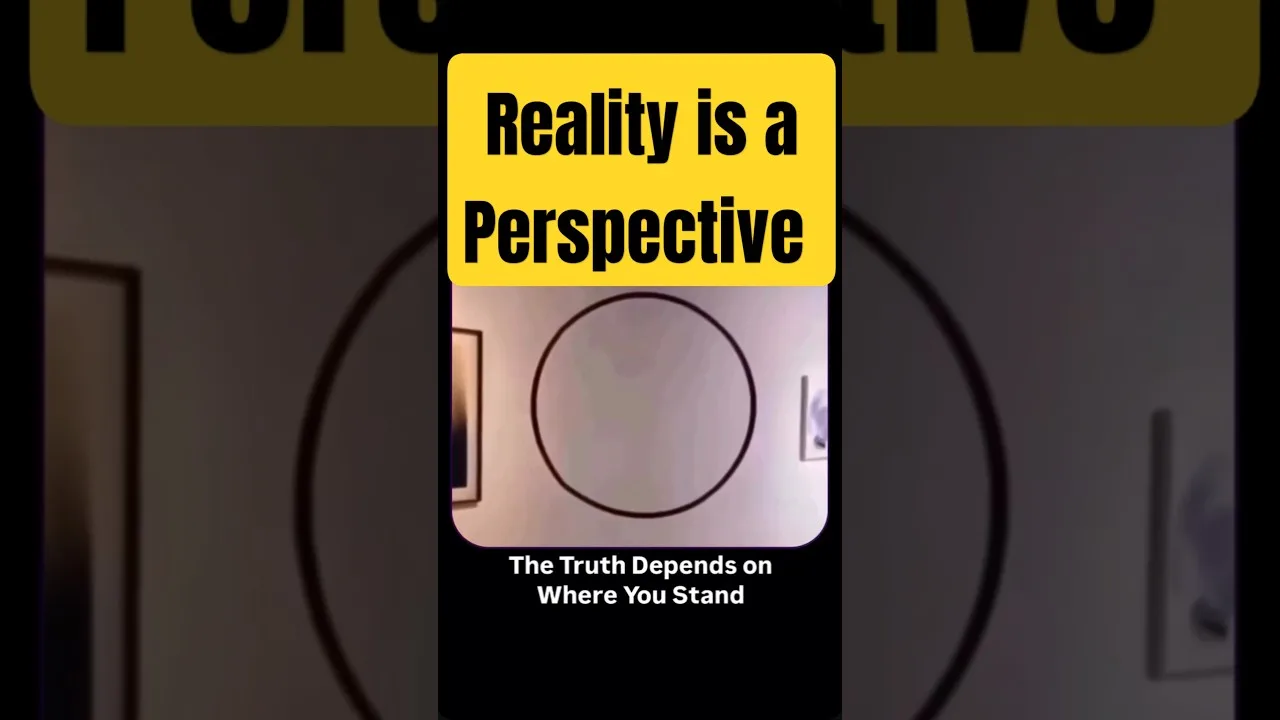
The ancient wisdom that perspective shapes reality has echoed through philosophy, psychology, and modern neuroscience for millennia. What we perceive as truth is rarely an objective absolute; rather, it is a construction filtered through the lens of our experiences, beliefs, and cognitive frameworks. This article explores the profound implications of the idea that perspective shapes reality, examining how shifting viewpoints can transform our understanding of the world, our relationships, and ourselves.
- Perspective shapes reality by acting as a cognitive filter that determines what we notice, how we interpret events, and what we remember.
- Philosophical traditions from relativism to phenomenology argue that objective truth is inaccessible without a subjective observer.
- Cognitive psychology demonstrates that perspective shapes reality through mechanisms like confirmation bias, framing effects, and narrative identity.
- Neuroscience reveals that the brain constructs reality predictively, meaning perspective shapes reality at the neural level before conscious awareness.
- Practical applications include conflict resolution, innovation, mental health, and leadership—all improved by consciously shifting perspective.
The Philosophical Foundations: Why Perspective Shapes Reality
Protagoras and the Measure of All Things
The Greek sophist Protagoras famously declared, “Man is the measure of all things.” This early articulation suggests that perspective shapes reality because there is no privileged, God’s-eye view available to humans. Every observation is situated—embedded in a specific time, place, culture, and sensory apparatus. Plato objected, arguing for eternal Forms, but the debate persists. Modern philosophers like Richard Rorty and Hilary Putnam have revived pragmatic and internal realist positions, asserting that perspective shapes reality in ways that make “objectivity” a social achievement rather than a metaphysical given.
Phenomenology: The Lived Experience
Edmund Husserl and Maurice Merleau-Ponty developed phenomenology to study how perspective shapes reality through embodied consciousness. Merleau-Ponty’s Phenomenology of Perception (1945) argues that we never encounter the world “in itself”; we encounter it through a body that has habits, skills, and a spatial orientation. The same mountain looks different to a geologist, a climber, and a painter—not merely in interpretation but in perceptual salience. This insight, that perspective shapes reality at the level of perception itself, bridges philosophy and cognitive science.
Constructivism and Social Reality
Peter Berger and Thomas Luckmann’s The Social Construction of Reality (1966) demonstrated that perspective shapes reality collectively. Institutions, money, laws, and even scientific facts gain their force through shared perspectives maintained by social processes. When a society’s perspective shifts—as with the abolition of slavery or the recognition of same-sex marriage—reality itself changes. This shows that perspective shapes reality not just individually but structurally.
Cognitive Science: How the Brain Makes Perspective Shape Reality
Predictive Processing: The Brain as a Prediction Engine
Contemporary neuroscience, particularly the predictive processing framework championed by Karl Friston and Andy Clark, reveals that perspective shapes reality at the neural level. The brain does not passively receive sensory data; it actively generates predictions based on prior beliefs (priors) and updates them with prediction errors. What we consciously experience is the brain’s best guess—its controlled hallucination. This means perspective shapes reality before we even “see” it. Two people with different priors will literally perceive different realities from identical sensory input.
Confirmation Bias and Motivated Reasoning
Psychological research since the 1960s (Wason, Lord, Ross, Lepper) has documented how perspective shapes reality through confirmation bias: we seek, interpret, and remember evidence that supports our existing views. Motivated reasoning extends this—when identity or emotion is at stake, perspective shapes reality even more powerfully. Kahan’s cultural cognition studies show that numerate individuals polarize further on climate change data when it threatens their cultural identity. Here, perspective shapes reality so strongly that intelligence amplifies distortion rather than correcting it.
Framing Effects: The Power of Description
Tversky and Kahneman’s Nobel-winning work on framing demonstrated that perspective shapes reality through language. A medical treatment described as “90% survival” is chosen over “10% mortality” despite logical equivalence. The frame—a perspective on the same facts—alters decisions. In negotiation, medicine, and policy, understanding that perspective shapes reality via framing is essential for ethical communication and effective choice architecture.
Narrative Identity: The Story Perspective Shapes Reality
Life as Story
Dan McAdams’ narrative identity theory posits that humans construct unity and purpose by integrating life events into an evolving story. This story is a perspective, and perspective shapes reality by determining which events become “turning points” and which fade into background. A job loss framed as “catastrophe” versus “catalyst for entrepreneurship” leads to different physiological stress responses, different future behaviors, and ultimately different life trajectories. The perspective is not merely descriptive; it is generative.
Redemptive vs. Contamination Sequences
Research shows that people whose life stories feature redemptive sequences (bad events leading to growth) report higher well-being than those with contamination sequences (good events ruined by bad ones). Both may describe identical events; the perspective differs. This proves that perspective shapes reality in measurable psychological and physiological outcomes. Therapeutic approaches like narrative therapy and cognitive restructuring explicitly leverage this: change the story, change the lived reality.
Perspective Shapes Reality in Conflict and Communication

The Fundamental Attribution Error
When others err, we attribute it to character (“they’re lazy”); when we err, we cite circumstances (“I was tired”). This asymmetry—fundamental attribution error—shows how perspective shapes reality in social judgment. Perspective-taking interventions (imagining the other’s situation) reduce this bias. In divorce mediation, international diplomacy, and workplace disputes, training that perspective shapes reality for all parties transforms zero-sum conflicts into integrative solutions.
Perspective-Taking vs. Perspective-Getting
Eyal, Steffel, and Epley (2018) distinguished perspective-taking (imagining another’s view) from perspective-getting (actually asking). Their experiments found that perspective-getting dramatically improves accuracy, while perspective-taking often increases confidence without accuracy. This distinction matters because assuming perspective shapes reality for others without verification creates false empathy. Effective leaders and negotiators practice perspective-getting: “Help me see it from your side.”
Innovation and Problem-Solving: When Perspective Shapes Reality Creatively
Reframing as a Creative Act
Design thinking begins with reframing—deliberately shifting the problem definition. IDEO’s redesign of the shopping cart started not with “better cart” but “better shopping experience.” This shift in perspective generated radically different solutions. Research on functional fixedness (Duncker, 1945) shows that perspective shapes reality by constraining or expanding the solution space. Experts often suffer more fixedness; beginners’ perspectives see novel uses. Organizations that cultivate diverse perspectives outperform homogeneous ones on innovation metrics (Page, 2007).
The Outsider Advantage
Historical analysis of scientific breakthroughs (Kuhn, 1962; Simonton, 2004) reveals that paradigm shifts often come from outsiders or interdisciplinary thinkers whose perspectives differ from the dominant framework. Einstein, a patent clerk, questioned absolute time—a perspective shaped by his distance from academic physics. This demonstrates that perspective shapes reality at the frontier of knowledge: the questions we can ask depend on the perspective we inhabit.
Leadership and Organizational Culture
Growth Mindset: A Perspective That Shapes Reality
Carol Dweck’s mindset research shows that believing abilities are developable (growth mindset) versus fixed (fixed mindset) alters learning trajectories. Students taught that “the brain grows with effort” improve grades; managers with growth mindsets mentor more effectively. Here, perspective shapes reality by changing behavior, which changes outcomes, which reinforces the perspective—a self-fulfilling prophecy. Microsoft’s cultural transformation under Satya Nadella, from “know-it-all” to “learn-it-all,” exemplifies organizational application.
Psychological Safety: The Perspective That Enables Truth
Google’s Project Aristotle found that psychological safety—shared belief that the team is safe for interpersonal risk-taking—was the top predictor of team effectiveness. When members believe “my perspective won’t be punished,” they share dissenting views, catching errors early. This creates a culture where perspective shapes reality constructively: diverse perspectives surface, integrate, and produce better decisions. Amy Edmondson’s work shows this is not “being nice” but a rigorous perspective on learning from failure.
Mental Health: Therapeutic Perspectives That Shape Reality
Cognitive Behavioral Therapy (CBT)
CBT, developed by Aaron Beck in the 1960s, is built on the premise that perspective shapes reality in depression and anxiety. Automatic thoughts (“I’m a failure”) are not facts but perspectives. CBT teaches patients to identify, evaluate, and modify these perspectives. Meta-analyses confirm CBT’s efficacy across disorders. The mechanism: changing perspective changes emotional reality, which changes behavior, which changes life circumstances. This is perspective shapes reality as clinical intervention.
Acceptance and Commitment Therapy (ACT)
ACT, developed by Steven Hayes, takes a different approach: rather than disputing perspectives, it changes the relationship to them. “I’m having the thought that I’m a failure” creates distance. This cognitive defusion demonstrates that perspective shapes reality not only through content but through stance. Mindfulness-based therapies similarly show that observing perspectives without fusion alters their impact. The perspective on perspectives shapes reality.
Technology and Media: How Digital Perspectives Shape Reality
Algorithmic Curation and Filter Bubbles
Social media algorithms optimize engagement by showing content that confirms existing perspectives. Pariser’s “filter bubble” and Sunstein’s “echo chamber” concepts describe how perspective shapes reality digitally: the perspective fed to us shapes the reality we inhabit. Studies show algorithmic personalization increases political polarization and reduces shared factual baselines. When perspective shapes reality through opaque code, democratic discourse suffers. Regulation (EU’s Digital Services Act) and platform redesign (chronological feeds, perspective diversity nudges) attempt to counter this.
Deepfakes and Synthetic Media
Generative AI now creates photorealistic fake videos, audio, and text. This technology means perspective shapes reality can be weaponized: a fabricated perspective (“the candidate said X”) becomes social reality for millions before debunking. The “liar’s dividend”—real evidence dismissed as fake—further erodes shared reality. Media literacy, provenance standards (C2PA), and detection tools are responses, but the arms race continues. Understanding that perspective shapes reality is now a survival skill in the information environment.
Cultural and Cross-Cultural Perspectives
Individualism vs. Collectivism
Cultural psychology (Markus & Kitayama, 1991; Nisbett, 2003) documents how perspective shapes reality across cultures. Western independent selves attend to focal objects, categorize analytically, and attribute behavior to traits. East Asian interdependent selves attend to context, categorize relationally, and attribute behavior to situations. These are not mere opinions; eye-tracking and fMRI studies show perceptual differences. The same scene is literally seen differently. This research proves that perspective shapes reality at the most basic cognitive levels, shaped by cultural practices.
Linguistic Relativity
The Sapir-Whorf hypothesis—that language shapes thought—has empirical support in domains like color perception (Russian speakers distinguish goluboy and siniy blues faster), spatial reasoning (Guugu Yimithirr speakers use absolute cardinal directions), and time metaphors (Mandarin vertical, English horizontal). These linguistic perspectives shape cognitive reality. While strong determinism is rejected, weak relativity is robust: perspective shapes reality through the semantic tools a language provides.
Practical Exercises: Cultivating Perspective Awareness
1. The “Five Perspectives” Technique
When facing a challenging situation, deliberately generate five distinct perspectives: (a) your current view, (b) the opposite view, (c) a neutral observer, (d) your future self in 10 years, (e) someone you admire. Write each out. This exercise makes visible how perspective shapes reality by showing the multiplicity of valid interpretations for identical facts.
2. Perspective Journaling
Daily, record one event and three possible interpretations. Over weeks, patterns emerge: you may default to threat, victimhood, or opportunity perspectives. Awareness creates choice. Research on expressive writing (Pennebaker) shows this practice improves immune function and well-being—perspective shapes reality biologically.
3. Structured Perspective-Getting in Teams
In meetings, assign a “devil’s advocate” role rotating weekly. Use “pre-mortems” (Klein): imagine the project failed; each member writes why. This legitimizes dissenting perspectives, countering groupthink. Google’s “disagree and commit” culture operationalizes the principle that perspective shapes reality best when all perspectives are heard before commitment.
The Ethics of Perspective: Responsibility in a World Where Perspective Shapes Reality
If perspective shapes reality, we bear responsibility for the perspectives we cultivate, amplify, and impose. Parents shape children’s reality through the perspectives they model. Leaders shape organizational reality through the narratives they authorize. Algorithms shape societal reality through the perspectives they promote. This is not relativism—”anything goes”—but perspectival realism”: reality exists, but our access is always perspectival. The ethical task is to cultivate perspectives that are more inclusive, more accurate, more compassionate, and more conducive to flourishing.
Philosopher Iris Murdoch wrote: “We can only learn to see by looking at what is not ourselves.” This captures the paradox and the promise: perspective shapes reality, but we can choose perspectives that expand rather than contract our vision. In a polarized, algorithmically fragmented world, this capacity—perspectival flexibility grounded in epistemic humility—may be the defining skill of the 21st century.
Frequently Asked Questions
Does “perspective shapes reality” mean there is no objective truth?
No. It means our access to truth is always mediated by perspective. The mountain exists regardless of the geologist, climber, or painter—but what each sees, values, and understands differs. Science progresses by triangulating multiple perspectives (methods, disciplines, cultures) to approach objectivity asymptotically. Perspective shapes reality epistemically, not necessarily ontologically.
Can we ever escape our own perspective?
Not completely—we are embodied, situated beings. But we can expand our perspective through travel, reading, dialogue, art, and deliberate practice. The goal is not a “view from nowhere” (impossible) but a “view from somewhere richer.” Cognitive flexibility—the ability to hold and switch perspectives—is trainable and correlates with wisdom measures.
How does “perspective shapes reality” apply to systemic injustice?
Power determines which perspectives become “reality” (law, curriculum, media norms). Marginalized perspectives are often excluded, making injustice invisible to the dominant perspective. Social movements succeed by forcing perspective shifts: civil rights media coverage made Northern whites “see” Southern brutality; #MeToo shifted the perspective on harassment from “personal problem” to “systemic pattern.” Here, perspective shapes reality politically: changing the dominant perspective changes material conditions.
Is there a danger in overemphasizing perspective?
Yes. Radical constructivism can slide into nihilism (“nothing matters, it’s all perspective”) or gaslighting (“your trauma is just your perspective”). The remedy is distinguishing perspective on facts from perspective as substitute for facts. Climate change occurs regardless of perspective; the perspective shapes response, not the physics. Ethical use of “perspective shapes reality” respects empirical constraints while honoring interpretive plurality.
How can I teach children that perspective shapes reality?
Use concrete exercises: read the same story from different characters’ viewpoints (The True Story of the Three Little Pigs); have them photograph the same object from five angles; play “devil’s advocate” at dinner. Model perspective language: “From my perspective…” “I wonder how it looks from…” Research shows children as young as 4 can grasp perspective difference; by 7-8, they understand interpretive frameworks. Early practice builds cognitive flexibility for life.
Frequently Asked Questions
No. It means our access to truth is always mediated by perspective. The mountain exists regardless of the geologist, climber, or painter—but what each sees, values, and understands differs. Science progresses by triangulating multiple perspectives to approach objectivity asymptotically.
Not completely—we are embodied, situated beings. But we can expand our perspective through travel, reading, dialogue, art, and deliberate practice. The goal is not a 'view from nowhere' but a 'view from somewhere richer.' Cognitive flexibility is trainable and correlates with wisdom measures.
Power determines which perspectives become 'reality' (law, curriculum, media norms). Marginalized perspectives are often excluded, making injustice invisible. Social movements succeed by forcing perspective shifts: civil rights coverage made Northern whites 'see' Southern brutality; #MeToo shifted harassment from 'personal problem' to 'systemic pattern.'