Blog
UPSC Prelims 2024 Geography: Complete Preparation Guide


Table of Contents
- Decoding the UPSC Prelims 2024 Geography Syllabus
- Physical Geography: The Conceptual Bedrock
- Indian Geography: The High-Yield Zone
- Physiographic Divisions and Drainage Systems
- Climate, Soil, and Natural Vegetation
- Mineral and Energy Resources
- Environment and Ecology: The Game Changer
- Biodiversity Conservation Framework
- Environmental Legislations and International Conventions
- Climate Change Mitigation and Adaptation
- Map-Based Questions: Precision Practice
- Curated Resource Repository
- Core Textbooks (Non-Negotiable)
- Environment Specific
- Current Affairs Integration
- Three-Tier Revision Architecture
- Daily Revision (30 minutes)
- Weekly Revision (2 hours)
- Monthly Revision (6-8 hours)
- Mock Test Strategy and PYQ Analysis
- Common Pitfalls and Strategic Corrections
- Final 90-Day Sprint Plan (January-March 2024)
- Conclusion
The UPSC Prelims 2024 Geography section remains one of the most scoring yet challenging components of the Civil Services Preliminary Examination. With the Union Public Service Commission consistently allocating 15-20 questions annually to Geography and Environment combined, aspirants cannot afford superficial preparation. This comprehensive guide, curated by the expert faculty team at Shield IAS under The Geoecologist initiative, provides a structured roadmap to master every dimension of the syllabus — from physical geography fundamentals to contemporary environmental legislations.
- Syllabus Mastery: Complete coverage of Physical, Indian, and World Geography as per official UPSC notification
- Environment Integration: Seamless blending of Ecology, Biodiversity, and Climate Change with core geography concepts
- Map-Based Precision: Targeted practice for location-based questions that constitute 20-25% of geography questions
- Current Affairs Linkage: Connecting static concepts with recent developments like COP28, IPCC reports, and national missions
- Resource Optimization: Curated booklist, PDF repositories, and video lectures from The Geoecologist YouTube channel
- Revision Framework: 3-tier revision strategy (daily, weekly, monthly) with mock test integration
Decoding the UPSC Prelims 2024 Geography Syllabus
The official UPSC notification delineates Geography into three broad categories: Physical Geography, Human Geography, and Geography of India. However, the UPSC Prelims 2024 Geography trend analysis reveals that Physical Geography and Indian Geography dominate with approximately 60% weightage. The Environment section, though technically separate, overlaps significantly with topics like biomes, soil types, natural hazards, and climate systems. Aspirants must approach these as an integrated continuum rather than isolated silos.
Physical Geography: The Conceptual Bedrock
Physical Geography forms the theoretical foundation upon which applied geography rests. Key sub-topics demanding rigorous preparation include:
Geomorphology and Landform Evolution
Questions on plate tectonics, volcanic activity, earthquake distribution, and resultant landforms appear consistently. The 2023 paper featured a question on the Pacific Ring of Fire’s geological significance. Aspirants should master:
- Continental Drift Theory vs. Plate Tectonics — evidence and mechanisms
- Classification of mountains (fold, block, volcanic, residual) with Indian examples
- Cycle of erosion — Davis vs. Penck models and their limitations
- Karst topography, glacial landforms, and coastal features with locational mapping
Climatology: Atmospheric Dynamics and Weather Systems
Climatology contributes 4-6 questions annually. The UPSC Prelims 2024 Geography preparation must prioritize:
- Insolation, heat budget, and temperature inversion phenomena
- Pressure belts, planetary winds, and monsoon mechanisms (especially Indian Monsoon)
- Cyclone formation — tropical vs. temperate, naming conventions, and disaster management
- Climate classification (Köppen, Thornthwaite) and climate change indicators
Oceanography: The Blue Planet Dimension
Ocean relief, temperature-salinity distribution, currents, and marine resources form the core. Recent emphasis on Blue Economy and UNCLOS provisions makes this section increasingly relevant. Map-based identification of major currents (Gulf Stream, Kuroshio, Humboldt, Agulhas) and their climatic impacts is essential. – a key consideration for UPSC Prelims 2024 Geography.
Indian Geography: The High-Yield Zone
Indian Geography consistently yields 8-12 questions in the UPSC Prelims 2024 Geography paper. The Shield IAS team recommends a region-wise approach complemented by thematic mapping.
Physiographic Divisions and Drainage Systems
India’s six physiographic divisions — Himalayas, Northern Plains, Peninsular Plateau, Coastal Plains, Islands, and Thar Desert — each carry distinct geological, climatic, and ecological characteristics. The Himalayan drainage (Indus, Ganga, Brahmaputra) versus Peninsular drainage (Godavari, Krishna, Cauvery, Mahanadi) comparison is a perennial favorite. Aspirants must memorize: – a key consideration for UPSC Prelims 2024 Geography.
- Major tributaries, confluence points, and hydroelectric projects on each river
- Interlinking of rivers — Ken-Betwa, Damanganga-Pinjal, and Par-Tapi-Narmada projects
- Wetland conservation sites under Ramsar Convention (India has 75+ sites as of 2024)
Climate, Soil, and Natural Vegetation
The Indian Monsoon’s onset, advance, withdrawal, and variability (El Niño/La Niña/Indian Ocean Dipole correlations) require conceptual clarity backed by data from IMD reports. Soil types (alluvial, black, red, laterite, arid, forest/mountain) with their crop suitability and degradation issues link directly to agriculture geography. Natural vegetation classification (tropical evergreen, deciduous, thorn, montane, mangrove) must be mapped to biosphere reserves and national parks. – a key consideration for UPSC Prelims 2024 Geography.
Mineral and Energy Resources
Distribution of iron ore, manganese, bauxite, copper, coal, petroleum, and atomic minerals across geological formations (Dharwar, Cuddapah, Vindhyan, Gondwana, Tertiary) is frequently tested. The shift toward critical minerals (lithium, cobalt, rare earths) for energy transition and India’s Khanij Bidesh India Ltd. (KABIL) initiative add contemporary relevance. – a key consideration for UPSC Prelims 2024 Geography.
Environment and Ecology: The Game Changer
Since 2011, Environment has emerged as a decisive section. The UPSC Prelims 2024 Geography strategy must treat Ecology as applied geography. The Shield IAS Environmental Legislations lecture (available at The Geoecologist YouTube channel) provides exhaustive coverage of legal frameworks.
Biodiversity Conservation Framework
India’s biodiversity hotspots (Himalaya, Indo-Burma, Western Ghats, Sundaland) and their endemic species, protected area network (106 national parks, 573 wildlife sanctuaries, 105 conservation reserves, 220 community reserves as per Wildlife Institute of India 2024 data), and species-specific projects (Project Tiger, Project Elephant, Project Dolphin, Project Great Indian Bustard) form the static core. The Wildlife Protection Act 1972 amendments (2002, 2006, 2022) and the Biological Diversity Act 2002 with 2023 amendments require section-wise study. – a key consideration for UPSC Prelims 2024 Geography.
Environmental Legislations and International Conventions
This sub-section yields 3-5 direct questions annually. Priority legislation includes:
- Environment Protection Act 1986 — umbrella legislation with EIA Notification 2006 (and 2020 draft)
- Air (Prevention and Control of Pollution) Act 1981 and Water Act 1974
- Forest Conservation Act 1980 with 2023 amendments
- National Green Tribunal Act 2010 — landmark judgments
International conventions — UNFCCC (Paris Agreement, COP28 UAE Consensus), CBD (Kunming-Montreal Global Biodiversity Framework), UNCCD, Montreal Protocol (Kigali Amendment), Basel/Rotterdam/Stockholm Conventions — must be tracked for recent COP outcomes.
Climate Change Mitigation and Adaptation
India’s Nationally Determined Contributions (NDCs) updated in 2022 (45% emission intensity reduction by 2030, 50% non-fossil fuel capacity), National Action Plan on Climate Change (8 missions), and state action plans form the policy backbone. Concepts like carbon credits, green hydrogen mission, LiFE (Lifestyle for Environment), and Mission LiFE are examinable.
Map-Based Questions: Precision Practice
Approximately 20-25% of UPSC Prelims 2024 Geography questions are map-based. The Shield IAS Telegram channel (t.me/geoecologist) provides downloadable PDF maps for daily practice. Focus areas:
- India political — states, capitals, major cities, border disputes
- India physical — mountain peaks, passes, lakes, rivers, dams, wetlands
- World physical — mountain ranges, deserts, oceans, currents, biomes
- World political — countries in news, strategic locations, trade routes
- Protected areas — national parks, tiger reserves, biosphere reserves, Ramsar sites
Daily 10-minute map marking using Oxford Student Atlas or Orient BlackSwan Atlas builds spatial memory. The Geoecologist paid courses at thegeoecologist.com include dedicated map mastery modules.
Curated Resource Repository
Resource overload is a common pitfall. The Shield IAS team recommends this minimal, high-impact booklist:
Core Textbooks (Non-Negotiable)
- NCERT Class VI-XII — Old + New (Geography: 6-10, 11-12 Fundamentals of Physical Geography, India Physical Environment, India People and Economy)
- Certificate Physical and Human Geography by G.C. Leong — Chapters 1-25 (selective reading)
- India: A Comprehensive Geography by D.R. Khullar — Reference for data and maps
Environment Specific
- Environment by Shankar IAS (latest edition) — Bible for ecology section
- India Year Book 2024 — Chapters on Environment, Water Resources, Energy
- Economic Survey 2023-24 Volume 2 — Climate Change and Sustainable Development chapter
Current Affairs Integration
- The Hindu / Indian Express — Daily geography/environment news tracking
- Down To Earth magazine — Fortnightly deep dives
- PIB releases — Government schemes, missions, international agreements
- Yojana/Kurukshetra — Special issues on water, agriculture, climate
Three-Tier Revision Architecture
Retention is the biggest challenge in UPSC Prelims 2024 Geography preparation. The Geoecologist faculty advocates:
Daily Revision (30 minutes)
- Flashcards for definitions, conventions, species names, park locations
- One map marking exercise (5 locations)
- Current affairs geography/environment snippets
Weekly Revision (2 hours)
- One full topic revision (e.g., Indian Monsoon or Biodiversity Conservation)
- 10-15 previous year questions (PYQs) topic-wise
- Mock test analysis — error log maintenance
Monthly Revision (6-8 hours)
- Full syllabus sweep using mind maps and flowcharts
- Full-length mock test under exam conditions
- Weak area identification and targeted remediation
Mock Test Strategy and PYQ Analysis
Previous Year Questions (1995-2023) are the single most reliable predictor of UPSC Prelims 2024 Geography patterns. The Shield IAS analysis reveals:
- Conceptual clarity > Rote memorization (70% questions test application)
- Interdisciplinary links — Geography + Economy + Polity + Science
- Elimination technique mastery — 50% questions solvable via smart elimination
- Assertion-Reason and Statement-based questions increasing (30% of geography)
Enroll in a reputable test series (Vision IAS, InsightsIAS, ForumIAS, or Shield IAS) by January 2024. Attempt 30+ full-length tests. Post-test analysis must categorize errors as: conceptual gap, factual gap, misreading, or silly mistake.
Common Pitfalls and Strategic Corrections
| Pitfall | Correction |
|---|---|
| Ignoring NCERTs for advanced books | NCERTs are the source for 40% direct questions. Read them 3 times. |
| Treating Geography and Environment separately | Integrate: Study Western Ghats biodiversity WITH physiography and monsoon. |
| Neglecting map practice | Daily 10-minute map marking is non-negotiable. Use blank political/physical maps. |
| Over-reliance on current affairs without static base | Current affairs only make sense ON a strong static foundation. Static first. |
| Skipping Environmental Legislations | High ROI section. 3-5 guaranteed questions. Watch The Geoecologist lecture. |
| Passive reading without active recall | Use Feynman technique: Explain concepts aloud as if teaching a peer. |
Final 90-Day Sprint Plan (January-March 2024)
For aspirants entering the final stretch, the Shield IAS team recommends this intensive schedule:
- January: Complete Physical Geography + Indian Physical Geography + Map Practice (Daily 3 hrs)
- February: Indian Human/Economic Geography + Environment/ Ecology + Legislations (Daily 3.5 hrs)
- March: Full syllabus revision + 20 Full Mocks + PYQ Marathon + Error Log Resolution (Daily 4-5 hrs)
Weekends reserved for full-length mocks and weekly revision. The last 15 days before Prelims: Only revision, mocks, and map practice. Zero new material.
Conclusion
The UPSC Prelims 2024 Geography section rewards systematic, integrated, and map-centric preparation over fragmented memorization. The Shield IAS team, through The Geoecologist platform, has distilled years of teaching experience into this roadmap. Leverage the free resources — YouTube lectures, Telegram PDFs, website articles — and consider the paid courses for structured mentorship. Remember: Geography is not about memorizing facts; UPSC Prelims 2024 Geography’s about understanding spatial relationships and processes. Master the ‘why’ and ‘where’, and the ‘what’ follows naturally. Your success in UPSC Prelims 2024 begins with the first map you mark today.
For personalized guidance, contact the Shield IAS team at krishna.geography@gmail.com or visit shieldias.in. Follow @thegeoecologist on Instagram for daily geography snippets and map practice.
Frequently Asked Questions
Historically, UPSC asks 15-20 questions from Geography and Environment combined in the Prelims paper. Physical Geography and Indian Geography typically contribute 8-12 questions, while Environment and Ecology contribute 7-10 questions. The exact distribution varies annually but the combined weightage remains significant.
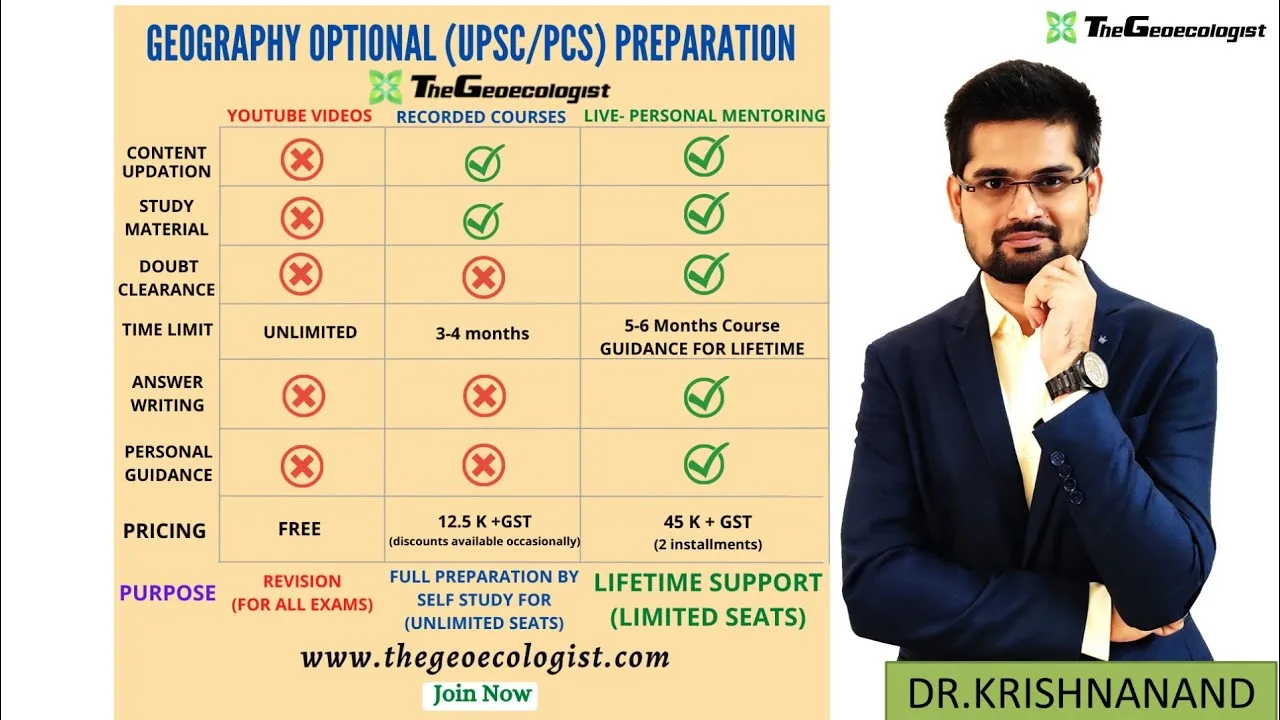
NCERTs (Class VI-XII) form the indispensable foundation and source for approximately 40% of direct questions. However, they must be supplemented with G.C. Leong for Physical Geography concepts, a standard atlas for map practice, Shankar IAS Environment for ecology, and current affairs for recent developments. NCERTs are necessary but not sufficient alone.
Daily 10-minute map marking using Oxford or Orient BlackSwan atlas is essential. Focus on: Indian states/capitals, major rivers/dams/lakes, mountain peaks/passes, national parks/tiger reserves/biosphere reserves/Ramsar sites, and world physical features (mountains, deserts, currents). Practice locating places in news. The Geoecologist Telegram channel provides free downloadable map PDFs for practice.