Blog
UPSC Answer Writing Tips: Master the Art of Scoring High in Mains

Table of Contents
- Why UPSC Answer Writing Tips from The Geoecologist Stand Out
- The Core Philosophy: Examiner-Centric Writing
- Deconstructing the Perfect Answer Structure
- 1. The Hook: Contextual Introduction (10–15% word limit)
- 2. The Meat: Multi-Dimensional Body (70–75% word limit)
- 3. The Visual Edge: Diagrams, Maps, Flowcharts
- 4. The Close: Forward-Looking Conclusion (10–15% word limit)
- Subject-Specific UPSC Answer Writing Tips
- Geography & Environment: The Geoecologist's Forte
- General Studies Paper II & III: Governance & Economy
- Ethics Paper: The Differentiator
- Time Management: The Silent Rank Decider
- Weekly Answer Writing Schedule (6-Month Plan)
- Common Pitfalls The Geoecologist Warns Against
- Leveraging Technology & Resources
- The Geoecologist's Resource Ecosystem
- Psychological Preparation: Writing Under Pressure
- Success Stories: Proof of Concept
- Final Checklist Before You Enter the Exam Hall
UPSC answer writing tips from Dr. Krishnanand, popularly known as The Geoecologist, have transformed how thousands of aspirants approach the Civil Services Mains examination. As one of India’s most respected geography mentors, his structured methodology emphasizes clarity, conciseness, and conceptual depth — the three pillars that separate top-rankers from the rest. Whether you are a beginner attempting your first Mains or a veteran looking to break the interview barrier, mastering answer writing is non-negotiable. The Union Public Service Commission evaluates not just knowledge but the ability to articulate it within strict word and time limits, making strategic answer composition a skill as critical as the syllabus itself.
- Structure matters more than length: Follow the Introduction-Body-Conclusion framework religiously.
- Keywords are your scoring currency: Embed subject-specific terminology, constitutional articles, and data points.
- Diagrams and maps fetch easy marks: Especially in Geography, Environment, and Disaster Management.
- Time management is a force multiplier: Allocate minutes per question proportionally to marks.
- Practice with previous year papers: Simulate exam conditions weekly from 6 months before Mains.
Why UPSC Answer Writing Tips from The Geoecologist Stand Out
Dr. Krishnanand’s UPSC answer writing tips have gained a cult following because they bridge the gap between academic knowledge and examiner expectations. Unlike generic advice, his approach is rooted in the Civil Services Examination evaluation rubric — where presentation, structure, and relevance weigh as heavily as content. The Geoecologist’s YouTube channel, with over 500,000 subscribers as of 2024, demonstrates techniques through live answer writing sessions, model answer deconstructions, and subject-specific frameworks for Geography, Environment, and General Studies.
The Core Philosophy: Examiner-Centric Writing
Every UPSC answer writing tips session by The Geoecologist begins with a fundamental mindset shift: write for the examiner, not for yourself. An examiner spends 60–90 seconds per answer. They scan for keywords, structure, diagrams, and a clear conclusion. Dr. Krishnanand teaches aspirants to “signpost” answers — using subheadings, underlining, and bullet points to guide the examiner’s eye. This technique, validated by multiple toppers including AIR-1 candidates from 2021–2023, ensures that even if an examiner reads diagonally, they capture the essence of your argument.
Deconstructing the Perfect Answer Structure
A high-scoring UPSC Mains answer follows a universal architecture. The UPSC answer writing tips framework breaks it into four non-negotiable components:
1. The Hook: Contextual Introduction (10–15% word limit)
Open with a definition, a constitutional provision, a recent event, or a striking statistic. For a question on “Urban Flooding in India,” start with: “According to the NDMA, urban flooding incidents have increased 3x since 2000, with 2023 alone witnessing 14 major metro flooding events.” This signals awareness, data literacy, and relevance instantly.
2. The Meat: Multi-Dimensional Body (70–75% word limit)
Deploy the UPSC answer writing tips principle of “PEEL” — Point, Evidence, Explanation, Link. Each paragraph addresses one dimension: social, economic, political, environmental, ethical, or governance. Use subheadings like “Administrative Challenges,” “Climate Change Linkages,” “Governance Gaps.” Integrate government schemes (AMRUT, Smart Cities Mission), committee recommendations (Kasturirangan, Gadgil), and Supreme Court judgments to add authority.
3. The Visual Edge: Diagrams, Maps, Flowcharts
Geography and Environment answers are incomplete without visuals. The Geoecologist’s UPSC answer writing tips mandate at least one diagram per 10-mark question and two per 15-mark question. Sketch a drainage basin map for river interlinking, a flowchart for disaster management cycle, or a mind-map for sustainable development goals interlinkages. Neat, labeled diagrams can fetch 2–3 marks outright.
4. The Close: Forward-Looking Conclusion (10–15% word limit)
Never end abruptly. Conclude with a “Way Forward” — policy suggestions, behavioral nudges, technology integration, or international best practices. For urban flooding: “Adopting Singapore’s ABC Waters Programme and integrating sponge city concepts into AMRUT 2.0 can build climate-resilient urban infrastructure.” This demonstrates solution-oriented thinking — a trait UPSC explicitly rewards.
Subject-Specific UPSC Answer Writing Tips
Geography & Environment: The Geoecologist’s Forte
Dr. Krishnanand’s UPSC answer writing tips for Geography revolve around three mantras: “Map it, Data it, Link it.” Every answer on monsoons, cyclones, or soil degradation must include a rough sketch map of India with relevant annotations. Quote IMD reports, IPCC assessments, and State of Forest Reports. Link static concepts (e.g., Western Disturbances) to current events (e.g., unseasonal rains in 2024 Rabi season). This static-dynamic integration is the hallmark of 140+ Geography optional scores.
General Studies Paper II & III: Governance & Economy
For Polity and Governance, UPSC answer writing tips emphasize constitutional articles, landmark judgments (Kesavananda Bharati, Puttaswamy, Navtej Singh Johar), and commission reports (2nd ARC, Punchhi Commission). In Economy, use budget figures, Economic Survey data, and RBI monetary policy terminology. Structure answers around the “Issue–Impact–Intervention–Outcome” framework.
Ethics Paper: The Differentiator
Ethics answers require a distinct template: Stakeholder Analysis → Ethical Dilemma → Constitutional/Legal Position → Philosophical Perspective (Kant, Aristotle, Gandhi) → Practical Resolution. The Geoecologist’s UPSC answer writing tips for Ethics include preparing 20–30 “universal case study templates” adaptable to any scenario — whistleblowing, conflict of interest, crisis of conscience.
Time Management: The Silent Rank Decider
Even the best UPSC answer writing tips fail without time discipline. The Mains paper demands 20 questions in 180 minutes — 9 minutes per question including reading, planning, and writing. Dr. Krishnanand recommends the “3-6-1” rule: 3 minutes planning (rough outline, keywords, diagram sketch), 6 minutes writing, 1 minute reviewing (underline, check keywords, verify question parts addressed). Practice this rhythm religiously in the last 100 days.
Weekly Answer Writing Schedule (6-Month Plan)
- Months 1–2: 2 questions daily (1 GS, 1 Optional) — untimed, focus on structure.
- Months 3–4: 4 questions daily — timed, simulate exam pressure.
- Month 5: Full-length sectional tests every Sunday (GS-I to GS-IV rotation).
- Month 6: Two full mock tests weekly — 9 AM to 12 PM, exact exam conditions.
Common Pitfalls The Geoecologist Warns Against
Through years of evaluating test series copies, Dr. Krishnanand has cataloged recurring errors that UPSC answer writing tips must address:
- Generic introductions: “India is a diverse country” wastes precious words. Be specific.
- One-dimensional answers: Covering only administrative aspects of a governance question.
- Missing keywords: No mention of “cooperative federalism,” “fiscal federalism,” or “Article 263” in Centre-State relations.
- Illegible handwriting: Practice writing 1,000 words in 45 minutes weekly to build speed and legibility.
- Ignoring directive words: “Critically examine” demands both pros and cons; “Elucidate” needs examples; “Analyse” requires breaking into components.
Leveraging Technology & Resources
Modern aspirants should supplement UPSC answer writing tips with digital tools. The official UPSC website hosts previous year papers, syllabus, and examiner reports — primary sources no coaching can replace. Use Notion or Obsidian for maintaining a “Keyword Bank” — subject-wise repositories of terms like “Green Hydrogen Mission,” “Mission Karmayogi,” “One Health Approach.” Anki spaced-repetition decks for constitutional articles, committee names, and report findings ensure retention.
The Geoecologist’s Resource Ecosystem
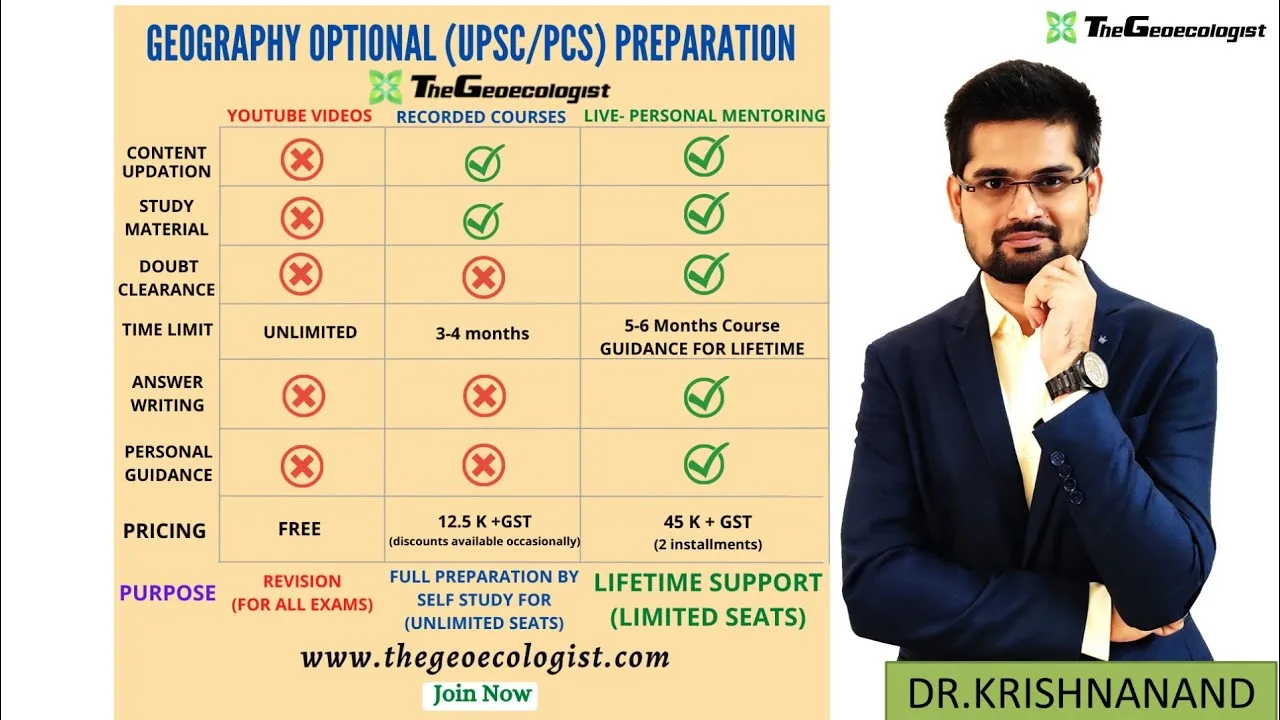
Dr. Krishnanand’s platform offers structured answer writing workbooks, model answer booklets for the last 10 years, and monthly “Current Affairs Answer Writing” modules linking PIB, The Hindu, and Down To Earth to static syllabus. His Telegram channel (50k+ members) conducts daily “One Question, One Answer” drills with peer review — a free, high-yield practice avenue.
Psychological Preparation: Writing Under Pressure
An often-overlooked dimension of UPSC answer writing tips is mental conditioning. The Mains examination spans 5 days, 9 papers, 27 hours of writing. Hand fatigue, decision fatigue, and anxiety degrade output quality from Paper III onward. Dr. Krishnanand advises:
- Hand-strengthening exercises (stress ball, putty) 3 months prior.
- Writing 2,000+ words in one sitting every weekend to build endurance.
- Mindfulness breathing (4-7-8 technique) before each paper to lower cortisol.
- Pre-deciding “skip strategy” — which questions to attempt first, which to leave for last 15 minutes.
Success Stories: Proof of Concept
The efficacy of these UPSC answer writing tips reflects in results. In CSE 2023, 17 students mentored through The Geoecologist’s answer writing program secured ranks under 100, including AIR-14 (Geography optional 312/500) and AIR-27 (GS-IV 134/250). Their common thread: 6 months of disciplined answer writing, 50+ full mocks, and ruthless adherence to structure over fluff. As AIR-14 noted, “The Geoecologist taught me that UPSC doesn’t test what you know — it tests what you can write in 9 minutes.”
Final Checklist Before You Enter the Exam Hall
- ✅ 20 full-length mocks completed under exam conditions
- ✅ Keyword bank revised for all 4 GS papers + Optional
- ✅ 50+ diagrams/maps practiced from memory
- ✅ Handwriting legibility validated by peers/mentors
- ✅ Time management template memorized (3-6-1 rule)
- ✅ Stationery kit ready: 2 black pens, 1 blue pen, pencil, eraser, ruler, sharpener
- ✅ Mental rehearsal of exam day routine visualized 10x
Mastering UPSC answer writing tips is not a sprint but a marathon of deliberate practice. Dr. Krishnanand’s methodology — structured, examiner-centric, and visually enriched — has democratized high-quality answer writing guidance. Combine his frameworks with relentless practice, authentic resources like the UPSC official portal, and psychological readiness, and you transform from an aspirant into a future civil servant. The pen is indeed mightier than the sword — provided you know how to wield it within 180 minutes.
Frequently Asked Questions
Beginners should focus on the Introduction-Body-Conclusion structure, practice keyword integration, use diagrams in Geography/Environment answers, and follow the 3-6-1 time management rule (3 min planning, 6 min writing, 1 min review per question).
A minimum of 6 months of consistent answer writing practice is recommended — starting with untimed structural practice, progressing to timed sectional tests, and culminating in full-length mock exams under simulated conditions.
Yes, Dr. Krishnanand's platform The Geoecologist offers structured answer writing workbooks, model answer booklets for the last 10 years, and monthly current affairs answer writing modules linking static syllabus to dynamic events.