Blog
Politics of Displacement Infrastructure: A Comprehensive Guide for UPSC Aspirants and Geography Enthusiasts

Key Takeaways
Understanding Politics of Displacement Infrastructure is essential for anyone preparing for the UPSC CSE examination or studying political geography at the undergraduate level. This multifaceted topic sits at the intersection of human geography, political science, and development studies, making it a recurring fixture in competitive exams and academic curricula alike. Below are the essential points to keep in mind as you explore this subject.
- Politics of Displacement Infrastructure examines how large-scale infrastructure projects — dams, highways, urban redevelopment — directly cause population displacement and reshape political landscapes.
- The topic is prescribed under the CBCS syllabus for geography undergraduates and features prominently in the UPSC CSE GS Paper I.
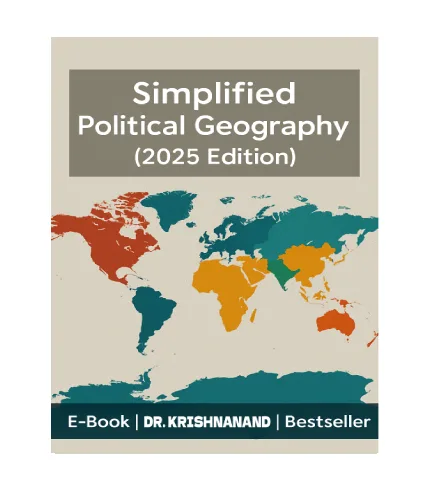
- Dr. Krishnanand’s Simplified Political Geography (2025 Edition) covers this topic with point-wise highlighted descriptions, diagrams, maps, and images that simplify complex concepts.
- Effective preparation requires a resource that blends theoretical frameworks with real-world case studies and statistical evidence.
- Understanding the geopolitical dimensions of displacement helps aspirants answer both descriptive and analytical questions in UPSC papers.
What Is Politics of Displacement Infrastructure?
Politics of Displacement Infrastructure refers to the study of how government-led and corporate-led infrastructure development — such as the construction of dams, railways, mining operations, and smart cities — leads to the forced relocation of communities and how these displacements carry deep political consequences. The field interrogates who benefits from infrastructure, who bears the cost, and how displacement alters power dynamics at local, national, and international levels.
According to the World Bank, approximately 10 to 30 million people are displaced annually due to infrastructure-related projects worldwide. These figures underscore why Politics of Displacement Infrastructure has become a non-negotiable topic for geography and political science students. The displacement is not merely physical; it reshapes electoral constituencies, alters demographic balances, and generates new forms of political mobilization among displaced populations.
For UPSC CSE aspirants, mastering Politics of Displacement Infrastructure means understanding the nexus between developmental policy and human rights, a theme that consistently appears in India’s discourse on Sardar Sarovar Dam displacement, the Narmada Bachao Andolan, and contemporary smart city initiatives.
Why Politics of Displacement Infrastructure Matters for UPSC CSE Aspirants
The UPSC CSE examination increasingly tests candidates on applied geography and the socio-political implications of developmental processes. Politics of Displacement Infrastructure bridges the gap between static syllabus content and dynamic, current-affairs-oriented questions. In recent years, the GS Paper I has featured questions on resource displacement, environmental refugees, and the political economy of development projects — all of which fall under the umbrella of Politics of Displacement Infrastructure.
Consider the Sardar Sarovar Dam on the Narmada River: this single infrastructure project displaced over 200,000 people and became the focal point of one of India’s longest-running civil resistance movements. An aspirant who understands Politics of Displacement Infrastructure can seamlessly connect this case study to broader themes like federalism, tribal rights, environmental governance, and international human rights frameworks. For verified context on displacement and development, the United Nations Human Rights Council publishes extensive reports on this subject at OHCHR.org.
Similarly, the political geography of displacement in Northeast India — where infrastructure corridors like the Bharatmala project intersect with indigenous land rights — offers another rich area where Politics of Displacement Infrastructure knowledge directly translates into higher marks.
How to Evaluate Resources on Politics of Displacement Infrastructure
Not all textbooks treat Politics of Displacement Infrastructure with equal depth. When selecting a resource, aspirants should evaluate three critical dimensions: comprehensiveness of coverage, clarity of explanation, and the inclusion of visual aids like maps and diagrams.
First, check whether the resource covers the evolution of political geography as a discipline, since Politics of Displacement Infrastructure cannot be understood in isolation from foundational theories like Heartland Theory and Rimland Theory. These frameworks explain the geopolitical strategies that often drive infrastructure-led displacement.
Second, assess whether the resource provides point-wise summaries. UPSC preparation demands concise revision material, and a book that presents Politics of Displacement Infrastructure in highlighted, bullet-pointed format saves invaluable study hours.
Third, look for integrated visual content — annotated maps showing displacement zones, diagrams illustrating infrastructure-politics linkages, and statistical tables on displacement figures. These elements transform abstract concepts into retainable, exam-ready knowledge. For broader academic context on political geography methodologies, the Royal Geographical Society’s publications at RGS.org offer peer-reviewed insights.
Why Simplified Political Geography (2025 Edition) Fits This Topic
Simplified Political Geography (2025 Edition) by Dr. Krishnanand has been specifically designed to address the exact challenges that aspirants face when studying complex topics like Politics of Displacement Infrastructure. This e-book is on the prescribed CBCS syllabus in geography, which means its content aligns directly with what universities and competitive examinations expect students to know.
The book covers the full spectrum of political geography, beginning with the nature, approaches, and scope of the discipline, then tracing the evolution of political geography, and diving into critical geopolitical theories like Heartland Theory and Rimland Theory. Each of these foundational chapters builds the analytical framework needed to understand Politics of Displacement Infrastructure at a deeper level.
What sets this e-book apart is its use of point-wise highlighted descriptions along with diagrams, maps, and images. When studying Politics of Displacement Infrastructure, visual context — such as maps showing displacement corridors or diagrams illustrating the political economy of dam construction — makes the difference between rote memorization and genuine comprehension. Dr. Krishnanand’s authoritative voice and structured approach make this e-book a reliable companion for serious aspirants.
Practical Usage: How to Study Politics of Displacement Infrastructure Effectively
Once you have the right resource, the next step is adopting a study strategy that maximizes your understanding of Politics of Displacement Infrastructure. Here is a practical framework:
Step 1: Build Foundations First — Begin with the chapters on the nature and evolution of political geography. These chapters in Simplified Political Geography (2025 Edition) provide the theoretical bedrock upon which all applied topics, including Politics of Displacement Infrastructure, are built.
Step 2: Link Theory to Case Studies — For every concept related to Politics of Displacement Infrastructure, identify at least one real-world case study. The Sardar Sarovar Dam, the Three Gorges Dam in China, and the displacement caused by urban renewal in Mumbai are all excellent examples that can be drawn from the book’s content and supplemented with current affairs.
Step 3: Revise Using Visual Aids — Use the maps and diagrams provided in the e-book to create mental maps of displacement zones and infrastructure corridors. Visual memory is far more durable than textual memory, especially during the intense revision phase before UPSC.
Step 4: Practice Answer Writing — Take topics within Politics of Displacement Infrastructure and practice writing structured answers that integrate theory, case studies, and statistical data. This practice transforms passive reading into active exam preparation.
Frequently Asked Questions
What is Politics of Displacement Infrastructure?
Politics of Displacement Infrastructure is a subfield of political geography that studies how infrastructure development projects — such as dams, highways, mining operations, and urban redevelopment — cause population displacement and generate political consequences, including changes in power dynamics, electoral patterns, and social mobilization.
Why is Politics of Displacement Infrastructure important for UPSC CSE preparation?
Politics of Displacement Infrastructure is important because UPSC CSE GS Paper I frequently tests candidates on the socio-political implications of developmental projects. Questions on environmental displacement, tribal rights, and the political economy of development all draw from this area. Understanding Politics of Displacement Infrastructure enables aspirants to connect static syllabus content with dynamic current affairs.
Does Simplified Political Geography (2025 Edition) cover Politics of Displacement Infrastructure?
Yes. Simplified Political Geography (2025 Edition) by Dr. Krishnanand covers the foundational theories and applied topics that underpin Politics of Displacement Infrastructure. The e-book is on the prescribed CBCS syllabus and uses point-wise highlighted descriptions, diagrams, maps, and images to simplify complex concepts, making it highly effective for mastering this topic.
Who should read Simplified Political Geography (2025 Edition)?
This e-book is ideal for UPSC CSE aspirants, undergraduate geography students following the CBCS syllabus, and anyone with a genuine interest in political geography. Dr. Krishnanand’s structured approach makes complex topics accessible to readers at various levels of expertise.
How does the 2025 Edition differ from earlier editions?
The 2025 Edition is a revised and updated version that reflects the latest developments in political geography, including contemporary case studies and updated data relevant to topics like Politics of Displacement Infrastructure. The inclusion of new diagrams, maps, and images ensures that readers have access to the most current and comprehensive material available.
Our Recommendation
📖 Part of our complete guide: Evolution of Geographical Thought: A Comprehensive Guide for UPSC Aspirants and Geography Enthusiasts
Frequently Asked Questions
What is Politics of Displacement Infrastructure?
Politics of Displacement Infrastructure is a subfield of political geography that examines how infrastructure development projects such as dams, highways, and urban redevelopment cause population displacement and create political consequences including shifts in power dynamics, electoral patterns, and social resistance movements.
Why is Politics of Displacement Infrastructure important for UPSC preparation?
Politics of Displacement Infrastructure is important because UPSC CSE GS Paper I regularly tests candidates on the socio-political implications of developmental projects. Topics like environmental displacement, tribal rights, and the political economy of large dams fall under this area, and mastering it helps aspirans connect theoretical knowledge with current affairs.
Does Simplified Political Geography (2025 Edition) cover Politics of Displacement Infrastructure?
Yes, Simplified Political Geography (2025 Edition) by Dr. Krishnanand covers the foundational theories and applied topics that underpin Politics of Displacement Infrastructure. The e-book is on the prescribed CBCS syllabus and uses point-wise highlighted descriptions, diagrams, maps, and images to simplify complex concepts for effective learning.