Blog
Geopolitics of resource conflicts: Understanding Forest Rights Struggles Through Political Geography

The Geopolitics of resource conflicts has become a defining challenge of the 21st century, with forest rights emerging as one of the most contested arenas where state power, corporate interests, and indigenous communities collide. From the Amazon to the Western Ghats, disputes over forest land, timber, minerals, and carbon credits illustrate how control over natural resources shapes political boundaries, triggers violence, and rewrites international relations. For students preparing for UPSC CSE, researchers analyzing geopolitical flashpoints, or professionals navigating environmental policy, mastering this intersection of geography and power is non-negotiable.
- Geopolitics of resource conflicts centers on how unequal access to natural resources drives political instability and territorial disputes.
- Forest rights conflicts involve overlapping claims by states, corporations, indigenous peoples, and conservation agencies — each backed by distinct legal and moral frameworks.
- Classical geopolitical theories (Heartland, Rimland) gain new relevance when applied to modern resource competition in forested regions.
- Academic resources that simplify these theories with maps, diagrams, and point-wise explanations accelerate mastery for competitive exams and research.
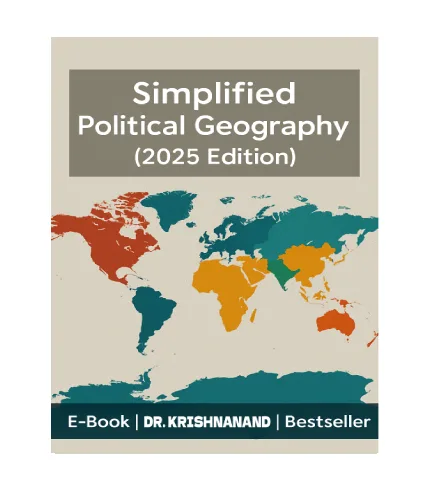
- The 2025 edition of Dr. Krishnanand’s Simplified Political Geography aligns with CBCS syllabi and covers these exact themes with updated case studies.
Understanding the Geopolitics of Resource Conflicts
The Geopolitics of resource conflicts refers to the strategic competition among states and non-state actors over the control, access, and distribution of natural resources. Unlike traditional interstate wars over territory, these conflicts often unfold within borders — pitting central governments against peripheral communities, or multinational corporations against local ecosystems. According to the United Nations Environment Programme, at least 40% of internal armed conflicts since 1990 have a significant natural resource dimension. Forests, which cover 31% of global land area and harbor 80% of terrestrial biodiversity, are ground zero for such struggles.
Political geography provides the analytical lens to decode these dynamics. It examines how spatial relationships — proximity to borders, resource concentration, infrastructure networks — influence power projection. For instance, the concentration of rare earth minerals in forested regions of Central Africa has drawn interventions from global powers, transforming local land disputes into proxy battlegrounds. A robust grasp of this framework allows aspirants to move beyond descriptive answers and offer structural explanations — a key differentiator in UPSC Mains evaluation.
Forest Rights as a Flashpoint in Resource Geopolitics
Forest rights disputes epitomize the Geopolitics of resource conflicts because they layer ecological, cultural, and economic claims onto the same terrain. The Forest Rights Act (FRA) 2006 in India recognized the rights of forest-dwelling communities over ancestral lands, yet implementation remains patchy. As of 2023, only 3.4 million of an estimated 10 million eligible claims had been settled, per Ministry of Tribal Affairs data. Simultaneously, compensatory afforestation funds (CAMPA) exceed ₹50,000 crore, often deployed without free, prior, and informed consent (FPIC) of gram sabhas.
Globally, the pattern repeats. In Indonesia, palm oil expansion has displaced Dayak communities; in Brazil, agribusiness lobbying weakened FUNAI’s demarcation of indigenous territories. These are not isolated incidents — they reflect a systemic tension between state-centric development models and community-based stewardship. Political geography helps map this tension spatially: where resource frontiers advance, governance often retreats, creating zones of contested sovereignty.
Key Theories Explaining Resource Conflict Dynamics
Classical geopolitical theories, often dismissed as Cold War relics, gain surprising explanatory power when applied to the Geopolitics of resource conflicts in forested regions. Halford Mackinder’s Heartland Theory posited that control over the Eurasian pivot area confers global dominance. Today, the “heartland” metaphor extends to resource-rich forest basins — the Congo Basin, the Amazon, the Sundaland — where control over carbon sinks, freshwater, and minerals translates into climate leverage and supply chain security.
Nicholas Spykman’s Rimland Theory, emphasizing coastal peripheries, finds echoes in the scramble for port access to export forest commodities. Meanwhile, critical geopolitics scholars like Gearóid Ó Tuathail argue that resource conflicts are not just about material scarcity but about how states represent nature — framing forests as “wastelands” for extraction or “carbon sinks” for offset markets. These theoretical tools, when taught with diagrams and comparative tables, transform abstract concepts into analytical instruments. Dr. Krishnanand’s Simplified Political Geography (2025 Edition) structures these theories in point-wise format with updated illustrations, making them directly applicable to answer-writing.
Case Studies: Forest Rights Struggles Worldwide
Concrete case studies anchor the Geopolitics of resource conflicts in empirical reality — essential for GS Paper 2 and 3, as well as geography optional. Consider three instructive examples:
- Niyamgiri Hills, Odisha (India): The Dongria Kondh’s successful resistance against Vedanta’s bauxite mining (2013 Supreme Court verdict) established that gram sabha consent is mandatory under FRA — a landmark for environmental democracy.
- Yasuní-ITT Initiative, Ecuador: A pioneering proposal to leave oil underground in exchange for international compensation collapsed in 2013, revealing the limits of market-based conservation when geopolitical energy demands prevail.
- Congo Basin Logging Concessions: Over 50 million hectares allocated to European and Asian firms, often overlapping with Pygmy territories, illustrate how global commodity chains drive local dispossession.
Each case reveals a common architecture: asymmetric information, legal pluralism, and the role of transnational advocacy networks. Mapping these cases spatially — as the 2025 edition does with dedicated maps — helps aspirants visualize the geography of conflict, not just memorize facts.
How Academic Frameworks Decode These Conflicts
Effective analysis of the Geopolitics of resource conflicts requires moving beyond event-based reporting to structural frameworks. Political geography offers three such frameworks:
- Scale analysis: How local forest disputes connect to national policies (e.g., India’s National Forest Policy 1988) and global regimes (UNFCCC, CBD, UNDRIP).
- Network mapping: Tracing actor constellations — state agencies, NGOs, corporations, courts — and their spatial reach.
- Territoriality: Examining how competing actors produce territory through laws, fences, maps, and violence.
These frameworks are rarely taught in standard textbooks, which often prioritize physical geography over political ecology. A specialized resource that bridges this gap — integrating CBCS-prescribed topics like “Evolution of Political Geography” and “Geopolitics of Resources” with contemporary forest rights jurisprudence — becomes a force multiplier for preparation. The Simplified Political Geography (2025 Edition) is one such resource, designed explicitly for this syllabus alignment.
Choosing the Right Resource for Political Geography Studies
With dozens of political geography books on the market, aspirants face a genuine evaluation problem. The Geopolitics of resource conflicts demands a text that balances theoretical depth with exam relevance. Key selection criteria include:
- Syllabus alignment: Does it cover CBCS/UPSC topics like Heartland/Rimland theories, geopolitics of resources, and political geography of India?
- Pedagogical design: Point-wise explanations, diagrams, maps, and images reduce cognitive load and aid retention.
- Currency: 2025 edition ensures recent case law (e.g., 2022-2024 FRA judgments), policy shifts (Forest Conservation Amendment Act 2023), and data.
- Author credibility: Dr. Krishnanand’s established reputation in geography education and bestseller status signal peer validation.
Many generic textbooks treat political geography as a static set of definitions. In contrast, a resource that frames the discipline as an evolving toolkit for analyzing live conflicts — like forest rights struggles — cultivates the analytical mindset examiners reward.
Practical Applications for UPSC and Research
Translating knowledge of the Geopolitics of resource conflicts into marks requires deliberate practice. Three high-yield strategies:
- Map-based answer enrichment: Annotate India’s forest cover map (ISFR 2021) with conflict hotspots (Hasdeo Arand, Talabira, Niyamgiri) and overlay mineral blocks — a technique the 2025 edition models with ready-to-use maps.
- Theory-application essays: Practice writing 250-word answers applying Heartland Theory to China’s Belt and Road forestry investments in Southeast Asia, or Rimland Theory to India’s Act East policy and teak diplomacy.
- Interdisciplinary linking: Connect forest rights to GS-2 (governance, federalism), GS-3 (environment, internal security), and Essay themes (development vs. ecology, rights of nature).
The World Bank’s Forests and Landscapes portal provides authoritative data on forest governance indicators that can substantiate such answers. Combining this data with a structured textbook creates a feedback loop: theory guides data selection, data grounds theory.
Frequently Asked Questions
Q: How does the Geopolitics of resource conflicts differ from traditional geopolitics?
A: Traditional geopolitics focuses on state power over territory; resource conflict geopolitics examines how competition over specific natural assets (forests, water, minerals) drives political behavior at multiple scales — local to global — often involving non-state actors.
Q: Why are forest rights central to resource geopolitics in India?
A: India’s forests overlap with mineral reserves (coal, iron ore, bauxite), tribal populations (8.6% of total), and climate commitments (NDC target: 2.5-3 GtCO2e additional sink). This convergence makes forest land a strategic asset contested by ministries, corporations, courts, and communities simultaneously.
Q: Can a single e-book cover both classical theories and contemporary forest conflicts?
A: Yes, if designed for syllabus integration. The 2025 edition of Simplified Political Geography explicitly links Mackinder/Spykman to modern resource geopolitics and includes dedicated sections on geopolitics of resources, forest rights, and India’s political geography — all in CBCS-aligned, point-wise format with diagrams.
Our Recommendation
📖 Part of our complete guide: Evolution of Geographical Thought: A Comprehensive Guide for UPSC Aspirants and Geography Enthusiasts
Frequently Asked Questions
How does the Geopolitics of resource conflicts differ from traditional geopolitics?
Traditional geopolitics focuses on state power over territory; resource conflict geopolitics examines how competition over specific natural assets (forests, water, minerals) drives political behavior at multiple scales — local to global — often involving non-state actors.
Why are forest rights central to resource geopolitics in India?
India's forests overlap with mineral reserves (coal, iron ore, bauxite), tribal populations (8.6% of total), and climate commitments (NDC target: 2.5-3 GtCO2e additional sink). This convergence makes forest land a strategic asset contested by ministries, corporations, courts, and communities simultaneously.
Can a single e-book cover both classical theories and contemporary forest conflicts?
Yes, if designed for syllabus integration. The 2025 edition of Simplified Political Geography explicitly links Mackinder/Spykman to modern resource geopolitics and includes dedicated sections on geopolitics of resources, forest rights, and India's political geography — all in CBCS-aligned, point-wise format with diagrams.