Blog
Gross National Happiness Index: A Geoecologist’s Guide

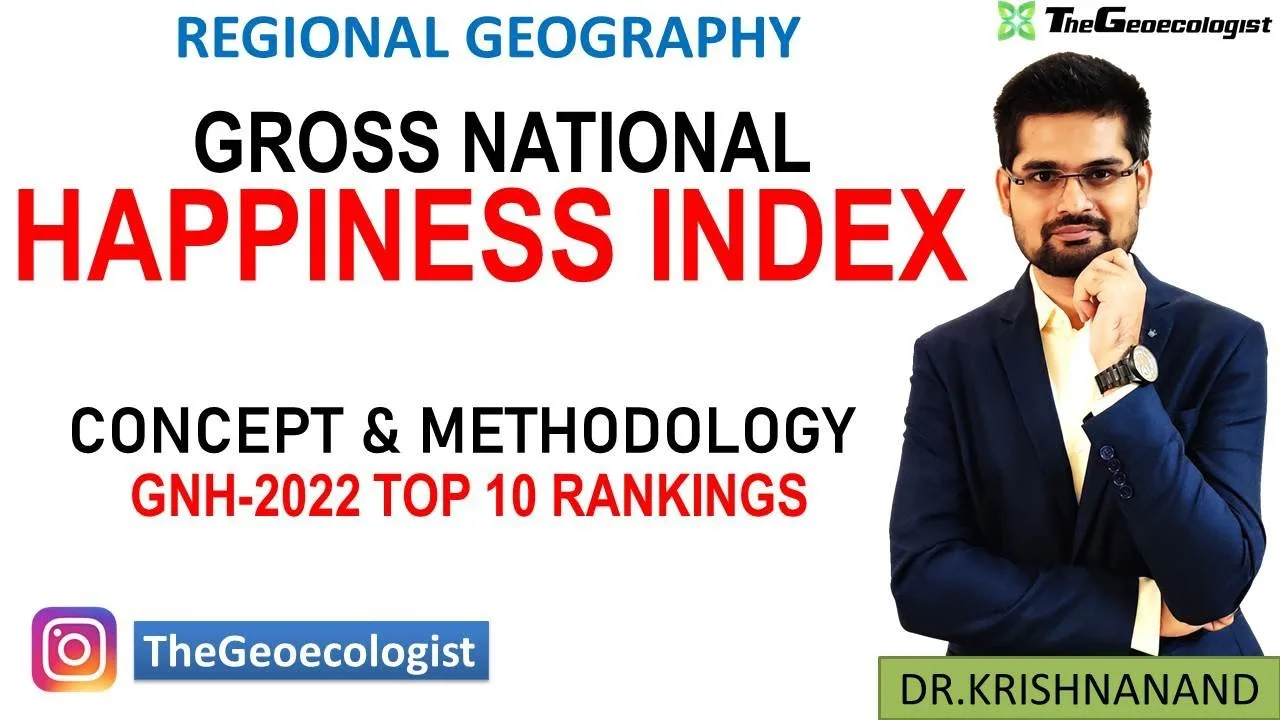
Table of Contents
- Introduction to the Gross National Happiness Index
- The Evolution of Development Metrics
- Defining the Gross National Happiness Index Framework
- The Four Pillars of Happiness
- The Role of Geoecologists in Measuring Happiness
- Linking Theory to Real-World Geography
- Relevance to UPSC Geography Optional Syllabus
- Key Syllabus Integration Points
- Case Studies for Answer Writing
- Why Focus on the Gross National Happiness Index?
- Conclusion
Introduction to the Gross National Happiness Index
The Gross National Happiness Index (GNH) represents a revolutionary paradigm shift in how nations measure progress and prosperity. In an era where economic indicators like Gross Domestic Product (GDP) dominate discussions on national development, the Gross National Happiness Index offers a refreshing alternative by prioritizing holistic well-being over mere monetary output. For UPSC Geography Optional aspirants and students of human geography, understanding the Gross National Happiness Index is essential, as it integrates socio-cultural, environmental, and governance parameters into comprehensive regional development strategies.
- Holistic Well-being: Moving beyond GDP to include psychological and social metrics.
- Four Pillars: Sustainable development, cultural preservation, environmental conservation, and good governance.
- Geographical Relevance: Analyzing the spatial distribution of well-being and resource management.
- UPSC Significance: A critical component for Regional Development and Human-Environment interaction topics.
The Evolution of Development Metrics
Historically, the success of a nation was quantified solely by its industrial output and consumption levels. However, the limitations of GDP—such as its inability to account for environmental degradation or income inequality—led to the birth of the Gross National Happiness Index. Pioneered by the Kingdom of Bhutan in the 1970s, this framework posits that true progress is achieved when material and spiritual development coexist in harmony. By evaluating non-material dimensions, the Gross National Happiness Index provides a nuanced view of how a society functions as a living, breathing ecosystem rather than just a collection of economic transactions.
Defining the Gross National Happiness Index Framework

To understand the Gross National Happiness Index, one must look at its multifaceted structure. Unlike traditional economic models, this index is built upon several core pillars that ensure a balanced approach to nation-building. These pillars are designed to create a sustainable feedback loop between the people, their culture, and their land.
The Four Pillars of Happiness
The framework utilized in the Gross National Happiness Index is categorized into four primary domains:
- Sustainable and Equitable Socioeconomic Development: Ensuring that economic growth does not leave marginalized communities behind and that resources are distributed fairly across different geographic regions.
- Environmental Conservation: Recognizing that a degraded environment directly leads to a degraded quality of life. This pillar emphasizes the protection of biodiversity and ecosystems.
- Preservation and Promotion of Culture: Maintaining the unique identity, language, and traditions of a population, which provides social cohesion and psychological stability.
- Good Governance: Implementing transparent, accountable, and efficient administrative systems that serve the needs of the citizenry effectively.
These pillars are further operationalized through 33 distinct indicators. For geography students, these indicators are vital for understanding how variables like health, education, and ecological resilience interact to form the spatial patterns of human well-being. For instance, a region with high resource availability but poor governance will likely score lower on the Gross National Happiness Index than a more resource-scarce region with high social capital.
The Role of Geoecologists in Measuring Happiness
Geoecologists play a pivotal role in analyzing the spatial and environmental aspects of the Gross National Happiness Index. While economists look at the flow of money, geoecologists look at the flow of energy, nutrients, and human impact within a landscape. By studying human-environment interactions, geoecologists assess how factors like deforestation, rapid urbanization, and climate resilience directly impact community well-being.
For example, Bhutan’s constitutional mandate to maintain a minimum of 60% forest cover is a cornerstone of their Gross National Happiness Index. This is not just an environmental policy; it is a socio-economic and psychological policy. A lush, forested landscape provides ecosystem services, supports traditional livelihoods, and maintains the cultural sanctity of the land. Geoecologists use advanced tools such as Geographic Information Systems (GIS) and remote sensing to monitor these indicators, providing the empirical data needed to adjust national policies in real-time.
Linking Theory to Real-World Geography
Dr. Krishnanand, founder of TheGeoecologist, emphasizes that the Gross National Happiness Index is not just a theoretical concept but a practical tool for sustainable regional planning. By utilizing spatial analysis, geoecologists can identify ‘happiness deserts’—regions where environmental degradation or social exclusion has led to a decline in well-being. This data-driven approach allows governments to move away from ‘one-size-fits-all’ development models and toward localized, ecologically sensitive interventions.
Relevance to UPSC Geography Optional Syllabus
For aspirants preparing for the Civil Services Examination, the Gross National Happiness Index is a high-yield topic that bridges the gap between several syllabus sections. It is particularly relevant to the Regional Geography and Human Geography components of the optional subject.
Key Syllabus Integration Points
1. Regional Development Planning: Aspirants should be prepared to contrast GDP-centric models with happiness-based frameworks. Discussing how the Gross National Happiness Index promotes decentralized planning can add significant value to answers regarding regional disparities.
2. Human-Environment Relationships: The index provides a perfect case study for how ecological health is inextricably linked to human psychological and social health. Understanding the feedback loops between forest cover, climate, and community happiness is crucial.
3. Policy Analysis and Comparative Geography: Students should compare the Bhutanese model with other initiatives, such as India’s focus on quality-of-life indicators or the UN’s Sustainable Development Goals (SDGs). Comparing the Gross National Happiness Index with the Sustainable Development Goals shows a deep understanding of global development trends.
Case Studies for Answer Writing
To score highly in UPSC, it is not enough to define the term. One must provide comparative analysis. For example, one could compare the Bhutanese model, which emphasizes Buddhist values in governance, with the Kerala model in India, which focuses on high social development indices through healthcare and education. This interdisciplinary approach—linking geography with sociology and economics—is what examiners look for in a top-tier candidate.
Why Focus on the Gross National Happiness Index?
In an era of global uncertainty, the Gross National Happiness Index offers a conceptual foundation for the future of sustainable development. There are three main reasons why this topic deserves focused study:
- Holistic Perspective: It prepares students to critique traditional, purely economic development models in essays and long-form answers.
- Current Global Relevance: As the world shifts toward the UN SDGs, the principles of the Gross National Happiness Index are becoming the global standard for sustainable progress.
- Interdisciplinary Linkages: It forces the student to connect geography with economics, sociology, and environmental science, fostering the ‘ystems thinking’ required for high-level administration.
Dr. Krishnanand’s lecture series on TheGeoecologist provides the necessary depth to master these complexities, offering strategies to integrate these themes into high-scoring UPSC answers.
Conclusion
The Gross National Happiness Index redefines the very meaning of progress, valuing the well-being of the soul and the planet as much as the wealth of the state. For geography students and UPSC aspirants, mastering this concept is essential for understanding the modern landscape of regional development and human-environment interactions. By looking beyond the numbers of GDP, we gain a deeper understanding of how sustainable, equitable, and culturally rich societies are built.
To deepen your understanding and master the nuances of Geography Optional, ensure you follow expert guidance. Subscribe to TheGeoecologist YouTube channel for detailed academic lectures and visit thegeoecologist.com for specialized study materials and E-books. For daily geography insights and updates, follow @thegeoecologist on Instagram.
Frequently Asked Questions
The Gross National Happiness Index is a measure of a nation's progress that prioritizes holistic well-being, including cultural preservation, environmental conservation, and good governance, instead of focusing solely on GDP.
While GDP measures the economic output and monetary value of goods and services, the Gross National Happiness Index measures non-material dimensions such as psychological well-being, ecological resilience, and social diversity.
It is vital for studying regional development planning, human-environment interactions, and comparative policy analysis, providing a holistic framework for understanding how geography shapes human well-being.