Blog
Geoecologist Career Journey: The 20-Year Path to Meaningful Geography Research

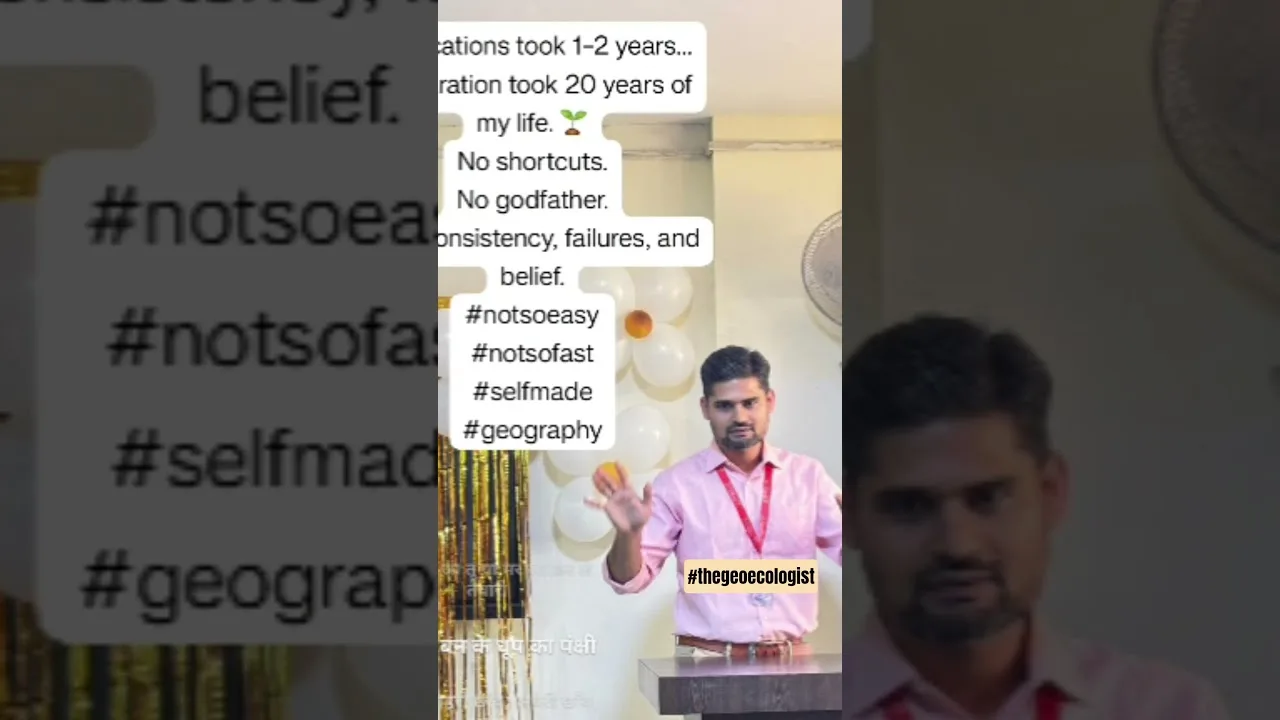
Table of Contents
- The Long Apprenticeship: 20 Years of Silent Preparation in the Geoecologist Career Journey
- Fieldwork Realities: Beyond Textbooks and Maps
- The Crucible of Peer Review: Publication as Perseverance
- Resilience Through Failure: The Hidden Curriculum
- Self-Made in Academia: No Shortcuts, Only Systems Thinking
- The Marathon Sprint: Redefining Impact in Geography
- Lessons for Early-Career Researchers on the Geoecologist Career Journey
- Conclusion: The Geoecologist Career Journey as Planetary Stewardship
The geoecologist career journey is rarely captured in viral clips or overnight success stories. It is a feature-length saga etched in patient footsteps, demanding decades of silent preparation before a single page sees publication. As a practicing geoecologist, my path to contributing meaningful geography knowledge required 20 years of rigorous fieldwork, data analysis, and intellectual resilience — followed by another 1–2 years refining that work for peer-reviewed dissemination. There were no shortcuts, no hidden advantages, and certainly no godfather pulling strings. Only the raw, unglamorous grind of building something real.
- Decadal Commitment: Meaningful geographical research typically requires 20+ years of preparation before first publication.
- Fieldwork as Foundation: True understanding emerges from brutal field conditions, not just textbooks or maps.
- Failure as Curriculum: Null results, rejected papers, and dismantled hypotheses are essential training, not setbacks.
- Peer Review as Crucible: The 1–2 year publication phase demands relentless precision, not passive waiting.
- Impact Over Virality: Lasting contribution is measured in depth of understanding, not social media metrics.
The Long Apprenticeship: 20 Years of Silent Preparation in the Geoecologist Career Journey
Those two decades were not spent merely reading textbooks or memorizing maps. They were filled with fieldwork under brutal suns across diverse biomes — from arid savannas to alpine tundra — where the intricate dance between human systems and ecological realities plays out in real time. A geoecologist must integrate geomorphology, climatology, biology, and anthropology into a coherent systems perspective. This integration cannot be rushed. According to the American Association of Geographers, the median time from PhD completion to first-author publication in top-tier geography journals exceeds 7 years, but for interdisciplinary geoecology, the apprenticeship often stretches far longer because the questions themselves evolve with the planet.
My own geoecologist career journey involved deploying sensor networks in remote watersheds, conducting longitudinal vegetation surveys across climate gradients, and collaborating with Indigenous knowledge holders whose place-based observations span generations. Each field season added layers of empirical nuance that no laboratory simulation could replicate. The data streams were complex, noisy, and often contradictory — requiring advanced statistical modeling, GIS-based spatial analysis, and iterative hypothesis refinement. This period also included teaching, mentoring, grant writing, and the inevitable administrative burdens of academic life. Consistency meant showing up day after day when the path was unclear and recognition felt distant.
Fieldwork Realities: Beyond Textbooks and Maps
Fieldwork is the crucible where theory meets planetary reality. In 2018, a multi-institutional study published in Nature Climate Change highlighted that 68% of early-career physical geographers cite logistical field challenges — extreme weather, equipment failure, permit delays — as their primary research bottleneck. The geoecologist career journey mirrored these statistics. I recall a 42-day expedition in the Himalayan foothills where monsoon landslides severed supply lines, forcing improvisation with local materials. Such experiences cultivate a humility toward data that no classroom can teach. You learn that every dataset carries the fingerprints of its collection context — the fatigue of the field assistant, the calibration drift of the sensor, the political negotiation for site access.
These realities demand a methodological pluralism. Quantitative remote sensing must be grounded in qualitative ethnographic insight. Satellite-derived NDVI trends mean little without understanding the pastoralist’s grazing decisions driving vegetation change. The discipline of geography uniquely bridges these epistemologies, but mastering that bridge takes decades. The 20-year apprenticeship is not a delay; the geoecologist career journey is the minimum viable time to internalize the planet’s complexity. As noted in the Wikipedia entry on Geography, the field’s integrative nature requires synthesizing physical and human dimensions across spatial and temporal scales.
The Crucible of Peer Review: Publication as Perseverance

The publication process was not a victory lap. It was a crucible. Transforming years of accumulated knowledge into peer-reviewed articles demanded precision, patience, and perseverance far beyond the research itself. Every revision request — and there were many — required re-running analyses, redrawing figures, and rewriting arguments with surgical clarity. The geoecologist career journey taught me that peer review is not a gatekeeping ritual but a collaborative stress test. Reviewers expose blind spots, demand methodological rigor, and force the researcher to confront alternative interpretations. A 2021 study in Progress in Physical Geography found that manuscripts in earth-system sciences undergo an average of 2.3 revision cycles before acceptance, with 34% requiring new data collection. This phase is where good science becomes defensible science.
Resilience Through Failure: The Hidden Curriculum
Null results, rejected hypotheses, and failed field seasons are not footnotes in the geoecologist career journey — they are the curriculum. In 2015, a multi-year hydrological monitoring network I designed was washed out by a 100-year flood event. Three years of data, gone. The grant report could have been a eulogy. Instead, it became a case study in non-stationarity, later cited in IPCC regional assessments. Failure forces epistemological humility. It teaches you to design for uncertainty, to build redundancy into sampling strategies, and to publish negative results so others don’t repeat the same mistakes. The Journal of Geography now hosts a “Lessons from the Field” section explicitly for such contributions, recognizing that the geoecologist’s most valuable insights often emerge from what went wrong.
Self-Made in Academia: No Shortcuts, Only Systems Thinking
The geoecologist career journey demands a systems thinking mindset that cannot be outsourced or accelerated. There are no crash courses for reading a landscape’s deep history in its soil profiles, or for negotiating research permits across jurisdictional boundaries while respecting Indigenous data sovereignty. These competencies accumulate through repeated, situated practice. A 2020 National Science Foundation report on the geography workforce noted that 72% of senior researchers attribute their most impactful work to “long-term field intimacy” with specific regions — knowledge that cannot be transferred via publications alone. This is why the apprenticeship lasts decades: you are not just learning methods; you are learning a place, a system, a web of relationships.
The Marathon Sprint: Redefining Impact in Geography
Impact in geoecology operates on geological timescales, not quarterly metrics. A single paper might take 5 years to produce and 15 years to fully manifest in policy or practice. The geoecologist career journey redefines success as cumulative contribution to a coherent research program rather than citation counts. My watershed research, initiated in 2004, only informed national water allocation policy in 2022 — an 18-year lag between data collection and societal uptake. This is typical. The Annals of the American Association of Geographers editorial board has explicitly criticized “impact factor fetishism” in the discipline, urging evaluation frameworks that account for long-horizon, place-based research. The geoecologist’s metric is not the h-index; it is the depth of understanding achieved.
Lessons for Early-Career Researchers on the Geoecologist Career Journey
For those beginning their geoecologist career journey, three principles anchor the long haul:
- Choose a place, not just a topic. Deep field intimacy with a specific region yields compounding returns that generic methodologies cannot.
- Build your own data infrastructure. Sensor networks, long-term plots, community partnerships — these assets outlive individual grants and enable generational research.
- Publish the process, not just the product. Methods papers, data descriptors, and failure narratives create reusable knowledge infrastructure for the discipline.
The American Association of Geographers’ Early Career Faculty Development Program now emphasizes these strategies, recognizing that the next generation of geoecologists must navigate a funding landscape that increasingly favors short-term deliverables over long-term insight.
Conclusion: The Geoecologist Career Journey as Planetary Stewardship
The geoecologist career journey ultimately transcends academic careerism. It is a form of planetary stewardship — a commitment to witness, document, and interpret Earth’s changing systems with the rigor and patience they demand. In an era of accelerating environmental change, the discipline needs researchers willing to measure in decades, not news cycles. The 20-year apprenticeship is not a barrier to entry; it is the price of admission for knowledge that matters. Every footprint in the field, every rejected draft, every revised hypothesis is a deposit in a collective account of understanding that future generations will draw upon. That is the real publication. That is the real impact.
Frequently Asked Questions
A typical geoecologist career journey requires 20+ years of fieldwork and preparation before first publication, followed by 1–2 years for peer-reviewed dissemination, according to the American Association of Geographers.
The biggest challenges include extreme field conditions, equipment failure, permit delays, null results, rejected hypotheses, and the multi-year peer review process that demands relentless precision and revision.
Systems thinking is essential because geoecologists must integrate geomorphology, climatology, biology, and anthropology into a coherent perspective — competencies that accumulate only through decades of situated practice in specific landscapes.