Blog
Assistant Professor Geography: Interview Cracking Guide

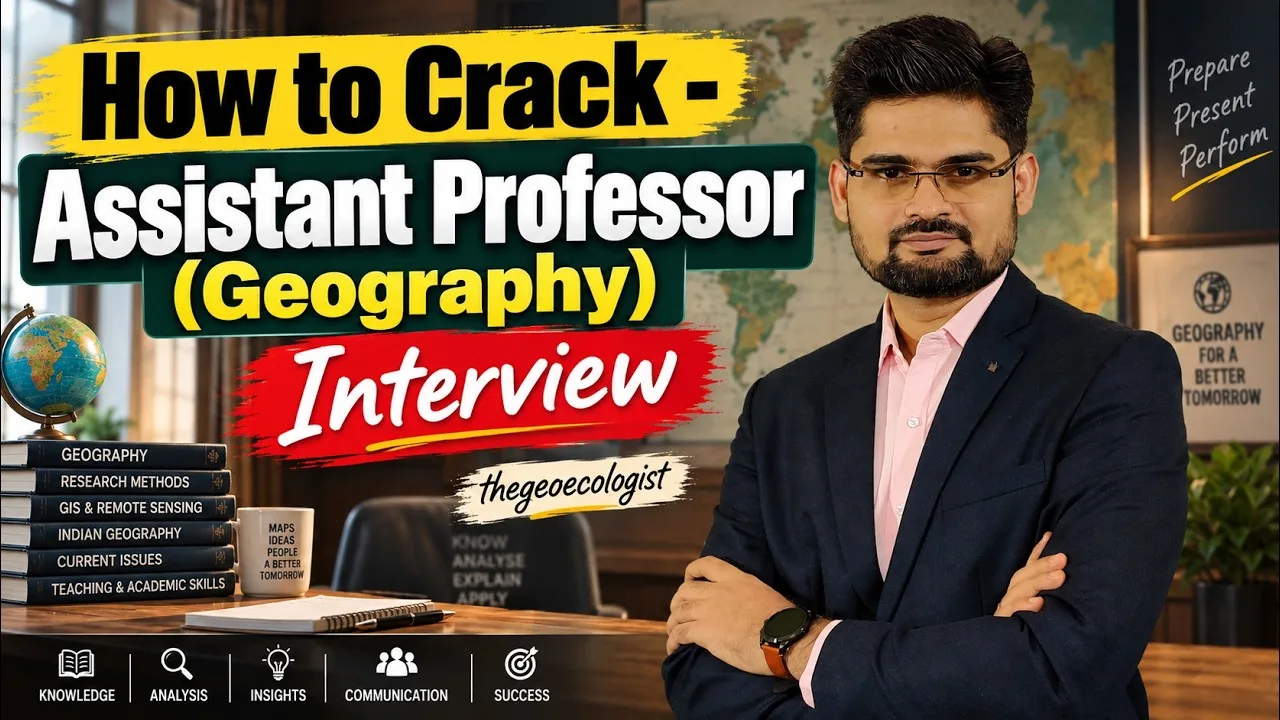
Table of Contents
- Understanding the Assistant Professor Geography Interview Process
- Core Evaluation Areas
- 1. Geographical Concepts & Theories
- 2. Indian Geography & Current Issues
- 3. Research Aptitude & Methodology
- 4. Analytical & Map‑Based Skills
- 5. Teaching Ability, Communication & Confidence
- Strategies to Prepare for Each Section
- Mastering Concepts and Theories
- Staying Updated on Indian Geography
- Developing Research Aptitude
- Practicing Map‑Based Questions
- Enhancing Teaching and Communication Skills
- Mock Interview Tips and Common Questions
- Final Checklist Before the Interview
- Conclusion
Assistant Professor Geography interviews are a pivotal step for aspiring academics aiming to secure a faculty position in universities across India.
- Understand the five core evaluation areas tested by the panel.
- Learn how to structure answers for conceptual, analytical, and teaching‑based questions.
- Access curated resources, mock question patterns, and expert tips to boost confidence.
Understanding the Assistant Professor Geography Interview Process
The Assistant Professor Geography interview is not merely a test of subject knowledge; it evaluates conceptual clarity, analytical ability, research aptitude, teaching skills, and communication. Panels typically consist of senior faculty members who assess whether a candidate can contribute to academic excellence, guide students, and undertake meaningful research. According to the UGC NET 2022 report, over 1.2 lakh candidates appeared for the Geography subject, highlighting the intense competition for limited faculty posts.
Core Evaluation Areas

1. Geographical Concepts & Theories
A strong grasp of fundamental geographical concepts and theories is essential. Candidates should be ready to discuss physical geography topics such as plate tectonics, climatology, geomorphology, and human geography themes like settlement patterns, migration, and cultural landscapes. Referring to authoritative sources like the Geography Wikipedia page can help refresh key definitions. The Assistant Professor Geography interview often asks for explanations of theories such as Central Place Theory, Herzberg’s Motivation Theory (in the context of spatial economics), and the concept of sustainable development.
2. Indian Geography & Current Issues
Indian geography forms a substantial portion of the interview. Questions may cover physiographic divisions, river systems, monsoon dynamics, agricultural patterns, and recent developments like the Interlinking of Rivers project or the impact of climate change on coastal states. Staying updated with reputable news portals such as The Hindu’s Environment section is advisable. The Assistant Professor Geography panel expects candidates to link theoretical knowledge with real‑world issues, for example, discussing how the 2023 heatwave affected wheat yields in Punjab and Haryana.
3. Research Aptitude & Methodology
Research aptitude is evaluated through questions on research design, data collection methods, sampling techniques, and statistical tools. Candidates might be asked to propose a small‑scale research project on topics like urban heat islands or groundwater depletion. Familiarity with qualitative and quantitative methods, as well as software like GIS and SPSS, adds weight to your profile. The Assistant professor Wikipedia entry outlines the typical expectations for research output in academia.
4. Analytical & Map‑Based Skills
Map interpretation remains a classic component of the Assistant Professor Geography interview. Candidates may be presented with a topographic sheet, a climatic map, or a socio‑economic dataset and asked to infer patterns, identify anomalies, or suggest planning interventions. Practicing with Survey of India maps and using online platforms like Bhuvan can sharpen these skills. The ability to articulate observations clearly—such as noting a dendritic drainage pattern indicating homogeneous rock structures—demonstrates analytical depth.
5. Teaching Ability, Communication & Confidence
Beyond knowledge, the panel gauges how effectively you can convey complex ideas to diverse learners. Expect a short teaching demonstration or a question like “How would you explain the concept of erosion to undergraduate students?” Your response should exhibit lesson planning, use of analogies, and engagement techniques. Confidence, body language, and clarity of speech are assessed throughout the interaction.
Strategies to Prepare for Each Section
Mastering Concepts and Theories
Start by revisiting standard textbooks such as “Physical Geography” by Savindra Singh and “Human Geography” by Majid Husain. Create concise notes that highlight definitions, assumptions, and applications of each theory. For the Assistant Professor Geography interview, it helps to prepare one‑minute elevator pitches for major concepts—this trains you to articulate ideas swiftly under pressure.
Staying Updated on Indian Geography
Allocate time weekly to read current affairs magazines like “Yojana” and “Kurukshetra” with a focus on geography‑related schemes (e.g., Pradhan Mantri Krishi Sinchayee Yojana). Make flashcards of recent data points: India’s forest cover rose to 24.56% in 2023 (ISFR report), or the Ganges basin supports over 600 million people. Incorporating such statistics into answers shows awareness of contemporary issues.
Developing Research Aptitude
Draft a brief research proposal (200‑300 words) on a niche topic like “Impact of solar panel installation on agricultural land use in Rajasthan.” Outline objectives, hypothesis, methodology, expected outcomes, and potential challenges. Being ready to discuss this proposal demonstrates initiative and aligns with the Assistant Professor Geography expectation of contributing to the department’s research agenda.
Practicing Map‑Based Questions
Work through previous years’ UGC NET Geography map questions and timed practice sets. When interpreting a map, follow a structured approach: (1) identify the map type and scale, (2) note major physical features, (3) observe human-made elements, (4) infer relationships, and (5) conclude with a geographical explanation. Repeating this process builds speed and accuracy.
Enhancing Teaching and Communication Skills
Record yourself delivering a 5‑minute lecture on a topic like “Monsoon Mechanisms.” Review the video for clarity, pacing, and use of visual aids. Seek feedback from peers or mentors. Additionally, practice answering common interview questions aloud, focusing on structuring responses with an introduction, body, and conclusion—this mirrors the expectations of the Assistant Professor Geography interview.
Mock Interview Tips and Common Questions
Engage in mock interviews with faculty members or senior candidates. Typical questions include:
- “Explain the concept of isostasy and its relevance to Himalayan tectonics.”
- “How would you differentiate between conventional and unconventional sources of energy in the context of India’s geography?”
- “Describe a recent fieldwork experience and what you learned from it.”
- “What teaching methods would you adopt to make climatology interesting for first‑year students?”
When answering, begin with a brief definition, follow with examples or data, and conclude with its significance. This structure satisfies the Assistant Professor Geography panel’s preference for logical, evidence‑based responses.
Final Checklist Before the Interview
Before the day of the Assistant Professor Geography interview, run through this checklist:
- Review core concepts and ensure you can explain them in simple terms.
- Update your knowledge on recent Indian geographical developments (last 6 months).
- Prepare a one‑page research idea summary.
- Practice map interpretation with at least five different maps.
- Conduct a mock teaching session and time it.
- Check formal attire, documents, and technical setup (if online).
- Practice breathing exercises to manage anxiety.
Being thorough in these areas transforms nervousness into confidence, increasing your chances of success.
Conclusion
Cracking the Assistant Professor Geography interview requires a balanced blend of deep subject mastery, awareness of current issues, research readiness, analytical prowess, and effective communication. By systematically addressing each evaluation area, leveraging trusted resources, and practicing diligently, you position yourself as a strong candidate for a faculty role. Remember, the journey to becoming an Assistant Professor Geography educator is as much about demonstrating passion for the discipline as it is about showcasing your expertise. Start preparing today, stay consistent, and let your enthusiasm for geography shine through every answer.
Frequently Asked Questions
The panel evaluates geographical concepts and theories, Indian geography and current issues, research aptitude and methodology, analytical and map‑based skills, and teaching ability, communication, and confidence.
Practice with Survey of India topographic sheets and online platforms like Bhuvan. Use a systematic approach: identify map type, note physical and human features, infer relationships, and conclude with a geographical explanation.
While not always mandatory, presenting a concise research proposal demonstrates initiative and aligns with the panel’s expectation of research aptitude for an Assistant Professor Geography role.