Blog
Humanistic Geography: Meaning, Concepts & Applications

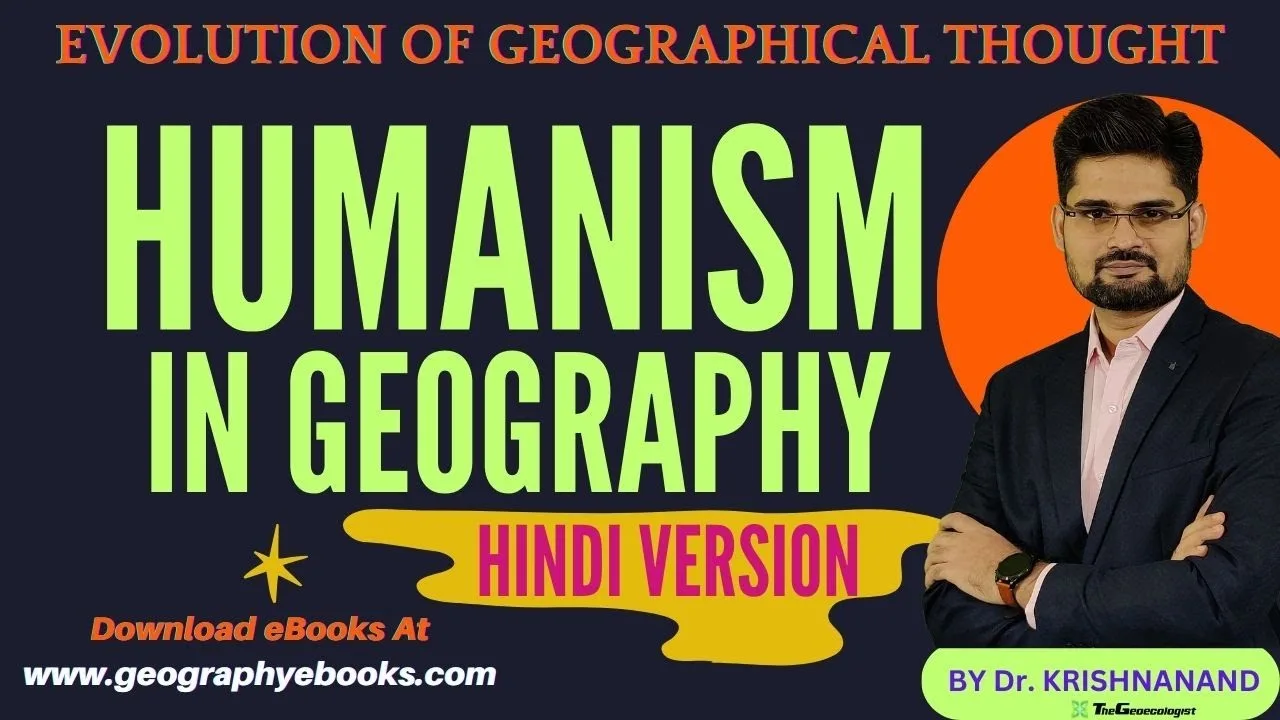
Table of Contents
- What is Humanistic Geography?
- Philosophical Foundations
- Emergence and Critique of Positivism
- Space versus Place
- Definitions and Characteristics
- Yi‑Fu Tuan’s Contributions
- Core Concepts in Humanistic Geography
- Topophilia
- Sense of Place
- Place Attachment
- Experiential Geography
- Humanistic versus Behavioural Geography
- Applications of Humanistic Geography
- Cultural Geography
- Urban Geography
- Environmental Perception
- Landscape Interpretation
- Criticisms and Limitations
- Relevance for Competitive Exams
- Conclusion
Humanistic Geography represents a pivotal shift in geographical thought, emphasizing human experience, perception, and the emotional bonds people form with places. Humanistic Geography emerged in the mid‑20th century as a reaction against the dominance of quantitative models and positivist approaches, advocating instead for a focus on meaning, values, and symbolism attached to space.
- Humanistic Geography prioritizes lived experience over abstract spatial models.
- It emerged as a critique of positivism and behavioural geography in the 1960s‑70s.
- Yi‑Fu Tuan is regarded as the founding father, introducing concepts such as topophilia and sense of place.
- The approach is highly relevant for cultural, urban, and environmental geography.
- Understanding Humanistic Geography improves answer quality for UGC NET, UPSC, and university exams.
What is Humanistic Geography?
At its core, Humanistic Geography seeks to understand how individuals and groups perceive, interpret, and attach meaning to places. Unlike traditional spatial science that relies on statistics and mathematical models, this perspective explores the affective dimensions of space—feelings, memories, beliefs, and aspirations. Scholars argue that places are not merely locations on a map but are imbued with personal and cultural significance.
Philosophical Foundations
The philosophical roots of Humanistic Geography lie in phenomenology, existentialism, and humanist thought. Influenced by thinkers such as Martin Heidegger, Maurice Merleau‑Ponty, and Edmund Husserl, geographers began to examine the lifeworld (Lebenswelt) of individuals. This shift allowed geography to address questions of identity, belonging, and the symbolic landscapes that shape human behaviour.
Emergence and Critique of Positivism
During the 1950s and 60s, geography was dominated by quantitative revolution and behavioural geography, which emphasized spatial patterns, models, and predictive laws. Critics argued that this approach neglected the subjective experience of place. In response, scholars like Yi‑Fu Tuan, Anne Buttimer, and Edward Relph advocated for a human‑centred framework, leading to the formal establishment of Humanistic Geography as a distinct paradigm by the early 1970s.
Space versus Place
A fundamental distinction in Humanistic Geography is between space and place. Space refers to abstract, geometrical extensions that can be measured and mapped, whereas place is space that has been given meaning through human experience. As Tuan famously noted, “Place is space that has been invested with meaning.” This concept underpins much of the work in cultural geography, urban studies, and environmental perception.
Definitions and Characteristics
Space is often described as location, distribution, and arrangement—concepts amenable to GIS and remote sensing. Place, by contrast, encompasses attachment, identity, and sentiment. A place can be a hometown, a sacred site, or even a neighbourhood that evokes nostalgia. The transformation of space into place occurs through repeated interaction, storytelling, and cultural practices.
Yi‑Fu Tuan’s Contributions
Yi‑Fu Tuan’s work remains central to Humanistic Geography. His seminal books, Topophilia: A Study of Environmental Perception, Attitudes, and Values (1974) and Space and Place: The Perspective of Experience (1977), laid the theoretical groundwork for understanding affective bonds to environments. Yi-Fu Tuan introduced the term topophilia (love of place) and emphasized that human geography must consider the qualitative, experiential dimension of landscapes.
Core Concepts in Humanistic Geography

Topophilia
Topophilia denotes the affective tie between people and their surroundings. It can be positive (love of a landscape) or negative (topophobia, fear of certain environments). Tuan identified various types of topophilia, including love for home, homeland, wilderness, and urban settings. This concept helps explain migration patterns, tourism behaviour, and resistance to environmental change.
Sense of Place
Sense of place refers to the feelings of belonging and identity that individuals associate with a location. It is shaped by personal experiences, cultural narratives, and social interactions. A strong sense of place can foster community cohesion, while a weakened sense may lead to alienation or placelessness—a term coined by Relph to describe homogeneous, featureless environments lacking meaning.
Place Attachment
Place attachment extends the idea of sense of place by emphasizing the emotional bond that develops over time. Researchers measure place attachment through psychological scales that assess dependence, identity, and emotional connection. High place attachment is linked to pro‑environmental behaviours, place‑based stewardship, and resilience in the face of disasters.
Experiential Geography
Experiential geography focuses on the lived, embodied experiences of individuals as they move through and interact with environments. It draws on methods such as walk‑along interviews, phenomenological observation, and mental mapping. This approach reveals how sensory perceptions—sight, sound, smell, and touch—contribute to the construction of place.
Humanistic versus Behavioural Geography
While both humanistic and behavioural geography study human‑environment interactions, they differ in epistemology and methodology. Behavioural geography, rooted in psychology, seeks to explain spatial behaviour through stimulus‑response models, decision‑making theory, and cognitive maps. It tends to be more positivist, aiming for generalization and prediction. Humanistic geography, in contrast, values subjective meaning, rejects strict generalization, and employs interpretive, qualitative methods to uncover the significance places hold for people.
Applications of Humanistic Geography
Cultural Geography
In cultural geography, Humanistic Geography illuminates how landscapes reflect cultural values, myths, and identity. Studies of sacred landscapes, ethnic enclaves, and heritage sites reveal the ways communities inscribe meaning onto the physical environment. For example, the analysis of pilgrimage routes demonstrates how spiritual beliefs transform ordinary spaces into places of profound significance.
Urban Geography
Urban scholars apply humanistic concepts to examine neighbourhood identity, gentrification, and urban nostalgia. Sense of place analyses help planners understand why residents resist redevelopment or cherish specific streetscapes. Topophilia studies explain the appeal of historic districts, waterfronts, and urban parks, informing design strategies that foster attachment and well‑being.
Environmental Perception
Environmental perception research investigates how individuals perceive risks, aesthetics, and affordances in natural settings. Humanistic approaches uncover the cultural filters that shape perceptions of wilderness, pollution, and climate change. Such insights are vital for effective communication, policy framing, and community‑based conservation initiatives.
Landscape Interpretation
Landscape interpretation uses humanistic geography to decode the symbolic layers embedded in rural and urban terrains. By examining place names, architectural styles, and land‑use patterns, geographers uncover historical narratives, power relations, and collective memories. This method enriches heritage management and contributes to more nuanced environmental impact assessments.
Criticisms and Limitations
Despite its influence, Humanistic Geography faces several critiques. Some argue that its focus on subjectivity can lead to relativism, making it difficult to derive comparative or generalizable findings. Others contend that the approach may overlook structural forces such as political economy, class, and gender that shape place formation. Additionally, the reliance on qualitative methods raises concerns about reproducibility and scalability. Nevertheless, many scholars view these criticisms as opportunities for integration, advocating for mixed‑methods approaches that combine humanistic insight with rigorous spatial analysis.
Relevance for Competitive Exams
For aspirants of UGC NET, SET, CUET‑PG, UPSC Geography Optional, and university examinations, Humanistic Geography is a high‑yield topic. Questions frequently appear on the meaning and evolution of the paradigm, the contributions of Yi‑Fu Tuan, distinctions between space and place, and applications in cultural and urban contexts. Mastery of concepts such as topophilia, sense of place, and place attachment enables candidates to craft nuanced, analytical answers that stand out in essay‑based papers.
Conclusion
Humanistic Geography has reshaped the discipline by restoring the human experience to the centre of geographical inquiry. Its emphasis on meaning, emotion, and perception complements traditional spatial sciences, offering a holistic understanding of the world we inhabit. As global challenges such as urbanization, climate change, and cultural displacement intensify, the insights derived from Humanistic Geography become increasingly vital for creating places that are not only functional but also meaningful, just, and resonant with human aspirations.
Frequently Asked Questions
Space is an abstract, measurable extension, while place is space that has been given meaning through human experience, emotion, and attachment.
Yi-Fu Tuan is regarded as the founder; he introduced concepts such as topophilia, sense of place, and experiential geography through works like Topophilia and Space and Place.
It frequently appears in questions about geographical thought, concepts like topophilia and sense of place, critiques of positivism, and applications in cultural and urban geography, helping students write analytical, exam‑oriented answers.