Blog
Whittlesey Classification: World Agriculture Typology Explained

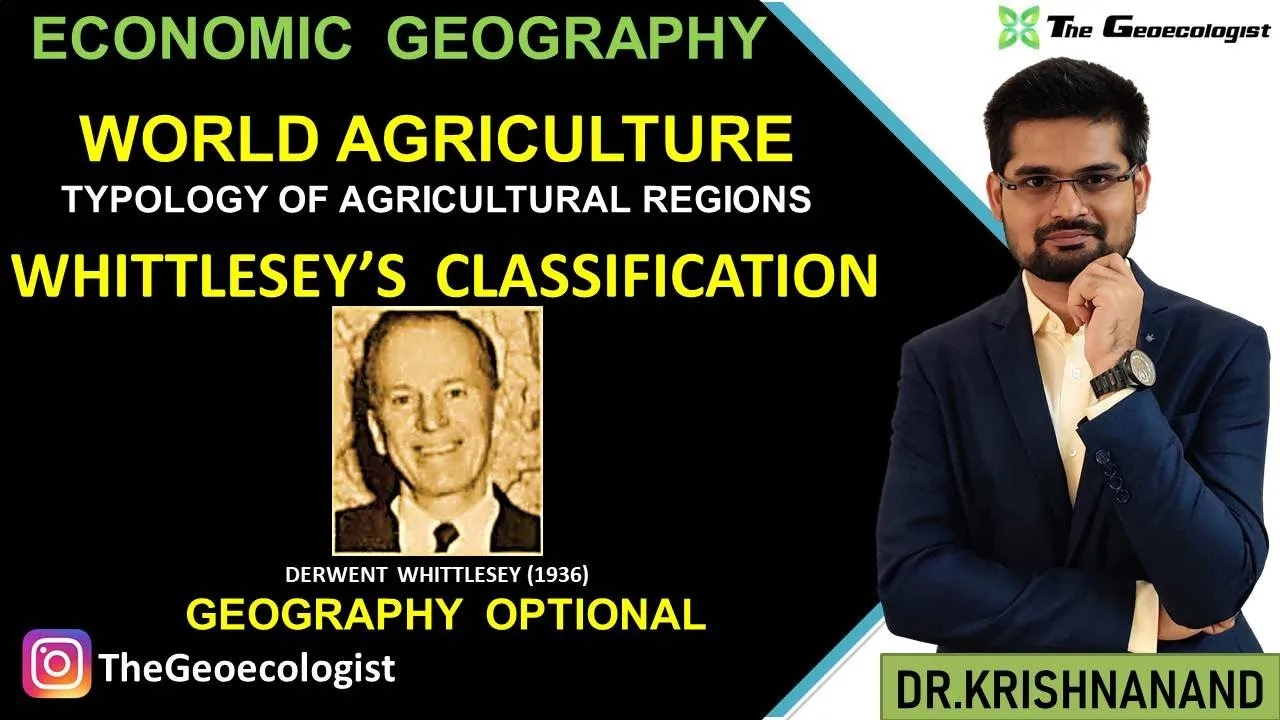
Table of Contents
- Introduction to Whittlesey Classification
- The Three Categories of Whittlesey Classification
- 1. Extensive Agriculture Regions
- 2. Intensive Agriculture Regions
- 3. Commercial Plantation Regions
- Historical Context and Development
- Application in Economic Geography
- Limitations and Criticisms
- Relevance for Competitive Examinations
- Conclusion
- Frequently Asked Questions
Introduction to Whittlesey Classification
The Whittlesey classification is a foundational concept in economic geography that categorizes global agricultural regions based on their development levels and economic structures. Developed by American geographer Carl Sauer’s student Wallace Imparato (often attributed to Whittlesey’s broader framework), this classification helps students and scholars understand how agricultural systems vary across the world. It forms an essential part of the World Agriculture Typology and is particularly relevant for UPSC Geography Optional preparation. This article provides a simplified yet comprehensive explanation of the Whittlesey classification and its role in understanding global agricultural patterns.
- Key Takeaway: The Whittlesey classification divides agricultural regions into three main types based on economic development.
- Key Takeaway: It is crucial for understanding global agricultural diversity and regional development disparities.
- Key Takeaway: This classification is widely studied in economic geography courses, including UPSC optional syllabus.
The Three Categories of Whittlesey Classification
The Whittlesey classification identifies three distinct types of agricultural regions:
1. Extensive Agriculture Regions
These regions are characterized by large landholdings with low labor intensity. They typically occur in developed economies where mechanization plays a significant role. Examples include the prairie states of North America and parts of Australia. In these areas, the Whittlesey classification highlights how technological advancement influences agricultural practices.
2. Intensive Agriculture Regions
In contrast, intensive agriculture regions feature small landholdings with high labor input. These areas are common in developing countries where population pressure drives the need for higher productivity per unit area. The Whittlesey classification clearly distinguishes these regions by their reliance on human labor rather than machinery. Southeast Asia represents a classic example of such regions.
3. Commercial Plantation Regions
This category includes areas dominated by large-scale production of cash crops like rubber, tea, and coffee. These regions often emerged during colonial periods and continue to influence modern agricultural economies. According to the Whittlesey classification, these areas represent specialized economic zones focused on export-oriented production.
Historical Context and Development
The origins of the Whittlesey classification trace back to early 20th-century geographical research. As part of the broader World Agriculture Typology, it was developed to address the growing need for systematic categorization of global agricultural systems. This work became influential in academic circles and later gained prominence in competitive examinations like the UPSC. The classification reflects the socio-economic conditions of different eras and continues to be relevant today.
Application in Economic Geography
Understanding the Whittlesey classification is vital for students studying economic geography. It provides a framework for analyzing how agricultural systems interact with economic development, climate, and cultural factors. For UPSC aspirants, mastering this concept can significantly enhance their performance in the geography optional paper. The classification also aids in comparing agricultural development across various world regions.
Limitations and Criticisms
While the Whittlesey classification remains useful, it has faced criticism for oversimplifying complex agricultural systems. Modern agricultural landscapes often blend characteristics from multiple categories, making strict classification challenging. Additionally, global changes such as climate change and technological innovation have altered traditional patterns. Despite these limitations, the core principles of the Whittlesey classification remain valuable for foundational learning in geography education.
Relevance for Competitive Examinations
For UPSC and other competitive exams, the Whittlesey classification is frequently tested due to its comprehensive coverage of global agricultural patterns. Students preparing for geography optional papers must understand each category thoroughly. The classification also helps in answering questions related to regional development, crop distribution, and economic geography. Many educational platforms, including TheGeoecologist, offer detailed video lectures explaining the Whittlesey classification in accessible language.
Conclusion
In summary, the Whittlesey classification serves as a critical tool for understanding global agricultural diversity. By categorizing regions into extensive, intensive, and commercial plantation types, it offers insights into how economic development shapes farming practices worldwide. Whether you’re a student preparing for UPSC or simply interested in economic geography, mastering the Whittlesey classification will deepen your appreciation of our planet’s agricultural complexity. For more detailed study materials and video lectures, visit TheGeoecologist website and explore their resources on economic geography.
Frequently Asked Questions
Q1: What is the primary purpose of the Whittlesey classification?
A1: The primary purpose is to categorize global agricultural regions based on their economic development levels and farming characteristics.
Q2: How many types of agricultural regions are identified in the Whittlesey classification?
A2: Three main types are identified: extensive agriculture regions, intensive agriculture regions, and commercial plantation regions.
Q3: Is the Whittlesey classification still relevant for modern geography studies?
A3: Yes, despite some limitations, it remains a fundamental concept taught in economic geography courses and competitive examinations like UPSC.
Frequently Asked Questions
The three main categories are extensive agriculture regions, intensive agriculture regions, and commercial plantation regions, each defined by different levels of technological development and labor intensity.
It is a core topic in Economic Geography for the UPSC Geography Optional paper and helps candidates analyze global agricultural patterns and regional development variations effectively.
While the Whittlesey classification focuses on economic development and labor intensity, modern classifications incorporate additional factors like climate change impacts, sustainable practices, and digital agriculture technologies.