Blog
Primary Activities Economic Geography: Complete UPSC Guide

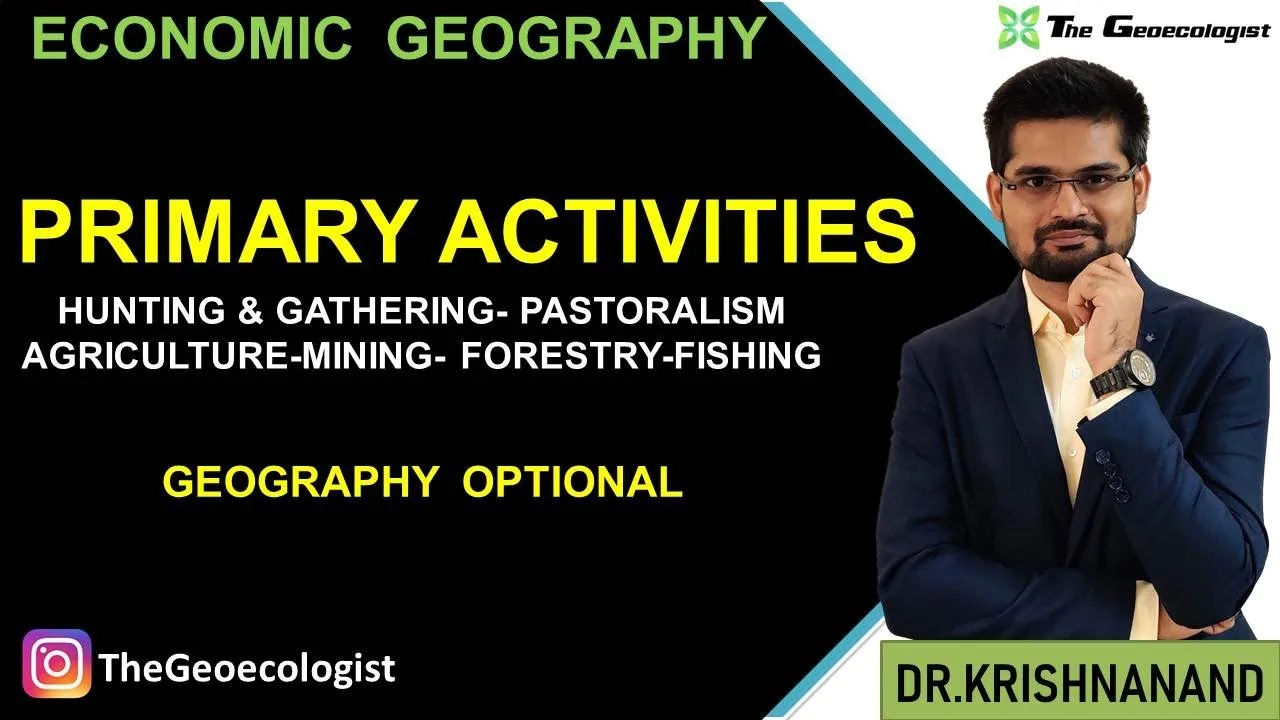
Table of Contents
- Understanding Primary Activities in Economic Geography
- Major Categories of Primary Activities
- Locational Factors: Why Primary Activities Cluster Where They Do
- Global Patterns and Regional Case Studies
- Major Agricultural Regions of the World
- World Mining Belts
- Fishing Grounds and Aquaculture Hubs
- Primary Activities in the Indian Context: UPSC Focus Areas
- Agriculture
- Minerals and Energy
- Forestry and Fisheries
- Contemporary Challenges and Sustainable Pathways
- Dr. Krishnanand's Pedagogical Approach: Why primary activities economic geography Works for UPSC
- Preparation Strategy for UPSC Geography Optional
- Static Syllabus Coverage
- Dynamic Component
- Answer Writing Practice
- Frequently Asked Questions (FAQs)
- What are the five primary activities in economic geography?
- Why is primary activities economic geography important for UPSC?
- How to prepare primary activities for UPSC Geography Optional?
- Conclusion
Primary activities economic geography forms the foundational pillar of human economic endeavor, encompassing all occupations directly dependent on natural resources. For UPSC Geography Optional aspirants, mastering primary activities economic geography is non-negotiable, as primary activities economic geography constitutes a significant portion of the Economic Geography syllabus and frequently appears in both Prelims and Mains examinations. Dr. Krishnanand, founder of TheGeoecologist, delivers a simplified yet comprehensive lecture series that demystifies these concepts for beginners and advanced learners alike.
- Primary activities involve direct extraction and production from nature: agriculture, mining, forestry, fishing, and hunting.
- They form the base of the economic pyramid, supporting secondary and tertiary sectors through raw material supply.
- Geographical factors—climate, soil, topography, mineral deposits—determine spatial distribution of these activities.
- UPSC questions often test comparative analysis (e.g., intensive vs. extensive farming, fishing grounds location).
- Dr. Krishnanand’s simplified framework links theory with current affairs and map-based applications.
Understanding Primary Activities in Economic Geography
In the classification of economic activities, primary activities economic geography represents the first order of production. These are activities where humans directly utilize natural resources without significant transformation. The sector includes agriculture (crop cultivation, livestock rearing), mining and quarrying (mineral extraction), forestry (timber, non-timber products), fishing (marine, inland, aquaculture), and hunting/gathering (largely subsistence). Unlike secondary activities that process raw materials, or tertiary activities that provide services, primary activities are resource-extractive in nature.
The significance of this sector varies across economies. In least developed countries, primary activities may employ 50–70% of the workforce and contribute 20–40% of GDP. In contrast, developed nations like the USA or UK see less than 2% employment in agriculture and mining combined, yet remain major global producers due to high mechanization and productivity. This structural transformation—from primary to secondary to tertiary dominance—is central to Clark-Fisher model of economic development, a staple concept in UPSC Economic Geography. – a key consideration for primary activities economic geography.
Major Categories of Primary Activities
1. Agriculture: The Dominant Primary Activity
Agriculture is the most widespread primary activity, engaging nearly 1 billion people globally. primary activities economic geography is classified into subsistence (shifting cultivation, intensive subsistence, pastoral nomadism) and commercial (grain farming, plantation, mixed farming, dairy, horticulture) types. The von Thünen model of agricultural land use—explaining crop zonation around a market center based on transport costs and land rent—remains a favorite UPSC topic. Factors influencing agriculture include physical (temperature, rainfall, soil, slope) and socio-economic (land tenure, capital, technology, market access, government policy).
India’s Green Revolution (1960s–70s) transformed the country from a food-deficit to a food-surplus nation, making primary activities economic geography a critical case study. Current issues—fragmented landholdings (86% small/marginal farmers), groundwater depletion, MSP debates, and climate resilience—frequently appear in GS Paper III and Geography Optional Paper II.
2. Mining and Quarrying: Extracting Mineral Wealth
Mining involves extraction of minerals—metallic (iron, copper, gold), non-metallic (limestone, gypsum), and fuel (coal, petroleum, natural gas). The spatial distribution is governed by geological occurrence: iron ore in Banded Iron Formations (BIFs) of Odisha-Jharkhand, Carajás (Brazil), Pilbara (Australia); coal in Gondwana basins (India), Appalachian (USA), Ruhr (Germany); oil in sedimentary basins (Middle East, Gulf of Mexico, Bombay High). – a key consideration for primary activities economic geography.
UPSC aspirants must know major mining regions, mineral belts of India (e.g., Chotanagpur Plateau, Karnataka Plateau), and contemporary issues: MMDR Act amendments, auction regimes, District Mineral Foundations (DMF), illegal mining, and environmental clearances. The concept of resource curse (Dutch Disease) and sustainable mining practices are also examinable. – a key consideration for primary activities economic geography.
3. Forestry: Timber and Ecosystem Services
Forestry covers commercial logging, fuelwood collection, and non-timber forest products (NTFPs) like resins, medicinal plants, honey. Tropical rainforests (Amazon, Congo, Southeast Asia) and temperate coniferous forests (Siberia, Canada, Scandinavia) are major timber sources. India’s forest cover stands at 21.71% (ISFR 2021), with Madhya Pradesh, Arunachal Pradesh, Chhattisgarh leading. The Forest Rights Act 2006, Joint Forest Management (JFM), and REDD+ mechanism are policy-relevant dimensions. – a key consideration for primary activities economic geography.
4. Fishing: Harvesting Aquatic Resources
Fishing includes capture fisheries (marine, inland) and aquaculture (fish farming). Major fishing grounds—Dogger Bank, Grand Banks, Peru-Chile, Northwest Pacific—occur where cold and warm currents meet, promoting plankton growth. India ranks 2nd globally in aquaculture and 3rd in fisheries production. The Blue Revolution, Pradhan Mantri Matsya Sampada Yojana (PMMSY), deep-sea fishing policy, and IUU (Illegal, Unreported, Unregulated) fishing are current affairs hotspots.
Locational Factors: Why Primary Activities Cluster Where They Do
The spatial pattern of primary activities economic geography is not random. primary activities economic geography follows deterministic and probabilistic logic rooted in physical geography and economic theory. Key locational factors include:
- Physical endowments: Soil fertility (alluvial plains for rice/wheat), mineral deposits (cratons, fold mountains), forest types (climate-driven), fish stocks (upwelling zones).
- Climate: Temperature regimes define crop calendars; rainfall reliability distinguishes rainfed vs. irrigated farming; monsoon dynamics drive Indian agriculture.
- Topography: Plains favor mechanized farming; hills suit plantation crops (tea in Darjeeling, coffee in Kodagu) and terraced cultivation; continental shelves favor demersal fishing.
- Accessibility and infrastructure: Proximity to ports (iron ore exports from Mormugao, Paradip), rail/road networks, power supply for mining.
- Market demand and technology: High-value perishables (floriculture, dairy) locate near urban centers (von Thünen); refrigeration and cold chains extend reach.
- Policy and institutional framework: Land reforms, mineral concession rules, forest conservation laws, fishing quotas, subsidies.
Weber’s Least Cost Theory (1909) formalizes location decisions for resource-based industries: minimize transport costs of weight-losing raw materials (ore, timber) to processing sites. This explains why steel plants (Jamshedpur, Bhilai, Rourkela) locate near coal-iron ore fields, not markets.
Global Patterns and Regional Case Studies
Major Agricultural Regions of the World
UPSC requires familiarity with Whittlesey’s 13 agricultural regions. Key ones include: Nomadic herding (Central Asia, Sahara); Shifting cultivation (Amazon, Northeast India, Southeast Asia); Intensive subsistence rice farming (East/South/Southeast Asia monsoon lands); Commercial grain farming (Prairies, Pampas, Ukraine, Downs); Plantation agriculture (tropical belts: tea in Assam/Sri Lanka, rubber in Malaysia/Indonesia, cocoa in West Africa); Mediterranean agriculture (olives, grapes, citrus in California, Chile, South Africa, Australia); Dairy farming (NW Europe, New Zealand, North America).
World Mining Belts
Memorize: Iron ore – Lake Superior (USA), Carajás (Brazil), Kiruna (Sweden), Pilbara (Australia), Chotanagpur (India); Coal – Appalachian, Ruhr, Donbas, Kuznetsk, Gondwana (India), Bowen Basin (Australia); Petroleum – Persian Gulf (60% reserves), Gulf of Mexico, North Sea, West Siberia, Bombay High, Assam-Arakan; Bauxite – Guinea, Australia, Jamaica, Odisha (India).
Fishing Grounds and Aquaculture Hubs
Top capture fisheries: Peru-Chile (anchoveta), Northwest Pacific (pollock, cod), Northeast Atlantic (herring, mackerel), Western Central Pacific (tuna). Aquaculture leaders: China (60% global output), India, Indonesia, Vietnam, Bangladesh. India’s East Coast vs. West Coast fisheries contrast (continental shelf width, upwelling, species composition) is a classic map-based question.
Primary Activities in the Indian Context: UPSC Focus Areas
For Geography Optional Paper II (Indian Geography), primary activities economic geography manifests through specific regional patterns and policy debates. Aspirants should prepare:
Agriculture
- Cropping patterns: Rice-wheat (Punjab-Haryana-West UP), coarse cereals (Deccan Plateau), pulses (Madhya Pradesh, Maharashtra), oilseeds (Gujarat, Rajasthan), cotton (Deccan black soil), sugarcane (UP, Maharashtra), plantation crops (Western Ghats, Northeast).
- Irrigation: Canal (North India), tank (South India), groundwater (Northwest, South), micro-irrigation expansion.
- Issues: Fragmentation, soil degradation, groundwater crisis (Punjab, Haryana, Rajasthan), farmer suicides, contract farming laws, PM-KISAN, crop insurance.
Minerals and Energy
- Belts: North-Eastern Peninsular (iron, coal, manganese, mica), Central Indian (bauxite, limestone), Southern (gold, iron, manganese), Himalayan (copper, lead, zinc, limestone), Offshore (oil, gas).
- Critical minerals: Lithium (J&K, Rajasthan), Rare Earths (Odisha, beach sands), Cobalt, Nickel – vital for EV transition.
- Policy: National Mineral Policy 2019, MMDR Amendment 2021, Khanij Bidesh India Ltd (KABIL), Critical Minerals Strategy.
Forestry and Fisheries
- Forest types: Tropical evergreen (Western Ghats, Andaman), deciduous (Central India), thorn (Rajasthan), montane (Himalayas), mangroves (Sundarbans, Gujarat).
- Fisheries: Marine (68% of production) – Gujarat, Kerala, Tamil Nadu, Andhra; Inland (32%) – Andhra, West Bengal, Bihar, UP. Aquaculture: Andhra (shrimp), West Bengal (carp), Odisha.
Contemporary Challenges and Sustainable Pathways
The 21st century poses existential challenges to primary activities economic geography. Climate change alters agro-climatic zones—wheat yields in Indo-Gangetic Plain may decline 6–23% by 2050 (IPCC AR6). Water scarcity threatens irrigation-dependent agriculture. Soil degradation affects 30% of India’s land. Mining faces stricter ESG norms and community opposition. Overfishing has depleted 34% of global stocks (FAO 2022).
Sustainable solutions are gaining traction: Climate-Smart Agriculture (CSA) (drought-tolerant varieties, conservation agriculture, agroforestry); Precision farming (IoT, drones, AI for input optimization); Circular economy in mining (urban mining, recycling, tailings reprocessing); Blue Economy (sustainable aquaculture, mariculture, seaweed farming, ocean energy); Forest landscape restoration (Bonn Challenge, India’s 26 Mha target).
The FAO estimates global food demand will rise 50% by 2050. Meeting this without breaching planetary boundaries requires transforming primary sectors from extractive to regenerative. Concepts like regenerative agriculture, agroecology, sustainable intensification, and payment for ecosystem services (PES) are entering policy discourse—and UPSC syllabi.
Dr. Krishnanand’s Pedagogical Approach: Why primary activities economic geography Works for UPSC
Dr. Krishnanand, through TheGeoecologist, has pioneered a simplified explanation of primary activities that bridges academic rigor and exam utility. His lectures feature:
- Conceptual clarity: Breaking down models (von Thünen, Weber, Whittlesey) with Indian examples.
- Map integration: Every concept linked to atlas work—mineral belts, cropping regions, fishing grounds.
- Current affairs linkage: Connecting static theory to schemes (PM-KISAN, PMMSY, KABIL), reports (ISFR, Economic Survey), and global indices.
- Answer-writing framework: Structuring 10/15/20 markers with intro-body-conclusion, diagrams, data, and case studies.
- Bilingual delivery: English-Hindi mix ensures accessibility for diverse aspirants.
His eBook “Simplified Economic Geography” consolidates these lectures into a structured reference, complete with previous year questions, model answers, and mind maps. TheGeoecologist YouTube channel and Instagram handle (@thegeoecologist) provide free supplementary content—map sessions, doubt clearance, and strategy videos.
Preparation Strategy for UPSC Geography Optional
Static Syllabus Coverage
- Thoroughly read Majid Husain (Economic Geography chapters) and K. Siddhartha for models and theories.
- Supplement with NCERT Class 12 (India: People and Economy) for Indian primary sector data.
- Memorize world maps: agricultural regions, mineral belts, fishing grounds, forest types.
- Prepare comparative tables: subsistence vs. commercial farming; capture vs. culture fisheries; metallic vs. non-metallic minerals.
Dynamic Component
- Follow Economic Survey (Agriculture, Industry chapters), India State of Forest Report, Annual Report Ministry of Mines.
- Track budget allocations for agriculture, fisheries, mining ministries.
- Note Supreme Court/NGT judgments on mining bans, forest clearance, GM crops.
- Monitor international reports: FAO SOFA, World Bank Commodity Markets, IEA World Energy Outlook, IPCC.
Answer Writing Practice
- Solve previous year questions (2013–2023) for Geography Optional Paper I & II.
- Practice 150-word answers for GS Paper I (geography) and Paper III (economy, environment).
- Draw schematic maps/diagrams in every answer: von Thünen rings, Weber’s triangle, cropping pattern maps.
- Use data points: production ranks, percentage shares, growth rates, scheme outlays.
Frequently Asked Questions (FAQs)
What are the five primary activities in economic geography?
The five main primary activities are agriculture, mining, forestry, fishing, and hunting/gathering. All involve direct extraction of natural resources.
Why is primary activities economic geography important for UPSC?
primary activities economic geography covers 20–25% of Geography Optional Paper I (Economic Geography) and Paper II (Indian Geography), and appears in GS Papers I and III. Questions test models, locational factors, Indian regional patterns, and current policies.
How to prepare primary activities for UPSC Geography Optional?
Study standard texts (Majid Husain, Siddhartha), master world/India maps, link static concepts with current affairs (schemes, reports), practice previous year questions with diagrams, and follow simplified lectures like Dr. Krishnanand’s for conceptual clarity.
Conclusion
Mastering primary activities economic geography is a strategic imperative for every serious UPSC Geography Optional aspirant. primary activities economic geography’s interdisciplinary nature—spanning physical geography, economics, policy, and current affairs—makes primary activities economic geography a high-yield area for both Optional and General Studies. Dr. Krishnanand’s TheGeoecologist platform offers a rare blend of academic depth and exam-oriented simplification, making complex models accessible and memorable. Combine his lectures with disciplined map practice, answer writing, and current affairs integration to transform this foundational topic into your scoring stronghold. Subscribe to TheGeoecologist YouTube channel, follow @thegeoecologist on Instagram, and download the “Simplified Economic Geography” eBook to structure your preparation with expert guidance.
Frequently Asked Questions
The five main primary activities are agriculture, mining, forestry, fishing, and hunting/gathering. All involve direct extraction of natural resources.
It covers 20–25% of Geography Optional Paper I (Economic Geography) and Paper II (Indian Geography), and appears in GS Papers I and III. Questions test models, locational factors, Indian regional patterns, and current policies.
Study standard texts (Majid Husain, Siddhartha), master world/India maps, link static concepts with current affairs (schemes, reports), practice previous year questions with diagrams, and follow simplified lectures like Dr. Krishnanand's for conceptual clarity.