Blog
Best Geography of UP Book for State Exams — Why This eBook Beats Generic Notes

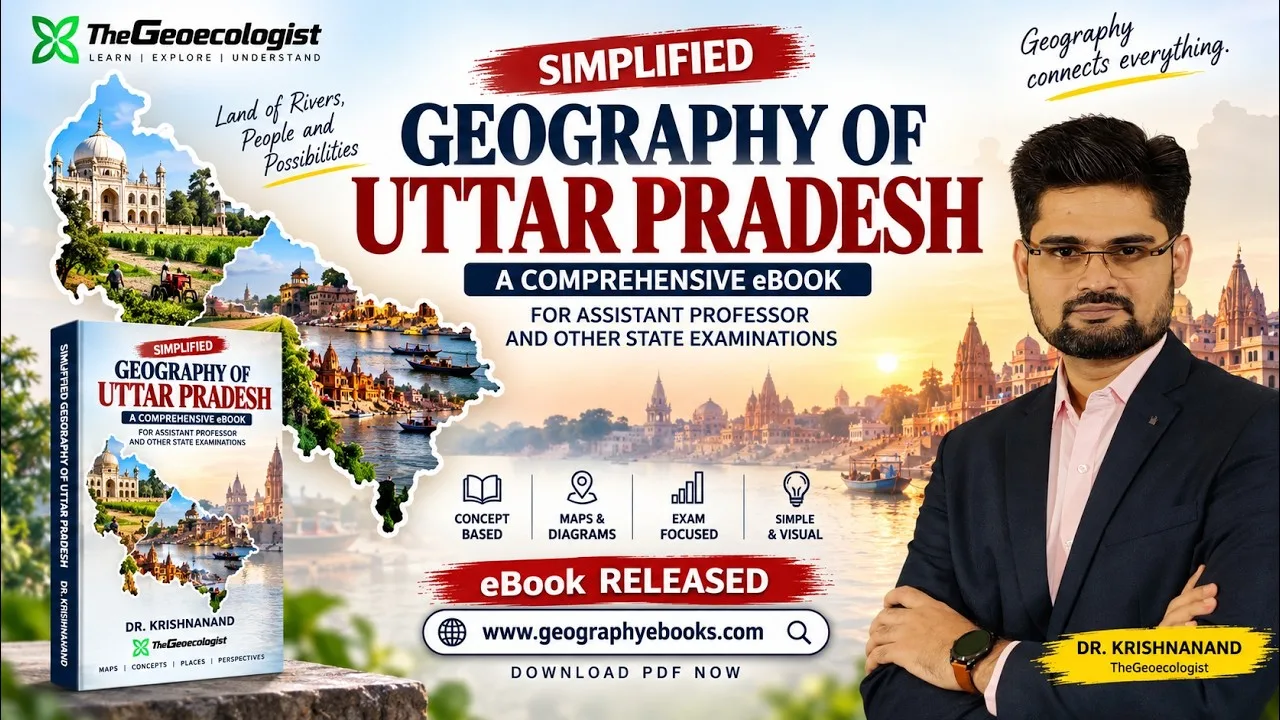
Preparing for Assistant Professor, UP State PCS, or UGC NET Geography? Your first decision is choosing the right study material — and the search results keep pointing candidates toward one question: what is the Best Geography of UP Book for State Exams? The answer matters because Uttar Pradesh’s geography is vast, ranging from the Terai floodplains in the north to the Bundelkhand plateau in the south, and generic notes rarely capture that spatial complexity.
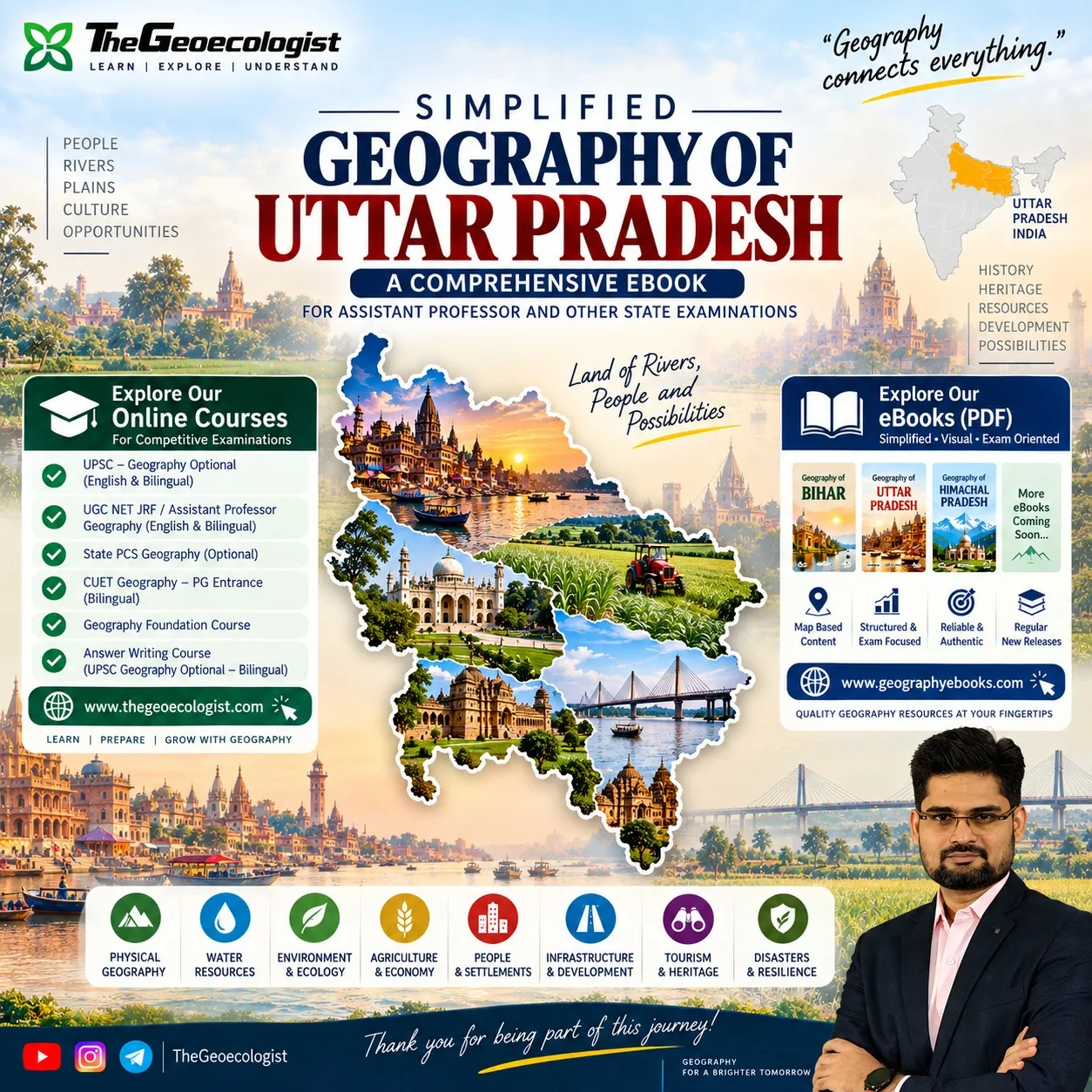
- Covers physical geography, water resources, environment & ecology, agriculture, settlements, infrastructure, tourism, and disaster resilience
- Built from Dr. Krishnanand’s lecture series with maps, diagrams, and spatial models
- Priced at ₹249 — designed specifically for UP State-level and national geography exams
- Available as an instant-download eBook from GeographyEBooks.com
Understanding the Geography of UP Exam Landscape
Uttar Pradesh accounts for roughly 16% of India’s population and spans 240,928 sq km of diverse terrain — Gangetic plains, Shivalik foothills, Vindhyan plateaus, and the dry Bundelkhand region. State recruitment exams, Assistant Professor tests, and UPSC optionals routinely ask questions on river systems, soil types, agricultural patterns, and disaster vulnerability across these zones. Candidates who rely on scattered facts instead of a structured spatial narrative often lose marks on map-based and analytical questions. That is exactly where the Best Geography of UP Book should earn its place — by converting scattered data into a coherent, exam-ready story.
What Makes a Geography Book Effective for State Exams
An effective UP geography book must do three things: connect physical processes to human outcomes, use visual aids like maps and diagrams, and align with the syllabus of Assistant Professor, State PCS, and UGC NET papers. Most standard texts focus heavily on physical processes but neglect human geography — settlements, infrastructure, tourism, and disaster resilience — which are increasingly tested in state-level exams. The Best Geography of UP Book fills this gap by integrating “Know Where, Understand Why There, See the Bigger Picture” as its core learning framework.
Why Geography of Uttar Pradesh eBook by Dr. Krishnanand Stands Out
This eBook transforms Dr. Krishnanand’s lecture content into a visually-driven compilation that covers eight major blocks: Physical Geography & Relief, Water Resources & River Systems, Environment & Ecology, Agriculture & Economy, People & Settlements, Infrastructure & Development, Tourism & Heritage, and Disasters & Resilience. Unlike generic notes, it uses maps, diagrams, spatial models, and geographical synthesis to link physical and human processes. For candidates targeting Assistant Professor recruitment or UP State PCS, this structured, exam-ready resource offers conceptual clarity that rote notes cannot match — making it arguably the Best Geography of UP Book for serious aspirants.
How to Use This eBook for Maximum Exam Preparation
Start with the Physical Geography & Relief chapter to build a mental map of UP’s terrain — from the Terai in the north to Bundelkhand in the south. Move to Water Resources & River Systems, focusing on the Ganga-Yamuna doab, the Ghaghara, Gomti, and Son basins, because river questions appear repeatedly in state exams. Use the Environment & Ecology section alongside current affairs on air pollution in the Gangetic belt and wetland conservation. For Agriculture & Economy, correlate crop distributions with soil and rainfall maps. Finally, revise Infrastructure, Tourism, and Disaster Resilience using the diagrams — these sections reward visual recall during fast-paced objective exams.
Physical Geography & Relief Coverage
The eBook dedicates substantial space to UP’s physiographic divisions: the Terai, Bhabar, Bangar, and Khadar alluvial plains, the Shivalik foothills, the Central Ganga Plain, and the Bundelkhand upland. It explains formation processes, soil profiles, and elevation gradients with labeled diagrams — a level of visual detail that printed notes rarely achieve. For exams that ask you to identify regions on a map or explain why a particular soil type supports a specific crop, this structured coverage is invaluable.
Water Resources, Environment & Agriculture
UP’s water profile is defined by the Ganga basin, Yamuna tributaries, groundwater overexploitation in western UP, and flood-prone eastern districts. The eBook maps these challenges alongside environment & ecology topics — biodiversity in Dudhwa, bird migrations at Okhla, and air-quality dynamics in the Indo-Gangetic plain. Agriculture coverage links cropping patterns to rainfall, irrigation infrastructure, and government schemes, giving you the “why there” behind Uttar Pradesh’s position as India’s leading food-grain producer.
Infrastructure, Tourism & Disaster Resilience
Modern state exams increasingly test knowledge of expressways, industrial corridors, river-linking projects, and heritage tourism circuits. The eBook integrates these themes with disaster resilience — flood management in the Kosi-Ghaghara belt, drought preparedness in Bundelkhand, and earthquake vulnerability in the Terai. This holistic approach ensures you are prepared for both factual and application-based questions.
FAQs
Is this eBook enough for Assistant Professor Geography preparation? It covers the UP-specific geography syllabus comprehensively, but combine it with standard textbooks for physical geography theory and previous-year questions for practice.
Who is Dr. Krishnanand? He is the Founder and Director of TheGeoecologist, a Geography graduate from Shaheed Bhagat Singh College, Delhi, and Ph.D. holder from the Department of Geography, Delhi School of Economics. He has taught UPSC, State PCS, UGC NET, and other competitive exams.
How does this eBook differ from regular notes? It uses maps, diagrams, spatial models, and geographical synthesis rather than bullet-point facts, aligning with the “Know Where, Understand Why There” learning philosophy.
Can UPSC optional candidates use this? Yes — the integrated approach to UP’s physical and human geography makes it useful as a supplementary resource for UPSC Geography optional papers.
What topics are covered? Physical Geography & Relief, Water Resources & River Systems, Environment & Ecology, Agriculture & Economy, People & Settlements, Infrastructure & Development, Tourism & Heritage, and Disasters & Resilience.
Further reading: Best Geography of UP Book on Wikipedia
Our Recommendation
📖 Part of our complete guide: Evolution of Geographical Thought: A Comprehensive Guide for UPSC Aspirants and Geography Enthusiasts
Frequently Asked Questions
Is this eBook enough for Assistant Professor Geography preparation?
It covers the UP-specific geography syllabus comprehensively, but combine it with standard textbooks for physical geography theory and previous-year questions for practice.
Who is Dr. Krishnanand?
He is the Founder and Director of TheGeoecologist, a Geography graduate from Shaheed Bhagat Singh College, Delhi, and Ph.D. holder from the Department of Geography, Delhi School of Economics.
How does this eBook differ from regular notes?
It uses maps, diagrams, spatial models, and geographical synthesis rather than bullet-point facts, aligning with the 'Know Where, Understand Why There' learning philosophy.