Blog
Soils of Uttar Pradesh Classification and Distribution: A Detailed Study Guide for Exams

In the crowded landscape of Uttar Pradesh competitive exam preparation, one topic quietly separates high scorers from the rest: Soils of Uttar Pradesh Classification and Distribution. Aspirants hunting for answers to queries like ‘Soils of Uttar Pradesh Classification and Distribution’ often stumble upon fragmented notes that list soil types without explaining how they connect to agriculture, water resources, or regional development. This gap is exactly why a spatially integrated resource becomes indispensable.
If you’re preparing for Assistant Professor recruitment exams, UP State PCS, UPSC optionals, or UGC NET Geography, you already know that understanding soil isn’t just about memorizing names and colors. You need to see how the soil classification of Uttar Pradesh links to its physical relief, river systems, land use patterns, and even tourism potential. Geography as a discipline thrives on connections, and nowhere is this more evident than in the study of soils.
- Soils of Uttar Pradesh Classification and Distribution: The state hosts five major soil types shaped by its diverse physiography.
- Alluvial soils dominate the Indo-Gangetic plains, supporting intensive agriculture.
- Red and yellow soils occur in the plateau regions like Bundelkhand.
- Black cotton soils are found in limited southern tracts.
- Understanding soil distribution helps decode land use, crop patterns, and development challenges.
The Physiographic Context Behind Soils of Uttar Pradesh Classification and Distribution
Uttar Pradesh spans roughly 243,286 square kilometers, stretching from the Himalayan foothills in the north to the Deccan Plateau in the south. This dramatic variation in elevation—from less than 100 meters in the Gangetic plains to over 600 meters in the Vindhyan ranges—directly influences the Soils of Uttar Pradesh Classification and Distribution. The northern plains receive thick layers of alluvium deposited by the Ganga, Yamuna, and their tributaries, creating deep, fertile soils ideal for rice-wheat cultivation. In contrast, the southern plateau, including parts of Bundelkhand and the Vindhyan region, experiences lower rainfall and more intense weathering, leading to red and yellow soils that are less fertile but support drought-resistant crops.
This physiographic diversity means that any serious attempt to understand Soils of Uttar Pradesh Classification and Distribution must begin with a map-based approach. Aspirants who rely solely on textbook definitions often struggle to answer questions linking soil types to specific districts or river basins. A well-structured visual guide can bridge this gap by showing not just where each soil type occurs, but why it occurs there and what it implies for agriculture and development.
Detailed Breakdown of Soils of Uttar Pradesh Classification and Distribution
The Soils of Uttar Pradesh Classification and Distribution are typically grouped into five broad categories, each with distinct characteristics:
Alluvial Soils
Alluvial soils cover approximately 75% of Uttar Pradesh and are the most extensively studied category. These soils are further divided into Khadar (new alluvium found in active floodplains) and Bangar (old alluvium located on elevated terraces). Khadar soils are finer and more fertile, while Bangar soils are coarser and sometimes saline. The fertility of alluvial soils supports Uttar Pradesh’s position as India’s leading producer of rice, wheat, and sugarcane. However, the Soils of Uttar Pradesh Classification and Distribution also reveal vulnerabilities—excessive groundwater extraction in these regions threatens long-term soil health.
Red and Yellow Soils
Found primarily in the Bundelkhand region and parts of the Vindhyan plateau, red and yellow soils are formed under conditions of moderate rainfall and alternating wet and dry periods. These soils are generally less fertile than alluvial soils but are suitable for crops like maize, pulses, and oilseeds. The Soils of Uttar Pradesh Classification and Distribution in these areas often suffer from moisture stress, making them prone to drought—a challenge that aspiring geographers must understand in the context of rural livelihoods and migration.
Black Cotton Soils
Also known as regur soils, black cotton soils are found in limited parts of southern Uttar Pradesh, particularly in the districts bordering Madhya Pradesh. These soils are rich in clay content and swell significantly during monsoons, making them difficult to work with during certain seasons. The Soils of Uttar Pradesh Classification and Distribution includes this soil type, though it covers a relatively small area compared to alluvial and red soils.
Forest and Mountain Soils
In the Himalayan foothills and forested tracts of the state, soil formation is influenced by leaf litter, high organic content, and steep slopes. These soils are generally shallow and prone to erosion, especially during heavy rainfall. Understanding the Soils of Uttar Pradesh Classification and Distribution in these regions is crucial for studying environmental degradation, afforestation efforts, and the sustainability of hill agriculture.
Saline and Alkaline Soils
A significant portion of the Ganga-Yamuna doab suffers from waterlogging and salinity issues due to poor drainage and excessive irrigation. The Soils of Uttar Pradesh Classification and Distribution in these areas reflects the impact of human interventions on natural soil systems. Students preparing for exams must grasp how these degraded soils affect crop productivity and what measures—such as raised bed cultivation and subsurface drainage—are being implemented to restore them.
Why Traditional Study Materials Fall Short for Soils of Uttar Pradesh Classification and Distribution
Most standard textbooks and online resources present the Soils of Uttar Pradesh Classification and Distribution as isolated facts, often without linking them to broader geographical themes like climate change, urbanization, or disaster management. This fragmented approach leaves aspirants struggling to answer analytical questions that require them to integrate soil data with information about population density, infrastructure development, or tourism potential.
For instance, when asked to explain why certain districts in Uttar Pradesh have higher groundwater depletion rates, successful candidates draw upon their understanding of soil permeability, irrigation practices, and river flow patterns—all elements that are part of a comprehensive study of the Soils of Uttar Pradesh Classification and Distribution. Generic notes rarely provide this level of synthesis, which is why many serious aspirants turn to specialized resources that combine data, visuals, and conceptual clarity.
How to Evaluate a Quality Resource for Soils of Uttar Pradesh Classification and Distribution
When selecting study material for the Soils of Uttar Pradesh Classification and Distribution, look for resources that offer the following features:
- Map-based explanations: Visual representations showing the spatial distribution of soil types across districts.
- Integration with other themes: Links between soil characteristics and agriculture, water resources, or disaster risk.
- Current data: Updated statistics on soil health, land use changes, and government initiatives like the Soil Health Card Scheme.
- Exam-oriented structure: Clear organization that aligns with the syllabus of major competitive exams.
- Author credibility: Content developed by subject matter experts with academic and teaching experience.
Resources that check these boxes tend to stand out in the crowded market of educational content. They don’t just list soil types—they help learners visualize patterns, understand processes, and apply knowledge to real-world scenarios.
Geography of Uttar Pradesh | eBook | Dr. Krishnanand: A Strategic Choice for Aspirants
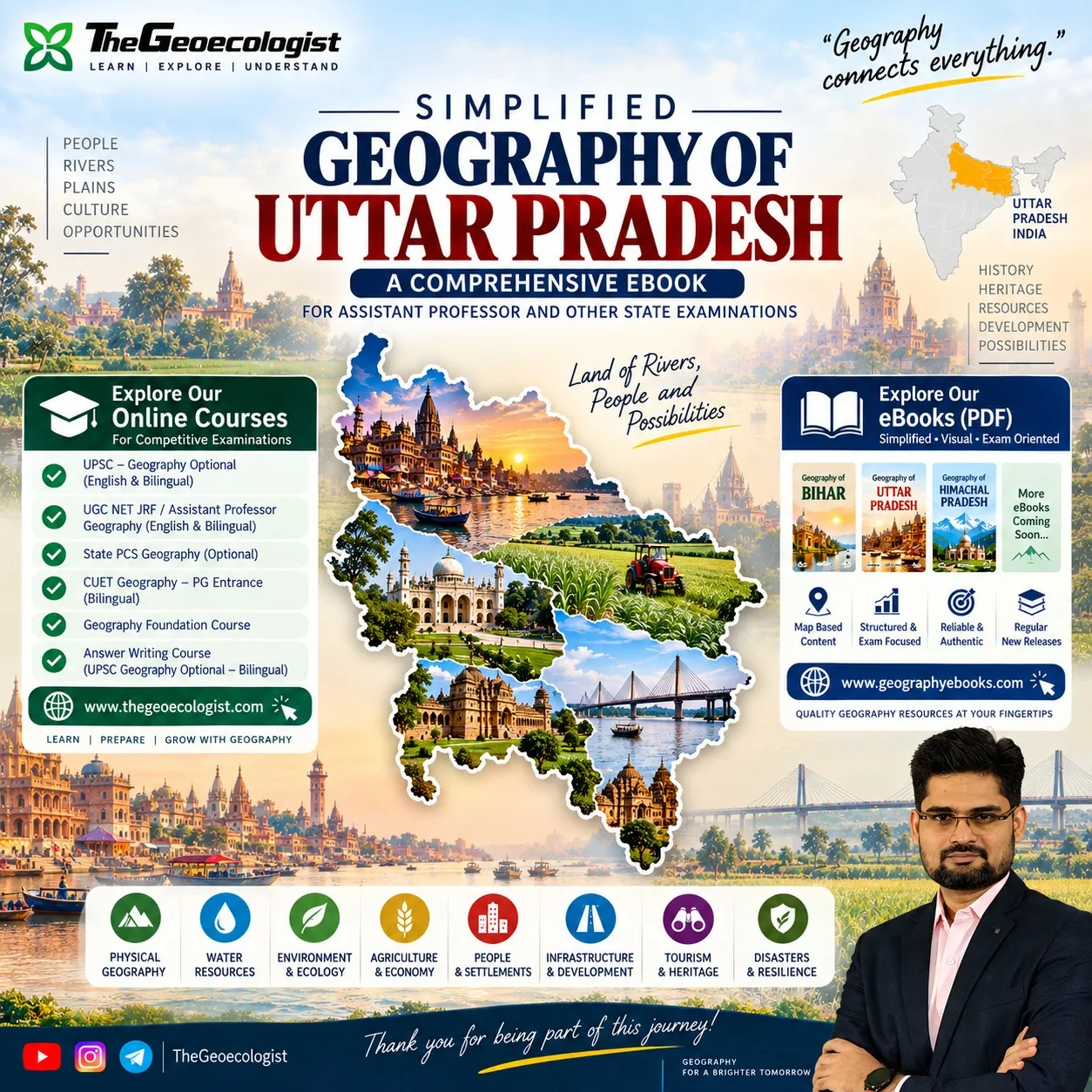
For aspirants seeking a reliable guide to master the Soils of Uttar Pradesh Classification and Distribution, the Geography of Uttar Pradesh | eBook | Dr. Krishnanand offers a structured and visually rich approach. Based on Dr. Krishnanand’s extensive lecture series, this eBook integrates physical geography, water resources, environment and ecology, agriculture, settlements, infrastructure, tourism, and disaster resilience—all within a single cohesive framework.
Unlike generic notes that treat soil classification as a standalone topic, this eBook demonstrates how the Soils of Uttar Pradesh Classification and Distribution connects to larger geographical narratives. Maps and diagrams illustrate the spatial relationships between soil types and river systems, while case studies highlight the implications of soil degradation for rural communities. The content is particularly valuable for exams where conceptual clarity and map-based understanding carry significant weight, such as the Assistant Professor recruitment exams, UP State PCS, UPSC optionals, and UGC NET Geography.
At INR 249, the eBook provides affordable access to high-quality, exam-ready material that many aspirants struggle to compile from multiple sources. Its structured format allows learners to study efficiently, focusing on areas that are most likely to appear in competitive assessments.
Practical Usage and Buying Guidance for the eBook
To maximize the value of the Geography of Uttar Pradesh | eBook | Dr. Krishnanand, consider the following tips:
- Study in modules: Begin with the chapters on physical geography and soil classification, then progress to agriculture and land use.
- Use maps actively: Trace soil boundaries on blank outline maps to reinforce spatial memory.
- Cross-reference with current affairs: Connect soil data to recent news about irrigation projects, farm laws, or climate adaptation strategies.
- Practice answer writing: Frame answers that integrate soil information with other geographical themes, as expected in mains examinations.
- Revise regularly: Revisit key diagrams and summaries weekly to ensure retention.
Purchasing the eBook is straightforward—visit the official product page and complete the transaction using preferred payment methods. Once downloaded, the content can be accessed offline, making it convenient for aspirants who study in environments with limited internet connectivity.
Conclusion: Mastering Soils of Uttar Pradesh Classification and Distribution Through Integrated Learning
The Soils of Uttar Pradesh Classification and Distribution represent more than a list of categories to memorize—they form the foundation for understanding the state’s agricultural economy, environmental challenges, and development trajectory. Aspirants who invest time in building a nuanced understanding of these soil types, supported by quality visual and conceptual resources, position themselves for success in competitive examinations.
By choosing the Geography of Uttar Pradesh | eBook | Dr. Krishnanand, learners gain access to a resource that goes beyond rote learning, fostering the kind of analytical thinking that examiners reward. Whether you’re studying for the first time or revisiting concepts ahead of an exam, an integrated approach to geography ensures that every fact you learn stays connected to the bigger picture.
Frequently Asked Questions About Soils of Uttar Pradesh Classification and Distribution
What are the five major soil types found in Uttar Pradesh?
The five major soil types in Uttar Pradesh are alluvial soils, red and yellow soils, black cotton soils, forest and mountain soils, and saline and alkaline soils. Each type varies in composition, fertility, and suitability for different crops, reflecting the state’s diverse physiography.
Which soil type covers the largest area in Uttaw Pradesh?
Alluvial soils cover approximately 75% of Uttar Pradesh, making them the most widespread soil type in the state. These soils are deposited by the Ganga, Yamuna, and their tributaries, and are crucial for supporting the state’s intensive agriculture.
How does soil classification relate to agriculture in Uttar Pradesh?
Soil classification directly influences crop selection and agricultural practices. Alluvial soils support rice and wheat cultivation, red and yellow soils are suitable for pulses and oilseeds, and black cotton soils require specific timing for sowing due to their moisture retention properties. Understanding this relationship is essential for answering exam questions on land use and rural economy.
Are there any online resources for studying soil distribution in Uttar Pradesh?
Yes, several resources including state agricultural universities, the National Bureau of Soil Health, and educational platforms offer maps and data on soil distribution. However, for exam preparation, consolidated guides like the Geography of Uttar Pradesh eBook provide a more focused and integrated approach.
Can soil health impact disaster resilience in Uttar Pradesh?
Absolutely. Poor soil health increases vulnerability to floods, droughts, and erosion. Compacted or degraded soils reduce water infiltration, exacerbating surface runoff during heavy rains. Conversely, healthy soils with good organic content improve water retention and reduce the impact of droughts, making soil management a key component of disaster resilience planning.
Our Recommendation
📖 Part of our complete guide: Evolution of Geographical Thought: A Comprehensive Guide for UPSC Aspirants and Geography Enthusiasts
Frequently Asked Questions
What are the five major soil types found in Uttar Pradesh?
The five major soil types in Uttar Pradesh are alluvial soils, red and yellow soils, black cotton soils, forest and mountain soils, and saline and alkaline soils. Each type varies in composition, fertility, and suitability for different crops, reflecting the state's diverse physiography.
Which soil type covers the largest area in Uttar Pradesh?
Alluvial soils cover approximately 75% of Uttar Pradesh, making them the most widespread soil type in the state. These soils are deposited by the Ganga, Yamuna, and their tributaries, and are crucial for supporting the state's intensive agriculture.
How does soil classification relate to agriculture in Uttar Pradesh?
Soil classification directly influences crop selection and agricultural practices. Alluvial soils support rice and wheat cultivation, red and yellow soils are suitable for pulses and oilseeds, and black cotton soils require specific timing for sowing due to their moisture retention properties. Understanding this relationship is essential for answering exam questions on land use and rural economy.
Are there any online resources for studying soil distribution in Uttar Pradesh?
Yes, several resources including state agricultural universities, the National Bureau of Soil Health, and educational platforms offer maps and data on soil distribution. However, for exam preparation, consolidated guides like the Geography of Uttar Pradesh eBook provide a more focused and integrated approach.
Can soil health impact disaster resilience in Uttar Pradesh?
Absolutely. Poor soil health increases vulnerability to floods, droughts, and erosion. Compacted or degraded soils reduce water infiltration, exacerbating surface runoff during heavy rains. Conversely, healthy soils with good organic content improve water retention and reduce the impact of droughts, making soil management a key component of disaster resilience planning.