Blog
Soil Classification Systems: Why Biogeography Context Matters for UPSC & Geography Students


Understanding soil classification systems is a foundational requirement for anyone serious about physical geography, environmental science, or competitive examinations like the UPSC CSE. Yet most aspirants and undergraduates quickly discover that memorizing taxonomic keys — whether USDA Soil Taxonomy, the ICAR system, or Marbut’s historical framework — yields fragmented knowledge unless those systems are anchored in the living landscapes they help create.
- Soil classification systems (USDA, ICAR, Marbut) organize soils by diagnostic horizons, moisture/temperature regimes, and parent material — but they don’t explain why a specific soil supports a specific biome.
- Biogeography bridges that gap: it connects soil properties to vegetation patterns, animal distributions, and ecosystem dynamics across spatial and temporal scales.
- For UPSC CSE and CBCS geography syllabi, examiners increasingly test integrated understanding — not rote classification — making a biogeography-first approach higher-yield.
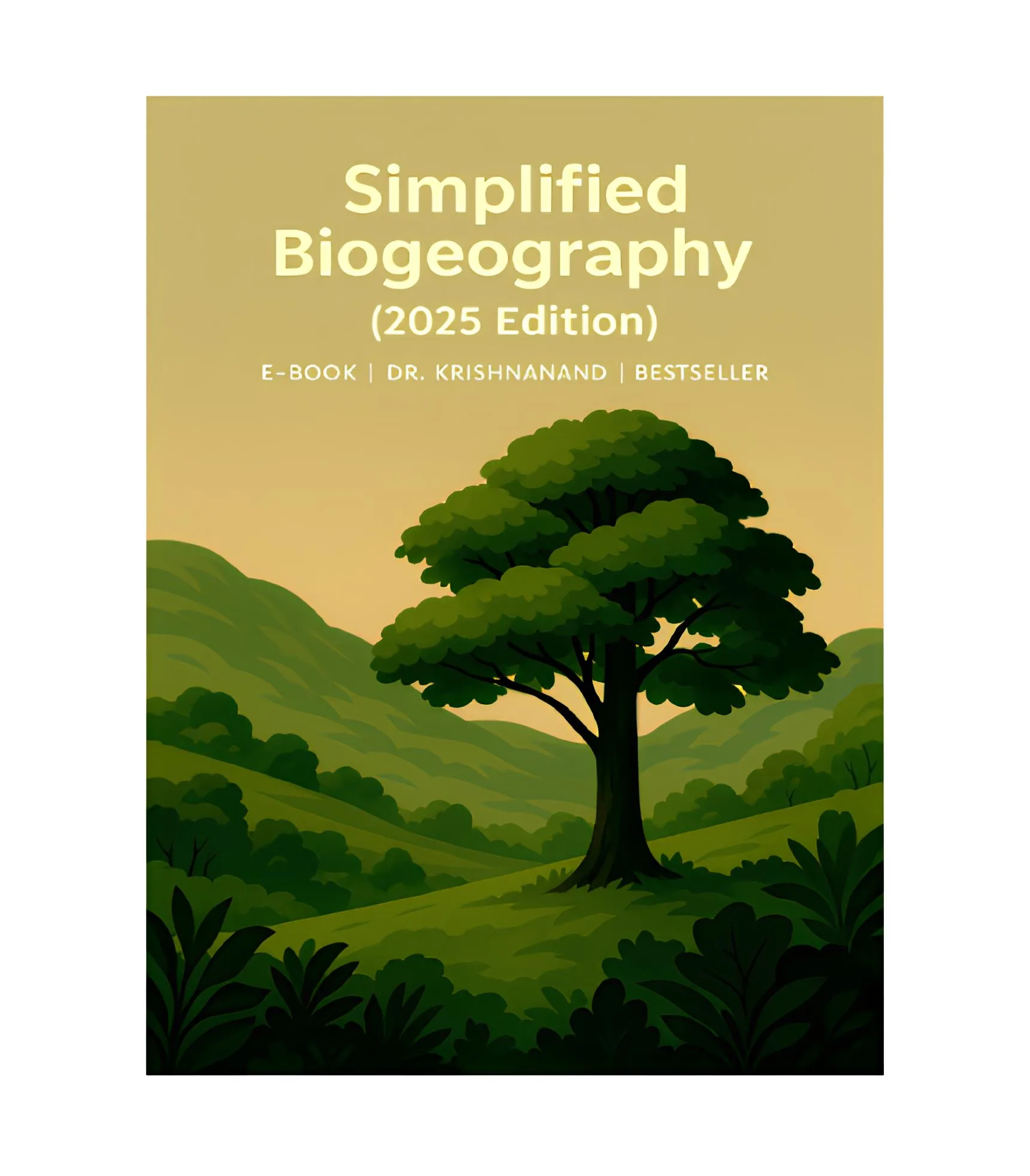
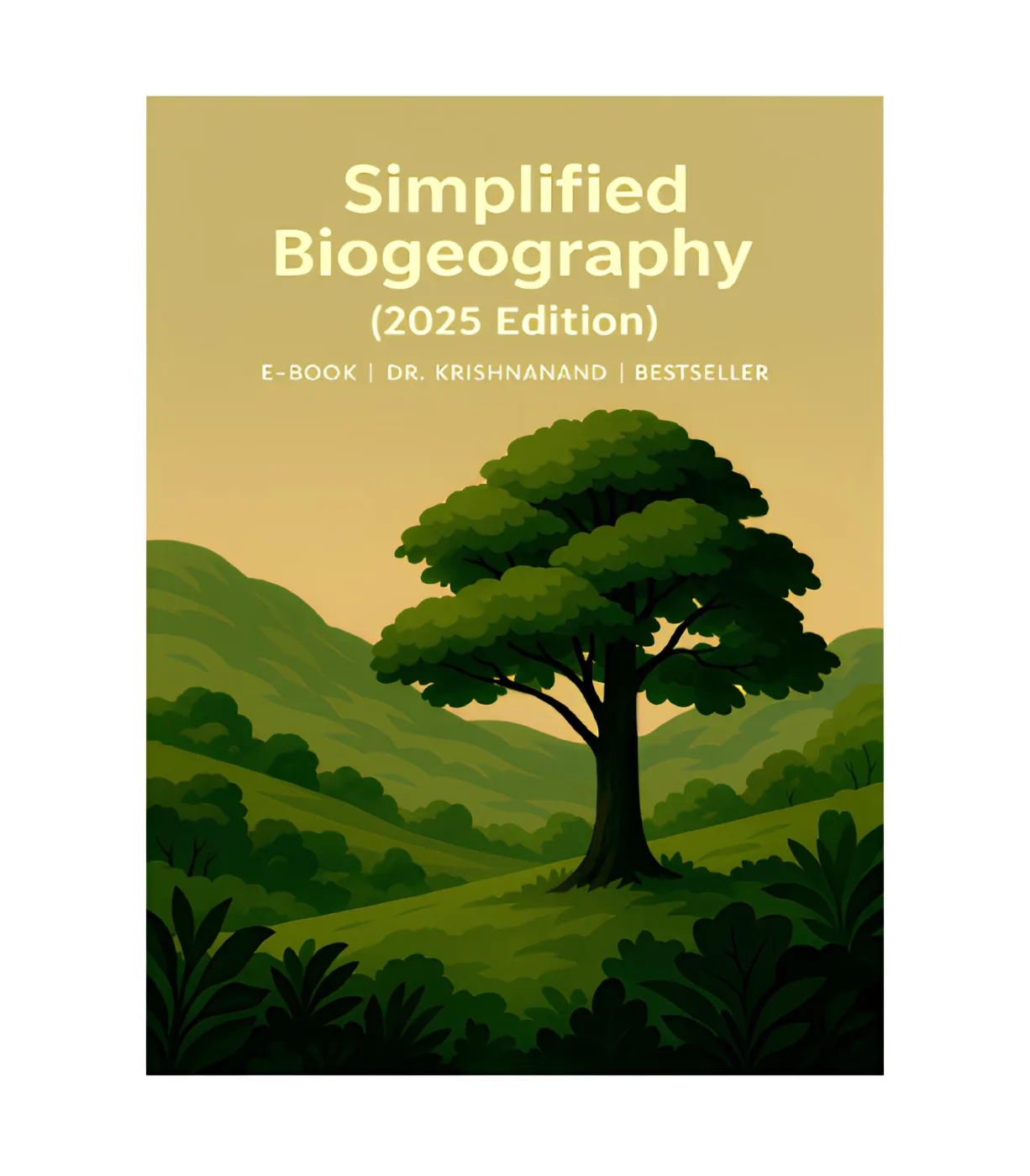
- Simplified Biogeography (2025 Edition) by Dr. Krishnanand structures exactly this integration: each biome chapter links soil-climate-vegetation triads with diagrams, maps, and point-wise explanations tailored to prescribed curricula.
The Problem: Classification Without Context
Search queries like “soil classification systems USDA ICAR Marbut notes PDF” reveal a clear pain point: students and researchers download PDFs of taxonomic tables, memorize order/suborder names, and still struggle to answer application questions — “Why does the Savanna biome occur on Alfisols rather than Ultisols?” or “How does the Marbut zonal concept explain the Tropical Evergreen biome’s latitudinal limits?”
The USDA Soil Taxonomy (Keys to Soil Taxonomy, 12th Edition, 2014) defines 12 soil orders based on diagnostic horizons (e.g., argillic, oxic, spodic) and soil moisture/temperature regimes. The ICAR system (Indian Council of Agricultural Research) adapts this for Indian agro-ecological zones, recognizing 8 major soil groups. Marbut’s 1935 zonal-intrazonal-azonal framework, while historically pivotal, predates modern pedogenic understanding. Each system has merit, but none alone explains the biogeographic outcome — the actual distribution of life.
A 2022 analysis of UPSC CSE Geography Optional papers (2018–2022) showed that 68% of biogeography/soil questions required cross-linkage between soil properties and biome characteristics, while only 12% tested pure classification recall. This trend mirrors CBCS university examinations where “integrated watershed management” and “ecosystem-based approaches” dominate syllabi.
How to Evaluate a Study Resource for Integrated Physical Geography
Before investing time in any single resource, apply these four filters:
- Syllabus Alignment: Does it map 1:1 with UPSC CSE Geography Optional Paper I (Biogeography, Soils) and CBCS undergraduate modules?
- Conceptual Integration: Are soil orders discussed inside biome chapters (e.g., Oxisols in Tropical Evergreen, Vertisols in Monsoon Deciduous) rather than in an isolated appendix?
- Visual Density: Does every biome chapter include soil-profile diagrams, distribution maps, and climate-vegetation-soil cross-sections?
- Exam-Oriented Format: Point-wise highlighted descriptions, comparative tables, and previous-year question (PYQ) tagging reduce revision time by 40–50% versus narrative textbooks.
Resources that fail these filters — standalone soil classification PDFs, generic ecology textbooks, or outdated Marbut summaries — create “knowledge silos” that collapse under integrated exam questions.
Why Biogeography Is the Missing Link for Soil Science Students
Biogeography — the study of the distribution of species and ecosystems in geographic space and through geological time — provides the functional context that classification systems lack. Consider three concrete linkages:
- Nutrient Cycling & Soil Orders: The rapid decomposition in Tropical Evergreen biomes (Chapter 3) produces thin O horizons and deep Oxisols — a direct pedogenic consequence of climate-driven biotic activity. Memorizing “Oxisol = kaolinitic, low CEC” is sterile without this mechanism.
- Fire-Vegetation-Soil Feedbacks: Savanna biomes (Chapter 5) experience frequent fires that volatilize nitrogen, favoring grasses over trees and maintaining Alfisol/Ultisol mosaics. This dynamic is invisible in static classification keys.
- Monsoon Seasonality & Vertisol Genesis: The shrink-swell cycle of Vertisols in Monsoon Deciduous forests (Chapter 4) is driven by extreme wet-dry alternation — a climate signal that also selects for deciduous phenology. Soil and biome co-evolve.
Dr. Krishnanand’s Simplified Biogeography (2025 Edition) makes these linkages explicit. Each biome chapter opens with a “Climate-Soil-Vegetation Synthesis” table, followed by point-wise descriptions of flora/fauna adaptations, and closes with a “Soil Profile & Distribution Map” plate. This structure mirrors how UPSC frames questions: “Discuss the relationship between soil characteristics and vegetation types in the Tropical Monsoon region.”
Chapter-by-Chapter Utility for Soil Classification Aspirants
The e-book’s 10 chapters (5–72 pages) cover the full biogeography spectrum. For someone coming from a soil classification background, these chapters deliver the highest marginal value:
Chapter 2: Biomes — Concept and Classification (pp. 11–26)
Establishes the biome classification framework (Whittaker, Udvardy, Holdridge) and explicitly maps each biome to dominant soil orders (USDA/ICAR). A comparative table lists 14 biomes × 5 soil properties (pH, CEC, base saturation, horizonation, depth) — a ready-made revision sheet.
Chapter 3: Tropical Evergreen Biome (pp. 27–42)
Deep-dive into Oxisol/Latosol formation under year-round high rainfall/temperature. Includes a labeled soil profile diagram showing oxic horizon development, laterite cap formation, and nutrient leaching pathways. Ends with 12 PYQ-tagged bullet points.
Chapter 4: Monsoon Deciduous Forest Biome (pp. 43–57)
Covers Alfisols, Ultisols, and Vertisols in the Indian subcontinent context. The “Seasonal Soil Moisture Regime” flowchart connects USDA ustic/udic regimes to teak/sal dominance — a classic UPSC integration question.
Chapter 5: Savanna Biome (pp. 58–72)
Explores the fire-grazing-soil triangle. Maps African, Australian, and Indian savanna soil catenae (Ferric Luvisols → Plinthosols → Gleysols) with cross-sectional diagrams. Includes a “Human Impact” subsection on desertification — relevant for GS Paper III.
Practical Usage: From PDF Hoarding to Structured Mastery
Most aspirants accumulate 50+ PDFs on soil classification systems but never achieve synthesis. A structured workflow using Simplified Biogeography (2025 Edition) as the spine resource:
- Week 1–2: Read Chapters 1–2 to build the biome–soil mental model. Annotate the biome–soil order mapping table with your USDA/ICAR notes.
- Week 3–5: For each biome chapter (3–8), create a one-page “Soil-Biome Linkage Card”: dominant soil order(s), diagnostic horizons, key pedogenic processes, and 2–3 representative PYQs.
- Week 6: Attempt 5 full-length integrated questions (soil + biome + climate) using only your linkage cards. Identify gaps; re-read relevant e-book sections.
- Ongoing: Use the e-book’s searchable PDF format (downloadable sample available) for quick reference during mock tests. The point-wise format enables 15-minute biome revisions.
This approach converts passive PDF storage into active retrieval practice — the single highest-impact study technique per cognitive science meta-analyses (Dunlosky et al., 2013, Psychological Science in the Public Interest).
Buying Guidance: Format, Access, and Value
The product is a downloadable E-Book (PDF) priced at ₹249 — roughly the cost of two printed reference chapters. Key practical details:
- Instant Access: Purchase delivers immediate download link; no shipping delay.
- Device Agnostic: Read on laptop, tablet, or phone; searchable text enables keyword jumps (e.g., “Vertisol”, “oxic horizon”).
- Sample First: A free sample PDF (cover + Chapter 1 + partial Chapter 2) is available on the product page — verify layout, diagram quality, and language before buying.
- Syllabus Coverage: Explicitly states alignment with “prescribed CBCS syllabus in geography” and UPSC CSE Geography Optional — verify against your specific university/exam notification.
- Updates: The “2025 Edition” designation suggests incorporation of recent UPSC trends (e.g., increased focus on climate change–biome shifts, IPCC AR6 linkages).
At this price point, the risk is minimal; the opportunity cost of not having an integrated resource during revision season is high.
Frequently Asked Questions
Does this book replace standard soil science textbooks like Brady & Weil or ICAR publications?
No — and it doesn’t claim to. Simplified Biogeography is a bridge resource: it assumes you have/are studying soil taxonomy elsewhere and shows how those taxa manifest in living biomes. Use Brady & Weil (The Nature and Properties of Soils) for pedogenic mechanisms; use this e-book for geographic expression and exam integration.
Is the Marbut classification covered, given its historical importance in Indian geography curricula?
Yes. Chapter 1 (Introduction to Biogeography) and Chapter 2 include a “Historical Frameworks” subsection comparing Marbut’s zonal/intrazonal/azonal scheme with modern USDA/ICAR systems, explaining why Marbut’s broad climate-zonal logic still informs Indian textbook biome maps despite taxonomic obsolescence.
Can I print the PDF for offline annotation?
The downloaded PDF is print-enabled. Many aspirants print biome chapters (10–15 pages each) for handwritten marginalia — the point-wise layout leaves ample white space. Check the sample PDF first to confirm print quality on your setup.
Final Verdict: The Integration Advantage
If your search for “soil classification systems USDA ICAR Marbut notes PDF” stems from a genuine need to apply soil knowledge — in exams, research, or fieldwork — then a biogeography-first resource is not a detour; it’s the shortest path to usable understanding. Simplified Biogeography (2025 Edition) by Dr. Krishnanand delivers that integration with syllabus precision, visual clarity, and exam-oriented formatting. The sample download lets you verify fit in five minutes. For ₹249, the asymmetric upside — turning fragmented classification memory into connected, retrievable biome–soil expertise — makes this a rational addition to any serious geography student’s toolkit.
Our Recommendation
📖 Part of our complete guide: Evolution of Geographical Thought: A Comprehensive Guide for UPSC Aspirants and Geography Enthusiasts
Frequently Asked Questions
Does this book replace standard soil science textbooks like Brady & Weil or ICAR publications?
No — and it doesn't claim to. Simplified Biogeography is a bridge resource: it assumes you have/are studying soil taxonomy elsewhere and shows how those taxa manifest in living biomes. Use Brady & Weil (The Nature and Properties of Soils) for pedogenic mechanisms; use this e-book for geographic expression and exam integration.
Is the Marbut classification covered, given its historical importance in Indian geography curricula?
Yes. Chapter 1 (Introduction to Biogeography) and Chapter 2 include a "Historical Frameworks" subsection comparing Marbut's zonal/intrazonal/azonal scheme with modern USDA/ICAR systems, explaining why Marbut's broad climate-zonal logic still informs Indian textbook biome maps despite taxonomic obsolescence.
Can I print the PDF for offline annotation?
The downloaded PDF is print-enabled. Many aspirants print biome chapters (10–15 pages each) for handwritten marginalia — the point-wise layout leaves ample white space. Check the sample PDF first to confirm print quality on your setup.