Blog
Vicariance and Long Distance Dispersal: A Complete Guide to Biogeography

Vicariance and Long Distance Dispersal are two fundamental mechanisms that explain how species spread across the planet. Whether you are a UPSC CSE aspirant preparing for geography optional or an undergraduate studying biogeography for the first time, understanding these processes is essential. The concept of Vicariance and Long Distance Dispersal biogeography forms the backbone of how scientists interpret the distribution of flora and fauna across continents and islands. If you have been searching for a clear, exam-oriented resource that covers these topics comprehensively, this guide will help you evaluate your options and find the right study material.
- Vicariance and Long Distance Dispersal biogeography explains how species distributions arise from both geological splitting and over-water or over-land migration.
- These mechanisms are prescribed in the CBCS syllabus for geography undergraduates and are frequently tested in UPSC CSE examinations.
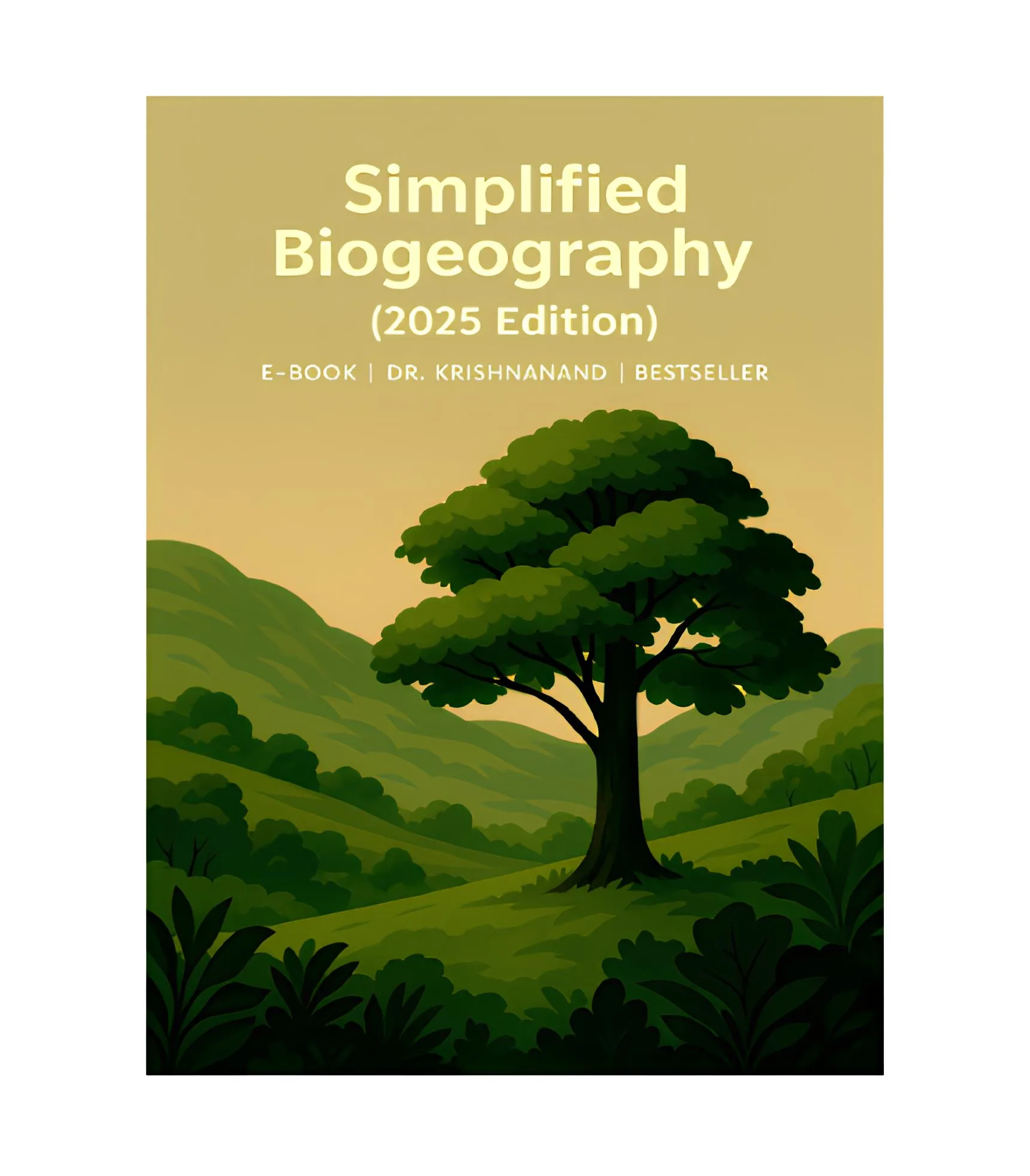
- Dr. Krishnanand’s Simplified Biogeography (2025 Edition) E-Book covers these concepts with diagrams, maps, and point-wise descriptions designed for exam success.
- Choosing a resource that integrates both mechanisms with real-world examples is critical for scoring well in competitive exams.
What Is Vicariance and Long Distance Dispersal Biogeography?
Vicariance and Long Distance Dispersal biogeography represents two contrasting yet complementary explanations for why organisms occur where they do. Vicariance refers to the process where a geographic barrier — such as a mountain range, river, or ocean — splits a previously continuous population into two or more isolated groups, leading to speciation over evolutionary time. Long Distance Dispersal, on the other hand, describes the movement of organisms across barriers that would otherwise separate them, such as a bird carrying seeds across an ocean or a reptile rafting on debris to a distant island. Together, Vicariance and Long Distance Dispersal account for nearly every major biogeographic pattern observed on Earth, from the distribution of marsupials in Australia to the presence of similar plant species on isolated archipelagos. According to research published by the Smithsonian Institution’s biogeography division, both mechanisms operate simultaneously but dominate different spatial and temporal scales. Understanding Vicariance and Long Distance Dispersal is therefore not optional — it is the foundational framework upon which all of biogeography is built.
Why Students and Aspirants Struggle with This Topic
For many students, Vicariance and Long Distance Dispersal biogeography feels abstract because textbooks often present the mechanisms in isolation, without connecting them to real-world case studies. UPSC CSE candidates frequently report that questions on biogeography — particularly in the geography optional paper — require precise knowledge of both mechanisms and the ability to distinguish between them in an exam hall. The challenge intensifies when a single question may ask you to explain whether a particular species distribution is best explained by vicariance or by long distance dispersal, requiring you to apply both concepts simultaneously. Common mistakes include confusing vicariance with sequential dispersal or failing to recognize that long distance dispersal events, though rare, have disproportionately large effects on global biodiversity patterns. This is precisely why a dedicated resource like Simplified Biogeography (2025 Edition) by Dr. Krishnanand has become a bestseller among aspirants — it addresses these exact pain points with structured, point-wise explanations that make Vicariance and Long Distance Dispersal accessible and exam-ready.
How to Evaluate a Biogeography Study Resource
Not every biogeography textbook handles Vicariance and Long Distance Dispersal with the depth and clarity that competitive exams demand. When evaluating a resource, consider the following criteria. First, check whether the book explicitly separates vicariance from dispersal mechanisms and provides dedicated sections for each, rather than blending them into a single vague chapter. Second, look for diagrammatic and map-based explanations — biogeography is inherently spatial, and a text that relies only on paragraphs without visuals will fail to build the conceptual clarity you need. Third, assess whether the book includes case studies from the CBCS syllabus, such as tropical biomes, island biogeography, and the distribution of specific plant and animal groups. Fourth, consider the author’s track record; resources written by educators who understand UPSC CSE exam patterns tend to align explanations with the style of questions actually asked. Finally, check whether the resource is up to date — the 2025 edition ensures that all data, classification schemes, and syllabus references reflect the latest academic and examination standards. A strong resource on Vicariance and Long Distance Dispersal biogeography will make you feel confident answering both short-answer and essay-type questions in your examination.
Why Simplified Biogeography (2025 Edition) by Dr. Krishnanand Is the Right Choice
Simplified Biogeography (2025 Edition) by Dr. Krishnanand directly addresses the challenges students face when studying Vicariance and Long Distance Dispersal biogeography. The book is prescribed on the CBCS syllabus in geography, which means every chapter aligns with what universities and examination bodies expect. Chapter 1 introduces biogeography’s principles and scope, immediately grounding the reader in the conceptual framework within which vicariance and dispersal operate. Chapter 2 on Biomes: Concept and Classification provides the ecological baseline needed to understand why Vicariance and Long Distance Dispersal produce different patterns in different biomes — for instance, vicariance events in tropical evergreen forests versus long distance dispersal events in savannas. The point-wise highlighted descriptions, paired with diagrams, maps, and images, transform what could be a dense theoretical topic into an engaging and comprehensive study experience. For UPSC CSE aspirants specifically, the structured format means you can revise Vicariance and Long Distance Dispersal biogeography quickly before an exam without re-reading entire chapters. The book’s bestseller status reflects the genuine demand for a resource that makes this complex topic approachable without sacrificing academic rigor.
How to Use This E-Book Effectively for Exam Preparation
To maximize the value of Simplified Biogeography (2025 Edition) when studying Vicariance and Long Distance Dispersal biogeography, adopt a structured reading strategy. Begin with Chapter 1 and Chapter 2 to build your foundational understanding of biogeographic principles and biome classification. Then move to the biome-specific chapters, where you will encounter real-world examples of vicariance — such as the separation of Gondwana landmasses leading to distinct southern hemisphere flora — and long distance dispersal — such as the colonization of oceanic islands like Hawaii and the Galápagos. As you read, create a comparison table that lists vicariance and long distance dispersal side by side, noting the mechanisms, evidence, and example species for each. Use the diagrams and maps in the e-book to trace biogeographic routes visually, reinforcing your spatial understanding. Practice answering previous year UPSC questions on Vicariance and Long Distance Dispersal biogeography using only the information from this e-book to test your retention. Finally, revisit the key takeaway points at the end of each chapter before your exam to consolidate your understanding of this critical topic.
Buying Guidance and Practical Considerations
When purchasing Simplified Biogeography (2025 Edition), ensure you are acquiring the latest edition to benefit from updated syllabus references and revised content. The e-book format offers the advantage of searchable text, which is particularly useful when you need to quickly locate sections on Vicariance and Long Distance Dispersal biogeography during revision. The price point of 249 makes it an affordable investment compared to traditional printed biogeography textbooks that may not align with the CBCS syllabus or UPSC CSE exam patterns. Before buying, verify that the product listing matches the 2025 edition by Dr. Krishnanand, as earlier editions may contain outdated classification systems or omit recent developments in biogeographic theory. This resource is particularly valuable for undergraduates studying the prescribed CBCS geography syllabus, UPSC CSE aspirants preparing for geography optional, and any learner who wants a clear, diagram-rich introduction to how Vicariance and Long Distance Dispersal shape the living world. The combination of comprehensive content, exam-oriented structure, and accessible language makes it a resource that genuinely earns its recommendation rather than relying on hype.
Frequently Asked Questions About Vicariance and Long Distance Dispersal Biogeography
What is the difference between vicariance and long distance dispersal?
Vicariance occurs when a geographic barrier splits an existing population into isolated groups, leading to independent evolution, while long distance dispersal involves organisms crossing existing barriers through rare but impactful events such as wind, water, or animal-mediated transport. Both are key mechanisms in Vicariance and Long Distance Dispersal biogeography.
Is Vicariance and Long Distance Dispersal biogeography part of the UPSC CSE syllabus?
Yes, biogeography topics including vicariance and dispersal mechanisms fall within the geography optional syllabus for UPSC CSE and are also prescribed in the CBCS curriculum for undergraduate geography programs. Resources like Simplified Biogeography (2025 Edition) by Dr. Krishnanand cover these topics in alignment with official syllabus requirements.
Can beginners understand Vicariance and Long Distance Dispersal biogeography without prior expertise?
Yes, well-structured resources designed for students — particularly those with diagrams, maps, and point-wise explanations — make Vicariance and Long Distance Dispersal biogeography accessible to beginners. The Simplified Biogeography (2025 Edition) E-Book by Dr. Krishnanand is specifically designed for students, aspirants, and enthusiasts without requiring prior advanced knowledge.
Why are diagrams and maps important for studying biogeography?
Biogeography is inherently spatial, and diagrams and maps help learners visualize how species distributions change across regions, biomes, and geological formations. For topics like Vicariance and Long Distance Dispersal biogeography, visual aids make it possible to trace dispersal routes and identify barrier effects that text alone cannot convey effectively.
Our Recommendation
📖 Part of our complete guide: Evolution of Geographical Thought: A Comprehensive Guide for UPSC Aspirants and Geography Enthusiasts
Frequently Asked Questions
What is the difference between vicariance and long distance dispersal?
Vicariance occurs when a geographic barrier splits an existing population into isolated groups, leading to independent evolution, while long distance dispersal involves organisms crossing existing barriers through rare but impactful events such as wind, water, or animal-mediated transport.
Is Vicariance and Long Distance Dispersal biogeography part of the UPSC CSE syllabus?
Yes, biogeography topics including vicariance and dispersal mechanisms fall within the geography optional syllabus for UPSC CSE and are also prescribed in the CBCS curriculum for undergraduate geography programs.
Can beginners understand Vicariance and Long Distance Dispersal biogeography without prior expertise?
Yes, well-structured resources designed for students — particularly those with diagrams, maps, and point-wise explanations — make this topic accessible to beginners without requiring prior advanced knowledge.