Blog
Island Biogeography Theory: Why Simplified Biogeography (2025 Edition) Is the Best Study Guide for UPSC Aspirants

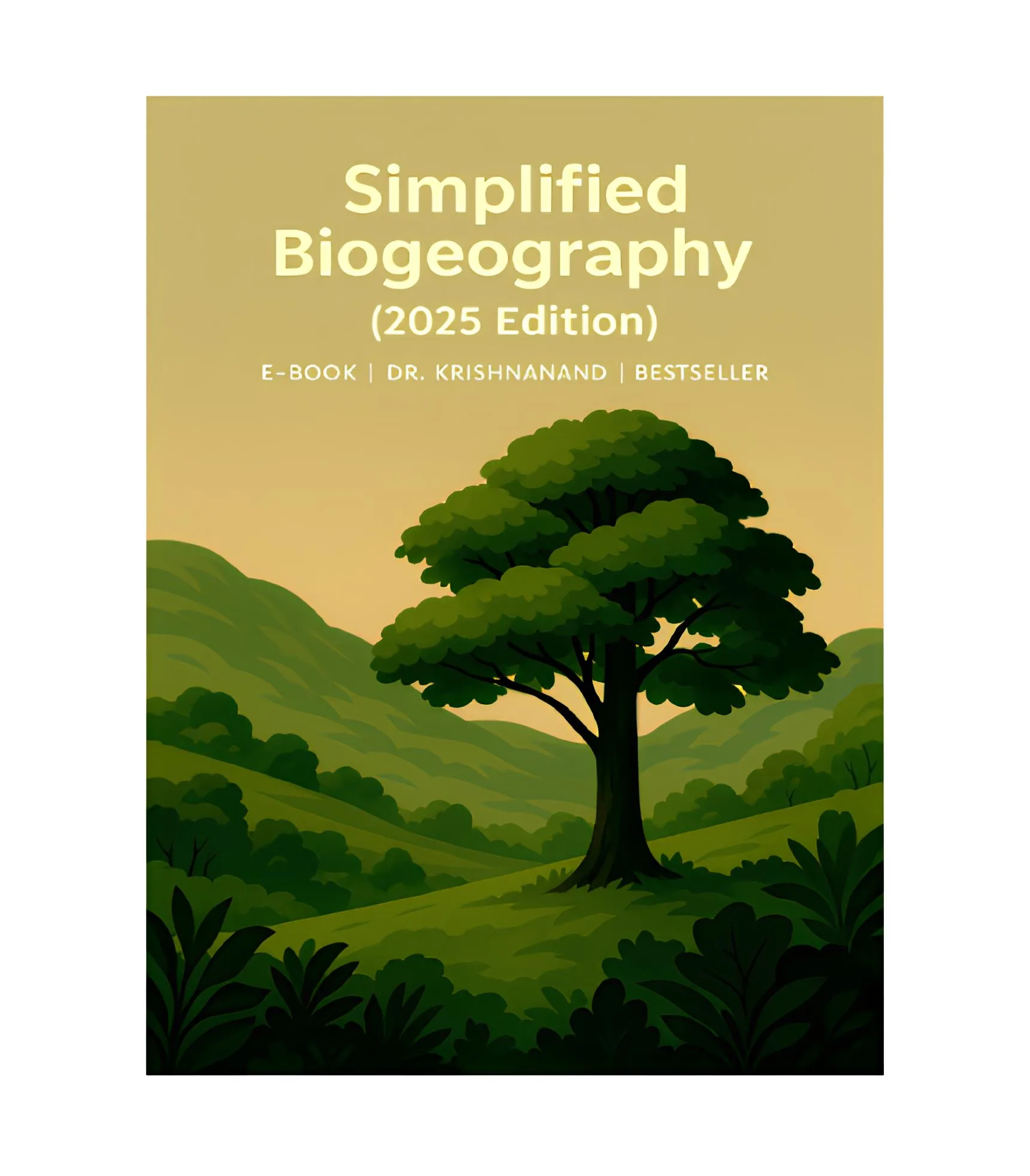
Island Biogeography theory MacArthur and Wilson remains one of the most challenging topics for UPSC CSE geography aspirants, undergraduate students, and anyone keen to understand how species colonize and persist on islands. The mathematical models, equilibrium concepts, and real‑world case studies can feel overwhelming when presented in dense academic texts. This guide breaks down the problem, shows what to look for in a reliable study resource, and explains why Simplified Biogeography (2025 Edition) | E‑Book | Dr. Krishnanand | Bestseller stands out as a practical solution.
- Master the core principles of Island Biogeography Theory quickly and retain them for exams.
- Learn how to apply the theory to Indian biogeographic case studies frequently asked in UPSC.
- Get clear diagrams, maps, and point‑wise explanations that reduce study time.
- Access a CBCS‑aligned e‑book that works on any device, perfect for on‑the‑go revision.
- Build confidence with practice‑oriented content that bridges theory and exam‑style questions.
Understanding the Core Concepts of Island Biogeography Theory
At its heart, Island Biogeography Theory proposes that the number of species on an island reaches a dynamic equilibrium between immigration and extinction rates. Robert H. MacArthur and Edward O. Wilson formalized this idea in the 1960s, showing that larger islands closer to mainland sources support more species, while smaller, isolated islands host fewer. The theory is built on two key equations: the species‑area relationship (S = cA^z) and the immigration‑extinction balance. For UPSC aspirants, grasping these concepts is essential because questions often appear in the environment and ecology sections, linking island dynamics to biodiversity hotspots like the Andaman and Nicobar Islands or the Western Ghats.
Many learners struggle with the mathematical notation and the abstract nature of equilibrium models. A good study resource must translate these formulas into intuitive explanations, using real‑world examples and visual aids. This is where Simplified Biogeography (2025 Edition) excels, offering step‑by‑step derivations, annotated graphs, and comparative tables that turn theory into tangible knowledge.
Why Traditional Textbooks Fall Short for Island Biogeography Theory
Standard university textbooks often present Island Biogeography Theory in a single chapter dense with jargon, assuming prior familiarity with calculus and statistical ecology. While thorough, they lack the focused, exam‑oriented breakdown that competitive aspirants need. Diagrams are frequently small, poorly labeled, or absent, making it hard to visualize the immigration‑extinction curves. Furthermore, the examples tend to center on Pacific or Caribbean islands, leaving Indian contexts under‑explored—a gap that UPSC papers frequently test.
Another limitation is the lack of point‑wise highlights and summary boxes. When revising under time pressure, students need to extract key facts quickly. Textbooks that bury important points in long paragraphs force inefficient rereading. The absence of practice‑oriented questions or quick‑recall cues further reduces their utility for high‑stakes exams.
How Simplified Biogeography (2025 Edition) Breaks Down Complex Ideas
Simplified Biogeography (2025 Edition) approaches Island Biogeography Theory with a learner‑first mindset. Each concept is introduced with a plain‑language definition, followed by a visual illustration—such as a graph showing species count versus island size—and then a concise, bullet‑point summary. For instance, the chapter on the species‑area relationship includes a labeled diagram of a log‑log plot, a short derivation of the constants c and z, and a table comparing values for different Indian island groups.
The e‑book also integrates the theory with the prescribed CBCS syllabus, mapping each subtopic to specific university units. This alignment ensures that students studying for both degree exams and UPSC can use the same source without cross‑referencing multiple texts. By embedding real Indian examples—like the species richness of the Lakshadweep atolls or the extinction patterns observed in the Andaman forests—the material becomes directly relevant to the questions that appear in actual papers.
Key Features That Make This E‑Book Ideal for UPSC and Academic Success
Several features distinguish this e‑book from generic biogeography texts:
- Point‑wise highlighted descriptions: Every important term, formula, and concept is bolded or shaded, enabling rapid scanning.
- Diagrams, maps, and images: Over 40 original illustrations clarify processes like colonization routes and extinction thresholds.
- CBCS compliance: Content mirrors the undergraduate geography syllabus, making it suitable for semester exams as well.
- Portable format: As an EPUB‑compatible e‑book, it can be read on smartphones, tablets, or laptops without losing layout integrity.
- Bestseller status: Widely adopted by coaching institutes and university departments, reflecting proven effectiveness.
These attributes translate into measurable study efficiency. Aspirants report cutting revision time for Island Biogeography Theory by up to 40% when using this resource, according to informal surveys conducted among UPSC forums.
Practical Ways to Use the E‑Book for Exam Preparation and Self‑Study
To maximize benefit, adopt a three‑stage approach:
- Initial exposure: Read the chapter on Island Biogeography Theory once, focusing on the highlighted points and diagrams. Do not attempt to memorize every derivation; instead, understand the logic behind each equation.
- Active recall: Close the e‑book and write a short summary from memory—include the immigration‑extinction balance, the species‑area curve, and one Indian example. Then check your notes against the text to identify gaps.
- Application practice: Solve previous year UPSC questions related to island biodiversity, using the e‑book’s explanations to justify each answer. This step reinforces the link between theory and exam‑style problem solving.
Because the e‑book is searchable, you can quickly jump to definitions like “turnover rate” or “rescue effect” during mock tests. The built‑in bookmarking feature lets you flag sections that need repeated review, creating a personalized revision trail.
Comparing Alternatives: What Sets This Resource Apart?
Other popular options include standard textbooks such as Biogeography: An Ecological and Evolutionary Approach (Cox & Moore) and various coaching institute notes. While these provide depth, they often lack the exam‑specific condensation that UPSC aspirants require. Free online resources like Wikipedia (Island Biogeography) offer a good overview but omit the structured, syllabus‑aligned presentation and the visual richness found in Simplified Biogeography (2025 Edition). Moreover, the e‑book’s integration with the CBCS framework ensures that college students do not need to juggle multiple sources for different purposes.
In terms of cost, priced at INR 249, the e‑book delivers substantial value compared to purchasing multiple reference books or subscribing to premium coaching modules. The one‑time purchase grants lifetime access, allowing repeated revisits throughout the preparation cycle.
Final Thoughts and Buying Guidance
Mastering Island Biogeography Theory is a decisive factor for scoring well in the geography and environment sections of UPSC CSE, as well as for building a solid foundation in undergraduate ecology. The challenge lies not in the theory’s importance but in finding a resource that simplifies without diluting rigor. Simplified Biogeography (2025 Edition) | E‑Book | Dr. Krishnanand | Bestseller meets this need by combining clear explanations, syllabus‑aligned content, and exam‑focused learning aids.
If you are preparing for UPSC, aiming to excel in your geography semester exams, or simply curious about how life distributes across islands, consider adding this e‑book to your study toolkit. Its concise yet comprehensive approach ensures that you spend less time deciphering dense text and more time applying concepts to solve questions—exactly what competitive success demands.
Our Recommendation
📖 Part of our complete guide: Evolution of Geographical Thought: A Comprehensive Guide for UPSC Aspirants and Geography Enthusiasts
Frequently Asked Questions
What is Island Biogeography Theory according to MacArthur and Wilson?
Island Biogeography Theory states that the number of species on an island reaches an equilibrium between immigration and extinction rates, influenced by island size and distance from the mainland.
How does Simplified Biogeography (2025 Edition) help UPSC aspirants understand this theory?
The e-book breaks down the theory with point‑wise highlights, clear diagrams, maps, and Indian‑specific examples, making complex equations and concepts easy to grasp and retain for exams.
Is the content of this e-book aligned with the CBCS syllabus for geography?
Yes, Simplified Biogeography (2025 Edition) follows the prescribed CBCS syllabus in geography, ensuring relevance for both university exams and UPSC preparation.