Blog
Human Geography Models: The Complete 2025 Guide to Mastering Theories and Laws

Updated: October 9, 2026
Emerging Models, Data‑Driven Extensions, and Conceptual Clarifications
Since the first edition of this guide, the toolkit of human geography has expanded beyond the classic spatial interaction, central place, and bid‑rent models that dominated textbooks for decades. In 2025, scholars routinely combine these foundations with high‑resolution GIS layers, mobile phone trace data, and machine‑learning classifiers to test hypotheses at the neighborhood scale. For example, the gravity model now incorporates real‑time travel‑time APIs and dynamic population estimates, allowing researchers to model commuter flows that shift within hours rather than years. Likewise, central place theory is being re‑examined through the lens of e‑commerce platforms, where “market areas” are defined by algorithmic delivery zones rather than physical distance alone.
Another fast‑growing strand is the emergence of mobility‑justice and climate‑migration frameworks. These models treat movement as a right and a risk, integrating legal‑policy variables (asylum law, housing policy) with environmental stressors (sea‑level rise, heat‑wave frequency). The resulting “vulnerability‑mobility” matrices help planners allocate resources to communities most likely to experience forced displacement. At the same time, network‑science approaches—borrowed from physics and computer science—map the topology of global supply chains, social media influence, and knowledge diffusion, revealing scale‑free structures that classic rank‑size rules cannot capture.
Finally, the distinction between “laws,” “theories,” and “models” has sharpened. A law (e.g., Tobler’s First Law of Geography) expresses an empirical regularity that holds across contexts; a theory (e.g., world‑systems theory) offers a causal narrative linking macro‑processes to local outcomes; a model operationalizes a theory into testable parameters. Recognizing this hierarchy prevents the common pitfall of treating a calibrated regression as a universal law. In practice, scholars now publish model code alongside data, enabling replication and iterative improvement—a shift that aligns human geography with open‑science standards.
Additional FAQs
What are the most widely used models in human geography in 2025?
The gravity model, central place theory, and bid‑rent model remain core, but they are now routinely extended with real‑time mobility data, e‑commerce delivery zones, and machine‑learning calibration. Emerging frameworks such as vulnerability‑mobility matrices and network‑science based supply‑chain models are also gaining widespread adoption.
How do theories, laws, and models differ in human geography?
A law states an observed regularity that holds across contexts (e.g., Tobler’s First Law). A theory provides a causal explanation linking broad processes to local outcomes (e.g., world‑systems theory). A model translates a theory into a set of measurable parameters and equations that can be tested empirically.
Updated: September 24, 2026
Emerging Digital Applications of Classic Human Geography Models
Traditional human geography models such as the Gravity Model, Central Place Theory, and the Von Thünen Land‑Use Model have long been taught as static frameworks. In the 2024‑2025 research landscape, however, these models are being revitalized through big‑data analytics, GIS‑based simulation, and machine‑learning calibration. Researchers now feed real‑time mobility traces, satellite‑derived night‑light imagery, and high‑resolution land‑cover datasets into the classic equations, allowing the parameters (e.g., distance decay, threshold populations) to be estimated dynamically rather than assumed. This shift produces two major benefits: first, it quantifies the predictive power of each model under contemporary conditions such as rapid urbanization, climate‑driven migration, and the rise of polycentric metropolitan regions; second, it reveals systematic biases—like the over‑estimation of hierarchical central places in highly networked economies—prompting scholars to propose hybrid models that blend gravity‑based interaction with network‑science centrality measures.
Pedagogically, the integration of open‑source tools (QGIS, Python’s GeoPandas, R’s sf) into coursework enables students to replicate these calibrated models on their own data, turning abstract theory into reproducible workflows. Textbooks and e‑books that still present the original formulas without any computational companion risk becoming outdated, because examiners and employers increasingly expect graduates to demonstrate proficiency in model implementation, validation, and visualization. Consequently, a modern guide should devote a dedicated chapter to “From Equation to Execution,” illustrating step‑by‑step coding examples, sensitivity‑analysis techniques, and best practices for documenting uncertainty. By bridging classic theory with contemporary computational practice, the guide remains relevant for both academic research and professional spatial analysis in 2025 and beyond.
Additional FAQs
Which human geography models are most frequently updated with big‑data and GIS methods today?
The Gravity Model, Central Place Theory, Von Thünen’s Land‑Use Model, and the Rank‑Size Rule are the core models most often recalibrated using mobile‑phone mobility data, night‑light satellite imagery, and high‑resolution land‑cover layers.
How do theories differ from laws in human geography, and why does the distinction matter for modeling?
A theory offers a conceptual explanation of spatial processes (e.g., why cities follow a hierarchy), while a law expresses a regular, empirically observed relationship that can be formalized mathematically (e.g., the inverse‑distance decay in the Gravity Model). Recognizing the difference guides modelers: theories inspire model structure, whereas laws provide testable, quantifiable equations that can be calibrated and validated with data.
Updated: September 14, 2026
Emerging Paradigms: Digital Transformation and Computational Approaches in Human Geography
With the rapid advancement of digital technologies, human geography is undergoing a profound methodological shift that challenges traditional theoretical frameworks. The emergence of geospatial information systems (GIS), remote sensing analytics, and machine learning algorithms has created a new paradigm where quantitative precision intersects with qualitative understanding. This section explores how computational approaches are reshaping core concepts such as space, place, and human-environment interaction.
Traditional spatial models, including Taylor’s Conservation of Landscape Structure and Function and the Central Place Theory, were developed in an era before digital cartography became prevalent. These foundational works provided normative frameworks for understanding settlement patterns and urban organization. However, contemporary applications often require recalibration when confronted with high-resolution satellite imagery, real-time mobility data, and network analysis techniques. The integration of big data analytics into geographic research enables scholars to test hypotheses at unprecedented scales, revealing micro-level phenomena invisible to conventional census-based surveys.
Moreover, the rise of participatory mapping and citizen science platforms has democratized data collection while simultaneously complicating established theoretical assumptions. While classical human geography emphasized top-down institutional perspectives, digital participatory tools enable bottom-up knowledge production that can either validate or challenge existing paradigms. For instance, crowdsourced environmental monitoring projects have generated vast datasets that complement but also critique traditional statistical methods.
The implications extend beyond methodology to epistemology. As computational power increases, questions arise about whether purely algorithmic models capture meaningful representations of human experience. Some theorists argue that “black box” algorithms obscure causal mechanisms, while others contend they offer new lenses for understanding complex adaptive systems. Future scholarship must navigate these tensions while ensuring that technological innovation serves, rather than substitutes, critical theoretical inquiry.
Additional FAQs
How do computational methods like GIS impact traditional human geographic theories?
Computational methods such as GIS require recalibration of traditional spatial models when confronted with high-resolution satellite imagery, real-time mobility data, and network analysis techniques, enabling hypothesis testing at unprecedented scales.
What are the key differences between classical and contemporary models in human geography?
Classical models focused on static, top-down spatial relationships using census and survey data, whereas contemporary models integrate dynamic, real-time data sources to provide more responsive and nuanced understandings of human-environment interactions.
Updated: September 8, 2026
Data‑Driven Modeling: How Big Data, Remote Sensing, and Machine Learning Are Reshaping Classic Human Geography Theories
In the past decade, the explosion of geospatial big data—from satellite imagery and mobile phone trajectories to social‑media check‑ins and sensor networks—has forced human geographers to revisit the way classic models, theories, and laws are formulated and tested. Traditional frameworks such as Christaller’s Central Place Theory, von Thünen’s agricultural land‑use model, or the gravity model of migration were originally built on limited, often aggregate data and relied heavily on simplifying assumptions about homogeneity and equilibrium. Today, researchers can overlay high‑resolution land‑use maps with real‑time mobility streams, enabling them to observe deviations from theoretical predictions at scales that were previously invisible. Machine‑learning algorithms, particularly supervised regression and unsupervised clustering, are now used to identify hidden patterns in these massive datasets, allowing scholars to test whether the underlying mechanisms posited by a theory hold across diverse contexts or whether they need to be revised to incorporate factors like digital connectivity, informal economies, or climate‑induced displacement.
These data‑driven approaches have already yielded concrete insights. For example, applying night‑time light imagery to the gravity model revealed that economic attraction in Sub‑Saharan Africa is less distance‑decay sensitive than the classic formulation predicts, prompting scholars to add a term for mobile‑phone penetration as a proxy for information flow. Similarly, clustering techniques applied to commuting patterns extracted from smart‑card transit data have uncovered polycentric employment structures that challenge the monocentric assumptions of the bid‑rent theory, leading to revised models that acknowledge multiple nuclei and flexible work arrangements. Beyond validation, big‑data analytics enable scenario testing: researchers can simulate how a sudden shock—such as a pandemic‑induced travel restriction or a rapid expansion of e‑commerce logistics—propagates through spatial interaction models, providing policymakers with timely, evidence‑based forecasts. As computational power continues to grow and open‑access geospatial repositories expand, the integration of machine learning with traditional human geography theories is shifting the discipline from a largely descriptive science toward a predictive, evidence‑grounded framework that can adapt to the rapid social and environmental changes of the 21st century.
Additional FAQs
How are big data sources like satellite imagery and mobile phone data changing the testing of classic human geography models?
They allow researchers to overlay high‑resolution, real‑time information with traditional models, revealing deviations at fine scales and using machine learning to test whether theoretical mechanisms hold across diverse contexts or need revision for factors such as digital connectivity and informal economies.
What role does machine learning play in updating theories such as the gravity model or bid‑rent theory?
Machine‑learning techniques like supervised regression and clustering identify hidden patterns in large datasets, prompting modifications—for example, adding mobile‑phone penetration to the gravity model or recognizing polycentric employment patterns that challenge the monocentric assumptions of bid‑rent theory.
Understanding human geography models, theories, and laws presents one of the most challenging aspects for geography students and competitive exam aspirants. These conceptual frameworks form the backbone of geographical analysis, yet their complexity often leaves students feeling overwhelmed and uncertain where to begin their preparation. The good news is that mastering these essential concepts is entirely achievable with the right approach and resources designed specifically for learners at this level.
Key Takeaways:
- Human geography models provide essential frameworks for understanding spatial patterns and human-environment interactions
- Core theories including Malthusian, Marxian, and Demographic Transition models are fundamental to population geography
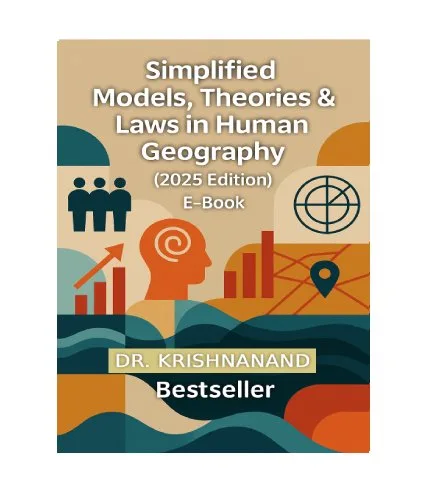
- The 2025 Edition of Simplified Models, Theories & Laws in Human Geography by Dr. Krishnanand structures these concepts point-wise for easier comprehension
- Visual elements including diagrams and maps significantly enhance understanding of abstract geographical concepts
- This resource aligns with CBCS syllabus requirements for undergraduate geography programs
Why Human Geography Models Matter in Academic Success
Human geography models serve as analytical tools that help us understand the complex relationships between human populations and their spatial environments. These models transform abstract theoretical concepts into actionable frameworks that geographers use to explain settlement patterns, migration flows, urbanization processes, and resource distribution across the globe.
For students preparing for competitive examinations like UPSC CSE, a thorough grasp of these models is non-negotiable. Questions related to population theories, settlement geography, and spatial analysis appear consistently across Prelims and Mains examinations. The ability to not just memorize but actually comprehend and apply these models determines examination success.
The theoretical foundations in human geography extend far beyond academic requirements. They inform real-world policy decisions regarding urban planning, sustainable development, and resource management. Understanding why certain regions experience population growth while others face stagnation requires the analytical frameworks these models provide.
Core Population Theories Every Geography Student Must Know
The study of population forms a significant portion of human geography curricula worldwide. Three foundational theories dominate this domain and appear repeatedly in examination settings and academic assessments.
Malthusian Population Theory
Thomas Malthus proposed his theory in 1798, arguing that population grows geometrically while food production increases only arithmetically. This framework remains relevant today when analyzing concerns about resource scarcity and sustainable development. Students studying Malthusian theory learn to evaluate the relationship between population growth rates and agricultural productivity, understanding the historical context and modern applications of these concepts.
Marxian Population Theory
Karl Marx offered an alternative perspective, arguing that population issues stem from capitalist mode of production rather than inherent biological constraints. The Marxian framework examines labor supply dynamics, class exploitation, and social inequality as primary drivers of population phenomena. This theoretical approach provides essential批判 analysis tools for understanding development geography and global economic disparities.
Demographic Transition Theory
The Demographic Transition Model represents perhaps the most comprehensive framework for understanding population change over time. It describes the shift from high birth and death rates to low rates as societies industrialize and develop. This theory explains the population characteristics of countries at different development stages, making it essential for understanding global demographic patterns.
Geography textbooks and examination resources consistently emphasize these three population theories because they provide fundamentally different lenses for analyzing human population dynamics. Dr. Krishnanand’s 2025 Edition presents these theories with detailed point-wise explanations, enabling students to grasp both the theoretical foundations and practical implications.
Essential Models and Laws in Human Geography
Beyond population theories, human geography encompasses numerous models that explain spatial relationships and patterns. These frameworks move beyond population dynamics to address urbanization, industrial location, and regional development.
Central Place Theory, developed by Walter Christaller, explains the size, number, and distribution of settlements in an urban hierarchy. Understanding this model requires grasping concepts of range, threshold, and the hexagonal market area that characterizes Christaller’s framework. Students applying this theory learn to predict settlement patterns based on goods and services provision.
Ravenstein’s Laws of Migration provide empirical guidelines for understanding migration patterns. These eleven laws describe who migrates, where they move, and what factors influence migration decisions. Applied geography frequently requires analyzing migration data through Ravenstein’s lens.
Industrial location models including Weber’s Least Cost Theory explain how entrepreneurs make decisions about factory locations based on transportation costs, labor expenses, and agglomeration benefits. This framework remains highly relevant for understanding contemporary industrial geography and regional economic development patterns.
How to Evaluate Human Geography Study Resources
Selecting the appropriate study material significantly impacts your ability to master human geography models effectively. With numerous resources available, understanding what distinguishes quality content from mediocre alternatives becomes crucial for efficient preparation.
First, evaluate whether the resource presents concepts systematically rather than in disorganized collections. Effective human geography study materials organize theories logically, building from foundational concepts to more complex applications. Each model should be explained with sufficient context regarding its historical development, core assumptions, and practical limitations.
Visual representation matters substantially when studying spatial concepts. Quality resources incorporate diagrams, maps, and charts that illustrate abstract theoretical frameworks. The Simplified Models, Theories & Laws in Human Geography (2025 Edition) by Dr. Krishnanand includes numerous visual elements specifically designed to clarify complex geographical concepts for learners.
Examination alignment represents another critical evaluation criterion. The resource must cover topics appearing in current syllabi for UPSC CSE, undergraduate geography programs, and other relevant examinations. Coverage that extends beyond or diverges from prescribed content wastes valuable study time.
Why the 2025 Edition Stands Out for Geography Students
The Simplified Models, Theories & Laws in Human Geography (2025 Edition) has established itself as a bestseller among geography students and aspirants. Its distinctive approach to presenting complex concepts makes it particularly valuable for those seeking to master human geography models efficiently.
The book’s point-wise highlighted descriptions break down each theory and model into digestible components. Rather than presenting dense paragraphs of theoretical exposition, the 2025 Edition structures information in a format optimized for learning and revision. This approach proves especially beneficial during examination preparation when efficient review becomes essential.
Dr. Krishnanand has designed this resource specifically for UPSC CSE aspirants, undergraduate geography students, and geography enthusiasts. This target audience focus is evident throughout the book’s structure, content depth, and explanatory approach. The material covers concepts at an appropriate level for competitive examination requirements without unnecessary complexity.
Being prescribed according to the CBCS (Choice Based Credit System) syllabus means this book aligns directly with university curriculum requirements. Students using this resource simultaneously prepare for both academic assessments and competitive examinations without needing separate materials for each purpose.
Practical Study Strategies for Mastering Geographical Models
Effective preparation for human geography requires more than simply reading and memorizing theoretical frameworks. Implementing strategic study approaches maximizes comprehension and retention of complex material.
Active diagram analysis strengthens understanding of spatial concepts. When studying models like Central Place Theory or Demographic Transition, draw the diagrams yourself and annotate each component. This active engagement reveals gaps in understanding that passive reading often conceals. The diagrams and maps included in comprehensive resources like Dr. Krishnanand’s book provide reference points for your own practice drawings.
Comparative analysis helps distinguish between similar concepts. Create comparison tables for population theories, noting their assumptions, predictions, strengths, and criticisms. This approach clarifies differences that might otherwise create confusion during examination settings.
Application practice involves applying theoretical models to real-world case studies. When studying urbanization models, consider examples from Indian cities or international contexts. This application demonstrates the practical utility of theoretical frameworks and prepares you for questions requiring analytical rather than mere descriptive responses.
Regular revision using the point-wise summaries found in well-structured resources ensures concepts remain fresh in memory. The highlighted descriptions in the 2025 Edition facilitate efficient revision sessions, allowing you to cover substantial material quickly during examination preparation phases.
Frequently Asked Questions About Human Geography Preparation
Which human geography models are most important for UPSC CSE preparation?
The most frequently tested models include Demographic Transition Theory, Malthusian and Marxian population theories, Central Place Theory, and Weber’s Industrial Location Theory. Focus first on understanding population theories thoroughly, as these appear consistently across both Prelims and Mains examinations. Secondary emphasis should go to settlement and urban models, followed by agricultural and industrial location theories.
How should I approach studying multiple population theories?
Begin by understanding each theory’s core premise independently before comparing them. Note the historical context of each theorist’s argument and consider how their perspective influenced their conclusions. Create a comparative framework examining assumptions, predictions, and applicability to contemporary situations. This systematic approach prevents confusion between theories and builds comprehensive understanding.
Are visual resources important for learning human geography?
Visual resources are essential for mastering human geography concepts. Spatial theories and models require visual representation for proper comprehension. Diagrams illustrating models like Central Place Theory, population pyramids demonstrating Demographic Transition stages, and maps showing settlement hierarchies all contribute significantly to understanding. Resources incorporating these visual elements substantially accelerate learning compared to text-only materials.
How does the CBCS syllabus impact human geography preparation?
The CBCS (Choice Based Credit System) syllabus defines the standard curriculum for undergraduate geography programs in Indian universities. Resources prescribed according to CBCS ensure coverage of all required topics at appropriate depth. For competitive examination aspirants, CBCS alignment indicates content relevance for academic portions of the examination while simultaneously covering university examination requirements.
Mastering human geography models, theories, and laws requires both comprehensive resources and strategic study approaches. The theoretical foundations discussed here provide the framework for understanding human-environment interactions that define the discipline. With dedicated preparation using well-structured materials, students can develop the analytical capabilities that geographical study demands.
For those seeking a comprehensive resource aligned with examination requirements and current syllabi, the Simplified Models, Theories & Laws in Human Geography (2025 Edition) offers structured point-wise content designed specifically for efficient learning and revision. This resource combines theoretical depth with accessible presentation, making complex geographical concepts achievable for dedicated students at all levels.
Our Recommendation
📖 Part of our complete guide: Evolution of Geographical Thought: A Comprehensive Guide for UPSC Aspirants and Geography Enthusiasts
Frequently Asked Questions
Which human geography models are most important for UPSC CSE preparation?
The most frequently tested models include Demographic Transition Theory, Malthusian and Marxian population theories, Central Place Theory, and Weber's Industrial Location Theory. Focus first on understanding population theories thoroughly as these appear consistently across both Prelims and Mains examinations.
How should I approach studying multiple population theories?
Begin by understanding each theory's core premise independently before comparing them. Note the historical context of each theorist's argument and consider how their perspective influenced their conclusions. Create a comparative framework examining assumptions, predictions, and applicability to contemporary situations.
Are visual resources important for learning human geography?
Visual resources are essential for mastering human geography concepts. Spatial theories and models require visual representation for proper comprehension. Diagrams illustrating models like Central Place Theory, population pyramids demonstrating Demographic Transition stages, and maps showing settlement hierarchies all contribute significantly to understanding.
How does the CBCS syllabus impact human geography preparation?
The CBCS (Choice Based Credit System) syllabus defines the standard curriculum for undergraduate geography programs in Indian universities. Resources prescribed according to CBCS ensure coverage of all required topics at appropriate depth while simultaneously covering university examination requirements.