

Blog
Best Disaster Management Book for Competitive Exams: 2025 Buying Guide

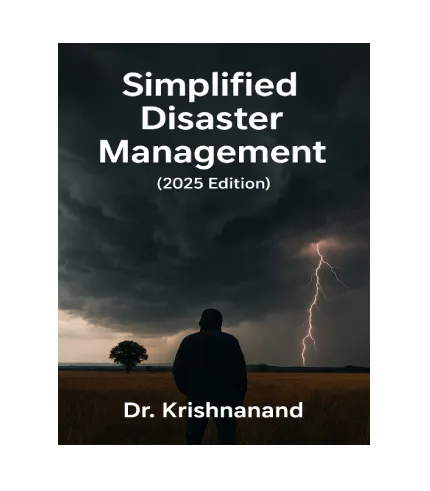

Disaster management has become one of the most scoring yet demanding topics in geography-related competitive examinations. Whether you are preparing for the UPSC Geography Optional, UGC NET-NTA, or postgraduate entrance tests, the sheer volume of concepts—from hazard vulnerability curves to the Sendai Framework—can feel overwhelming. The search for the Best Disaster Management Book often ends with conflicting reviews, outdated editions, and content that lacks exam-oriented clarity. Dr. Krishnanand’s Simplified Disaster Management (2025 Edition) | E-Book aims to bridge that gap by offering a structured, exam-focused approach backed by decades of academic experience.
- Covers UPSC, UGC NET, and postgraduate geography syllabi comprehensively
- 2025 edition updated with latest disaster policies and case studies
- Includes multimedia resources and practical exam-oriented tips
- Clear explanations suitable for beginners and advanced learners
- Priced at ₹249, offering high value for competitive exam aspirants
Why Disaster Management Is a High-Weightage Topic in Competitive Exams
Disaster management carries significant marks in geography optional papers and general studies sections of UPSC and UGC NET. The subject intersects with physical geography, human geography, and current affairs, making it a high-yield area for aspirants. According to the United Nations Office for Disaster Risk Reduction (UNDRR), Asia-Pacific accounts for over 70% of global disaster-related economic losses, underscoring why Indian exam syllabi emphasize this topic heavily. The National Disaster Management Authority (NDMA) updates protocols annually, and exam questions frequently test awareness of these evolving frameworks. For candidates, a single well-structured book can replace hours of scattered reading from multiple sources.
How to Evaluate a Disaster Management Book for Exam Prep
Not every disaster management book is built for competitive exams. When evaluating options, look for these non-negotiable features: syllabus alignment with UPSC and UGC NET patterns, clear definitions of technical terms like VUCA and HEC, updated statistics from the Disaster Management Division of the Ministry of Home Affairs, and practice-oriented content such as previous year question links and answer-writing frameworks. Beware of books that drown you in theoretical jargon without connecting concepts to India-specific scenarios—floods in Bihar, cyclones in Odisha, or earthquakes in Uttarakhand. The ideal guide balances academic rigor with exam pragmatism, offering diagrams, flowcharts, and mnemonics that stick during revision.
Simplified Disaster Management (2025 Edition): What Makes It Different
Dr. Krishnanand’s Simplified Disaster Management (2025 Edition) | E-Book enters the market with a clear mandate: simplify without sacrificing depth. The author, a recognized geography educator, structures the book around the four pillars of disaster management—mitigation, preparedness, response, and recovery—while weaving in contemporary case studies from the 2024 global disaster landscape. The 2025 edition incorporates recent policy shifts, including updates to the National Disaster Management Plan and references to the Sendai Framework for Disaster Risk Reduction 2015-2030. What sets this e-book apart is its integration of multimedia resources, which cater to visual learners who struggle with dense text alone. For aspirants short on time, the book distills complex topics like vulnerability assessment and capacity analysis into digestible segments that align directly with exam question patterns.
Key Features and Study Approach for UPSC Geography Optional
The e-book covers essential topics such as types of hazards—geophysical, hydrological, climatological, biological, and technological—with Indian context examples for each. It dedicates separate chapters to institutional frameworks like the NDMA, NIDM, and state-level disaster management authorities. For UPSC Geography Optional paper II, the book’s coverage of disaster vulnerability mapping and risk assessment matrices is particularly valuable. The study approach recommended by the author involves three passes: first, read for concept clarity; second, annotate with exam-relevant facts and statistics; third, revise using the built-in summary tables and keyword boxes. This layered method mirrors the cognitive science principle of spaced repetition, proven to improve retention for high-stakes exams.
Who Should Buy This E-Book and How to Use It
This resource is purpose-built for UPSC Geography Optional candidates, UGC NET-NTA geography paper takers, undergraduate and postgraduate geography students, and research scholars working on disaster-related theses. The e-book format allows instant access and searchability, letting you locate specific terms like ‘Capacity Assessment’ or ‘Hazard Profile’ in seconds. Pair the book with the India State of Forest Report and NDMA reports for current affairs integration. Use the multimedia components—such as embedded maps and diagrams—to enhance your answer-writing visuals. At ₹249, the cost is negligible compared to coaching materials, yet the coverage rivals expensive printed guides.
Frequently Asked Questions
Is Simplified Disaster Management suitable for UGC NET Geography Paper II?
Yes. The book aligns with the UGC NET syllabus for disaster management, covering concepts like vulnerability, resilience, and the Disaster Management Act 2005 with the depth required for both Paper I and Paper II.
Does the 2025 edition include recent disaster case studies?
Absolutely. The 2025 edition updates case studies and policy references to reflect events and frameworks from 2023-2025, ensuring relevance for current exam patterns.
Can beginners with no prior geography background use this book?
Yes. Dr. Krishnanand writes in accessible language, defining technical terms before diving into complex topics, making it suitable for beginners while still serving advanced learners.
How does this e-book compare to printed disaster management guides?
The e-book offers comparable content depth with the added advantage of multimedia resources, instant updates, and portability. Its exam-focused structure often makes it more efficient than generic printed guides.
Final Verdict: Is This the Best Disaster Management Book for Competitive Exams?
For geography-focused competitive exam aspirants, Simplified Disaster Management (2025 Edition) | E-Book delivers a rare combination of syllabus coverage, clarity, and affordability. It respects your time by filtering out noise and focusing on what actually appears in UPSC, UGC NET, and postgraduate exams. The 2025 updates ensure you are not studying outdated protocols, and the multimedia support adds a modern learning dimension. If you have been searching for the Best Disaster Management Book that balances academic depth with exam pragmatism, this edition deserves serious consideration. Download the sample, test the clarity of the explanations, and decide if it fits your preparation strategy.
Further reading: Best Disaster Management Book on Wikipedia
Our Recommendation
📖 Part of our complete guide: Evolution of Geographical Thought: A Comprehensive Guide for UPSC Aspirants and Geography Enthusiasts
Frequently Asked Questions
Is Simplified Disaster Management suitable for UGC NET Geography Paper II?
Yes. The book aligns with the UGC NET syllabus for disaster management, covering concepts like vulnerability, resilience, and the Disaster Management Act 2005 with the depth required for both Paper I and Paper II.
Does the 2025 edition include recent disaster case studies?
Absolutely. The 2025 edition updates case studies and policy references to reflect events and frameworks from 2023-2025, ensuring relevance for current exam patterns.
Can beginners with no prior geography background use this book?
Yes. Dr. Krishnanand writes in accessible language, defining technical terms before diving into complex topics, making it suitable for beginners while still serving advanced learners.
