Blog
Geography of Uttar Pradesh: Complete Guide for UPSC, UPPSC & State Exams

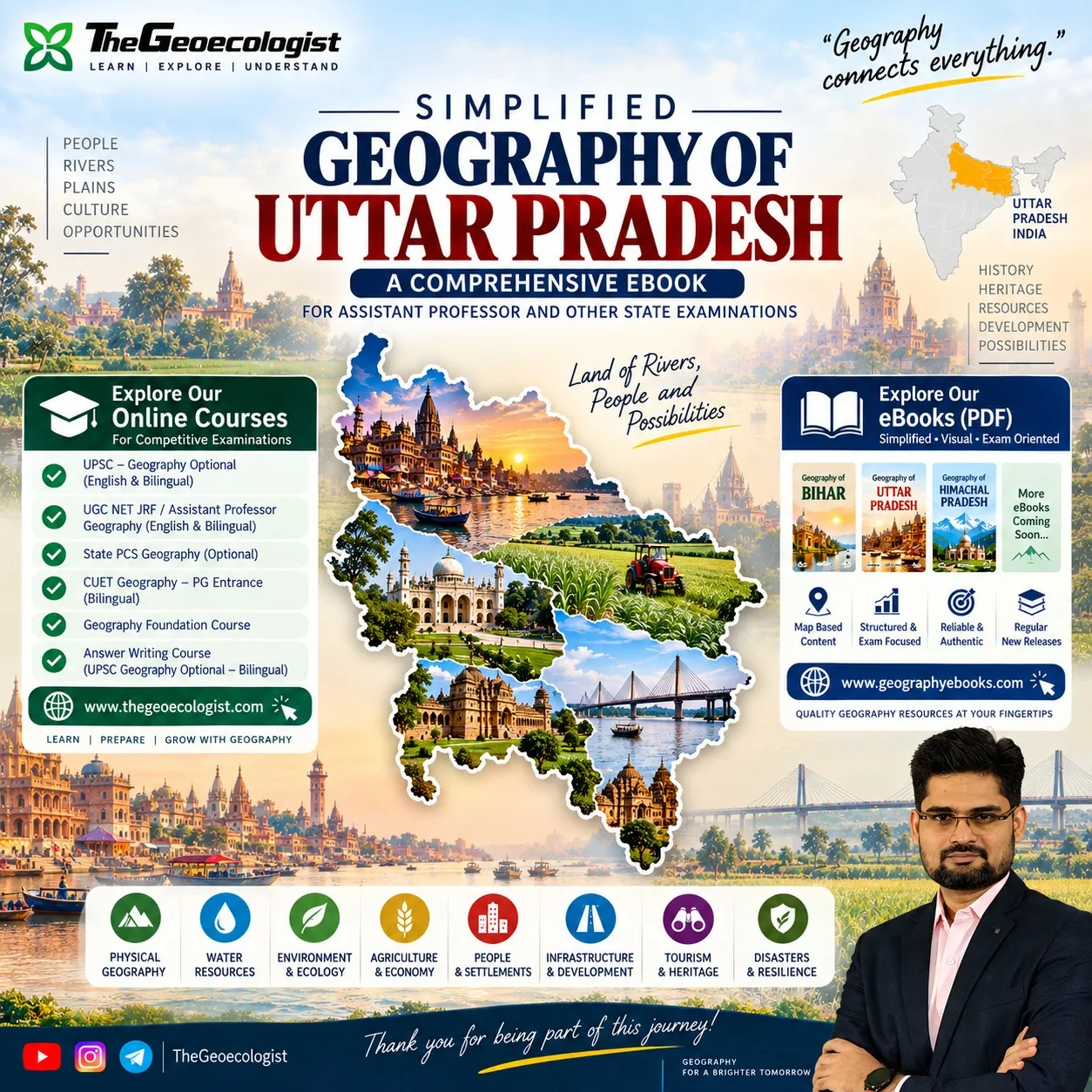
Many aspirants searching for a reliable Geography of Uttar Pradesh PDF struggle to find updated, concise material that covers both physical and human aspects needed for state-level exams.
- Understand the core physical geography of Uttar Pradesh, from the Terai to Bundelkhand.
- Grasp water resources, river systems, and environmental challenges.
- Learn about agriculture, settlements, infrastructure, tourism, and disaster resilience.
- Get exam‑ready notes with maps, diagrams, and spatial models.
- Save time by using a single, authoritative source instead of scattered PDFs.
Why Geography of Uttar Pradesh Matters for Competitive Exams
The Geography of Uttar Pradesh is a cornerstone topic for examinations such as UPPCS, UGC NET Geography, and Assistant Professor recruitment tests. Questions frequently ask about the distribution of alluvial soils in the Gangetic plain, the physiographic divisions ranging from the Siwalik foothills to the Vindhyan plateau, and the river systems that sustain agriculture and industry. Mastery of this subject enables candidates to interpret map‑based questions, explain regional disparities, and connect physical processes with socio‑economic development. A solid grasp of the Geography of Uttar Pradesh PDF material also aids in answering interdisciplinary questions that link environment, economy, and disaster management—areas where examiners test conceptual clarity over rote memorization.
According to the Uttar Pradesh Public Service Commission (UPPSC) syllabus, geography contributes approximately 15‑20% of the General Studies paper I marks, making it a high‑yield area for scoring. Moreover, the optional geography paper for UPSC and state services demands an integrated understanding of physical and human geography, which is precisely what a well‑structured Geography of Uttar Pradesh resource provides.
Common Challenges When Looking for a Geography of Uttar Pradesh PDF
Many candidates report frustration when searching for a Geography of Uttar Pradesh PDF because the available files are often outdated, poorly scanned, or lack essential visual aids such as maps and diagrams. Free notes found on forums may omit recent data on river interlinking projects, the status of the Ganga Action Plan, or the latest census‑based settlement patterns. Additionally, the fragmentation of content across multiple PDFs forces aspirants to spend valuable time cross‑referencing topics, increasing the risk of missing key concepts.
Another issue is the absence of exam‑oriented pedagogy. Generic PDFs tend to present facts in a linear fashion without highlighting the spatial relationships that are crucial for answering application‑based questions. For instance, understanding why the Terai region exhibits high biodiversity requires linking topography, climate, and soil type—a connection that is rarely made clear in disjointed notes. Consequently, students who rely solely on such PDFs often find themselves underprepared for map interpretation and case‑study questions that dominate higher‑level examinations.
How to Evaluate a Quality Geography Study Resource
When assessing a Geography of Uttar Pradesh study material, candidates should look for five core attributes: comprehensiveness, visual integration, currency, exam relevance, and author credibility. A comprehensive resource covers all eight thematic units outlined in the UPPSC syllabus—physical geography, water resources, environment and ecology, agriculture and economy, people and settlements, infrastructure and development, tourism and heritage, and disaster resilience. Visual integration means the inclusion of clear maps, diagrams, and spatial models that facilitate quick recall and support answer writing.
Currency is vital; the material should reflect recent developments such as the Namami Gange programme, the Sethusamudram shipping canal project updates, and the latest agricultural productivity statistics from the Directorate of Economics and Statistics, Uttar Pradesh. Exam relevance is demonstrated through the inclusion of previous year question patterns, practice exercises, and tip‑boxes that highlight frequently asked concepts. Finally, author credibility ensures that the content is grounded in academic rigor and teaching experience, especially for competitive exams where conceptual depth is rewarded.
Introducing the Geography of Uttar Pradesh eBook by Dr. Krishnanand
The Geography of Uttar Pradesh | eBook | Dr. Krishnanand directly addresses the gaps identified in generic PDFs. Developed from Dr. Krishnanand’s lecture series aimed at Assistant Professor, UPPCS, and UGC NET aspirants, this eBook synthesizes scattered facts into a coherent spatial narrative. It moves beyond mere description to explain the “why” behind geographic phenomena—for example, why the Gangetic plain exhibits high agricultural productivity or why the Bundelkhand plateau faces recurrent water scarcity.
What sets this eBook apart is its emphasis on geographical synthesis. Each chapter integrates physical processes with human responses, using maps, diagrams, and spatial models to illustrate concepts such as watershed management, land‑use change, and disaster risk reduction. The author’s approach follows the mantra “Know Where, Understand Why There, See the Bigger Picture,” which aligns perfectly with the analytical demands of modern competitive examinations.
Key Features That Make This eBook Stand Out
First, the eBook offers complete coverage of the eight core units prescribed for state‑level geography papers. Each unit begins with a concise overview followed by detailed sub‑sections that include the latest data up to 2023. Second, visual learning tools are embedded throughout: over 120 original maps, 80 diagrams, and 30 spatial models that simplify complex topics such as river basin dynamics, soil classification, and urban growth patterns.
Third, the content is exam‑oriented. Each chapter ends with a “Quick Recall” box summarizing key points, a “Map‑Based Question” practice item, and a “Concept Clarifier” that addresses common misconceptions. Fourth, the language is accessible yet precise, avoiding unnecessary jargon while maintaining academic rigor. Fifth, the eBook is updated regularly; purchasers receive notifications of any revisions that reflect new government policies or recent geographical research.
Finally, the author’s credentials add confidence. Dr. Krishnanand holds a Ph.D. in Geography from the Delhi School of Economics and has taught thousands of students preparing for UPSC, State PCS, and UGC NET examinations. His insights are drawn from both academic research and practical teaching experience, ensuring that the Geography of Uttar Pradesh | eBook | Dr. Krishnanand is both authoritative and pedagogically sound.
How to Use This eBook Effectively for Exam Preparation
To maximize benefits, aspirants should adopt a three‑stage approach: preview, deep dive, and revision. In the preview stage, skim the table of contents and the “Quick Recall” boxes to familiarize yourself with the layout and identify which units need extra attention. During the deep dive, read each chapter sequentially, paying close attention to the maps and diagrams; try to reproduce them from memory to reinforce spatial understanding. After completing a chapter, attempt the map‑based question and compare your answer with the provided explanation.
In the revision stage, use the eBook’s summary sheets and the embedded practice questions to test retention. Create flashcards for definitions, dates, and numerical data (e.g., average annual rainfall in the Terai, percentage of net sown area in western Uttar Pradesh). Additionally, link the eBook content to current affairs—such as recent flood events in the Ghaghara basin or new industrial corridors along the Delhi‑Mumbai Industrial Corridor—to develop the ability to answer interdisciplinary questions that examiners favor.
Because the eBook is available in a digital format, you can annotate directly using PDF‑reading tools, highlight important sections, and search for specific keywords like “Ganga tributaries” or “disaster resilience” in seconds. This flexibility makes it far more efficient than juggling multiple printed PDFs or loose notes.
Buying Guide and Access Details
The Geography of Uttar Pradesh | eBook | Dr. Krishnanand is priced at INR 249 and can be accessed instantly upon purchase through the publisher’s secure portal. After payment, you receive a download link that allows you to save the eBook on any device—laptop, tablet, or smartphone—for offline study. The file is DRM‑free, meaning you can transfer it across your personal devices without restriction, ensuring you have access wherever and whenever you study.
Before purchasing, verify that your device supports PDF viewing and that you have sufficient storage space (the file size is approximately 12 MB). It is also advisable to check the edition number and publication date to ensure you receive the most recent version, which incorporates the latest updates from the Uttar Pradesh government’s annual reports and recent geographical research published in peer‑reviewed journals.
Investing in this eBook replaces the need to download dozens of disparate Geography of Uttar Pradesh PDF files, saving both time and mental energy. With its structured approach, visual richness, and exam‑focused content, it offers a clear path to mastering the geography of India’s most populous state and achieving higher scores in competitive examinations.
Further reading: Geography of Uttar Pradesh on Wikipedia
Our Recommendation
📖 Part of our complete guide: Evolution of Geographical Thought: A Comprehensive Guide for UPSC Aspirants and Geography Enthusiasts
Frequently Asked Questions
Is the Geography of Uttar Pradesh eBook suitable for UPSC optional geography?
Yes, the eBook covers physical and human geography with map‑based explanations that align with the UPSC optional syllabus, making it a valuable resource for answer writing and diagram practice.
Does the eBook include recent data on Uttar Pradesh’s water resources?
Absolutely. It incorporates the latest statistics from the Ministry of Jal Shakti, updates on the Namami Gange programme, and details of river interlinking projects relevant to state‑level exams.
How can I access the eBook after purchase?
After completing the payment, you receive an instant download link. The PDF can be saved on any device and accessed offline without any restrictions.