Blog
Geography of Uttar Pradesh: Comprehensive Guide to the eBook by Dr. Krishnanand

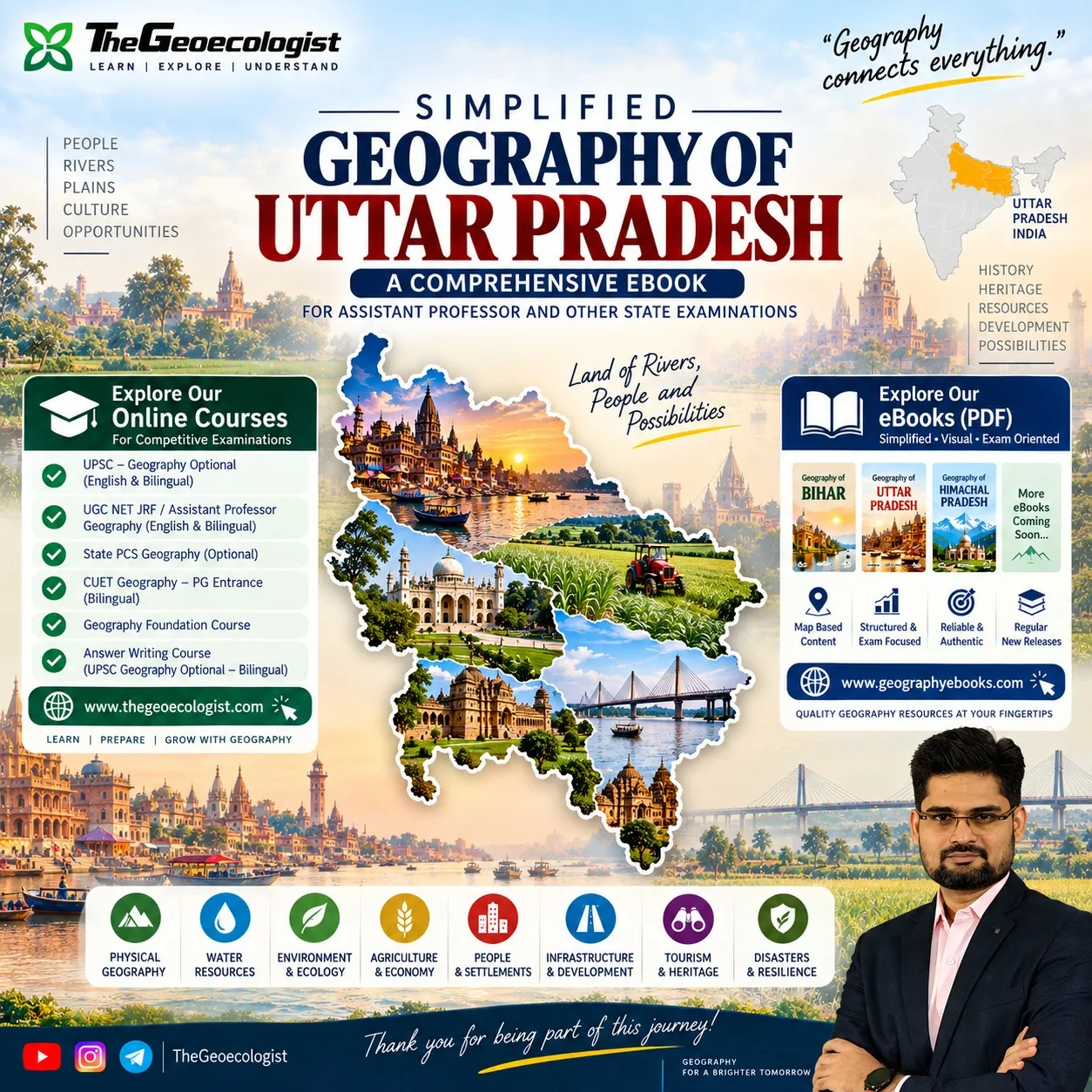
Many aspirants preparing for UPPCS, UGC NET, or Assistant Professor recruitment exams find themselves stuck when they search for Geography of Uttar Pradesh PDF notes by Dr Krishnanand. The query reflects a genuine need for concise, visually rich, and exam‑oriented material that ties physical landscapes to human geography in India’s most populous state. Generic PDFs often lack maps, diagrams, or a logical flow, leaving students to piece together scattered facts from multiple sources.
- The Geography of Uttar Pradesh eBook consolidates physical, economic, and cultural geography into a single, exam‑ready resource.
- It is built around map‑based learning, helping aspirants answer spatial questions quickly.
- Authored by Dr. Krishnanand, a seasoned trainer for UPSC, State PCS, and UGC NET.
- Ideal for Assistant Professor, UP State PCS, UPSC optional, and UGC NET Geography papers.
- Price: INR 249, instant download after purchase.
Why Geography of Uttar Pradesh Matters for Competitive Exams
Uttar Pradesh covers over 240,000 square kilometres, encompassing the Gangetic plains, the Terai, the Bundelkhand plateau, and the Vindhyan ranges. Questions in state‑level services exams frequently test knowledge of river systems (Ganga, Yamuna, Ghaghra, Gandak), monsoon patterns, agricultural zones (wheat‑rice belt, sugarcane belts), mineral reserves, and tribal settlements. A solid grasp of Geography of Uttar Pradesh enables candidates to interpret map‑based questions, correlate climate with crop patterns, and evaluate disaster‑management scenarios—skills that directly boost scores in GS Paper I and optional papers.
Data from the Uttar Pradesh Economic Survey 2023‑24 shows that agriculture contributes about 22% of the state’s GSDP, while industries linked to agro‑processing and textiles depend heavily on water availability from the Ganga tributaries. Understanding these linkages is not just academic; it is a prerequisite for answering analytical questions in UPPCS mains.
Common Pain Points When Searching for Study Materials
When candidates type Geography of Uttar Pradesh PDF notes by Dr Krishnanand into Google, they often encounter:
- Fragmented notes that cover only physical geography or only economic aspects.
- Scanned PDFs with poor readability, missing diagrams, or outdated data.
- Materials that lack a clear narrative, making revision time‑consuming.
- No author credibility—many notes are compiled by unknown sources without academic background.
These issues lead to wasted study hours, lower retention, and anxiety before exams. The aspirant’s real need is a single, authoritative source that integrates theory with visual aids, aligns with the latest syllabus, and is backed by an expert educator.
How to Choose the Right Geography Resource
Evaluating a geography study aid involves checking five criteria:
- Syllabus Coverage: Does it include all topics listed in the UPPCS and UGC NET Geography syllabi?
- Visual Learning: Are maps, diagrams, and spatial models present to support conceptual understanding?
- Exam Orientation: Does it provide previous‑year question patterns, quick‑reference tables, and summary points?
- Author Expertise: Is the creator a qualified academician with teaching experience in competitive exams?
- Format & Accessibility: Is the material available as a searchable eBook, compatible with mobile and tablet devices?
The Geography of Uttar Pradesh eBook satisfies each of these criteria, making it a strong candidate for serious aspirants.
Inside the Geography of Uttar Pradesh eBook by Dr. Krishnanand
Dr. Krishnanand’s lecture series forms the backbone of this eBook. The content is divided into eight core modules, each enriched with original maps, flowcharts, and case‑study boxes:
- Physical Geography & Relief: Detailed description of the Shiwalik foothills, Terai, Gangetic alluvium, and the Bundelkhand plateau, accompanied by elevation maps.
- Water Resources & River Systems: Basin-wise analysis of the Ganga, Yamuna, Ghaghra, Gandak, and Ramganga, including irrigation projects and flood‑prone zones.
- Environment & Ecology: Coverage of protected areas (Dudhwa National Park, Chandra Prabha Wildlife Sanctuary), wetland conservation, and air‑quality challenges in urban centres.
- Agriculture & Economy: Agro‑climatic zones, crop calendars, livestock distribution, and the role of MSMEs in the state’s industrial output.
- People & Settlements: Demographic trends, tribal populations (Tharu, Bhoksa), urban‑rural migration patterns, and settlement hierarchies.
- Infrastructure & Development: Expressway networks (Agra‑Lucknow, Purvanchal), power projects, and digital‑infrastructure initiatives.
- Tourism & Heritage: Circuit mapping of religious sites (Varanasi, Ayodhya, Mathura), Buddhist circuits, and eco‑tourism spots.
- Disasters & Resilience: Flood vulnerability matrices, earthquake zone mapping, and disaster‑management frameworks.
Each module ends with a “Quick Recall” box that summarises key facts in bullet form—ideal for last‑minute revision. The eBook also includes over 120 original maps, all drawn to scale and labelled for direct use in answer writing.
How to Use This eBook Effectively in Your Preparation
To maximise benefit, adopt a three‑stage approach:
- Initial Scan (Day 1‑2): Browse the table of contents, note the modules that align with your weak areas, and skim the Quick Recall boxes.
- Deep Dive (Week 1‑3): Study one module per day, create mind‑maps from the diagrams, and practice answering previous‑year questions related to that module.
- Revision & Mock Tests (Final Month): Use the eBook’s summary sheets for rapid revision, and simulate exam conditions by answering map‑based questions within time limits.
Because the eBook is PDF‑based, you can annotate it using any PDF reader (e.g., Xodo, Foxit) on a smartphone or tablet, making it convenient for travel or café study sessions.
Buying Guide: Getting the eBook and What to Expect
The Geography of Uttar Pradesh eBook is available directly from the publisher’s website at geographyebooks.com. After completing the secure checkout, you receive an instant download link via email. The file size is approximately 25 MB, ensuring quick download even on modest internet connections.
No subscription is required; the purchase grants lifetime access to the current version. Updates, if any, are communicated to buyers via email. The price of INR 249 positions it as an affordable alternative to costly coaching notes or multiple printed guides.
Before buying, verify that your device supports PDF viewing and that you have sufficient storage. The eBook is DRM‑free, allowing you to copy it across your personal devices for seamless study.
Frequently Asked Questions
Is the eBook aligned with the latest UPPCS syllabus?
Yes. The content follows the 2024‑25 UPPCS Geography syllabus, covering all prescribed topics from physical geography to disaster management.
Can I print the eBook for offline study?
The PDF is printable. You may print specific chapters or the entire book for personal use, but redistribution is prohibited.
How does this eBook compare to free PDF notes found online?
Free PDFs often lack maps, have outdated data, and are not structured for exam revision. This eBook offers original diagrams, syllabus‑wise organization, and author credibility—features absent in most free resources.
Further reading: Geography of Uttar Pradesh on Wikipedia
Our Recommendation
📖 Part of our complete guide: Evolution of Geographical Thought: A Comprehensive Guide for UPSC Aspirants and Geography Enthusiasts
Frequently Asked Questions
Is the eBook aligned with the latest UPPCS syllabus?
Yes. The content follows the 2024‑25 UPPCS Geography syllabus, covering all prescribed topics from physical geography to disaster management.
Can I print the eBook for offline study?
The PDF is printable. You may print specific chapters or the entire book for personal use, but redistribution is prohibited.
How does this eBook compare to free PDF notes found online?
Free PDFs often lack maps, have outdated data, and are not structured for exam revision. This eBook offers original diagrams, syllabus‑wise organization, and author credibility—features absent in most free resources.