Blog
ahar pynes: Bihar’s Ancient Water-Harvesting System

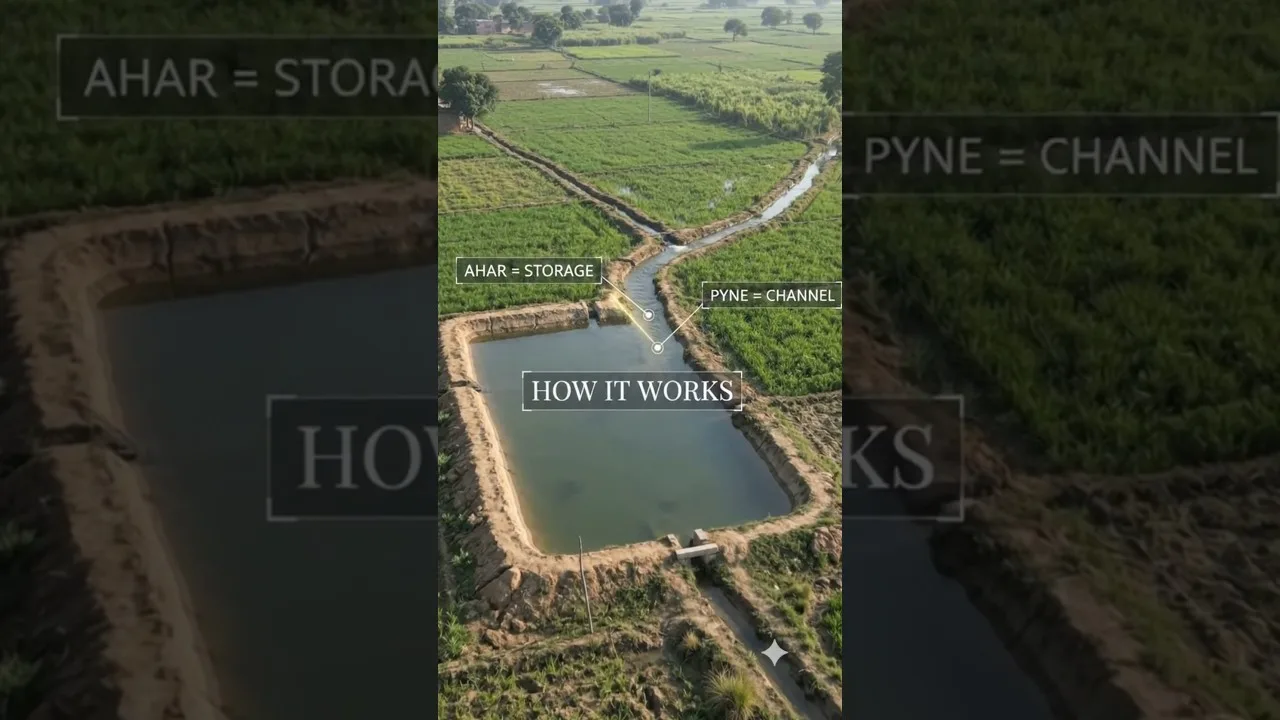
Table of Contents
ahar pynes represent one of India’s most ingenious traditional water-harvesting systems, originating in the fertile plains of Bihar. These interconnected structures consist of Ahars, which are rectangular catchment basins that store monsoon runoff, and Pynes, the artificial channels that divert stored water to agricultural fields. Developed centuries ago by local communities, the system enabled sustainable irrigation in a region prone to erratic rainfall and flooding, forming the backbone of agrarian livelihoods long before modern canals and tube wells appeared.
- ahar pynes combine storage (Ahars) and distribution (Pynes) for efficient water management.
- The system dates back to at least the 6th century CE, with references in ancient texts.
- Ahars can hold millions of cubic metres of water, irrigating thousands of hectares.
- Pynez channel water via gravity, minimizing energy loss and maintenance needs.
- Revival efforts today aim to combat groundwater depletion and climate variability.
Geography and Etymology of ahar pynes
The ahar pynes system is predominantly found in the southern and central parts of Bihar, especially in districts such as Patna, Nalanda, Sheikhpura, Jamui, and Lakhisarai. The topography features a gentle slope from the Chotanagpur plateau toward the Gangetic plains, facilitating gravity‑fed flow from Ahars to Pynes. The term “Ahar” is derived from the Sanskrit word “Āhara,” meaning a reservoir or pond, while “Pyne” (also spelled “Paine” or “Paina”) comes from the local dialect referring to an artificial channel. Historical records, including the Ain-i-Akbari (16th century), mention these structures as vital for rice cultivation in the Magadh region.
According to the Central Ground Water Board (2022), the average annual rainfall in the ahar pynes zone ranges from 1000 to 1400 mm, with over 60 % occurring during the monsoon months of June–September. This seasonal concentration necessitated a storage‑centric approach, which the ahar pynes design provides. Wikipedia’s entry on Ahar-Pynes notes that over 5,000 Ahars once existed across Bihar, though many have fallen into disuse.
How Ahars Function as Reservoirs
Ahars are typically rectangular or square basins, ranging from 0.5 ha to over 5 ha in surface area, with embankments raised 2–4 m above the surrounding land. The embankments are compacted using locally available clay and reinforced with stone pitching to prevent breaching. Inflow is controlled through inlet structures that capture monsoon runoff from upstream catchments, while outlet sluices regulate release into the Pynes system. Sedimentation is managed by periodic desilting, a community‑driven activity traditionally performed after the monsoon.
Studies by the Indian Institute of Technology (IIT) Patna (2020) show that a typical Ahar can store between 0.8 and 2.5 million cubic metres of water, sufficient to irrigate approximately 200–600 hectares of paddy during the kharif season. The stored water also recharges shallow aquifers, improving well yields in adjacent villages.
Role of Pynes in Water Distribution

Pynes are earthen canals, often lined with clay or stone, that convey water from Ahars to fields located downstream. Their gradient is meticulously calibrated—usually a fall of 10–20 cm per kilometre—to ensure steady flow without causing erosion. Branching Pynes distribute water to individual plots via smaller field channels (known locally as “distributaries”). Flow control is achieved through simple wooden or bamboo gates, allowing farmers to irrigate according to crop needs.
In the Pyne network, water loss due to seepage is relatively low (<15 %) compared with unlined canals, owing to the fine‑textured alluvial soils of the Gangetic plain. The system’s design also facilitates flood mitigation: during excessive rainfall, surplus water can be diverted back into Ahars or allowed to spill over safe weirs, reducing downstream inundation.
Historical Significance and Agricultural Impact
Archaeological evidence suggests that ahar pynes were in use during the Gupta period (4th–6th century CE), supporting intensive rice and wheat cultivation that contributed to the region’s prosperity. Medieval texts such as the “Tarik‑i‑Mubarak Shahi” (15th century) describe the system as the lifeblood of Magadh’s agrarian economy. During the British colonial era, surveys conducted in the 1880s recorded over 3,000 functional Ahars, noting their superiority over early canal projects in terms of reliability and cost‑effectiveness.
Statistical analyses from the Directorate of Economics and Statistics, Bihar (2018) indicate that villages with active ahar pynes achieved 20–30 % higher paddy yields than those relying solely on rain‑fed agriculture, particularly in drought‑prone years. The system also supported diversified cropping, including pulses and oilseeds, enhancing food security.
Decline and Factors Leading to Neglect
Despite its resilience, the ahar pynes network began deteriorating after India’s independence, driven by several factors:
- Expansion of groundwater irrigation: The advent of diesel and electric tube wells in the 1970s shifted focus to individual well‑based irrigation, reducing community maintenance of Ahars.
- Land‑use changes: Urban sprawl and conversion of catchment areas to non‑agricultural uses diminished inflow to reservoirs.
- Inadequate governance: Lack of clear ownership and deteriorating collective action mechanisms led to encroachment and silting.
- Policy bias: State‑centric irrigation projects often overlooked traditional systems in funding allocations.
A 2015 study by the Water and Land Management Institute (WALMI), Bihar, estimated that nearly 60 % of recorded Ahars were either defunct or operating at less than 30 % of their original capacity.
Revival Initiatives and Success Stories
Recognizing the system’s potential for climate‑resilient agriculture, several governmental and non‑governmental programs have launched restoration efforts:
- “Jal Jeevan Hariyali” (2020‑present): A state‑wide campaign that has desilted over 400 Ahars and repaired 250 km of Pynes, benefitting approximately 120 000 farmers.
- World Bank‑supported Bihar Rural Livelihoods Project (BRLP): Promotes community‑based management of water bodies, including Ahars, through self‑help groups.
- NGO interventions: Organizations such as Down To Earth have documented successful models where revived Ahars increased kharif paddy production by up to 35 % in pilot villages.
One notable case is the village of Bariarpur in Sheikhpura district, where a community‑led desilting drive in 2021 restored an Ahar of 3.2 ha capacity. Post‑restoration, the irrigated area expanded from 45 ha to 110 ha, and groundwater levels rose by an average of 1.8 m during the post‑monsoon period.
Lessons for Modern Water Management
The ahar pynes experience offers valuable insights for contemporary water‑stressed regions:
- Integrated storage‑conveyance design: Combining centralized reservoirs with gravity‑fed distribution minimizes energy inputs.
- Community stewardship: Successful operation hinges on clear user rights, collective maintenance schedules, and conflict‑resolution mechanisms.
- Adaptive flexibility: The system can accommodate variable rainfall by adjusting storage release rates, a principle applicable to modern reservoir operation.
- Low‑tech, high‑impact: Simple earthen structures, when properly maintained, deliver comparable performance to costly concrete infrastructure.
- Synergy with groundwater: By promoting recharge, ahar pynes help sustain aquifer levels, reducing over‑extraction risks.
Policy makers are increasingly advocating for the inclusion of traditional water‑harvesting structures in state water‑security plans, leveraging their low carbon footprint and socio‑cultural acceptance.
Conclusion
ahar pynes stand as a testament to the ingenuity of pre‑modern societies in harnessing nature’s rhythms for sustainable livelihoods. Their dual‑function architecture—storage via Ahars and distribution via Pynes—addresses both water scarcity and flood risks, offering a holistic approach that modern engineering often treats separately. While decades of neglect have eroded much of this heritage, ongoing revival projects demonstrate that, with community participation and supportive policies, the system can once again become a cornerstone of Bihar’s agricultural resilience. As climate change intensifies rainfall variability, revisiting and scaling up such time‑tested solutions may prove essential for securing water and food security across the Gangetic plain and beyond.
Frequently Asked Questions
Ahars are rectangular catchment basins that store monsoon runoff, while Pynes are artificial channels that convey stored water from Ahars to agricultural fields for irrigation.
The system dates back to at least the 6th century CE, with historical references in Gupta-era texts and the Ain-i-Akbari of the 16th century.
Yes, revived ahar pynes improve groundwater recharge, provide reliable irrigation, and reduce dependency on groundwater pumping, making them valuable for climate‑resilient water management.