Blog
Simplified Oceanography (2025 Edition) – Best UPSC Oceanography Book


For students preparing for UPSC civil services exams, selecting the right reference material can make or break their preparation timeline. The primary challenge facing aspiring officers is identifying a reliable source that balances depth with accessibility, especially when dealing with a vast subject like geography. Among the numerous options available, finding a UPSC Oceanography Book that aligns with the CBCS syllabus while remaining digestible for undergraduate candidates requires careful evaluation. The search demand for such resources is substantial, driven by competitive exam preparation across India.
- Students often struggle with dense academic texts that obscure core concepts behind excessive jargon.
- The sheer volume of geographical topics requires a systematic approach to study efficiently.
- Up-to-date editions incorporating recent policy changes and syllabus revisions are essential but frequently overshadowed by older publications.
The Challenge of Finding the Right Oceanography Textbook for UPSC
In the highly competitive landscape of civil services examination preparation, time is arguably the most valuable resource. A UPSC aspirant cannot afford to waste hours wading through verbose chapters or struggling with outdated information. The fundamental issue is that many textbooks either sacrifice clarity for complexity or lack contemporary relevance. For example, traditional geography books may contain theoretical frameworks that fail to connect directly to the practical application areas tested in Prelims and Mains exams. This creates a gap where candidates either become overwhelmed by technical language or miss crucial conceptual connections required to score high marks.
What Makes a UPSC-Ready Oceanography Textbook?
A truly effective UPSC Oceanography Book must satisfy multiple criteria simultaneously. First, it should map comprehensively onto the CBCS syllabus, ensuring that every chapter corresponds to prescribed learning objectives. Second, it must distill complex oceanographic theories into actionable insights without diluting scientific accuracy. Third, the inclusion of mappable diagrams, comparative tables, and real-world case studies transforms abstract knowledge into visual learnability—critical for memory retention during intensive prep sessions. Finally, the book should address current trends such as climate change impacts on marine environments, renewable energy applications in coastal regions, and evolving geopolitical dynamics affecting maritime zones—topics increasingly emphasized in recent UPSC papers.
Why Traditional Oceanography Books Fall Short
Many established oceanography texts suffer from several systemic weaknesses. They tend to present oceanic phenomena in chronological order rather than thematic clusters relevant to exam patterns. Consequently, students find themselves jumping between unrelated chapters without a coherent framework. Additionally, older editions often omit updates related to satellite remote sensing technologies, modern bathymetric mapping techniques, and interdisciplinary approaches linking oceanography with environmental sustainability—areas now integral to CGS exams. The pedagogical style also lags behind digital-native learners who expect interactive elements, infographics, and concise summaries that facilitate rapid comprehension.
How Simplified Oceanography (2025 Edition) Addresses These Gaps
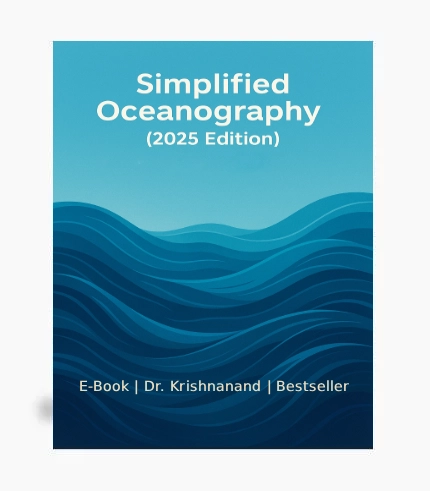
Simplified Oceanography (2025 Edition) by Dr. Krishnanand emerges as a strategic solution to these challenges. Written specifically with UPSC CSE aspirants in mind, this edition condenses complex themes into digestible modules while maintaining scholarly rigor. The structure follows a logical progression from foundational principles to specialized topics, mirroring the actual exam pattern. Each chapter begins with a clear learning objective, followed by illustrated explanations that bridge theory and practice seamlessly. Diagrams of ocean floor topography, temperature gradients, and salinity layers are incorporated to reinforce spatial understanding—a critical skill for geography-based questions.
Comprehensive Coverage of Geographical Settings for Exam Success
The book dedicates dedicated chapters to major ocean basins, enabling targeted revision aligned with syllabus priorities. Chapter 2 explores Atlantic Ocean Bottom Topography with detailed analysis of mid-ocean ridges and abyssal plains, providing essential context for potential question stems on tectonic activities and marine biodiversity hotspots. Chapter 3 focuses on the Indian Ocean, highlighting its unique trench systems and island chains—the region most frequently referenced in recent UPSC General Studies papers. Chapter 4 surveys the expansive Pacific, covering deep-sea trenches and volcanic archipelagos that serve as recurring examples of geological and ecological diversity. This basin-by-basin approach ensures that aspirants can allocate study time efficiently while building confidence in answering location-specific queries.
Practical Study Tools That Accelerate UPSC Preparation
Beyond the textual content, the book integrates practical aids designed to maximize retention. Comparative charts juxtapose physical oceanography parameters against their climatic implications, helping candidates quickly differentiate between similar concepts. Case studies draw parallels between historical oceanographic events—such as El Niño cycles—and socio-economic developments in coastal communities, a connection often tested in essay-type questions. Moreover, end-of-chapter summary boxes encapsulate key formulas, definitions, and notable facts, allowing for quick review sessions before mock tests. These tools transform passive reading into active learning, reducing cognitive load during intensive revision phases.
Why This Book Is the Top Choice for UPSC CSE Aspirants
When evaluating alternatives, the Superiority of Simplified Oceanography (2025 Edition) becomes evident. Unlike generic geography textbooks, this publication explicitly caters to the specific demands of UPSC CSE examinations. Its alignment with the CBCS framework eliminates the risk of studying unnecessary material that would only complicate revision schedules. The author, Dr. Krishnanand, brings expertise rooted in both academic research and practical exam feedback, ensuring that even nuanced topics receive accurate treatment. Furthermore, the 2025 edition incorporates recent amendments to the CGS guidelines, guaranteeing current relevance without compromising on foundational knowledge.
For those seeking a balanced blend of depth and readability, this book strikes the optimal equilibrium. Complex concepts such as thermohaline circulation and ocean acidification are explained with clarity, while supplementary material on emerging themes keeps candidates ahead of curricular shifts. The combination of visual aids, structured practice questions, and exam-oriented annotations positions it as a indispensable companion throughout the lengthy journey towards the Civil Services Bureau.
- Q1: Which oceanography book is recommended for UPSC CSE preparation?
- A1: The top choice is Simplified Oceanography (2025 Edition), a highly-rated UPSC Oceanography Book that aligns perfectly with the CBCS syllabus and includes updated content for current exam patterns.
- Q2: Does this book cover the latest CGS syllabus updates?
- A2: Yes, the 2025 edition incorporates recent revisions to the CGS curriculum, ensuring alignment with the latest examination requirements and avoiding outdated theoretical frameworks.
- Q3: How does the book aid in effective study planning?
- A3: The book features structured chapters, comparative diagrams, and practical study tools that enable efficient revision, timed practice sections, and quick reference consolidation—making it ideal for systematic exam preparation.
In conclusion, investing in a quality UPSC Oceanography Book is a strategic decision for any serious aspirant. Simplified Oceanography (2025 Edition) by Dr. Krishnanand offers precisely that—an accessible yet authoritative guide that respects the intensity of competitive exam preparation. With its emphasis on clarity, up-to-date content, and pedagogical innovation, it serves as both a study companion and a confidence booster throughout the months-long preparation process. Aspirants who adopt this resource stand to benefit significantly in terms of comprehension, retention, and ultimately, performance in the UPSC CSE examinations.
Further reading: UPSC Oceanography Book on Wikipedia
Our Recommendation
📖 Part of our complete guide: Evolution of Geographical Thought: A Comprehensive Guide for UPSC Aspirants and Geography Enthusiasts
Frequently Asked Questions
Which oceanography book is recommended for UPSC CSE preparation?
The top recommendation is Simplified Oceanography (2025 Edition), a highly-rated UPSC Oceanography Book that aligns perfectly with the CBCS syllabus and includes updated content for current exam patterns.
Does this book cover the latest CGS syllabus updates?
Yes, the 2025 edition incorporates recent revisions to the CGS curriculum, ensuring alignment with the latest examination requirements and avoiding outdated theoretical frameworks.
How does the book aid in effective study planning?
The book features structured chapters, comparative diagrams, and practical study tools that enable efficient revision, timed practice sections, and quick reference consolidation—making it ideal for systematic exam preparation.