Blog
Solar Radiation and Temperature: NCERT Class 11 Guide

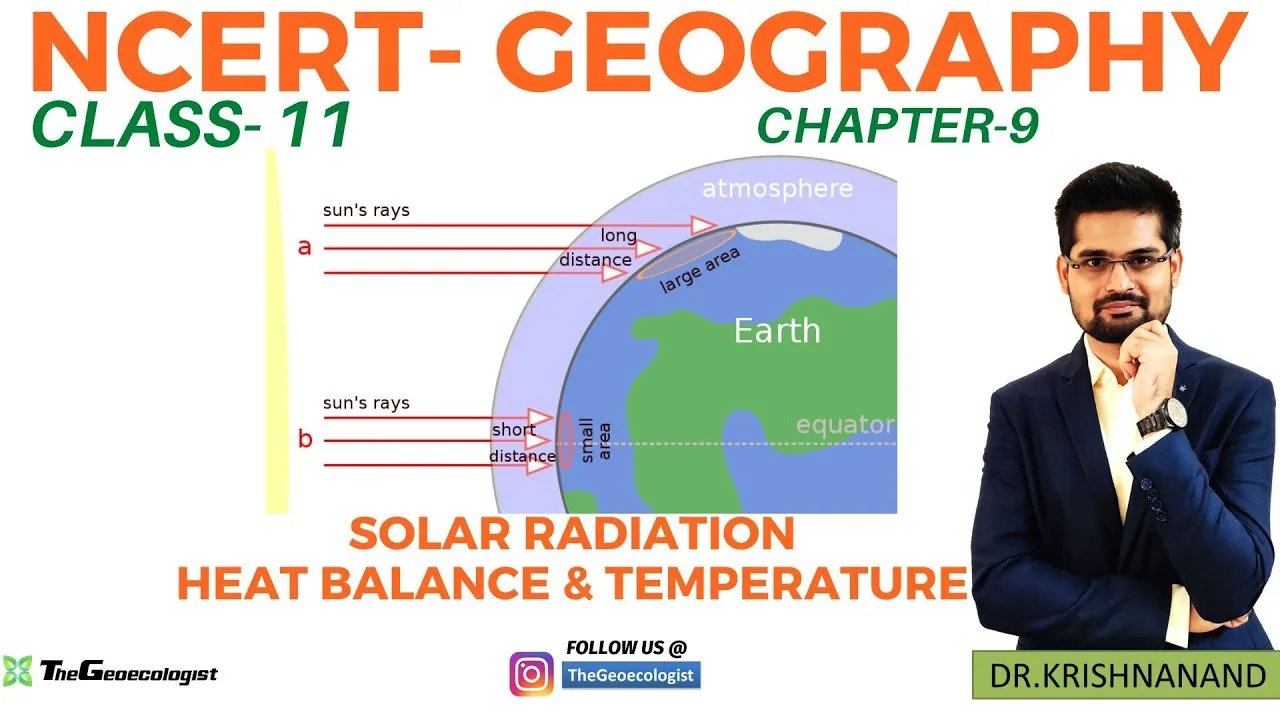
Table of Contents
- Key Takeaways
- The Mechanics of Solar Radiation and Temperature Dynamics
- Factors Influencing Insolation
- Earth’s Heat Budget and Thermal Equilibrium
- The Role of the Greenhouse Effect
- Mechanisms of Heat Transfer
- Global Temperature Distribution and Controlling Factors
- 1. Latitude: The Primary Driver
- 2. Altitude and the Lapse Rate
- 3. Land-Water Contrast (Continentality)
- 4. Ocean Currents
- Summary of Solar Radiation and Temperature Influences
Understanding solar radiation and temperature is fundamental to mastering the Earth’s complex climate systems. In this comprehensive guide, we dive deep into the concepts presented in NCERT Geography Class 11, Chapter 9, to explain how energy from the sun shapes our world’s thermal patterns. Whether you are a CBSE student or preparing for competitive exams like the UPSC, grasping the mechanics of solar radiation and temperature is essential for understanding global weather, climate change, and environmental shifts.
Key Takeaways
- Insolation: The primary driver of Earth’s energy budget is incoming solar radiation.
- Heat Budget: The Earth maintains a delicate equilibrium between absorbed short-wave and emitted long-wave radiation.
- Temperature Factors: Latitude, altitude, and ocean currents are critical determinants of regional temperatures.
- Greenhouse Effect: Atmospheric gases trap heat, maintaining a life-sustaining average temperature of approximately 15°C.
The Mechanics of Solar Radiation and Temperature Dynamics
To understand how our planet functions, we must first look at the sun. Solar radiation, often referred to as insolation (incoming solar radiation), acts as the engine for all atmospheric and oceanic processes. The distribution of this energy is not uniform, which is why we observe varying climates across different latitudes. The interplay between solar radiation and temperature is governed by several physical variables that dictate how much heat reaches the surface and how much is reflected back into space.
Factors Influencing Insolation
Not all sunlight reaches the Earth’s surface with the same intensity. The variation in solar radiation and temperature across the globe is influenced by three primary factors:
- Angle of Incidence: This is perhaps the most critical factor. When the sun’s rays strike the Earth vertically (as seen in equatorial regions), the energy is concentrated over a smaller surface area, leading to higher temperatures. Conversely, oblique rays strike at an angle, spreading the same amount of energy over a larger area, resulting in lower temperatures at the poles.
- Duration of Daylight: The length of the day significantly impacts how much solar radiation and temperature fluctuations occur. During summer months, longer daylight hours allow for prolonged heating, whereas shorter winter days lead to cooling.
- Atmospheric Transparency: As sunlight travels through the atmosphere, it encounters gases, dust particles, and clouds. These elements can scatter or absorb the radiation. The concept of Albedo is crucial here; it refers to the reflectivity of a surface. High albedo surfaces, like ice and snow, reflect most solar radiation, whereas dark oceans absorb it.
Earth’s Heat Budget and Thermal Equilibrium

If the Earth absorbed all the solar radiation it received without emitting any back, the planet would become an oven. If it reflected all of it, the Earth would be a frozen wasteland. The reason we have a habitable climate is the Earth’s ability to maintain a ‘Heat Budget.’ This balance between solar radiation and temperature is maintained through a constant exchange of energy.
The Role of the Greenhouse Effect
The greenhouse effect is a natural process that is vital for life. Gases such as carbon dioxide (CO2), methane, and water vapor act like a thermal blanket, trapping long-wave terrestrial radiation. This keeps the Earth’s average temperature at a manageable 15°C. However, human-induced increases in these gases are intensifying this effect, leading to global warming. Understanding the relationship between solar radiation and temperature is key to studying this phenomenon.
Mechanisms of Heat Transfer
Energy is not just absorbed; it is moved across the planet via three main methods:
- Conduction: This occurs through direct contact. The sun-warmed surface of the Earth transfers heat to the layer of air immediately above it.
- Convection: This is the vertical movement of air. As air warms, it becomes less dense and rises, creating currents that redistribute heat from the equator toward the poles.
- Advection: This refers to the horizontal movement of heat through wind. Advection plays a massive role in moving warm air from the tropics to higher latitudes.
Global Temperature Distribution and Controlling Factors
Because solar radiation and temperature are not distributed evenly, the Earth exhibits diverse climatic zones. To visualize this, meteorologists use Isotherms—lines on a map connecting points that have the same temperature. However, these lines are rarely straight because several factors disrupt the uniform flow of heat.
1. Latitude: The Primary Driver
The most significant factor in the distribution of solar radiation and temperature is latitude. As you move from the equator toward the poles, the angle of solar rays becomes more oblique, and the distance the rays must travel through the atmosphere increases. This results in a predictable decrease in temperature as latitude increases.
2. Altitude and the Lapse Rate
In mountainous regions, temperature behaves differently than at sea level. For every kilometer of ascent, the temperature typically drops by about 6.5°C (known as the normal lapse rate). This is why high-altitude hill stations remain cool even in tropical regions. The relationship between altitude and solar radiation and temperature is a fundamental concept in physical geography.
3. Land-Water Contrast (Continentality)
Land and water respond to solar radiation and temperature at different rates. Land has a low specific heat capacity, meaning it heats up and cools down very quickly. Water has a high specific heat capacity, meaning it absorbs and releases heat much more slowly. This leads to extreme temperature fluctuations in continental interiors (hot summers, cold winters) compared to the moderate, stable climates found in coastal areas.
4. Ocean Currents
The oceans act as a massive conveyor belt for heat. Warm ocean currents, such as the Gulf Stream, carry heat from the tropics toward the poles, significantly raising the temperature of coastal regions. Conversely, cold currents like the Benguela current bring cooler temperatures to the shores they pass.
Summary of Solar Radiation and Temperature Influences
To summarize, the complex dance of solar radiation and temperature is what creates our diverse biomes. From the scorching heat of the Sahara to the freezing expanse of Antarctica, every climate is a result of the specific balance of energy received, reflected, and redistributed. For students preparing for exams, remember that the interplay of latitude, altitude, and the heat budget are the pillars of this chapter.
For more detailed visual learning, you can explore academic resources on NCERT official portals or watch educational videos by TheGeoecologist to see these processes in motion through animation.
Frequently Asked Questions
The primary source is solar radiation, specifically incoming solar radiation (insolation) from the sun.
Temperature generally decreases as altitude increases, typically at a rate of 6.5°C per kilometer.
The greenhouse effect involves gases like CO2 trapping long-wave terrestrial radiation, maintaining Earth's average temperature at approximately 15°C.