Blog
Social Wellbeing: How Population Geography Resources Like Simplified Population Geography (2025 Edition) Boost Your Understanding

Many students, researchers, and UPSC aspirants searching for reliable insights on Social Wellbeing quickly discover that the topic is interdisciplinary, drawing from sociology, public health, economics, and geography. Without a clear framework, it becomes difficult to connect demographic trends—such as fertility rates, migration patterns, and age‑structure shifts—to tangible outcomes like community happiness, equity, and resilience. This gap often leaves learners overwhelmed by fragmented sources, outdated statistics, or overly theoretical texts that fail to offer actionable guidance. The solution lies in evaluating resources that combine rigorous data, conceptual clarity, and practical relevance, especially those aligned with current curricula and exam syllabi. In the following sections we explore how to assess such materials, why a focused population geography e‑book can serve as a cornerstone for Social Wellbeing study, and how to integrate it effectively into your learning routine.
Key Takeaways:
- Social Wellbeing is best understood through demographic lenses that reveal underlying population dynamics.
- Credible resources must offer up‑to‑date data, clear visual aids, and syllabus‑aligned content.
- Simplified Population Geography (2025 Edition) by Dr. Krishnanand meets these criteria, providing point‑wise explanations, diagrams, and maps tailored for UPSC CSE and undergraduate geography.
- Practical usage includes chapter‑wise note‑making, cross‑referencing with census data, and applying concepts to case studies on health, education, and inequality.
- Buying the e‑book grants instant access, lifelong updates, and a structured pathway to mastering both population geography and its Social Wellbeing implications.
Understanding Social Wellbeing: Why It Matters
Social Wellbeing reflects the quality of people’s lives, encompassing health, education, employment, social connections, and subjective happiness. Researchers from the World Health Organization emphasize that social determinants—such as income inequality, education access, and community safety—account for up to 50% of health outcomes. When examining Social Wellbeing through a population geography lens, analysts examine how spatial distribution of these determinants varies across regions, urban‑rural divides, and migratory flows. For instance, the Wikipedia entry on Social Wellbeing notes that countries with balanced age structures and lower dependency ratios often report higher life satisfaction scores. Grasping these links requires a solid grasp of demographic concepts, which is exactly what a focused population geography resource provides.
Challenges in Measuring Social Wellbeing
Measuring Social Wellbeing is not straightforward. Indicators such as the Human Development Index (HDI), Gross National Happiness (GNH), or the OECD Better Life Index rely on diverse data sources that may be inconsistent across time and space. Common obstacles include:
- Data lag: National censuses are often decennial, while wellbeing surveys may be annual, creating mismatches.
- Spatial granularity: National averages mask intra‑country disparities that are critical for policy.
- Conceptual overlap: Terms like “social capital,” “quality of life,” and “wellbeing” are used interchangeably, causing confusion.
To overcome these hurdles, learners need a resource that clarifies definitions, offers standardized measurement frameworks, and demonstrates how to reconcile disparate datasets. This is where a well‑structured geography text becomes indispensable.
How Population Geography Informs Social Wellbeing
Population geography studies the spatial patterns of human populations and the processes that shape them—fertility, mortality, migration, and ageing. These processes directly influence Social Wellbeing indicators:
- Fertility rates affect youth dependency ratios, influencing education spending and job market entry.
- Mortality and life expectancy reflect healthcare access and nutrition, core components of wellbeing.
- Migration reshapes urban service demand, housing pressure, and cultural integration.
- Ageing populations increase demand for pension systems, long‑term care, and age‑friendly infrastructure.
By mastering these linkages, students can predict how policy interventions—such as maternal health programs or urban housing schemes—will impact Social Wellbeing outcomes. A text that breaks down each component with diagrams, maps, and real‑world examples accelerates this learning.
Evaluating Resources for Social Wellbeing Study
When selecting a study aid for Social Wellbeing, consider the following criteria:
- Curriculum Alignment: Does the material follow the latest CBCS syllabus or UPSC CSE geography guidelines?
- Data Currency: Are statistics sourced from the most recent Census (2021), NFHS‑5, or NSS rounds?
- Clarity and Structure: Are concepts presented point‑wise with headings, bullet points, and visual aids?
- Application Focus: Does it include case studies, practice questions, or linkages to current affairs?
- Author Credibility: Is the author a recognized scholar with teaching and research experience in population studies?
Resources that satisfy most of these points reduce the need to cross‑reference multiple books, saving time and enhancing retention.
Why Simplified Population Geography (2025 Edition) Fits the Bill
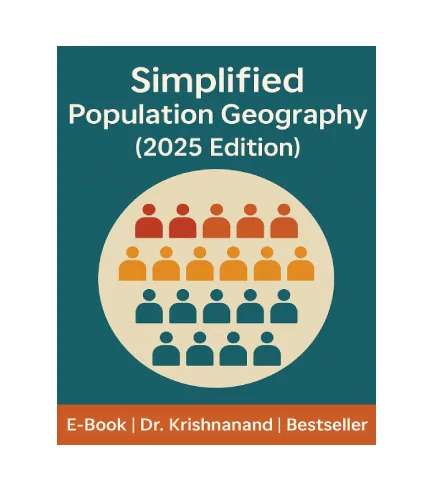
Simplified Population Geography (2025 Edition) | E‑Book | Dr. Krishnanand | Bestseller directly addresses the evaluation criteria outlined above. The e‑book is explicitly designed for the prescribed CBCS syllabus in geography and mirrors the UPSC CSE approach to population topics. Each chapter begins with a concise overview, followed by point‑wise highlighted descriptions, diagrams, maps, and images that make abstract concepts tangible. For example, Chapter 3 presents population size, distribution, and growth determinants with colour‑coded maps showing state‑wise variation in India’s decadal growth rates—data drawn directly from the 2021 Census and the National Sample Survey (NSS) 75th round. Chapter 4 details fertility, mortality, and migration mechanisms, linking them to real‑world policies such as Janani Suraksha Yojana and the National Urban Health Mission. This level of detail enables learners to connect demographic processes to Social Wellbeing outcomes without needing supplementary texts.
Practical Tips: Using the E‑Book for Social Wellbeing Research
To maximize the e‑book’s utility for Social Wellbeing analysis, adopt these strategies:
- Chapter‑wise Mapping: After reading Chapter 2 (Sources of Data), create a table comparing Census, Vital Statistics, and NSS indicators relevant to wellbeing (e.g., literacy rate, infant mortality, work participation).
- Visual Note‑Making: Reproduce the diagrams from Chapter 5 (Population Composition) in your notebook, annotating how age‑sex structures influence dependency ratios and thereby Social Wellbeing.
- Case Study Application: Use the migration patterns discussed in Chapter 4 to analyse a recent news story about urban slum formation, evaluating impacts on access to clean water and sanitation—key wellbeing markers.
- Self‑Assessment: Attempt the end‑of‑chapter practice questions (if included) or formulate your own based on the highlighted points, then compare answers with model solutions from UPSC previous year papers.
By treating the e‑book as an active workbook rather than a passive read, you reinforce retention and develop the analytical skills needed for both academic exams and real‑world policy analysis.
Buying Guidance and Next Steps
Purchasing Simplified Population Geography (2025 Edition) is straightforward: visit the product page, add the e‑book to your cart, and complete the secure checkout. Upon payment, you receive an instant download link granting lifetime access to the PDF, which can be read on any device—laptop, tablet, or smartphone. The price of ₹249 reflects the value of a comprehensive, exam‑focused resource that consolidates what would otherwise require multiple reference books. Given the frequent updates to census data and government reports, the 2025 edition ensures you are studying the most recent statistics available, a critical advantage for competitive exams where current affairs weight is high. After acquiring the e‑book, integrate it into your weekly study plan: allocate two chapters per week, supplement with monthly current affairs digests, and schedule mock tests that incorporate population geography questions linked to Social Wellbeing themes.
Our Recommendation
📖 Part of our complete guide: Evolution of Geographical Thought: A Comprehensive Guide for UPSC Aspirants and Geography Enthusiasts
Frequently Asked Questions
What makes Simplified Population Geography (2025 Edition) useful for Social Wellbeing study?
The e-book links demographic processes like fertility, mortality, and migration to wellbeing outcomes, provides up-to-date census data, and uses point-wise explanations with diagrams that simplify complex concepts for quick grasp.
Is the content aligned with the latest UPSC CSE geography syllabus?
Yes. The book follows the prescribed CBCS syllabus in geography and mirrors the UPSC CSE approach, making it suitable for both undergraduate studies and competitive exam preparation.
How can I apply the e-book’s concepts to real-world Social Wellbeing analysis?
Use the chapter-wise data tables and maps to compare regional indicators, apply migration and ageing trends to case studies on urban services or healthcare, and practice with self-made questions based on highlighted points.