Blog
Geography Optional UPSC: Answer Writing MasterCourse for 2026 Success

Table of Contents
- Why Geography Optional UPSC Aspirants Struggle in Mains
- The Gap Between Knowing and Writing
- Common Pitfalls in Answer Writing
- Decoding the Answer Writing MasterCourse Framework
- Module 1: Mastering Directive Words
- Module 2: Structure & Presentation Mastery
- Module 3: Resource Integration & Scholars' Viewpoints
- Module 4: PYQ-Based Practice & Weekly Tests
- Module 5: Paper I & II Mapping Strategy
- What Sets This Course Apart
- Live, Practice-Oriented Sessions
- Score Tracking & Weakness Mapping
- Direct Mentorship Access
- Proven Results
- Who Should Enroll in the 2026 Batch
- 1. Fresh Aspirants Starting Optional Preparation
- 2. Repeaters Stuck at 250-270 Marks
- 3. Students Who Know "What" But Not "How"
- About TheGeoecologist: Academic Rigor Meets Exam Pragmatism
- Strategic Preparation Timeline for UPSC 2026
- Phase 1: Foundation (June – October 2025)
- Phase 2: Integration (November 2025 – February 2026)
- Phase 3: Refinement (March – June 2026)
- Phase 4: Final Polish (July – September 2026)
- Frequently Asked Questions
- How does this course differ from standard test series?
- Can I join if I'm working full-time?
- What if I haven't finished the syllabus yet?
- Final Thoughts: Write to Win
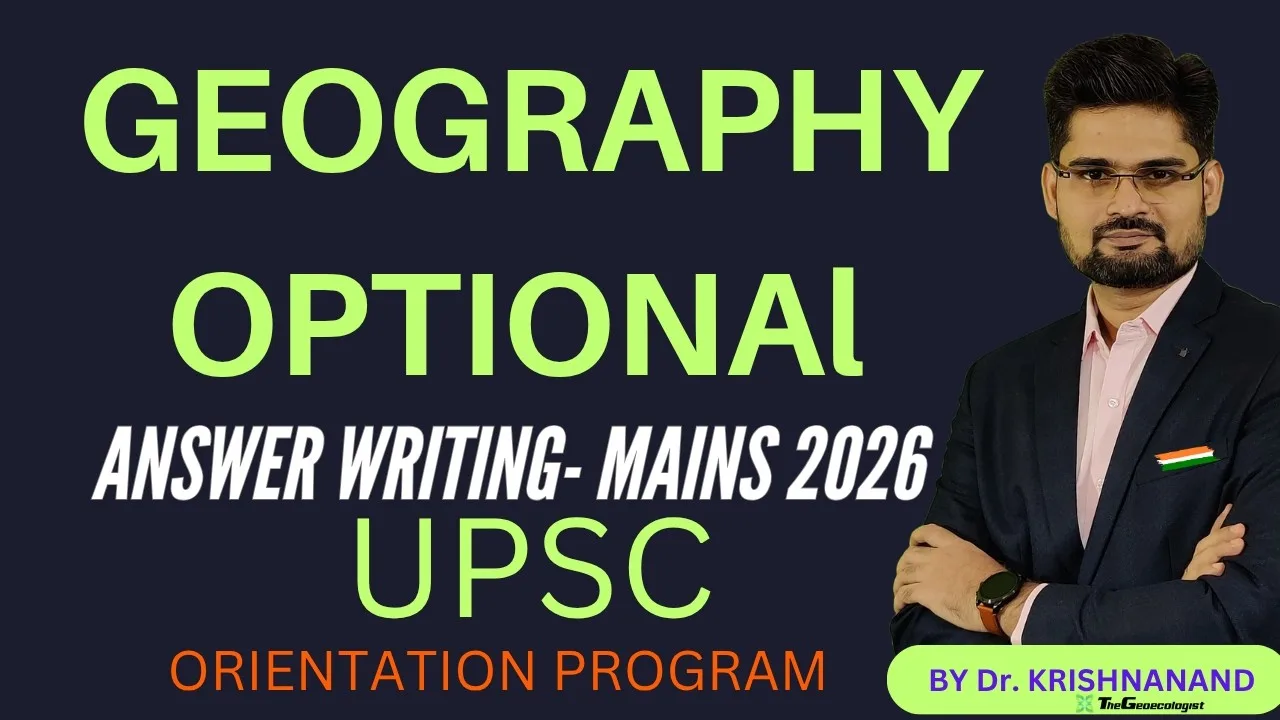
Preparing for Geography Optional UPSC requires more than just completing the syllabus—Geography Optional UPSC demands mastery of answer writing, analytical depth, and strategic presentation. TheGeoecologist’s Answer Writing MasterCourse (2026 Batch) is designed to bridge the gap between knowledge and high-scoring answers, helping aspirants achieve 300+ marks in the optional paper.
- Syllabus completion is only half the battle – UPSC Mains rewards analytical depth over rote memorization.
- Answer structure matters – Introduction → Body → Conclusion with diagrams, maps, and scholars’ viewpoints.
- Practice with feedback is essential – Weekly PYQ-based tests and personalized evaluation drive improvement.
- Interdisciplinary linking boosts scores – Connecting Paper I (Physical Geography) with Paper II (Human Geography & Current Affairs).
- Mentorship from 15+ year experts – Direct access to educators who understand evolving UPSC trends.
Why Geography Optional UPSC Aspirants Struggle in Mains
Every year, thousands of candidates choose Geography Optional UPSC due to its scientific nature, scoring potential, and overlap with General Studies. Yet, a significant number underperform in Mains. The core issue isn’t lack of knowledge—Geography Optional UPSC’s the inability to translate that knowledge into examiner-friendly answers.
The Gap Between Knowing and Writing
UPSC evaluators look for analytical depth, not descriptive reproduction. A 2023 analysis of topper answer scripts revealed that candidates scoring 300+ consistently demonstrated three traits: crisp structuring, strategic use of diagrams and maps, and integration of contemporary examples with theoretical frameworks. Without deliberate practice in these areas, even well-prepared aspirants plateau around 250 marks. – a key consideration for Geography Optional UPSC.
Common Pitfalls in Answer Writing
- Directive word confusion – Misinterpreting “Critically Analyse” vs “Discuss” vs “Evaluate” leads to off-target responses.
- Weak introductions and conclusions – Missing hooks, definitions, or forward-looking insights.
- Underutilization of visual aids – Skipping maps, flowcharts, and diagrams that convey complex concepts instantly.
- Static-dynamic disconnect – Failing to link geomorphology with disaster management, or climatology with climate change policy.
- Time mismanagement – Writing exhaustive answers for 10-markers while rushing 15-markers.
Decoding the Answer Writing MasterCourse Framework
TheGeoecologist’s Geography Optional UPSC Answer Writing MasterCourse (2026 Batch) is built on a practice-first philosophy. Designed by educators with over 15 years of UPSC mentoring experience—including Krishna, a renowned researcher and faculty—the program deconstructs answer writing into teachable, repeatable skills.
Module 1: Mastering Directive Words
UPSC questions hinge on directive words. This module provides a decision matrix for 20+ directives—”Examine,” “Elucidate,” “Comment,” “Critically Evaluate”—with annotated model answers showing exactly how structure shifts for each. Aspirants learn to identify the core demand within 30 seconds of reading the question.
Module 2: Structure & Presentation Mastery
High-scoring answers follow a universal architecture:
- Introduction (15-20 words): Definition + context + thesis statement.
- Body (structured arguments): Thematic segregation using subheadings, data points, scholars’ views (Humboldt, Ratzel, Mackinder, Hartshorne), and India-specific examples.
- Conclusion (15-20 words): Synthesis + policy implication / future outlook / SDG linkage.
Diagram drills cover 50+ essential sketches—from cycle of erosion to urban morphology—with scanning-quality reproduction techniques for exam conditions.
Module 3: Resource Integration & Scholars’ Viewpoints
Answers gain authority when grounded in geographical thought. The course provides a curated “Scholar Bank” with ready-to-use viewpoints: Vidal de la Blache on possibilism, Doxiadis on ekistics, Losch on economic landscape, and Indian geographers like R.L. Singh and M.H. Qureshi. Current affairs integration links The Hindu, Down To Earth, and PIB releases to static topics weekly.
Module 4: PYQ-Based Practice & Weekly Tests
Nothing predicts UPSC trends like Previous Year Questions (PYQs). The program includes:
- Decadal PYQ analysis (2013-2024) identifying recurring themes and evolving difficulty.
- Weekly timed tests mimicking Mains conditions (3 hours, 5 questions).
- Personalized feedback with rubric-based scoring: Content (40%), Structure (25%), Presentation (20%), Innovation (15%).
- Model answers with examiner’s comments highlighting “what worked” and “what didn’t.”
Module 5: Paper I & II Mapping Strategy
The true differentiator in Geography Optional UPSC is interdisciplinary linking. This module teaches:
- Geomorphology → Disaster Management: Landslide zonation, flood plain mapping, coastal regulation zone (CRZ) norms.
- Climatology → Climate Policy: Monsoon variability, heat action plans, India’s NDC commitments.
- Population Geography → Social Issues: Demographic dividend, migration policy, urban housing schemes.
- Agricultural Geography → Food Security: Cropping pattern shifts, MSP regime, precision farming.
- Industrial Geography → Economic Corridors: DMIC, CBIC, PLI schemes, logistics performance.
What Sets This Course Apart
Live, Practice-Oriented Sessions
Unlike passive lecture series, every session includes in-class writing drills. Aspirants write, peer-review, and receive real-time faculty input. This “write-learn-improve” cycle builds muscle memory for exam day.
Score Tracking & Weakness Mapping
A dedicated dashboard tracks performance across 15+ parameters—directive adherence, diagram quality, scholar usage, time management. Heatmaps reveal persistent gaps (e.g., “weak conclusions in Paper II 15-markers”) enabling targeted remediation.
Direct Mentorship Access
Enrolled students join a closed mentorship group with:
• Weekly doubt-resolution live sessions
• Strategy calls for optional-GS integration
• Personalized booklist and revision timetable
• Psychological support during the long preparation journey
Proven Results
Alumni of TheGeoecologist’s programs have consistently secured 300+ in Geography Optional UPSC. The 2023 batch saw 12 students cross 300, with the highest at 327. The 2024 batch results (declared April 2025) continued this trajectory, validating the practice-feedback-mentorship model.
Who Should Enroll in the 2026 Batch
The course is tailored for three distinct profiles:
1. Fresh Aspirants Starting Optional Preparation
If you’re targeting UPSC 2026 and haven’t begun Geography Optional, this course builds answer writing alongside content coverage. Early integration prevents the “content-first, writing-later” trap that costs attempts.
2. Repeaters Stuck at 250-270 Marks
You know the syllabus. You’ve read the books. But your answers lack the edge. The MasterCourse’s diagnostic tests pinpoint exactly which of the 15 scoring parameters are holding you back—and the drills fix them.
3. Students Who Know “What” But Not “How”
Many aspirants can explain concepts fluently but freeze when structuring a 150-word answer in 7 minutes. If this resonates, the course’s time-bound drills and template library are your solution.
About TheGeoecologist: Academic Rigor Meets Exam Pragmatism
Founded by Krishna—an educator, researcher, and UPSC mentor with 15+ years of experience—TheGeoecologist has become a trusted name in Geography Optional UPSC preparation. The platform’s philosophy: “We don’t teach AI-generated content; we teach what works in the exam hall.”
Resources extend beyond the MasterCourse:
- Online Courses: Comprehensive coverage at thegeoecologist.com
- Study Materials & E-Books: Curated notes, diagram banks, and scholar compilations at geographyebooks.com
- Free Strategy Content: YouTube channel with PYQ analyses, topper talks, and trend decoding
- Community Engagement: Instagram (@thegeoec) for daily map practice, current affairs snippets, and motivation
Strategic Preparation Timeline for UPSC 2026
Success in Geography Optional UPSC requires a phased approach. The MasterCourse aligns with this recommended timeline:
Phase 1: Foundation (June – October 2025)
- Complete Paper I (Physical Geography) with concurrent answer writing basics
- Master 30 core diagrams; practice 2 PYQs weekly
- Build scholar bank for geomorphology, climatology, oceanography
Phase 2: Integration (November 2025 – February 2026)
- Paper II (Human & Economic Geography of India) with heavy current affairs linking
- Interdisciplinary mapping drills (static + dynamic)
- Full-length sectional tests every 10 days
Phase 3: Refinement (March – June 2026)
- Full syllabus mock tests under exam conditions
- Personalized feedback on every mock; error log maintenance
- Revision of diagram bank, scholar quotes, India-specific case studies
Phase 4: Final Polish (July – September 2026)
- Post-Prelims intensive: 2 full mocks/week + daily 1-question drills
- Mentorship calls for strategy fine-tuning
- Mental stamina building: 3-hour writing simulations
Frequently Asked Questions
How does this course differ from standard test series?
Standard test series evaluate; this course teaches how to write. Every test is preceded by a skill-building session and followed by detailed deconstruction. The mentorship component ensures you’re not just practicing—but practicing correctly.
Can I join if I’m working full-time?
Yes. Sessions are recorded with lifetime access. Live doubt sessions occur on weekends. The practice drills are designed for 60-90 minute daily commitment, feasible alongside employment.
What if I haven’t finished the syllabus yet?
The course runs parallel to syllabus completion. Module 1 (Directive Words) and Module 2 (Structure) are syllabus-agnostic—you can start immediately. Content-specific modules align with your reading pace.
Final Thoughts: Write to Win
UPSC doesn’t reward the hardest worker—Geography Optional UPSC rewards the smartest writer. The difference between 260 and 310 in Geography Optional UPSC isn’t more books; Geography Optional UPSC’s better answers. TheGeoecologist’s Answer Writing MasterCourse (2026 Batch) gives you the framework, feedback, and mentorship to make every answer count.
Seats are limited to ensure personalized attention. Early enrollees receive the “Diagram Mastery Workbook” (50+ scanned diagrams with reproduction guide) and “Scholar Viewpoint Compendium” as bonuses.
Ready to transform your Geography Optional into a marks powerhouse?
🔗 Enroll Now – Limited Seats Available
📞 Queries? WhatsApp: 9311059xxx
🌐 Explore free resources: UPSC Official Information
Frequently Asked Questions
Standard test series evaluate; this course teaches how to write. Every test is preceded by a skill-building session and followed by detailed deconstruction. The mentorship component ensures you're not just practicing—but practicing correctly.
Yes. Sessions are recorded with lifetime access. Live doubt sessions occur on weekends. The practice drills are designed for 60-90 minute daily commitment, feasible alongside employment.
The course runs parallel to syllabus completion. Module 1 (Directive Words) and Module 2 (Structure) are syllabus-agnostic—you can start immediately. Content-specific modules align with your reading pace.