Blog
Ecosystem Services Human Ecology: Mastering Concepts with Simplified Environmental Geography (2025 Edition)


Many UPSC CSE aspirants, undergraduate geography students, and enthusiasts find the topic of Ecosystem Services Human Ecology and its linkage to food chains challenging due to the interdisciplinary nature of the subject.
- Clear definitions of ecosystem services and their role in human ecology.
- Diagram‑based explanations of food chains, energy flow, and nutrient cycling.
- Point‑wise highlights aligned with the latest CBCS syllabus for geography.
- Practical tips for answering UPSC prelims and mains questions on environmental topics.
- Guidance on how to use the e‑book for quick revision and deeper understanding.
Understanding Ecosystem Services Human Ecology and Food Chains
The phrase Ecosystem Services Human Ecology captures the ways natural systems support human wellbeing—through provisioning, regulating, cultural, and supporting services—while also shaping the structure of food chains. Aspirants often struggle to connect abstract definitions with concrete examples such as pollination services boosting crop yields or wetland regulation reducing flood risks. A structured resource that breaks down each service type, illustrates linkages with trophic levels, and provides exam‑oriented summaries can turn confusion into clarity.
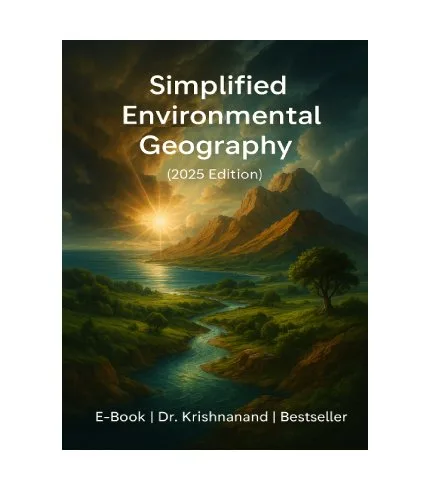
In the Simplified Environmental Geography (2025 Edition), Dr. Krishnanand dedicates Chapter 6 to Ecosystem Services, presenting them in bullet points with accompanying diagrams that show how services like water purification and carbon sequestration feed directly into food chain stability. This approach mirrors the way UPSC frames questions: “Explain how regulating ecosystem services influence agricultural productivity in the Indo‑Gangetic plain.”
Why a Focused E‑Book Beats Generic Textbooks
General environmental science books often devote only a few pages to ecosystem services, burying the details under lengthy theoretical discussions. For competitive exams, candidates need:
- Concise, point‑wise definitions that can be memorized quickly.
- Visual aids (maps, flowcharts) that reinforce retention.
- Direct links to the prescribed CBCS syllabus, ensuring no irrelevant content.
- Practice‑oriented snippets that mimic previous year question patterns.
The Simplified Environmental Geography (2025 Edition) meets all these criteria. Each chapter begins with a “Key Points” box, followed by illustrated explanations and ends with a “Quick Recap” section. For instance, Chapter 4 on Principles of Ecology includes a flowchart of energy flow that directly supports answering questions on Ecosystem Services Human Ecology and food chain efficiency.
How to Evaluate an Environmental Geography Resource
When selecting a study guide, consider the following checklist:
- Syllabus Alignment: Does the material follow the latest CBCS geography syllabus?
- Clarity of Concepts: Are definitions presented in simple language with examples?
- Visual Support: Are there diagrams, maps, and images that explain processes?
- Exam Orientation: Does it include previous year question patterns or model answers?
- Author Credibility: Is the author experienced in teaching UPSC geography?
Dr. Krishnanand’s e‑book scores high on each point. The publisher explicitly states that the content is on the prescribed CBCS syllabus, and the sample chapters showcase highlighted point‑wise descriptions with diagrams—exactly what aspirants need for mastering Ecosystem Services Human Ecology.
Practical Ways to Use the E‑Book for Exam Preparation
To maximize benefit, adopt a three‑stage approach:
- Initial Read‑Through: Go through Chapters 1‑6, focusing on the highlighted points and diagrams. Make short notes in the margin of each Ecosystem Services Human Ecology concept.
- Active Recall: After each chapter, close the e‑book and write a 150‑word summary of ecosystem services and their connection to food chains. Compare with the “Quick Recap” to identify gaps.
- Application Practice: Solve at least five previous year UPSC questions related to ecosystem services, using the e‑book’s explanations to verify answers. Mark any doubts and revisit the relevant sections.
This method transforms passive reading into active learning, ensuring that the material is retained for both prelims and mains.
Supplementary Authoritative Sources
For further reading, consider these trusted external references:
- Wikipedia – Ecosystem Services provides a comprehensive overview of the four service categories.
- UNEP – Global Environment Outlook 6 offers data on how ecosystem services affect food security and human health.
These sources complement the e‑book by offering broader context and up‑to‑date statistics that can be cited in mains answers.
Frequently Asked Questions
Is the e‑book suitable for beginners with no background in ecology?
Yes. The language is simplified, and each concept builds from the ground up, making Ecosystem Services Human Ecology accessible even to those new to the subject.
How many pages does the 2025 Edition contain?
The e‑book spans approximately 200 pages, with Chapters 1‑6 covering the core ecology and environmental geography topics required for UPSC.
Can I access a sample before purchasing?
The publisher provides a free sample download link on the product page, allowing you to review the point‑wise highlights and diagram style.
Our Recommendation
📖 Part of our complete guide: Evolution of Geographical Thought: A Comprehensive Guide for UPSC Aspirants and Geography Enthusiasts
Frequently Asked Questions
Is the e‑book suitable for beginners with no background in ecology?
Yes. The language is simplified, and each concept builds from the ground up, making Ecosystem Services Human Ecology accessible even to those new to the subject.
How many pages does the 2025 Edition contain?
The e‑book spans approximately 200 pages, with Chapters 1‑6 covering the core ecology and environmental geography topics required for UPSC.
Can I access a sample before purchasing?
The publisher provides a free sample download link on the product page, allowing you to review the point‑wise highlights and diagram style.