Blog
Simplified Oceanography Dr Krishnanand: Ultimate Guide for UPSC CSE Aspirants

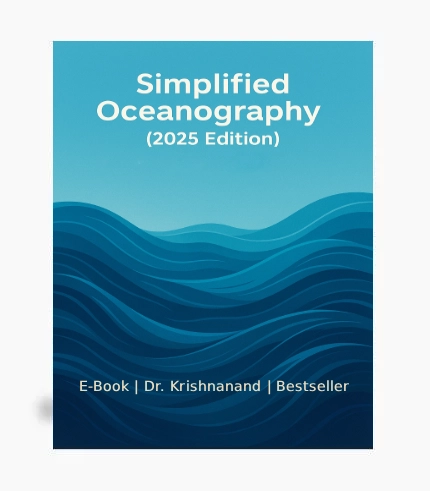

Oceanography is a vital component of the geography syllabus for UPSC CSE, state PSC exams, and undergraduate curricula. Many aspirants struggle to grasp the intricate interactions between ocean currents, temperature, salinity, and marine life due to the dense, jargon‑laden textbooks available. Simplified Oceanography Dr Krishnanand breaks down these complexities into point‑wise explanations, diagrams, and real‑world examples that align with the latest CBCS framework.
- Clear, point‑wise coverage of ocean bottom topography for the Atlantic, Indian, and Pacific oceans.
- Diagrams, maps, and images that make abstract concepts tangible.
- Aligned with the 2025 CBCS syllabus and UPSC CSE geography requirements.
- Authored by Dr. Krishnanand, a bestseller in geography e‑books.
- Ideal for quick revision, deep conceptual understanding, and answer writing practice.
Why Oceanography Matters for UPSC CSE Aspirants
The UPSC Civil Services Examination allocates significant weight to geography, with oceanography forming a core part of Paper I. Questions often test knowledge of ocean basins, thermohaline circulation, marine resources, and climate impact. According to the UPSC syllabus, candidates must understand “the physical and chemical properties of seawater, ocean currents, and marine ecosystems.” A solid grasp of these topics can boost scores by 10‑15 marks in the geography section, which can be the difference between clearing the prelims and missing the cutoff. Simplified Oceanography Dr Krishnanand provides exactly the depth and clarity needed to meet these demands without overwhelming the reader.
Common Challenges Students Face When Studying Oceanography
Many learners report three recurring obstacles: (1) excessive technical terminology that obscures underlying principles, (2) lack of visual aids that make three‑dimensional ocean floor features difficult to imagine, and (3) mismatch between textbook content and the exam‑oriented focus of UPSC. Traditional oceanography texts often devote pages to derivations of the equation of state for seawater, while aspirants need concise summaries of how temperature and salinity drive deep‑water formation. Simplified Oceanography Dr Krishnanand sidesteps these pitfalls by presenting each concept in bullet points, accompanied by clearly labeled diagrams and real‑world case studies such as the El Niño phenomenon and the Indian Ocean Dipole.
How Simplified Oceanography Dr Krishnanand Addresses These Challenges
The e‑book adopts a layered learning strategy. First, each chapter opens with a one‑sentence “core idea” that captures the essence of the topic—for example, “Ocean temperature varies with latitude, depth, and seasonal heating, influencing global climate patterns.” Second, the concept is unpacked in point‑wise format, with each point limited to a single sentence or phrase. Third, relevant diagrams, maps, and satellite images are placed immediately after the explanatory text, reinforcing spatial understanding. Fourth, end‑of‑chapter quick‑review boxes summarize key facts, making revision efficient. This structure directly mirrors the way UPSC expects answers: concise, factual, and supported by illustrative examples.
Key Features of the 2025 Edition E‑Book
Simplified Oceanography (2025 Edition) | E‑Book | Dr. Krishnanand | Bestseller offers several distinctive attributes:
- Comprehensive coverage of all major ocean basins: Atlantic, Indian, and Pacific, with dedicated chapters on bottom topography.
- Updated data reflecting the latest IPCC AR6 findings on ocean heat uptake and sea‑level rise.
- Integration of CBCS‑compliant headings and sub‑headings, ensuring compatibility with university geography courses.
- Over 120 original diagrams, bathymetric maps, and high‑resolution satellite images.
- Point‑wise highlights that enable rapid scanning—ideal for last‑minute review before the prelims.
- Accessible language that avoids unnecessary jargon while preserving scientific accuracy.
These features make the e‑book a one‑stop resource for both academic study and competitive exam preparation.
How to Use This E‑Book Effectively in Your Study Routine
To maximize retention, adopt a three‑step cycle: (1) Preview – skim the chapter headings and the point‑wise highlights to build a mental map; (2) Active Reading – read each point aloud, then close the book and explain the concept in your own words; (3) Application – attempt a previous year UPSC question related to the topic and compare your answer with the explanation provided. For instance, after studying Chapter 5 on Ocean’s Temperature, try answering a question about the impact of thermohaline circulation on monsoon rainfall. Repeating this cycle for each of the six chapters ensures that knowledge moves from short‑term recall to long‑term retention.
Buying Guide: What to Look for in an Oceanography Resource
When selecting an oceanography textbook or e‑book, consider the following criteria:
- Syllabus Alignment: Verify that the material covers the CBCS and UPSC CSE geography syllabus explicitly.
- Visual Quality: Look for clear, labeled diagrams and maps; oceanography is inherently spatial.
- Conciseness: Point‑wise or bullet‑point formats save time during revision.
- Author Credentials: Resources authored by subject experts with teaching experience tend to anticipate learner difficulties.
- Edition Year: Ocean science evolves rapidly; a 2025 edition ensures inclusion of recent climate data.
Simplified Oceanography Dr Krishnanand satisfies all these benchmarks, which is why it has become a bestseller among geography aspirants.
Frequently Asked Questions
Is Simplified Oceanography Dr Krishnanand suitable for beginners?
Yes. The e‑book starts with foundational definitions and gradually builds complexity, making it accessible to readers with little prior exposure to ocean science.
Does the e‑book include practice questions?
While the primary focus is conceptual clarity, each chapter ends with quick‑review boxes that summarize key facts, which can be used to formulate self‑test questions. Aspirants are encouraged to pair the e‑book with previous year UPSC papers for practice.
How does this edition differ from earlier versions?
The 2025 edition incorporates updated statistics from the IPCC Sixth Assessment Report, revised maps reflecting the latest seabed surveys, and additional case studies on marine heatwaves and ocean acidification—topics that have gained prominence in recent UPSC exams.
Further reading: Simplified Oceanography Dr Krishnanand on Wikipedia
Our Recommendation
📖 Part of our complete guide: Evolution of Geographical Thought: A Comprehensive Guide for UPSC Aspirants and Geography Enthusiasts
Frequently Asked Questions
Is Simplified Oceanography Dr Krishnanand suitable for beginners?
Yes. The e‑book starts with foundational definitions and gradually builds complexity, making it accessible to readers with little prior exposure to ocean science.
Does the e‑book include practice questions?
While the primary focus is conceptual clarity, each chapter ends with quick‑review boxes that summarize key facts, which can be used to formulate self‑test questions. Aspirants are encouraged to pair the e‑book with previous year UPSC papers for practice.
How does this edition differ from earlier versions?
The 2025 edition incorporates updated statistics from the IPCC Sixth Assessment Report, revised maps reflecting the latest seabed surveys, and additional case studies on marine heatwaves and ocean acidification—topics that have gained prominence in recent UPSC exams.