Blog
Paradigms In Geography | Geographical Thought | Kuhn’s Model | Human Geography | By Dr. Krishnanand

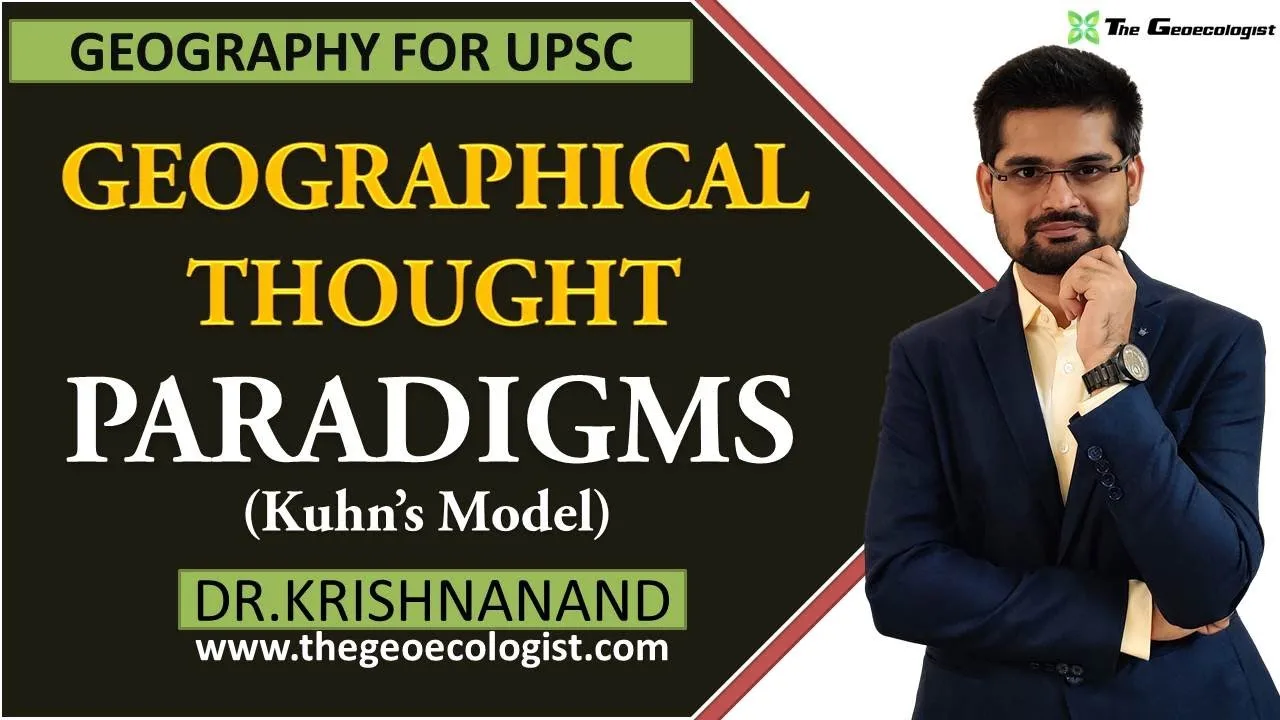
Paradigms In Geography | Geographical Thought | Kuhn’s Model | Human Geography | By Dr. Krishnanand
Paradigms in Geography: Understanding Kuhn’s Model of Paradigm Shift
Introduction
Geography, as a discipline, has evolved significantly over time, shaped by changing perspectives, methodologies, and intellectual paradigms. Paradigms in Geography—popularized by Thomas Kuhn’s theory of scientific revolutions—play a crucial role in understanding the shifts in geographical thought.
In this article, we explore the concept of paradigms in geography, their influence on the discipline, and Kuhn’s Model of Paradigm Shift—with insights from Dr. Krishnanand’s lecture on Geographical Thought. This discussion is particularly beneficial for UG geography students and UPSC (Human Geography optional) aspirants.
For an in-depth study, an e-book (PDF) on The Evolution of Geographical Thought is available at:
🔗 https://mithilacraft.com/product/evolution-of-geographical-thought/
What is a Paradigm?
A paradigm refers to a shared set of beliefs, methods, and assumptions that guide scientific research within a discipline. In geography, paradigms define how scholars perceive and interpret spatial phenomena.
Thomas Kuhn, in his seminal work The Structure of Scientific Revolutions (1962), proposed that scientific progress occurs through paradigm shifts—dramatic changes in fundamental concepts when existing paradigms fail to explain new observations.
Major Paradigms in Geography
Several dominant paradigms have shaped geographical thought:
1. Environmental Determinism (Early 20th Century)
- Assumes that human behavior and culture are shaped by physical geography (climate, terrain).
- Critics argue it oversimplifies human-environment relationships.
2. Possibilism (Mid-20th Century)
- Advocates that while nature sets limits, human agency determines outcomes.
- Emphasizes human adaptability and technological influence.
3. Quantitative Revolution (Spatial Analysis Paradigm)
- Introduced statistical methods, spatial modeling, and a scientific approach to geography.
- Focused on laws of spatial organization (e.g., Central Place Theory).
4. Behavioral & Humanistic Geography
- Shifts focus to human perception, experience, and cultural context.
- Challenges the purely quantitative approaches.
5. Radical (Critical) Geography
- Inspired by Marxism, it examines power, inequality, and social justice in spatial processes.
6. Postmodern Geography
- Rejects grand theories, embracing relativity, diversity, and deconstruction of space.
Kuhn’s Model of Paradigm Shift in Geography
Thomas Kuhn’s model explains how scientific disciplines evolve:
- Normal Science: Researchers work within an accepted paradigm.
- Anomalies: Findings that challenge the existing paradigm emerge.
- Crisis: Persistent anomalies lead to questioning the paradigm.
- Revolution: A new paradigm emerges, replacing the old one.
Example in Geography:
- The Quantitative Revolution (1950s-60s) challenged traditional regional geography, leading to a paradigm shift towards spatial science.
Conclusion
Understanding paradigms in geography helps in grasping how the discipline advances through intellectual revolutions. Kuhn’s Model of Paradigm Shift provides a framework for analyzing these transitions, making it essential for geography students and UPSC aspirants.
For further study, refer to Dr. Krishnanand’s detailed lecture and the E-book on Evolution of Geographical Thought available here:
📥 Download E-book
Subscribe & Follow for More Geography Insights!
📺 YouTube: THEGEOECOLOGIST
🌐 Website: https://thegeoecologist.com/
📷 Instagram: @thegeoecologist
geographicalthought #paradigmsingeography #paradigmshift #humangeography #UPSCgeography #drkrishnanand #thegeoecologist
All Rights Reserved. © TheGeoecologist, Dr. Krishnanand.
To Download E-Books & Study Material Visit The Shop Page