Blog
Ocean Waves Explained: Mastering Simplified Oceanography for Success

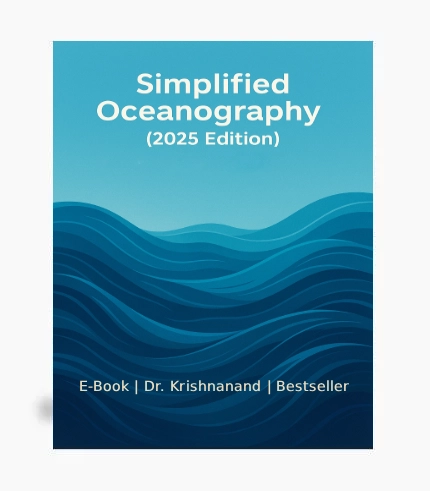

Ocean waves are among the most captivating and complex phenomena in Earth’s dynamic systems. For students preparing for competitive exams like the UPSC Civil Services Examination or undergraduate geography courses, understanding the science of ocean waves can feel overwhelming. From wave formation to their impact on coastal ecosystems, the sheer volume of information often leaves learners struggling to grasp foundational concepts. This is where targeted resources like Simplified Oceanography (2025 Edition) by Dr. Krishnanand become indispensable.
- Key Takeaways:
- Ocean waves play a critical role in shaping coastal environments and global climate systems.
- Understanding wave dynamics requires mastering technical terminology and visual aids.
- Dr. Krishnanand’s e-book simplifies complex oceanography topics for exam-focused learners.
- Visual elements like diagrams and maps enhance comprehension of wave-related processes.
- The CBCS-aligned structure ensures coverage of all syllabus-relevant wave concepts.
The Challenge of Understanding Ocean Waves
Ocean waves are not just surface phenomena; they are the result of intricate interactions between wind, water, and Earth’s gravitational forces. Students often struggle with concepts like wave height, wavelength, and energy transfer. For instance, explaining how wind generates waves through friction requires breaking down scientific jargon into digestible explanations. Without clear examples or visual aids, learners may resort to memorizing formulas without truly understanding their real-world applications. This gap in comprehension can severely impact performance in exams, where both theoretical knowledge and practical application are tested.
Key Concepts in Ocean Wave Dynamics
At the heart of oceanography lies the study of wave behavior. Fundamental principles include wave generation mechanisms, such as wind-driven waves and seismic-generated tsunamis. Learners must also grasp wave classification—whether they are surface waves, internal waves, or deep-sea waves. Equally important is understanding how wave energy dissipates over time and its effects on marine environments. For example, breaking waves contribute to sediment transport along coastlines, a process critical for understanding erosion and delta formation. Without a structured approach to these topics, students risk overlooking essential details that exams like the UPSC prioritize.
How Simplified Oceanography Addresses Learning Gaps
Dr. Krishnanand’s Simplified Oceanography (2025 Edition) is designed specifically to bridge these learning gaps. The e-book adopts a pointwise approach, breaking down complex topics like wave dynamics into concise, exam-friendly sections. For example, the chapter on Ocean’s Temperature (pages 59-74) meticulously explains how thermal gradients influence wave patterns, supported by annotated diagrams. Maps and images included in the book further clarify spatial relationships, such as how prevailing winds in different ocean basins generate distinct wave systems. This visual-first methodology ensures that even abstract concepts become accessible to learners at all levels.
Practical Applications for Students and Professionals
Ocean waves are not just academic topics; they have real-world implications. Coastal engineers rely on wave data to design resilient infrastructure, while marine biologists study wave patterns to assess habitat health. For UPSC aspirants, understanding wave-related phenomena is crucial for questions in the Geography and Environment sections. The e-book’s alignment with the CBCS syllabus ensures that readers encounter content directly relevant to their exam preparations. Moreover, the inclusion of case studies—such as the 2004 Indian Ocean tsunami—demonstrates how wave science intersects with disaster management, a topic frequently tested in competitive exams.
Making the Most of Your Study Materials
Traditional textbooks often overwhelm readers with dense paragraphs and minimal visual aids. In contrast, Simplified Oceanography employs a learner-centric approach. Each chapter begins with clear objectives, followed by bullet-pointed explanations and labeled diagrams. For instance, the section on Atlantic: Ocean Bottom Topography (pages 26-36) uses cross-sectional illustrations to show how underwater ridges influence wave propagation. This method not only aids memorization but also develops analytical skills necessary for answering diagram-based questions in exams. Additionally, the e-book’s structured format allows learners to prioritize high-yield topics, maximizing study efficiency.
Frequently Asked Questions About Ocean Waves
1. How do ocean waves form?
Ocean waves form when wind transfers energy to the water’s surface, creating ripples that grow into waves. Factors like wind speed, duration, and fetch (the distance over water) determine wave size and characteristics.
2. What is the difference between a wave and a tsunami?
While both involve water movement, tsunamis are seismic-generated waves with extremely long wavelengths and slow crest periods. Regular ocean waves, by contrast, are wind-driven and have shorter wavelengths.
3. Why is studying ocean waves important for UPSC exams?
Waves are integral to topics like coastal regulation, climate change impacts, and natural disasters—all of which feature prominently in the UPSC syllabus. Dr. Krishnanand’s book systematically covers these connections, making it a must-have resource for aspirants.
4. How does this e-book differ from other oceanography guides?
Its pointwise structure, combined with CBCS alignment and visual aids, makes it uniquely suited for exam preparation. Unlike traditional textbooks, it prioritizes clarity and brevity without sacrificing depth.
Why Choose This E-Book for Your Studies
The Simplified Oceanography (2025 Edition) stands out in a crowded market due to its pedagogical innovation. By condensing decades of oceanographic research into accessible language, it empowers learners to tackle challenging topics like wave energy transformation and coastal processes with confidence. The 2025 edition, in particular, incorporates updates on contemporary issues such as ocean acidification and its effects on wave dynamics—a critical area for environmental geography questions in exams. For students pressed for time, this e-book offers a shortcut to mastery without compromising on depth or accuracy.
Conclusion: Navigating Your Path to Success
Understanding ocean waves is not merely an academic exercise—it is a gateway to comprehending Earth’s interconnected systems. For those preparing for competitive exams or seeking to deepen their geographical knowledge, the right resource can make all the difference. The Simplified Oceanography (2025 Edition) provides that resource, transforming complexity into clarity through expert insights and strategic design. Whether you are tackling your first geography module or refining your UPSC preparation, this e-book ensures you sail smoothly through the seas of knowledge.
Further reading: Ocean Waves on Wikipedia
Our Recommendation
📖 Part of our complete guide: Evolution of Geographical Thought: A Comprehensive Guide for UPSC Aspirants and Geography Enthusiasts
Frequently Asked Questions
What are ocean waves and how do they form?
Ocean waves are surface water phenomena caused by wind energy transferring to the water's surface. They form when wind blows across water, creating ripples that grow into waves based on wind speed, duration, and fetch distance.
How does Simplified Oceanography help with exam preparation?
The 2025 edition uses pointwise explanations, diagrams, and CBCS syllabus alignment to simplify complex topics like wave dynamics for UPSC and undergraduate geography students.
What makes this e-book different from other oceanography guides?
Its unique combination of visual aids, exam-focused structure, and Dr. Krishnanand's expert explanations make it ideal for learners who need clarity without sacrificing academic rigor.
Is Simplified Oceanography suitable for both beginners and advanced learners?
Yes, the e-book's layered approach accommodates all levels, from foundational concepts like wave formation to advanced topics like tsunami dynamics and climate interactions.