Blog
NCERT Geography Chapter 9: Geographical Perspective on Selected Issues and Problems

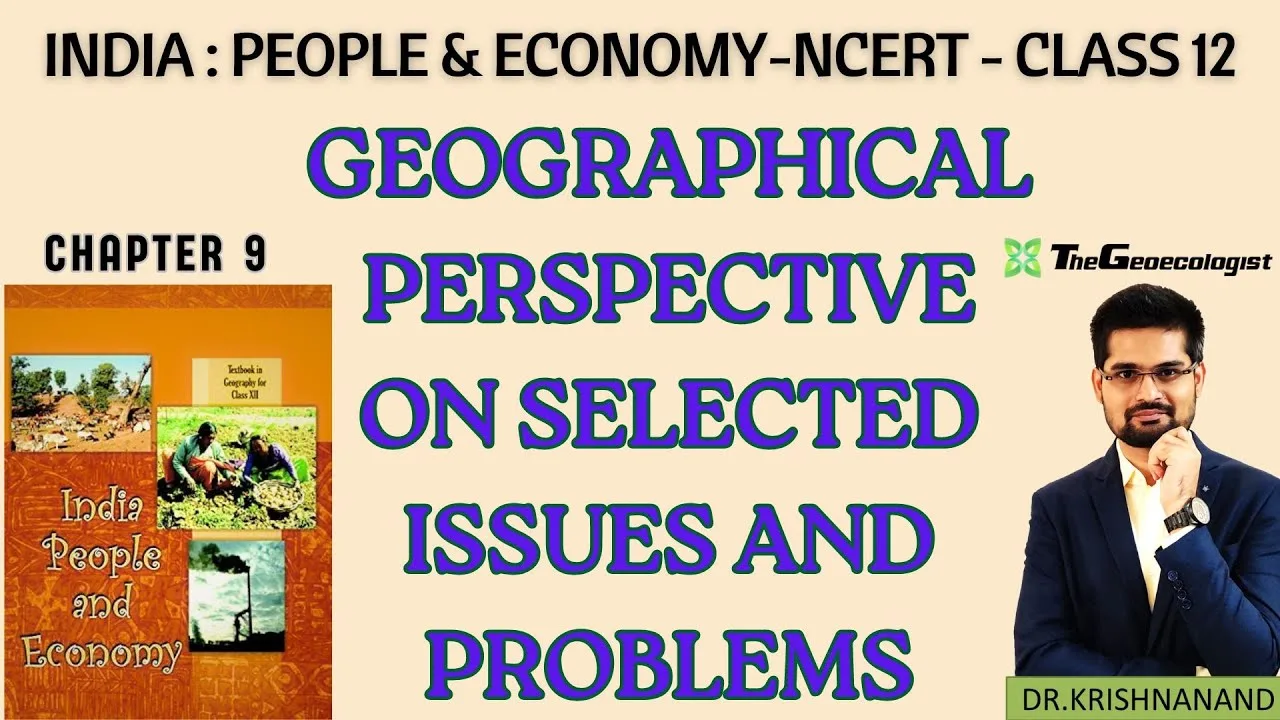
Table of Contents
- Overview of NCERT Geography Chapter 9
- Environmental Pollution Analysis in NCERT Geography Chapter 9
- Air Pollution Challenges
- Water Pollution and Groundwater Depletion
- Noise and Land Pollution
- Urban Waste Management Strategies
- Rural Environmental Challenges
- Sustainable Development Framework
- Exam Relevance for CBSE and Competitive Exams
- Study Resources and Video Lectures
- Conclusion
NCERT Geography Chapter 9 of the Class 12 textbook “India: People and Economy” provides a critical geographical lens to analyze pressing environmental and socio-economic challenges facing India today. This chapter moves beyond rote memorization, encouraging students to understand the spatial patterns, causes, and consequences of issues like pollution, waste management, and rural distress. For aspirants of CBSE board exams, CUET, UPSC, and UGC NET, mastering this chapter is non-negotiable as NCERT Geography Chapter 9 bridges static textbook knowledge with dynamic current affairs.
- Holistic Framework: The chapter integrates physical geography (monsoons, soil types) with human geography (urbanization, industrialization) to explain environmental degradation.
- Pollution Typology: Detailed classification of air, water, noise, and land pollution with India-specific case studies like Delhi smog and Ganga contamination.
- Urban-Rural Divide: Contrasts waste management crises in megacities with land degradation and water scarcity in agrarian regions.
- Policy Linkages: Direct references to government missions — Swachh Bharat Abhiyan, National Clean Air Programme (NCAP), Namami Gange — making NCERT Geography Chapter 9 highly relevant for competitive exams.
- Sustainable Development Goals (SDGs): Implicit alignment with SDG 6 (Clean Water), SDG 11 (Sustainable Cities), SDG 13 (Climate Action), and SDG 15 (Life on Land).
Overview of NCERT Geography Chapter 9
The NCERT Geography Chapter 9 titled “Geographical Perspective on Selected Issues and Problems” is the concluding chapter of the “India: People and Economy” textbook. It synthesizes concepts from previous chapters — population distribution, resource utilization, agricultural patterns, industrial development, and transport networks — to diagnose environmental problems. The geographical perspective here implies analyzing where problems occur, why they cluster in specific regions, and how spatial processes like wind patterns, river drainage, and urban sprawl amplify or mitigate them. This approach is distinct from a purely scientific or policy-oriented analysis; it emphasizes locational attributes, regional disparities, and human-environment interaction.
Environmental Pollution Analysis in NCERT Geography Chapter 9
The chapter dedicates substantial space to pollution, categorizing it by medium and source. Understanding these categories is essential for answering long-form questions in board exams and for GS Paper 1 and 3 in UPSC.
Air Pollution Challenges
Air pollution in India exhibits a distinct spatial pattern. The Indo-Gangetic Plain, particularly during winter, becomes a pollution hotspot due to temperature inversion, low wind speeds, and high emission loads. NCERT Geography Chapter 9 identifies vehicular emissions, industrial exhaust, thermal power plants, and agricultural residue burning in Punjab and Haryana as primary anthropogenic sources. The chapter highlights the phenomenon of photochemical smog in metropolitan cities like Delhi, Mumbai, and Kolkata. According to the Central Pollution Control Board (CPCB), over 130 Indian cities violate National Ambient Air Quality Standards (NAAQS) for PM10 and PM2.5. The geographical perspective here explains why Delhi — landlocked, with continental climate and surrounded by agricultural states — suffers more acutely than coastal cities like Chennai or Mumbai where sea breezes disperse pollutants.
Water Pollution and Groundwater Depletion
River pollution is analyzed through the lens of drainage basins. The Ganga, despite its cultural significance and high self-purification capacity due to bacteriophages, receives untreated sewage and industrial effluents from towns like Kanpur, Prayagraj, and Varanasi. The Yamuna, a tributary, is virtually a dead river in its 22-km stretch through Delhi. NCERT Geography Chapter 9 also covers groundwater crisis — India extracts more groundwater than the USA and China combined, with Punjab, Haryana, Rajasthan, and Delhi showing critical overexploitation. The chapter links this to the Green Revolution cropping pattern (rice-wheat) in semi-arid regions, a classic example of geographical mismatch between crop water requirements and agro-climatic suitability.
Noise and Land Pollution
Urbanization drives noise pollution beyond permissible limits (55 dB day / 45 dB night in residential zones per CPCB). Land pollution stems from unscientific disposal of municipal solid waste (MSW), hazardous industrial waste, and biomedical waste. The chapter notes that India generates over 160,000 metric tonnes of MSW daily, of which only 75-80% is collected and merely 22-28% processed. Open dumping creates leachate contaminating aquifers and methane emissions contributing to climate change.
Urban Waste Management Strategies
Rapid, unplanned urbanization — India’s urban population grew from 17.3% (1951) to 34.9% (2021) — has outpaced municipal capacity. NCERT Geography Chapter 9 emphasizes the waste management hierarchy: source segregation, collection, transportation, processing (composting, waste-to-energy), and scientific landfilling. The chapter cites the Solid Waste Management Rules, 2016, which mandate segregation at source into wet, dry, and domestic hazardous waste. Case studies of success — Indore’s 100% segregation and waste-to-energy model, Alappuzha’s decentralized composting — illustrate how local governance and community participation can overcome geographical constraints of space and finance. The Swachh Bharat Mission (Urban) 2.0 (2021-2026) aims for garbage-free cities, remediation of legacy dumpsites, and construction and demolition waste management. For a detailed policy timeline, refer to the official Swachh Bharat Mission portal.
Rural Environmental Challenges
Rural India faces a different geographical matrix of problems. Land degradation affects nearly 30% of India’s total geographical area (96.4 million hectares per ISRO’s Desertification and Land Degradation Atlas, 2021). Water erosion (11%), wind erosion (5%), salinity/alkalinity (2%), and waterlogging (1%) are dominant processes. NCERT Geography Chapter 9 explains how deforestation in the Himalayan foothills accelerates soil erosion and siltation in plains’ rivers. In Rajasthan and Gujarat, wind erosion and desertification threaten livelihoods. Groundwater depletion in hard-rock peninsular regions (Karnataka, Tamil Nadu, Telangana) differs from alluvial plains — here, aquifer recharge is limited by geology, making over-extraction irreversible. The chapter also touches on fluoride, arsenic, and nitrate contamination in drinking water, linking geology (arsenic in Bengal basin alluvium, fluoride in crystalline rocks of Rajasthan/Andhra) to public health.
Sustainable Development Framework
The chapter concludes with a forward-looking perspective on sustainable development. It advocates for resource conservation, afforestation (National Afforestation Programme, Green India Mission), renewable energy transition (National Solar Mission targeting 280 GW by 2030), and participatory watershed management (e.g., Ralegan Siddhi, Hiware Bazar in Maharashtra). NCERT Geography Chapter 9 implicitly critiques the “grow now, clean later” model, urging integration of environmental costs into economic planning. The concept of “carrying capacity” of ecosystems is introduced — a geographical idea that each region has a threshold of resource use and waste assimilation beyond which degradation becomes irreversible. This aligns with India’s commitment to the Paris Agreement (NDC: 45% emission intensity reduction by 2030 from 2005 levels) and the LiFE (Lifestyle for Environment) movement launched at COP26.
Exam Relevance for CBSE and Competitive Exams
For CBSE Class 12 board exams, NCERT Geography Chapter 9 typically yields 8-10 marks, including a 5-mark long-answer question on pollution types, urban waste management, or sustainable development. Map-based questions may ask to identify polluted river stretches (Ganga, Yamuna, Sabarmati), cities with severe air pollution (Delhi, Kanpur, Lucknow), or states with critical groundwater depletion (Punjab, Rajasthan, Haryana). For CUET Geography, the chapter maps to Unit 5 (Environmental Issues). UPSC aspirants find direct utility in GS Paper 1 (Urbanization, Environmental Degradation) and GS Paper 3 (Conservation, Pollution, Disaster Management). Previous year questions have asked about the National Clean Air Programme, solid waste management rules, and groundwater governance. The National Clean Air Programme (NCAP) launched in 2019 targeting 20-30% PM reduction by 2024 in 131 non-attainment cities is a frequent exam topic. UGC NET Geography candidates should focus on theoretical frameworks — human ecology, political ecology, and environmental determinism vs. possibilism — as applied in this chapter.
Study Resources and Video Lectures
While the NCERT textbook is the primary source, supplementary resources enhance conceptual clarity. TheGeoecologist’s bilingual (Hindi-English) video lectures on NCERT Geography Chapter 9 are widely recommended for their simplified explanations, map animations, and exam-oriented mnemonics. Visual aids showing pollutant dispersion models, waste management cycles, and groundwater depletion maps improve retention. For structured preparation, aspirants should also consult the official NCERT website for the latest textbook PDFs and exemplar problems. Reference books like “India: A Comprehensive Geography” by Khullar and “Environment” by Shankar IAS provide deeper case studies. Regular reading of Down To Earth magazine and PIB releases keeps the current affairs linkage active.
Conclusion
NCERT Geography Chapter 9 equips learners with a geographical toolkit to diagnose, analyze, and propose solutions for India’s most pressing environmental problems. Its spatial perspective — connecting pollution to physiography, urbanization to waste crises, and cropping patterns to groundwater decline — fosters systems thinking essential for both academic excellence and informed citizenship. By integrating textbook rigor with real-world policy initiatives like NCAP, Swachh Bharat, and Namami Gange, the chapter bridges the gap between theory and practice. Students who internalize this geographical perspective will not only score well in CBSE, CUET, UPSC, and UGC NET but also develop the analytical capacity to engage with sustainability challenges in their professional lives. The journey from understanding problems to designing geographically informed solutions begins here.
Frequently Asked Questions
NCERT Geography Chapter 9 covers environmental pollution (air, water, noise, land), urban waste management, rural challenges like land degradation and groundwater depletion, and sustainable development frameworks with policy linkages to Swachh Bharat, NCAP, and Namami Gange.
NCERT Geography Chapter 9 typically carries 8-10 marks in the CBSE Class 12 Geography board exam, including one 5-mark long-answer question and potential map-based questions on polluted rivers, air pollution hotspots, and groundwater-stressed states.
Yes, NCERT Geography Chapter 9 is highly important for UPSC. It directly supports GS Paper 1 (urbanization, environmental degradation) and GS Paper 3 (conservation, pollution control, disaster management). Topics like NCAP, Solid Waste Management Rules 2016, and groundwater governance are frequently asked.