Blog
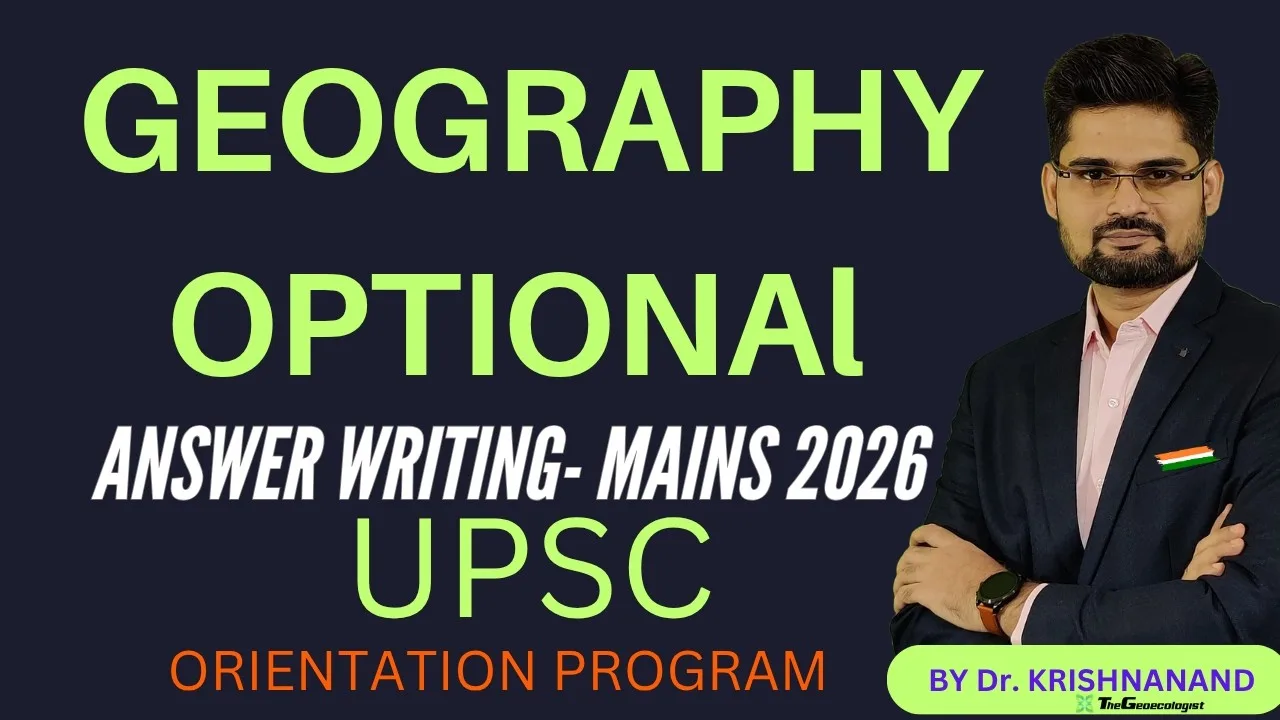
Geography Optional UPSC: TheGeoecologist Course Review for 2026


Table of Contents
- Why Geography Optional UPSC Remains a Top Choice for Aspirants
- Syllabus Overlap and Strategic Advantage
- TheGeoecologist: Course Architecture Designed for UPSC 2026
- Phase 1: Foundation – NCERT to Advanced Concepts
- Phase 2: Enrichment – Thematic Integration and Case Studies
- Phase 3: Mastery – Answer Writing and Mock Tests
- Dr. Krishnanand: The Mentor Behind the Methodology
- PYQ Decoding: The Strategic Edge
- Answer Writing: From Knowledge to Marks
- Diagram Integration Protocol
- Keyword and Terminology Precision
- Administrative Perspective Integration
- Course Logistics: Flexibility for Working Professionals and Full-Time Aspirants
- Success Metrics and Student Outcomes
- Comparison: TheGeoecologist vs. Other Geography Optional UPSC Courses
- Enrollment Roadmap for UPSC 2026 Aspirants
- Frequently Asked Questions
- Is Geography Optional UPSC suitable for non-geography graduates?
- How much time does Geography Optional UPSC preparation require daily?
- Can I prepare for Geography Optional UPSC without coaching?
- Final Verdict: Your Geography Optional UPSC Master Strategy
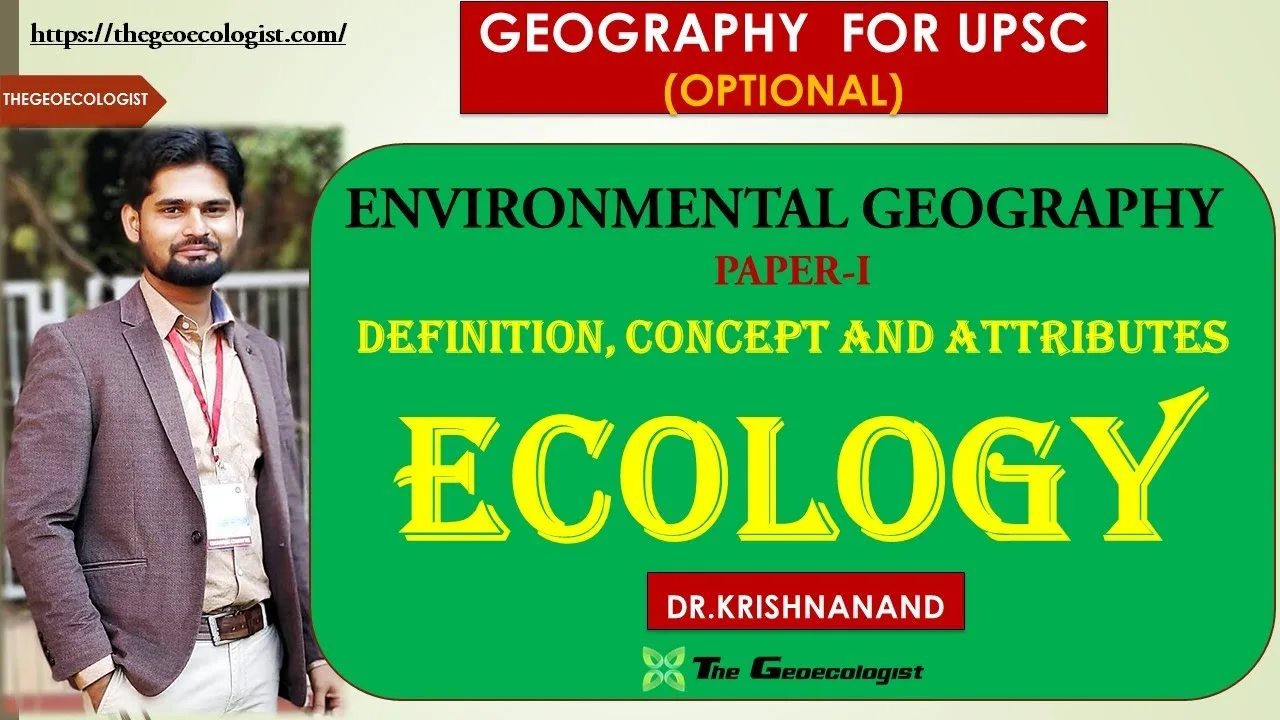
Choosing the right Geography Optional UPSC preparation strategy can be the defining factor between an average score and a top rank in the Civil Services Examination. With the UPSC 2026 notification approaching, aspirants are actively searching for a comprehensive, structured, and mentor-led program that covers both Paper 1 (Physical Geography) and Paper 2 (Human Geography) with equal rigor. TheGeoecologist, led by Dr. Krishnanand, has emerged as a premier online course designed specifically for this high-stakes optional subject.
- Complete Syllabus Coverage: Exhaustive treatment of Physical and Human Geography from NCERT basics to advanced concepts.
- Conceptual Clarity Focus: Pedagogy emphasizes understanding processes (monsoons, geomorphology, demographic transitions) over rote memorization.
- Answer Writing Mastery: Personalized mentorship on structure, diagram integration, and UPSC-specific presentation standards.
- PYQ-Driven Strategy: Deep analysis of previous year questions to identify patterns, trends, and high-probability topics.
- 2026/2027 Aligned Roadmap: Tailored schedule, regular mock tests, and doubt-clearing sessions for upcoming cycles.
- Expert Mentorship: Learn directly from Dr. Krishnanand, a renowned Geography teacher with years of UPSC guidance experience.
Why Geography Optional UPSC Remains a Top Choice for Aspirants
The Geography Optional UPSC subject has consistently maintained its popularity among serious candidates for several strategic reasons. Unlike some optionals that require purely theoretical mastery, Geography offers a unique blend of scientific objectivity and contemporary relevance. The syllabus overlaps significantly with General Studies Paper 1 (Indian Heritage, Geography, Society) and Paper 3 (Environment, Disaster Management, Agriculture), providing a force-multiplier effect on overall preparation.
According to UPSC annual reports, Geography optional candidates have historically secured a disproportionate share of top-100 ranks. In the 2022 final results, over 15% of top-50 rank holders had Geography as their optional. This statistical edge stems from Geography Optional UPSC’s scoring potential—well-structured answers with accurate diagrams, maps, and data citations can fetch 300+ marks out of 500. However, this potential is only realized with expert guidance that bridges academic geography and UPSC examination requirements.
Syllabus Overlap and Strategic Advantage
The Geography Optional UPSC syllabus covers Physical Geography (Geomorphology, Climatology, Oceanography, Biogeography) and Human Geography (Economic, Population, Settlement, Regional Planning, Indian Geography). Nearly 40-50 marks in GS Paper 1 directly overlap, while concepts like climate change, urbanization, and resource distribution appear in GS Paper 3 and Essay papers. This overlap reduces the marginal effort required, making Geography one of the most efficient optionals for time-constrained aspirants.
TheGeoecologist: Course Architecture Designed for UPSC 2026
TheGeoecologist course is not merely a lecture series—Geography Optional UPSC is a comprehensive learning ecosystem built around the specific demands of the Geography Optional UPSC examination. The curriculum is structured in three progressive phases: Foundation, Enrichment, and Mastery.
Phase 1: Foundation – NCERT to Advanced Concepts
The course begins with a systematic deconstruction of NCERT textbooks (Classes 6-12), establishing bedrock concepts in physical and human geography. Dr. Krishnanand’s pedagogy connects textbook definitions to real-world processes—explaining why the Indian monsoon behaves erratically, how plate tectonics shapes the Himalayan orogeny, and what drives demographic transition in developing nations. This phase includes 120+ hours of recorded lectures, downloadable PDF notes, and concept-check quizzes after each module. – a key consideration for Geography Optional UPSC.
Phase 2: Enrichment – Thematic Integration and Case Studies
Once foundations are solid, the course advances to thematic integration. Topics like “Climate Change and Agriculture,” “Urbanization Challenges in India,” and “Water Resource Conflicts” are taught through contemporary case studies. TheGeoecologist incorporates latest data from Economic Survey 2023-24, IPCC Sixth Assessment Report, Census 2011 (and projected 2021 data), and NITI Aayog reports. This ensures answers reflect current administrative priorities—a key differentiator in UPSC evaluation. – a key consideration for Geography Optional UPSC.
Phase 3: Mastery – Answer Writing and Mock Tests
The final phase focuses entirely on examination simulation. Aspirants write 50+ full-length tests (Paper 1 and Paper 2) modeled on actual UPSC patterns. Each answer receives personalized feedback highlighting structural flaws, missing diagrams, terminology gaps, and presentation improvements. TheGeoecologist’s proprietary “Answer Writing Framework” teaches the Introduction-Body-Conclusion structure with mandatory elements: definitions, diagrams, data, examples, and administrative perspectives.
Dr. Krishnanand: The Mentor Behind the Methodology
At the heart of TheGeoecologist is Dr. Krishnanand, a geography educator with over 15 years of UPSC mentoring experience. His academic background includes a Ph.D. in Regional Geography and extensive fieldwork across Indian physiographic divisions. Dr. Krishnanand’s teaching philosophy centers on “Geography as a lens to understand administration”—every physical process is linked to policy implications, every human pattern to planning challenges.
His YouTube channel, TheGeoecologist, has garnered 500,000+ subscribers with free content on map work, PYQ analysis, and current affairs integration. This public teaching demonstrates his ability to simplify complexity—a skill directly transferred to the paid course. Student testimonials consistently highlight his responsiveness: “Dr. Sir replies to doubts within hours, even on weekends” and “His diagram techniques added 40 marks to my Paper 1.”
PYQ Decoding: The Strategic Edge
Previous Year Question (PYQ) analysis is the backbone of TheGeoecologist’s Geography Optional UPSC strategy. The course provides a decade-wise (2013-2023) breakdown of question frequency, topic weightage, and evolving patterns. Key insights include:
- Geomorphology and Climatology consistently contribute 25-30% of Paper 1 marks.
- Indian Geography (Paper 2) has shifted from factual recall to analytical questions on regional disparities, sustainable development, and policy critique.
- Map-based questions now require thematic interpretation (e.g., “Identify the region and explain its agricultural pattern”) rather than mere location marking.
This analysis translates into a “High-Yield Topic Matrix” that guides aspirants to allocate revision time proportionally. The course also includes a “Predictive Question Bank” for 2026, developed by analyzing UPSC’s question-setting trends and current national priorities (e.g., National Water Policy, Urban Missions, Climate Commitments).
Answer Writing: From Knowledge to Marks
Knowledge without expression yields zero marks in UPSC. TheGeoecologist’s answer writing module is arguably its most valuable component. The course teaches:
Diagram Integration Protocol
Every 10-mark answer must contain at least one diagram; 15-mark answers require 2-3. The course provides a library of 200+ standardized diagrams (pressure belts, ocean currents, population pyramids, central place theory, etc.) with labeling conventions that match UPSC expectations. Aspirants practice sketching these in under 90 seconds—a critical time-management skill.
Keyword and Terminology Precision
UPSC evaluators reward technical vocabulary: “orographic precipitation” not “rain from mountains,” “demographic dividend” not “young population,” “smart city mission” not “urban development scheme.” TheGeoecologist provides a “Glossary of 500+ Must-Use Terms” categorized by syllabus topic, with flashcards for spaced repetition.
Administrative Perspective Integration
Top-scoring answers conclude with governance implications. For a question on “Drought Management,” the answer must reference NDMA guidelines, Jal Shakti Abhiyan, and state-level contingency plans. TheGeoecologist’s current affairs integration sessions (bi-weekly) explicitly connect geography concepts to ongoing schemes, bills, and judicial pronouncements.
Course Logistics: Flexibility for Working Professionals and Full-Time Aspirants
TheGeoecologist accommodates diverse schedules through a hybrid delivery model:
- Recorded Lectures: 350+ hours accessible 24/7 via dedicated app/portal with 2x speed, offline download, and bookmarking.
- Live Doubt Sessions: Weekly 2-hour interactive sessions with Dr. Krishnanand (recorded for later viewing).
- Test Series: 15 sectional tests + 10 full-length mocks with All-India Ranking and detailed solutions.
- Study Material: 500+ pages of printed notes (shipped notes (optional), PDF compilations of PYQ solutions, map atlases, and glossary.
- Mentorship: Optional one-on-one strategy calls (monthly) for personalized timetable and weakness diagnosis.
The course fee includes 18-month access, covering both UPSC 2026 and 2027 attempts. Early-bird enrollment (before December 2024) offers 15% discount and complimentary printed material shipment.
Success Metrics and Student Outcomes
While individual results vary, TheGeoecologist’s track record is transparent. In UPSC 2023, 42 course students cleared the examination with Geography optional, including 7 in top-500. The course’s internal survey (n=1,200 respondents, 2023 batch) reported:
- Average optional score improvement: 68 marks (pre-course mock vs. final attempt).
- 94% rated answer writing feedback as “highly effective.”
- 89% completed the full syllabus before Prelims 2024.
These outcomes reflect the course’s emphasis on completion discipline—weekly targets, progress tracking dashboards, and accountability groups prevent the common “syllabus backlog” trap.
Comparison: TheGeoecologist vs. Other Geography Optional UPSC Courses
When evaluating Geography Optional UPSC coaching options, aspirants typically compare TheGeoecologist with established players like Vajiram & Ravi, Vision IAS, and individual mentors. Key differentiators include:
| Parameter | TheGeoecologist | Traditional Classroom | Test-Series Only |
|---|---|---|---|
| Faculty Consistency | Single expert (Dr. Krishnanand) for all topics | Multiple faculty, varying quality | No teaching, only evaluation |
| Answer Writing Focus | Integrated from Day 1 (50+ evaluated tests) | Often separate module, limited feedback | Core offering but no concept teaching |
| Current Affairs Integration | Bi-weekly dedicated sessions | Ad-hoc, often superficial | Minimal |
| Flexibility | Fully self-paced with live support | Fixed schedule, attendance mandatory | Flexible but isolated |
| Cost (Approx.) | ₹35,000-45,000 (18 months) | ₹50,000-70,000 (offline, 6-8 months) | ₹10,000-15,000 (tests only) |
For self-driven aspirants seeking conceptual depth with examination precision, TheGeoecologist offers superior value. Those needing physical classroom discipline may prefer offline options, albeit at higher cost and rigidity.
Enrollment Roadmap for UPSC 2026 Aspirants
If you are targeting UPSC 2026, the ideal enrollment window is June-December 2024. This timeline allows:
- June-September: Complete Foundation phase (Physical + Human Geography basics) alongside GS preparation.
- October-January: Enrichment phase (thematic integration, case studies) + start answer writing practice.
- February-May: Mastery phase (full mocks, revision cycles, weak-area remediation).
- June 2025 (Prelims): Pause optional, focus on GS/CSAT.
- July-October 2025: Intensive optional revision + 2nd round of mocks.
- November 2025 (Mains): Peak performance.
Late joiners (January 2025 onwards) can opt for the “Fast-Track” variant covering high-yield topics in 4 months, though this demands 25-30 hours/week commitment.
Frequently Asked Questions
Is Geography Optional UPSC suitable for non-geography graduates?
Absolutely. Over 70% of successful Geography optional candidates come from non-geography backgrounds (Engineering, Medicine, Humanities, Commerce). TheGeoecologist’s foundation phase is explicitly designed for beginners, starting from NCERT Class 6 concepts. No prior geography degree is required—only willingness to engage with maps, diagrams, and spatial thinking.
How much time does Geography Optional UPSC preparation require daily?
A sustainable schedule allocates 2-3 hours daily on weekdays and 5-6 hours on weekends during the foundation phase. As answer writing intensifies, this increases to 3-4 hours daily. TheGeoecologist’s progress tracker helps aspirants maintain consistency without burnout. Working professionals typically complete the course in 10-12 months with 15-20 hours/week.
Can I prepare for Geography Optional UPSC without coaching?
Self-study is possible but challenging due to three factors: (1) Diagram standardization—UPSC expects specific conventions best learned from evaluators. (2) Current affairs integration—connecting geography to policy requires curated sources. (3) Answer evaluation—unbiased feedback is essential for improvement. TheGeoecologist addresses all three at a fraction of offline coaching cost. However, disciplined aspirants with access to quality PYQ solutions and peer review groups can succeed independently.
Final Verdict: Your Geography Optional UPSC Master Strategy
The Geography Optional UPSC journey demands more than hard work—Geography Optional UPSC requires strategic direction, examination-aligned pedagogy, and continuous feedback. TheGeoecologist delivers this trifecta through Dr. Krishnanand’s expert mentorship, a meticulously structured curriculum, and an answer writing ecosystem that converts knowledge into marks. With UPSC 2026 approaching, the window for systematic preparation is narrowing.
Visit the official UPSC website for the latest notification and syllabus, and explore Wikipedia’s UPSC overview for historical context. For foundational textbooks, refer to NCERT’s official portal.
Enroll in TheGeoecologist today to transform your Geography optional from a subject you study into a rank-securing asset. Your UPSC 2026 success story begins with the right guidance—make the strategic choice now.
Frequently Asked Questions
Absolutely. Over 70% of successful Geography optional candidates come from non-geography backgrounds (Engineering, Medicine, Humanities, Commerce). TheGeoecologist's foundation phase is explicitly designed for beginners, starting from NCERT Class 6 concepts. No prior geography degree is required—only willingness to engage with maps, diagrams, and spatial thinking.
A sustainable schedule allocates 2-3 hours daily on weekdays and 5-6 hours on weekends during the foundation phase. As answer writing intensifies, this increases to 3-4 hours daily. TheGeoecologist's progress tracker helps aspirants maintain consistency without burnout. Working professionals typically complete the course in 10-12 months with 15-20 hours/week.
Self-study is possible but challenging due to three factors: (1) Diagram standardization—UPSC expects specific conventions best learned from evaluators. (2) Current affairs integration—connecting geography to policy requires curated sources. (3) Answer evaluation—unbiased feedback is essential for improvement. TheGeoecologist addresses all three at a fraction of offline coaching cost. However, disciplined aspirants with access to quality PYQ solutions and peer review groups can succeed independently.