Blog
Ecology Definition Concepts: Complete Guide for UPSC Geography Optional Paper 1

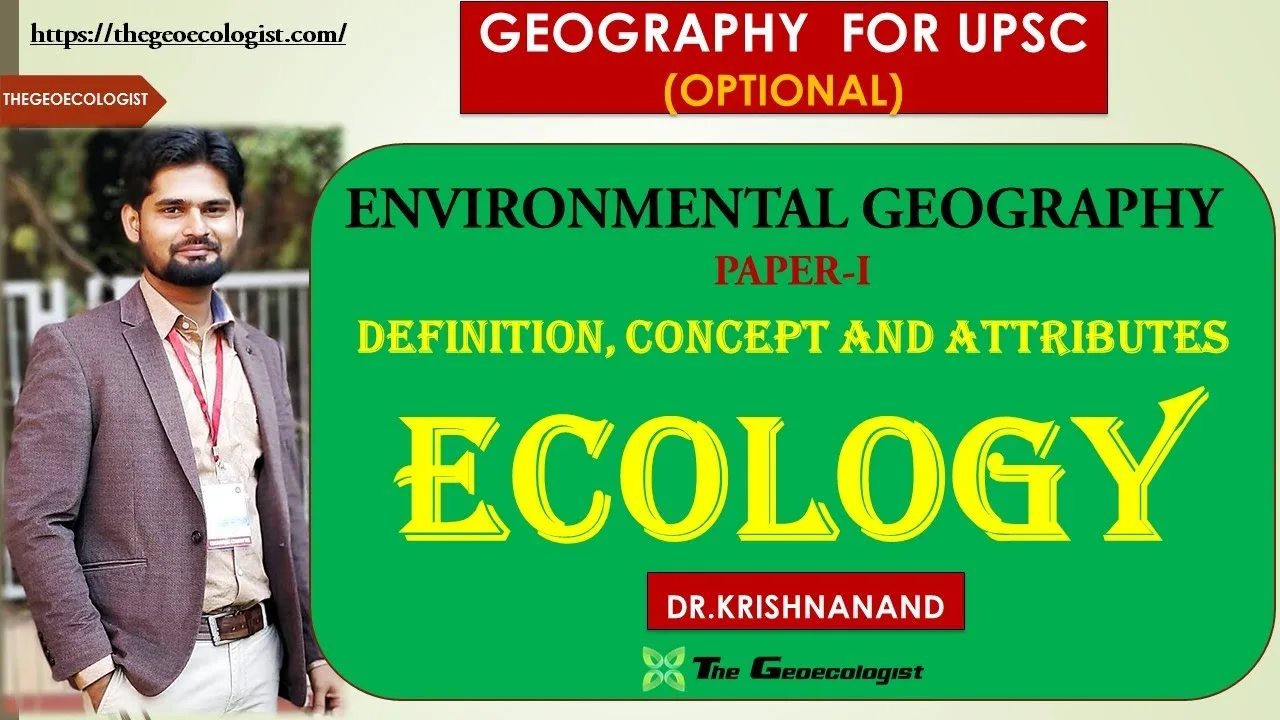
Table of Contents
- What Is Ecology? Core Ecology Definition Concepts Explained
- Historical Evolution of Ecology Definition Concepts
- Core Ecology Definition Concepts in Environmental Geography
- 1. Ecosystem Structure and Function
- 2. Ecological Succession
- 3. Biogeochemical Cycles
- 4. Population and Community Ecology
- Attributes of Ecology: A Framework for Analysis
- Holism
- Interdependence
- Energy Flow and Thermodynamics
- Nutrient Cycling
- Succession and Stability
- Ecology in UPSC Geography Optional Paper 1: Syllabus Mapping
- Strategic Preparation: Leveraging TheGeoecologist Resources
- Common Pitfalls in Mastering Ecology Definition Concepts
- Interdisciplinary Linkages for High-Scoring Answers
- Answer Writing Template for Ecology Questions
- Conclusion
Ecology definition concepts form the foundational bedrock of environmental geography, a critical component of the UPSC Civil Services Examination (CSE) Geography Optional Paper 1 syllabus. In a detailed lecture by Dr. Krishnanand, founder of TheGeoecologist, aspirants receive a simplified yet rigorous explanation of the definition, concept, and attributes of ecology tailored specifically for the UPSC/IAS examination. This article distills that expert guidance into a comprehensive resource, integrating core theoretical frameworks, historical evolution, and strategic preparation insights to help beginners and advanced candidates master this high-yield topic.
- Ecology definition concepts encompass the scientific study of interactions between organisms and their environment, including both biotic and abiotic components.
- The term “ecology” was coined by Ernst Haeckel in 1866, derived from Greek words oikos (house) and logos (study).
- Key attributes include holism, interdependence, energy flow, nutrient cycling, and succession — all essential for ecology definition concepts in environmental geography.
- UPSC Geography Optional Paper 1 explicitly tests ecological principles under the “Environmental Geography” section, making conceptual clarity non-negotiable.
- Dr. Krishnanand’s lecture on TheGeoecologist YouTube channel provides a structured, exam-oriented breakdown ideal for self-study aspirants.
What Is Ecology? Core Ecology Definition Concepts Explained
At its simplest, ecology definition concepts refer to the branch of biology that studies the relationships between living organisms and their physical surroundings. However, in the context of environmental geography for UPSC, the scope expands to include spatial patterns, human-environment interactions, and landscape-level processes. The classic definition by Charles Krebs (1972) describes ecology as “the scientific study of the interactions that determine the distribution and abundance of organisms.” This definition underscores two measurable outcomes — distribution and abundance — driven by interactions, a nuance frequently tested in UPSC mains answer writing.
The discipline operates at multiple hierarchical levels: individual (organismal ecology), population, community, ecosystem, landscape, and biosphere. Each level introduces distinct ecology definition concepts such as niche, habitat, carrying capacity, trophic structure, and biome classification. For instance, the concept of ecological niche (Grinnell, 1917; Elton, 1927; Hutchinson, 1957) differentiates between fundamental and realized niches — a distinction that appears in UPSC questions on species adaptation and competitive exclusion.
Historical Evolution of Ecology Definition Concepts
Understanding the historical trajectory enriches answer depth. The term “ecology” was formally introduced by German zoologist Ernst Haeckel in 1866, but ecological thinking predates this. Alexander von Humboldt’s work on plant geography (early 1800s) laid biogeographical foundations, while Darwin’s On the Origin of Species (1859) provided the evolutionary framework. In the 20th century, Arthur Tansley coined “ecosystem” (1935), and Raymond Lindeman formalized trophic-dynamic ecology (1942). Eugene Odum’s Fundamentals of Ecology (1953) systematized the field, making it a staple in geography curricula globally.
For UPSC aspirants, referencing these milestones — Haeckel (1866), Tansley (1935), Lindeman (1942), Odum (1953) — demonstrates scholarly awareness. The Wikipedia entry on ecology provides a reliable timeline for quick revision.
Core Ecology Definition Concepts in Environmental Geography
Environmental geography bridges physical geography and human ecology. Consequently, ecology definition concepts here emphasize spatial and scalar dimensions. Key concepts include:
1. Ecosystem Structure and Function
An ecosystem comprises biotic (producers, consumers, decomposers) and abiotic (climate, soil, water) components. Energy flows unidirectionally (solar → producers → consumers → heat loss), while nutrients cycle biogeochemically (carbon, nitrogen, phosphorus cycles). The ecology definition concepts of productivity — Gross Primary Productivity (GPP), Net Primary Productivity (NPP) — are quantifiable metrics often linked to biome comparisons in UPSC questions.
2. Ecological Succession
Succession — primary (on bare rock, sand) and secondary (post-disturbance) — illustrates community change over time. The ecology definition concepts of pioneer species, climax community, and facilitation/inhibition/tolerance models (Connell & Slatyer, 1977) are essential. Indian context examples: succession on Deccan Trap basalts or post-fire recovery in Western Ghats shola grasslands add locational specificity.
3. Biogeochemical Cycles
Carbon, nitrogen, and water cycles operate at global to local scales. Human alteration — e.g., nitrogen fixation via Haber-Bosch process exceeding natural rates — exemplifies anthropogenic impact, a recurring theme in UPSC’s “Human Ecology” and “Environmental Degradation” sub-topics.
4. Population and Community Ecology
Concepts like r/K selection, population density regulation (density-dependent vs. independent factors), species interactions (competition, predation, mutualism, commensalism, parasitism), and diversity indices (Simpson, Shannon-Wiener) constitute advanced ecology definition concepts tested in 15-20 mark questions.
Attributes of Ecology: A Framework for Analysis

Dr. Krishnanand emphasizes attributes that define ecology as a scientific discipline. These attributes double as analytical lenses for UPSC answers:
Holism
Ecology rejects reductionism; systems exhibit emergent properties. An ecosystem’s stability cannot be predicted solely from species lists — a principle central to landscape ecology and conservation planning.
Interdependence
No organism exists in isolation. Food webs, symbiotic networks, and keystone species (Paine, 1969) illustrate how removal of one element cascades through the system. The wolf reintroduction in Yellowstone (1995) — altering elk behavior, riparian vegetation, and even river morphology — is a classic case study for “trophic cascade” answers.
Energy Flow and Thermodynamics
Governed by the First and Second Laws of Thermodynamics, energy flow is unidirectional and inefficient (~10% transfer efficiency per trophic level, Lindeman). This constrains food chain length and biomass pyramids — a quantifiable ecology definition concepts application.
Nutrient Cycling
Unlike energy, nutrients recycle. Reservoirs (atmosphere, lithosphere, hydrosphere), fluxes, and residence times define cycle dynamics. Human-induced acceleration (e.g., reactive nitrogen doubling since 1950) links to planetary boundaries framework (Rockström et al., 2009).
Succession and Stability
Ecosystems evolve toward complexity (Odum’s 24 trends). Stability comprises resistance (withstanding disturbance) and resilience (recovery speed) — concepts vital for disaster management and climate adaptation answers.
Ecology in UPSC Geography Optional Paper 1: Syllabus Mapping
The UPSC Geography Optional Paper 1 syllabus includes “Environmental Geography” as a distinct unit. Key sub-topics where ecology definition concepts are directly examined:
- Concept of ecosystem, structure and function
- Energy flow, food chain, food web, ecological pyramids
- Biogeochemical cycles
- Ecological succession
- Biodiversity and conservation
- Environmental degradation and management
- Human ecology and sustainable development
Previous Year Questions (PYQs) analysis (2013-2023) reveals recurring patterns: “Explain the concept of ecological niche” (2016), “Discuss energy flow in ecosystems” (2019), “Elucidate the role of keystone species” (2021). Mastery of ecology definition concepts enables aspirants to structure answers with definitions, diagrams (energy pyramid, nutrient cycles), examples, and critical evaluation.
Strategic Preparation: Leveraging TheGeoecologist Resources
Dr. Krishnanand’s lecture on ecology definition concepts is part of a structured playlist for Geography Optional Paper 1. Aspirants should:
- Watch the video at 1.25x speed, pausing to replicate diagrams (ecosystem structure, pyramids, succession stages).
- Create one-page mind maps for each attribute (holism, interdependence, etc.) linking to PYQs.
- Supplement with Odum’s Fundamentals of Ecology (Chapters 1-4) and Savindra Singh’s Environmental Geography.
- Practice answer writing: 150-word notes on “ecotone,” “edge effect,” “ecological amplitude.”
- Integrate current affairs: IPBES Global Assessment (2019), Kunming-Montreal Global Biodiversity Framework (2022), India’s National Biodiversity Action Plan.
TheGeoecologist’s website (thegeoecologist.com) offers downloadable PDFs, test series, and mentorship — valuable for structured preparation.
Common Pitfalls in Mastering Ecology Definition Concepts
Aspirants often:
- Confuse habitat (address) with niche (profession) — clarify with Hutchinson’s n-dimensional hypervolume.
- Overlook abiotic drivers (edaphic, climatic) in favor of biotic interactions.
- Memorize cycles without understanding rate-limiting steps (e.g., nitrogen fixation).
- Neglect Indian case studies — Western Ghats endemism, Sundarbans mangrove ecology, Chilika Lake restoration.
Avoiding these ensures answers reflect applied ecology definition concepts, not rote reproduction.
Interdisciplinary Linkages for High-Scoring Answers
UPSC rewards integration. Connect ecology definition concepts to:
- Climatology: Biome-climate correspondence (Köppen, Holdridge life zones).
- Geomorphology: Soil formation (pedogenesis) as ecosystem process; landform-vegetation feedbacks.
- Human Geography: Cultural ecology (Steward), political ecology (Robbins), environmental justice.
- Economic Geography: Ecosystem services valuation (TEEB, 2010); green GDP.
For authoritative references on ecosystem services, see the Britannica ecology overview.
Answer Writing Template for Ecology Questions
Adopt this structure for 10/15/20 mark questions:
- Definition: Precone, authoritative (cite Odum/Tansley).
- Diagram: Labeled sketch (energy pyramid, nitrogen cycle, succession sere).
- Mechanism/Process: Stepwise explanation with terminology.
- Attributes/Principles: Link to holism, thermodynamics, etc.
- Examples: Global + Indian (mandatory for geography).
- Contemporary Relevance: Climate change, biodiversity loss, policy.
- Conclusion: Sustainable management / SDG linkage.
Conclusion
Mastering ecology definition concepts is not merely about memorizing definitions — it is about developing an ecological worldview that perceives patterns, processes, and human implications across scales. Dr. Krishnanand’s lecture on TheGeoecologist provides the pedagogical scaffolding; consistent revision, diagram practice, and PYQ integration transform this into exam-ready competence. For UPSC Geography Optional aspirants, environmental geography offers high return on investment — ecology is its conceptual core. Subscribe to TheGeoecologist, download the study materials, and build your ecological intuition one concept at a time.
Frequently Asked Questions
Core ecology definition concepts include ecosystem structure and function, energy flow, biogeochemical cycles, ecological succession, population and community ecology, and attributes like holism, interdependence, and thermodynamic constraints. These are explicitly listed in the UPSC Geography Optional Paper 1 syllabus under Environmental Geography.
Dr. Krishnanand provides a simplified, exam-oriented lecture covering the definition, concept, and attributes of ecology with diagrams, Indian examples, and PYQ linkages. His approach emphasizes conceptual clarity over rote learning, tailored for UPSC CSE aspirants at all levels.
Supplement with Eugene Odum's 'Fundamentals of Ecology' (Chapters 1-4), Savindra Singh's 'Environmental Geography', and NCERT Class 12 Biology (Ecology unit). TheGeoecologist website also offers downloadable PDFs and test series for structured revision.